For the first time in the history of the United Nations Human Rights Council and in all probability the history of the United Nations system, and for the first time in the long history of the Roman Catholic Church, a Cardinal addressed the UNHRC. It was also the first time in Lankan history that a top religious leader addressed a UN body and made a moral-ethical denunciation of ‘the incumbent government’.
Those who make justice unattainable nationally, render inevitable the call for justice internationally. Those who fail to follow the trail of guilt wherever it may lead, and are thought to kick over the traces of mass atrocities nationally, generate a powerful plea to switch on the searchlight of justice globally.
Church militant
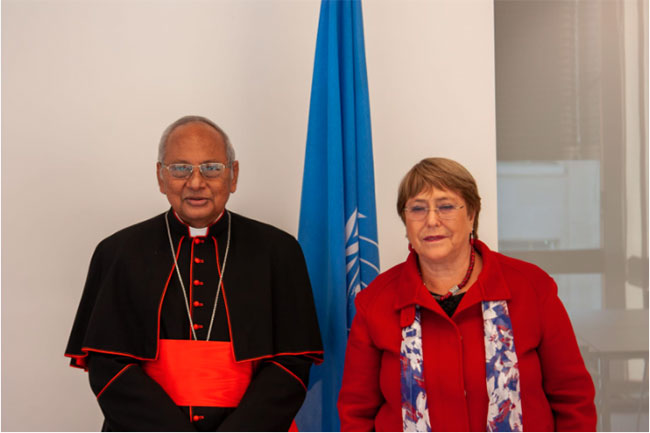
His Eminence Cardinal Malcolm Ranjith who met the leader of the world’s 1.3 billion Catholics, Pope Francis, and doubtless obtained permission and blessing for his UNHRC move from His Holiness, had a 45-minute conversation in Spanish (one of the seven languages he has mastered) with United Nations Human Rights High Commissioner Michelle Bachelet, and addressed the UNHRC.
After years of forbearance, His Eminence took the stand of moral and ethical denunciation of an Old Testament prophet and called out for globalised justice. He dropped a thermobaric bomb on the regime bunker:
“…The first impression of this massacre was that it was purely the work of a few Islamic extremists. However, subsequent investigations indicate that this massacre was part of a grand political plot.
…Instead of uncovering the truth behind the attack and prosecuting those responsible, there are attempts to harass and intimidate those who clamour for justice.
…we earnestly call upon the UNHRC and all its member countries to support the continuation of evidence gathering initiated by the Council last year and to devise a means to ensure an investigation to unravel the truth behind the Easter Sunday massacre.”
The Cardinal’s speech reached the world.
Foreign Minister G.L. Peiris’ speech against the Sri Lanka Accountability Project was collateral damage. GoSL’s global South card lies shredded, not only by India’s sharp reminder about the 13th amendment but by the realities that Pope Francis and Cardinal Ranjith are from the global South and the global South contains the majority of the world’s Catholics (Latin America, the Philippines).
Catholic priests were being pressurised and lay activists harassed by the authorities. Ministers and top officials were supercilious and patronising. The regime’s puffed-up hardliners shouldn’t have strayed out of their strictly local league, picked a globalised target and started something they can’t possibly finish.
Militarisation-accountability nexus
The recent vote demonstrated the appetite of the UN Human Rights Council for an international inquiry into the Ukraine war so as to establish accountability for possible violations of international law. This mood is certainly going to impact the Sri Lankan case, concerning which the UN Human Rights High Commissioner has already called for “alternate strategies” to advance international accountability, arguing that military and ex-military personalities have been appointed to an unprecedented number of high places in the Sri Lankan state structure, thereby turning entrenched impunity, structural if not systemic, and negating the chances of domestic accountability.
Sri Lanka’s Foreign Minister Prof. G.L. Peiris made a strong critique of an international accountability mechanism on the grounds that it was polarising rather than therapeutic in its domestic effects. A valid point, but absent an essential component, it was akin to a stern warning about the dangers of COVID-19 while refraining from providing the vaccines. The only possible protection against international accountability is a robust national accountability mechanism as clearly set out by the Presidential Commissions appointed by President Mahinda Rajapaksa.
As High Commissioner Bachelet notes: “Two years after the expression of commitments to pursue an ‘inclusive, domestically designed and executed reconciliation and accountability process’ before this Council, the Government has still not produced a credible roadmap on transitional justice towards accountability and reconciliation.”
Nothing of the sort has been established and what is worse, a soldier who was found guilty by the Sri Lankan courts of slaughtering children in cold blood by cutting their throats, was set free by President Gotabaya himself and visited upon release by his erstwhile commanding officer, the current Secretary/Defence, Gen. Kamal Gunaratne.
The UN Human Rights High Commissioner paints the over-exposed target with a laser beam:
“…The militarisation of civilian government functions is further deepening. I remain deeply concerned by the concentration of civilian positions in the hands of military officials – some of them implicated in serious allegations of human rights violations…The current Government has not only demonstrated its unwillingness to pursue accountability – it has incorporated military officials implicated in alleged war crimes into the highest levels of Government, reinforcing a narrative of impunity. For these reasons, and to provide some form of redress for victims. I have called on the Council to pursue alternate strategies to advance accountability at the international level.”
The operative phrase here is “For these reasons”. Thus has President Gotabaya’s unwise practice of fertilising and seeding the state with his former comrades-in-arms (while de-fertilising the food-producing farmlands) actually made the Sri Lankan armed forces and the war, more rather than less of an international target.
High Commissioner Bachelet’s exact recommendation to the UNHRC and member states should be studied: “…to investigate and prosecute perpetrators of international crimes committed by all parties in Sri Lanka, through judicial proceedings in their jurisdictions, under accepted principles of extraterritorial or universal jurisdiction.”
If international accountability moves forward under the rubric of universal jurisdiction, non-compliance could culminate in unilateral sanctions.
Sources of post-war folly
When Sri Lanka won the post-war vote at the UNHRC decisively in May 2009, it had engaged in a trade-off: domestic devolution for external accountability. After my dismissal from Geneva, GoSL double-crossed our partners and unilaterally reneged on that arrangement—indeed my removal was symbol and signal of that U-turn.
The Geneva May 2009 trade-off formula was the cheapest price we would ever have to pay. Just two things to do, neither of which were done. Now the chickens are well and truly coming home to roost.
One of those two things was to implement the 13th amendment—an issue that was flagged in India’s speech at the UNHRC last week. Coincidentally, Sri Lanka’s Ambassador/PR in Geneva, an ideologue of the GR project was a long-standing polemicist against the implementation of the 13th amendment and advocate of its post-war abolition.
Indian Ambassador/PR Pandey’s statement in Geneva at the on-going UNHRC session unambiguously reminded GoSL of the issue:
“…As its friend and immediate neighbour, India has consistently called upon Sri Lanka to fulfil its commitments on addressing the issues related to protecting the interest of Tamils in Sri Lanka. India believes that it is in Sri Lanka’s own interest that the expectations of Tamils in Sri Lanka for equality, justice, peace and dignity, within a united Sri Lanka, are fulfilled. This applies equally to the commitments made by the Sri Lankan Government on meaningful devolution, including through the 13th Amendment to the Sri Lankan constitution.
…We call upon Sri Lanka to take the necessary steps to address the legitimate aspirations of the Tamil community, including by carrying forward the process of reconciliation and the implementation of the Thirteenth Amendment to the Constitution of Sri Lanka, to ensure that the fundamental freedoms and human rights of all its citizens are fully protected.
We will continue to urge the Sri Lankan Government for the early conduct of elections to the Provincial Councils in keeping with its commitment to devolution of power.”
The other issue was a robust domestic accountability mechanism and process on emblematic cases. That too remains undone.
There was a third post-war task, and that was not part of the UNHRC Geneva process. It was to accept the deal on the table in the form of the Kerry-Lugar Report of the US Senate Foreign Relations Committee in late 2009, which listed just these two issues i.e., devolution and accountability. This would have normalised relations with the US, but it was ignored. Post-war Sinhala state nationalism assumed it was a seller’s market.
Unresponsiveness to the Kerry-Lugar report was not Prof. G.L. Peiris’ folly (we were both in Vietnam with President Mahinda Rajapaksa when the report came out). Where Prof. Peiris blundered was when he declined (to President MR’s dismay) US Secretary of State Hillary Clinton’s invitation for a discussion in Washington DC somewhere in 2011-2012.
The clock is ticking on the EU’s decision on GSP+. Sri Lanka’s National Human Rights Commission headed by a retired Supreme Court judge appointed by President Gotabaya Rajapaksa, has made strictures and recommendations on the PTA which the Sri Lankan government is ignoring despite the danger of losing GSP+.
President Gotabaya Rajapaksa and his myopic uber-nationalist hawks such as Minister Weerasekara (and Ven. Dr. Medagoda Abeytissa) now have to decide whether it is a worthwhile risk to continue their policy of filibustering on the 13th amendment—which I had warned against publicly in 2017-2018—in the face of the current convergence of circumstances:
(a) Forex bankruptcy and Minister Basil Rajapaksa’s impending visit to Delhi with a begging-bowl
(b) The tightening noose of international accountability, and
(c) The recently reiterated Indian insistence on devolution, the 13th amendment and the early holding of Provincial Council elections.
Sri Lanka would have continued to have India’s support, neutralised the USA’s hostility and enjoyed the unstinted backing of China, Russia and the global South, if GR and BR hadn’t taken turns in blocking MR’s wartime and immediate post-war international commitments on devolution and limited accountability.
MR allowed his wartime commitments to a post-war roadmap, manifested in his May 21st and 23rd joint communiques with India and the UNS-G, and the UNHRC Geneva May 27th 2009 Resolution, to be ripped apart by his siblings, who imposed their respective blueprints instead.
This is not merely a matter of external relations but also of economics. Sri Lanka would have had capital inflows from China, India, Japan and the West, avoiding the deep economic crisis we now find ourselves in. Post-war, Sri Lanka could have had it all. So could the Rajapaksas.
MR’s brothers were positioning themselves or were being flatteringly positioned by their respective fan-clubs (“Gota’s War” 2012), for post-MR succession. With secession defeated, succession moved to the top of the agenda. The state bureaucracy and state apparatus as a whole was carved up between GR and BR into spheres of influence. Ministers and top officials felt the need to take the cue from one or the other brother or operate in the zone between the two, rather than take the line from MR.
Head for an off-ramp
Succession has never been less meaningful than today. Succession to what? The captaincy of the Titanic? It is doubtful that the Rajapaksas could retain even the Ruhuna at a national election. The clan brand has become toxic. Once this Titanic sinks, it will take Namal longer to resurface it than it might take Dullas Alahapperuma, but as in the case of the Bandaranaikes and the Nehru-Gandhi dynasty, the Rajapaksas would rather the party be defeated than relinquish their death-grip on it. It will take over a decade for the electorate to forgive and forget the economic trauma inflicted by the Rajapaksas. After the fate of Wimal and Udaya, no one will come forward to defend them as the duo did.
Thanks to the policies of President Gotabaya Rajapaksa, which recently made the pages of one of the most prestigious international periodicals– though hardly positively—there is rage in the rural heartland. (Sri Lanka’s Organic Farming Experiment Went Catastrophically Wrong (foreignpolicy.com)
Things are reaching boiling point. One reason is debt repayment. Without a plan for “sensible restructuring” (Yanis Varoufakis’ phrase), the government will be left with a ‘Prisoner’s Dilemma’ in June: default, or pay up and risk bankruptcy, triggering a tsunami of social unrest. Dr. Nishan de Mel’s question is the crux of the matter: “if you make the repayment on schedule what are you going to be left with to pay for essentials?”
The only realistic strategy for the ruling clan is not one of winning elections or remaining in power without elections, but a survival strategy of a double-exit.
Firstly, exit from the economic downward spiral, because if the economy crashes, the ruled will come looking for the rulers and the military won’t be able to stop them because it will itself split.
Given that China (a) instituted the greatest economic miracle in the history of economic development (b) is a close friend of Sri Lanka and (c) cannot be accused of being an imperialist Western power, President Gotabaya Rajapaksa should immediately request President Xi Jinping to send a team of top economic experts to help us evade the coming economic catastrophe.
Ceylon/Sri Lanka had a history of seeking top-notch foreign expertise on matters of economic policy. No less a nationalist than Prime Minister SWRD Bandaranaike brought in Nicholas Kaldor and Joan Robinson. No less self-confident a leader than JR Jayewardene asked Lee Kuan Yew to send him an economic wizard and Lee sent Goh Keng Swee.
Significantly, President GR hasn’t named to his National Economic Council, Dr. Nalaka Godahewa who delivered the key presentation on economic development at the Shangri-La Viyath Maga-2 (2018).
I wouldn’t trust any National Economic Council under any administration, that doesn’t have Nishan de Mel and Dushni Weerakoon (discrepant as their current views are) as lead economists.
Secondly, an early election –which takes a legislative amendment through Parliament—and a peaceful transfer of power, is better than the alternative.
The ruling clan is playing for time in the hope of a turnaround. Why play for time when time is working against you? As the sovereign citizenry finds everyday life unliveable, it will sooner rather than later, make the place ungovernable by the rulers. Or is that the plan?
SLFP: Necessary ally
The 2015 Rajapaksa replacement strategy had three sources and components:
(i) Chandrika Bandaranaike Kumaratunga’s notion dating back to late 2005 of a bi-partisan government comprising Ranil’s UNP and the SLFP (she didn’t expect Mahinda to win), for a federal Constitution. CBK failed to foresee the genetically-encoded blowback of the vote base of her own party, the SLFP, against the West-centric neoliberalism of the Ranil-Mangala UNP.
(ii) Mangala Samaraweera’s formula of a majority of the minorities plus a minority of the majority.
(iii) Senior ambassadors and their experts who were probing for a fissure; an improvement on the SF option of 2010.
The sole rational element of the 2015 strategy was component (iii), the ‘Sison-Honigstein’ postulate: the Rajapaksa vote needed to be politically ‘hacked’ by a dissident, moderate-nationalist SLFP faction.
Today’s economically antagonised SLPP voter has left the Medamulana manor but may not move all the way over to the SJB or JVP-NPP, and therefore needs a halfway house. That makes the Sirisena SLFP an indispensable factor in any regime replacement scenario.