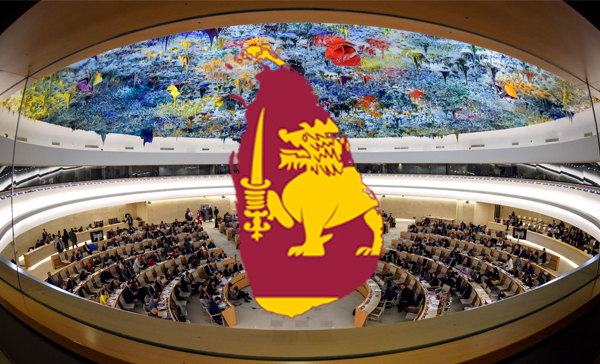
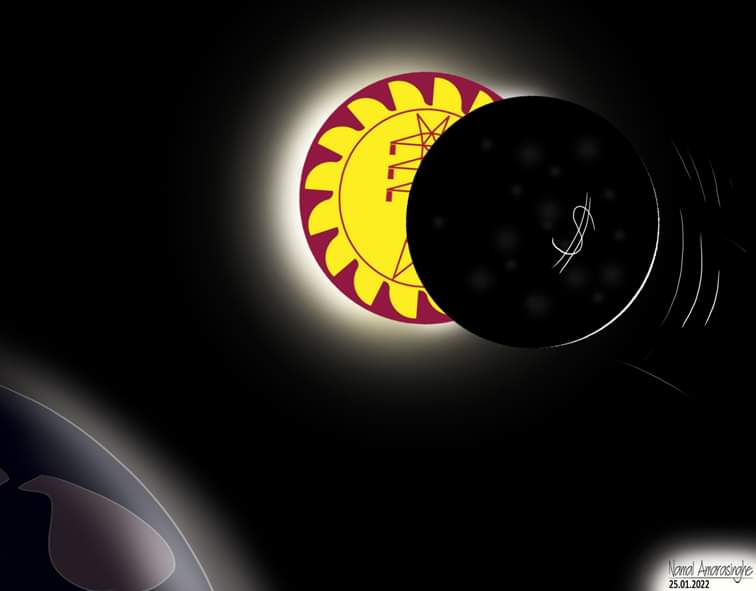
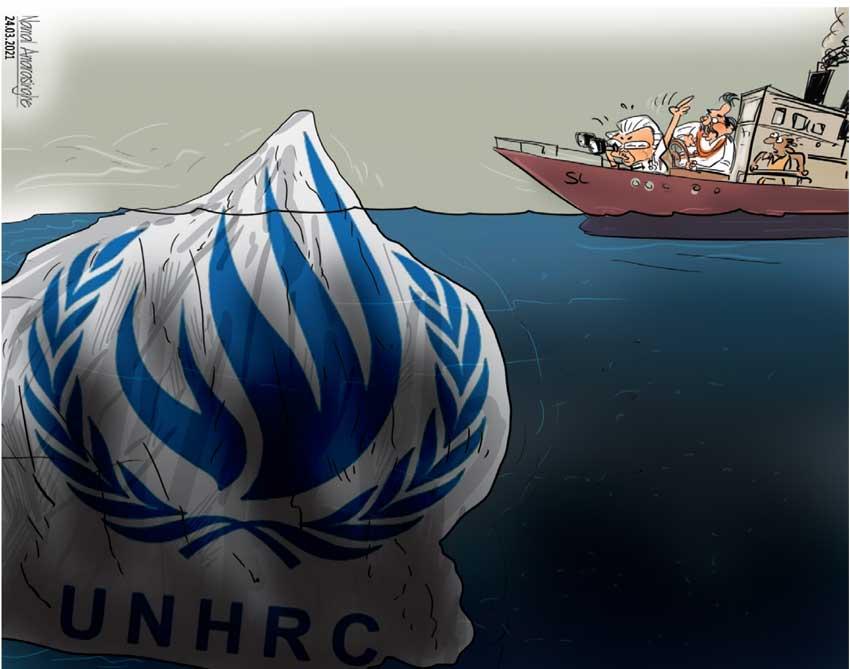
The economy continues to test Sri Lanka’s economic resilience on multiple fronts while the Government, led by President Gotabaya Rajapaksa and Prime Minister Mahinda Rajapaksa, gears up to face the United Nations Human Rights Council (UNHRC) at its impending 49th session in Geneva.
The Office of the High Commissioner for Human Rights (OHCHR) last Monday (14) sent the High Commissioner’s observations on Sri Lanka, which would be officially presented to the Council on 3 March. The Government was to send its official response to the UNHRC observations yesterday (19).
While the Foreign Ministry is preparing the diplomatic defence, the Finance Ministry continues with its search for financial assistance to shore up the country’s dwindling foreign reserves. Finance Minister Basil Rajapaksa had recently expressed confidence in overcoming the current economic crisis, especially the US Dollar crisis, shortly.
The economic relief package sought from India is expected to be received by Sri Lanka during the first week of March.
Finance Minister Rajapaksa is expected to travel to India this week to finalise the $ 1 billion aid package for food and medicine purchases. India has already granted a $ 400 million swap facility and a $ 500 million credit line for fuel.
According to the Treasury, the $ 1 billion assistance will be released after the Indian Government receives the necessary security clearances and Cabinet approval. The Government, meanwhile, is also looking at further financial assistance from China, with discussions in this regard already being initiated.
Foreign Minister Prof. G.L. Peiris last week said that India had pledged $ 2.4 billion in financial assistance to Sri Lanka and that Minister Basil Rajapaksa had created the foundation for this during his last visit. He said Sri Lanka would first receive a $ 1 billion loan from India to import goods from the country, such as food and medicine.
Meanwhile, a discussion on further financial assistance had been initiated between the Governments of Sri Lanka and China. However, a final decision is yet to be reached on the form and value of said financial assistance.
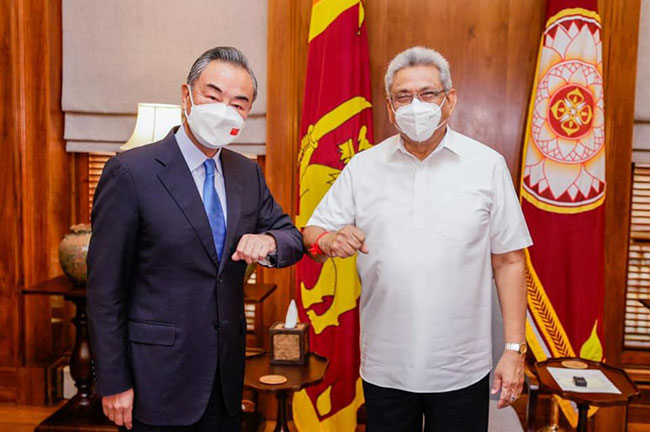
President Rajapaksa last month requested the Chinese Government to consider rescheduling Sri Lanka’s loans to China. The request was made during the official visit of Chinese Foreign Minister Wang Yi to Sri Lanka during 8 and 9 January.
The discussion on seeking assistance from the International Monetary Fund (IMF) continues within the Government, with Trade Minister Dr. Bandula Gunawardena last week stating that the Finance Minister is expected to inform his stance on the IMF report on Sri Lanka to the Cabinet of Ministers meeting this week.
“Finance Minister Basil Rajapaksa has held frequent discussions with the IMF since Sri Lanka is a member of the IMF. They also have an office at the Central Bank. Details of the report compiled by the IMF will be briefed at the Cabinet of Ministers meeting next week,” he said at last week’s post-Cabinet media briefing.
The Government’s aggressive move towards securing financial relief is amidst Sri Lanka’s trade deficit in 2021 increasing by over $ 2 billion due to an increase in imports despite commendable export performance amidst challenges. The trade deficit in 2021 amounted to $ 8.13 billion, against $ 6 billion in the previous year. In December the deficit topped the $ 1 billion mark, almost doubling from a year earlier.
Imports have increased by 28.5% to $ 20.6 billion in 2021 and exports have grown by 20% to $ 12.5 billion. In December, exports amounted to $ 1.15 billion, which is a 20% increase from a year earlier. Imports jumped by 47% to $ 2.2 billion.
Cabinet veto
Amidst the many financial challenges faced by the country, Finance Minister Rajapaksa’s move to accrue revenue by imposing a 25% surcharge on companies that have posted super gains last year, which included the private sector pension funds – the Employers’ Provident Fund (EPF) and Employees’ Trust Fund (ETF) – was taken up for discussion at last Monday’s Cabinet meeting.
Minister Gunawardena noted that 11 pension funds had been included in the proposed surcharge. He further observed that the issue of inclusion of pension funds in the surcharge had taken place due to the current definition of a ‘company,’ which needed to be resolved. Gunawardena added that it could be an oversight on the part of the Finance Ministry that needed to be corrected.
Finance Minister Rajapaksa responded saying that it was not an oversight. He explained that the Government was expecting to earn Rs. 105 billion from the proposed surcharge and Rs. 80 billion was expected from the 11 pension funds. “When ministers ask for monies for projects, where do you think it comes from?” he questioned.
Basil went on to say that he was prepared to remove the pension funds from the proposed surcharge and posed a question to the Cabinet as well: “Can the ministers here please tell me from where the Treasury could raise funds? Can you propose alternative revenue generation methods?”
According to Basil, another alternative was to increase the 3% VAT, which would have an adverse impact on all citizens.
Labour Minister Nimal Siripala de Silva pointed out that the EPF had 10 billion contributors and even if there was a Rs. 2,000 million profit for the fund, each contributor would only receive a paltry sum of Rs. 200.
Energy Minister Udaya Gammanpila proposed the imposing of the surcharge in several slabs as an alternative to raising the Government’s revenue while exempting the 11 pension funds from an additional tax.
He proposed that a 25% surcharge be imposed on companies that had recorded profits over Rs. 2,000 million, a 20% profit on companies that had recorded profits between Rs. 1,500 million and Rs. 2,000 million, and 15% for companies that had made profits below Rs. 1,500. Gammanpila explained that this method would cover the funds that were to be acquired from the pension funds.
Health Minister Keheliya Rambukwella also supported the proposal, saying that such slabs would be a good move as it covered all who had made profits last year.
After listening to the Ministers, Basil once again spoke, noting that none of the Cabinet Ministers could feign ignorance on the proposed surcharge and the companies included as it was taken up and approved by Cabinet.
Minister of Water Supply Vasudeva Nanayakkara immediately responded: “It must have come to Cabinet and it would have stated that a surcharge would be imposed on companies that have recorded super gains and not that it would be imposed on pension funds.”
With a majority of Cabinet Ministers speaking against an additional tax on pension funds, it was finally resolved that the pension funds would not be subjected to the proposed surcharge.
Finance Minister Rajapaksa later announced that the EPF and ETF would not be subjected to the surcharge.
However, it is yet unclear whether the Finance Ministry has officially withdrawn the gazette issued that includes pension funds under the surcharge or whether a clarification has been issued to rectify any miscommunication on the matter.
Fuel price issues
While the Government is trying to increase its revenue, the increasing global fuel prices and its strain on local prices have posed a new economic challenge in the making.
Central Bank of Sri Lanka (CBSL) Governor Ajith Nivard Cabraal on 28 January 2022 had in writing informed Energy Minister Udaya Gammanpila of the urgent need for the revision of domestic petroleum prices for demand management. The letter had also been copied to Finance Minister Rajapaksa.
“Further to my letter dated 15 December 2021 to Minister of Finance Basil Rajapaksa and with reference to the Cabinet Memorandum submitted by you on 18 January 2022, there is a dire need for focused efforts to limit the usage of petroleum products in light of external sector issues that the country is facing at the moment. This situation has significant negative implications on the banking sector and on overall macroeconomic and financial system stability, warranting urgent remedial measures,” Cabraal had noted in the letter.
The letter also noted that the Government had spent $ 3.4 billion on petroleum imports in 2021 and had projected a further increase in the expenditure this year with the normalisation of domestic economic activities, including the reopening of the tourism sector and the steadily rising global crude oil prices. “Furthermore, continuation of the current upward trend in crude oil prices and higher importation of refined products due to refinery closures, as seen in January 2022, could cause further increases in the fuel bill.”
According to the CBSL Chief’s letter, the credit extended by the two State banks to the CPC in foreign currency loan amounts stood at $ 3.7 billion as at November 2021. An immediate upwards revision was essential to improve the rupee liquidity position of the CPC. It had also been noted that only by doing so will the CPC be in a position to purchase foreign currency for settlement of its foreign currency loans.
Cabraal has also reminded that licensed banks had agreed to support petroleum purchases on the basis that rupees will be provided by the CPC to purchase foreign exchange. Accordingly, the CBSL had proposed that a litre of petrol be increased by Rs. 33 and auto diesel by Rs. 39. It is in such a backdrop that Gammanpila had stated that the next fuel price revision would be one of the highest that the country would witness.
Gammanpila had already drafted a fuel price formula and the Energy Ministry has sought price revisions from the Finance Ministry on several occasions, but is yet to receive a response.
It is however evident that the CPC is heading for a massive financial crisis due to the mounting debt from State institutions as well as the revolving losses through fuel sales in the local market.
Although the Government expected some relief from the 40,000 MT of fuel received from India last week, it is learnt that the relevant stock is only sufficient to meet the country’s fuel demand for one week.
Wrong timing
However, the Government seems to have mastered the art of missing opportunities – one such being the formation of a fuel stabilisation fund.
Although the Cabinet of Ministers approved the establishment of a fuel price stabilisation fund after many attempts at such a move, the Energy Ministry believes that now is not the best time to set up such a fund given the rising global oil prices.
Energy Ministry Secretary K.D.R. Olga told the media last week that Cabinet approval had been granted to set up a fuel price stabilisation fund, and that the mechanism through which said fund would be established had also been informed to the Cabinet.
“Approval has been given to set up a fuel price stabilisation fund. Now, all we have to do is complete the work related to setting it up. However, in the face of rising fuel prices in the world market, it is now impossible to establish it. It can only be set up when there is a decline in prices,” she explained.
Sources in the petroleum sector also explained that it was only by establishing a price stabilisation fund when prices were low in the global market that the benefits of such a fund could be reaped when prices were later on the rise.
“Otherwise, it will be a strain on the Government as the funds will have to be set up using monies from State coffers. The actual benefits will also not be felt at times of global price increases,” sources said.
PUCSL and CEB lock horns
Meanwhile, in the power sector, the Ceylon Electricity Board (CEB) has locked horns with the regulator, the Public Utilities Commission of Sri Lanka (PUCSL), over the handling of the ongoing power crisis and power cuts.
The PUCSL said last Tuesday (15) that it was possible to avoid scheduled daily power cuts until April, if the conservation initiatives that had been proposed were followed.
These conservation initiatives are that standby generators of bulk supply consumers be operational for specific periods of time, that all apartment buildings use their private generators for the operation of air conditioners between 6 p.m. and 10 p.m., and that all public institutions decrease their daily electricity consumption by 80%.
“We had discussions with the CEB on 12 February. Based on the data that was presented then and based on the following assumptions and proposed conservation initiatives, we decided yesterday that there is no need to go for scheduled daily power cuts within the next three months. This decision is based on the assumptions that we get fuel as planned, that there are no sudden breakdowns of any power plants, and that we are able to reduce hydropower generation by 50% for the next three months – until the rains come. To make this work, we have also directed the CEB to follow a number of conservation initiatives,” PUCSL Chairman Janaka Ratnayake said while addressing a media briefing last week.
However, he warned that if a 200 MW power plant faces a sudden breakdown, then one-hour daily power cuts would be necessary and that if a 300 MW power plant breaks down, one-and-a-half-hour daily power cuts would be necessary.
Commenting on the fuel shortages faced by the CEB, Ratnayake said that following discussions, both Energy Minister Gammanpila and the CBSL had agreed to help the CEB directly purchase fuel, instead of from the CPC, within the next 15 days. “Gammanpila will help the CEB store and transport fuel whilst the CBSL will provide the necessary dollars if the CEB pays it in rupees. We hope to import fuel needed for the next month, within the next 15 days (30,000 MT of diesel and 20,000 MT of naphtha). This will help us solve the issue of checking every morning whether we have enough fuel,” said Ratnayake.
Meanwhile, the CEB is formulating a plan of action on how to meet the national electricity demand over the coming months and a review of the plan will be carried out with the PUCSL.
“We do not know yet whether we will go for daily power outages. We are compiling a programme on how to meet the demand for electricity – especially considering potential factors like the unavailability of fuel in the near future and the fact that water reserves, used for the generation of hydropower, are declining,” CEB Spokesperson Andrew Navamani had told the media.
Despite the PUCSL announcement of no power cuts for three months, the Ceylon Electricity Board Engineers’ Union (CEBEU) had stated that it is unable to provide an uninterrupted power supply due to the ongoing fuel crisis.
CEBEU President Anil Ranjith has said the PUCSL’s decision had resulted in the CEBEU locking horns with the regulator. “We have enough coal stocks until next August. No sufficient fuel stocks have been received yet at the Kelanitissa Power Station (KPS). If the water levels of the reservoirs are low, we will have to face huge issues,” Ranjith told the media.
Interestingly, the PUCSL on Friday (18) announced a one-hour power cut that day. Accordingly, one-hour power cuts were carried out in four different areas between 2.30 p.m. and 6.30 p.m. Meanwhile, 45 minutes of power shedding were implemented in other areas between 6.30 p.m. and 10.30 p.m.
Yesterday (19), the PUCSL announced there would not be scheduled power cuts yesterday as the CEB would be receiving fuel stocks. However, he said intermittent interruptions between 2 p.m. and 6 p.m. may be experienced to stabilise the national grid.
Increasing expenditure
Amidst the ongoing economic challenges, the Government had taken yet another step to provide relief to the public by way of increasing the allowance given to Samurdhi recipients.
State Minister of Samurdhi, Household Economy, Micro Finance, Self-Employment, and Business Development Shehan Semasinghe announced last Sunday (13) that the Samurdhi beneficiary amount would increase by 28% from this month.
The Government expects to spend Rs. 65 billion in 2022 to provide allowances to Samurdhi beneficiaries. “The global pandemic affected many groups and the Government attempted to give relief to them. Some of this relief was included in the 2022 Budget but additional relief was decided by the Cabinet of Ministers, headed by President Gotabaya Rajapaksa. Accordingly, Samurdhi beneficiaries will see a 28% increase in the relief amount they receive from the Government,” Semasinghe said at a media briefing.
Semasinghe said that a family receiving Rs. 3,500 would now receive Rs. 4,500, a family receiving Rs. 2, 500 would now receive Rs. 3,200, and a family receiving Rs. 1,500 would now receive Rs. 1,900.
“We had prepared within the Budget to provide Rs. 50,000 million for the Samurdhi beneficiaries’ allowance in the overall Budget. With this increase the Government will spend an additional Rs. 15,000 million. Accordingly, the Government expects to spend Rs. 65,000 million to provide allowances to Samurdhi beneficiaries as a whole for the year 2022.”
Accordingly, the 1,767,000 Samurdhi recipients island-wide will receive the additional allowance from this month.
The increased Samurdhi allowances is yet another State expenditure undertaken by the Government. Last month, the Cabinet approved a proposal by Finance Minister Basil Rajapaksa to grant a Rs. 5,000 allowance to public sector workers while also granting relief to pensioners as well as several other groups in need of relief.
All these relief measures have added a cost amounting to several billions of rupees to the already-dwindling State coffers.
Dissent under fire
Amidst the economic chaos, last week dawned with an attack on a senior media personality.
A group of armed persons with their faces covered had attacked the house of popular journalist Chamuditha Samarawickrama in the Piliyandala area last Monday (14) morning, throwing stones and faeces at the house after holding the security guard at gunpoint.
“I am living in a housing complex. There is a security guard guarding the complex. A group of four persons had come in a car and had intimidated the security guard by holding him at gunpoint. Then one of them had stayed at the place where the security guard was, while the other three had entered the complex. They had then pelted stones at my house. They had also thrown faeces,” Samarawickrama told the media.
Noting that the attackers had all been covering their faces, Samarawickrama said that the attack had been recorded on closed circuit television (CCTV) cameras.
In June 2021, Samarawickrama had informed Inspector General of Police (IGP) Chandana D. Wickramaratne, in writing, about alleged death threats made against him.
On the same day, social activist Shehan Malaka Gamage was arrested by the Criminal Investigations Department (CID). Police Media Spokesperson (Attorney-at-Law) SSP Nihal Thalduwa said Gamage’s arrest was made due to a statement made back in 2021 with regard to the Easter Sunday attacks.
However, a video recorded by Gamage and released on social media at the time of his arrest showed his conversation with the CID officers at the time of his arrest. When he questioned the officers as to the reason for his arrest, the video features faint audio of an officer saying that he was being arrested under Section 120 of the Penal Code (inciting or attempting to incite disaffection). Gamage further mentions that he was taken while he was on the road, by officers in a white van.
Further footage also featured audio of people questioning as to how Gamage was still in possession of his phone, to which he replies that he will only hand over the phone once he signs the document to officially hand it over. “I will face what comes,” he added.
Meanwhile, social activist Manorama Weerasinghe was summoned to the CID on Thursday (17). The summons was issued last Monday (14). According to Weerasinghe, the CID had not given a proper reason as to why he was summoned. However, it had vaguely stated that it was related to a statement he had made, without any specifics.
Following these incidents, UN Resident Coordinator in Sri Lanka Hanaa Singer-Hamdy last week tweeted: “#Journalists & #activists play a fundamental role in ensuring a democratic society and their protection is vital to ensure freedom of expression, transparency and accountability. The silencing of critical voices, undermines public debate, freedom and the human rights of everyone.”
Cardinal hits out
Following Gamage’s arrest by the CID, National Catholic Social Communication Centre Director Rev. Cyril Gamini Fernando raised concerns about whether a ‘white van’ culture was on the rise again.
“All Gamage did was raise a voice seeking justice for victims of the Easter Sunday terror attacks. We are all critical of the delay in serving justice for these victims. His arrest leads us to suspect as to whether a ‘white van’ culture is on the rise again as he was arrested by those claiming to be CID officers who had come in a white van while he was on the road,” Fernando told the media.
He emphasised that this “culture” should not have a place in Sri Lanka or in any democratic country, adding that the freedoms of speech and expression are fundamental rights. “This includes the right to be critical of the Government,” he added.
“As always, we demand that justice be served to the victims of the Easter Sunday attacks through the Attorney General’s Department, without political influence. We remind the Government that such actions do not get rid of the unhappiness in the minds of the people. Is the Government dragging Sri Lanka into an authoritarian state?” questioned Fernando.
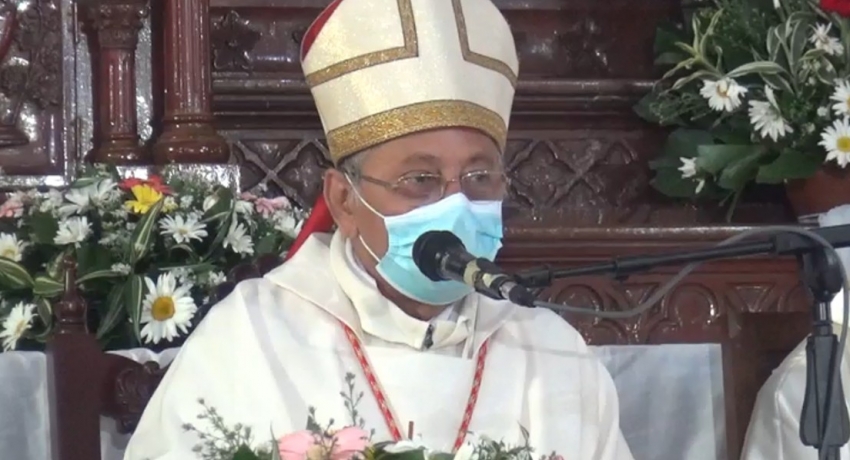
On Tuesday, Colombo Archbishop His Eminence Malcolm Cardinal Ranjith said that at a time when the Government was briefing the UNHRC on the human rights situation in Sri Lanka, it was ridiculous to treat people in such a manner.
“We are disappointed about the Government’s oppressive actions against those who are seeking justice. The public should pay attention to these actions of the Government and respond accordingly at the correct time.”
Referring to Gamage’s arrest and release, Cardinal Ranjith said, “Fortunately, Gamage recorded a video and put it up on social media at the time of his arrest. If not for the video, we wouldn’t even know where he was. There is a proper procedure that should be followed when arresting people. Officers should come in their official clothes and inform the charges clearly. Gamage’s arrest was like an abduction. We condemn it.”
He further claimed that the Attorney General was taking action against those who were demanding justice for the victims of the Easter Sunday terror attacks but not prosecuting those who had been named in the Presidential Commission of Inquiry (PCoI) into the Easter Sunday attacks.
“We don’t expect this from the Attorney General. He has been unsuccessful in pressing charges as per the recommendations of the findings of the Presidential Commission of Inquiry into the Easter Sunday attacks. But arrests of activists who are asking for justice for the victims of the attacks are taking place. He must remember that he is a public servant who is there to do a service to the society and to not act according to the whims and fancies of politicians,” Cardinal Ranjith claimed.
Recalling the bedrock principle of freedom of expression as a fundamental right for all Sri Lankans, senior lawyer Suren Fernando echoed the ruling of the Supreme Court in the Jana Ghosha case in 1993: “The right to support or to criticise Governments and political parties, policies and programmes, is fundamental to the democratic way of life, and the freedom of speech and expression is one which cannot be denied without violating those fundamental principles of liberty and justice which lie at the base of all civil and political institutions. Stifling the peaceful expression of legitimate dissent today can only result, inexorably, in the catastrophic explosion of violence some other day.”
Indeed, it does seem that as predicted by the Court nearly 30 years ago, the more the Government arrests people for political dissent, the more political dissent there seems to be rising up against the Government.
PTA amendments challenged
The Supreme Court last Friday decided to hear the Fundamental Rights (FR) petitions filed against the proposed PTA Amendment Bill.
A series of FR petitions have been filed before the Supreme Court against the PTA (Temporary Provisions) (Amendment) Bill to amend the Prevention of Terrorism (Temporary Provisions) Act No. 48 of 1979 (PTA) since its tabling in the order paper of Parliament on 10 February 2022.
Among these FR petitions was one filed by former Human Rights Commission of Sri Lanka (HRCSL) Commissioner, human rights activist, and lawyer Ambika Satkunanathan on Monday (14). On her official Twitter handle, she noted that the FR was filed on the basis that the amendments were inconsistent with Acts 3, 4, 11, 12(1), 13(1), 13(3), 13(4), 13(5), 138, and/or 141 of Sri Lanka’s Constitution. She stressed that the same could not be enacted into law unless it was approved by the people at referendum along with a two-thirds majority in Parliament.
Some of the other parties that filed FR petitions against the Bill include the Committee for Protecting the Rights of Prisoners (CPRP), activist Shreen Abdul Saroor, Centre for Policy Alternatives Founder/Executive Director Dr. Paikiasothy Saravanamuttu, and a group of trade unionists and journalists.
The recent amendments proposed by the Government to the PTA also came under widespread criticism from various parties, including MPs, civil society organisations, activists, lawyers, and journalists, who charged that it failed to address the key shortcomings in the existing PTA that left room for exploitation by State actors to violate the fundamental rights of citizens.
Meanwhile, the Human Rights Commission of Sri Lanka (HRCSL) has advocated for the complete abolition of the PTA (Temporary Provisions) Act No. 48 of 1979 as amended.
In a press release issued on Tuesday (15) on ‘The Briefing of the Diplomats on 8, 9, and 10 February, on the road map of the HRCSL for 2022 held at the HRCSL Headquarters,’ which dealt with the repeal of the Prevention of Terrorism Act (PTA), it was noted that the Commission “believes that the offence of terrorism should be included in the Penal Code with a new definition for terrorism, which should be explicitly for those who threaten or use violence unlawfully to target the civilian population by spreading fear to further a political, ideological, or religious cause”.
The Commission advocates that terrorism should be investigated under the general law of the country with necessary amendments. The Commission also supports that it is not required to exclude the application of the Evidence Ordinance for the offence of terrorism.
Moreover, the Commission has observed that the indefinite period of detention violates the Constitution’s Article 13(4) which holds that the “deprivation of liberty of a person pending investigation or trial shall not constitute punishment”.
Further, the Commission has pointed out that amendments to the Penal Code, the Code of Criminal Procedure, the Judicature Act, and the Bail Act require modifications for this purpose.
Meanwhile, an islandwide signature campaign was conducted by the ‘Justice for All’ organisation calling on the Sri Lankan Government to honour its promise to repeal the PTA, with the convener of the organisation being MP M.A. Sumanthiran.
The island-wide signature campaign in Colombo was conducted from 11 a.m. to 1 p.m. in front of the Fort Railway Station.
“The Government has given several assurances in the past that this legislation will be repealed and a law will be enacted in its place that complies with international human rights standards and norms. However, the recent Amendment Bill presented to the Parliament falls short of such assurances and fails to address any of the draconian provisions in the PTA,” the letter noted.
The letter additionally states that the 1979 PTA was brought about as a Temporary Provisions Act for six months, yet continues to be in operation for over 40 years.
“During this period, we have witnessed its use to crush dissent against the Government of the day, as has been done consistently in the past and which continues today,” the letter mentioned.
Cardinal Ranjith also placed his signature in the letter calling for the repeal of the PTA.
Seeking support
Amidst all this, Foreign Minister Peiris last Monday (14) said the Government of Sri Lanka hoped the international community would look at Sri Lanka with an unbiased eye, accept its stance, and come to just conclusions about the country at the upcoming 49th UNHRC session.
“The subject of coexistence is a complicated one and any country that has undergone a long war has these problems. There is no overnight solution to this problem. If we are to establish a long-term solution, it should be one that is in line with our culture and people. The international community should look at the broad programme already implemented in Sri Lanka, in an unbiased manner, and come to just conclusions about us. We hope that the majority of the community will accept our stance.”
He added that the findings of the “Presidential Commission of Inquiry for the Appraisal of the Findings of Previous Commissions and Committees on Human Rights and the Way Forward (the ‘Nawaz’ Commission),” chaired by Supreme Court Judge Justice A.H.M.D. Nawaz would be handed over to President Gotabaya Rajapaksa shortly. An interim report by the Nawaz Commission was given to the President in July 2021.
“The ‘Nawaz’ Commission has gone all over the country to compile its report, including gathering evidence from 53 persons in Jaffna. Along with the ‘Nawaz’ Commission, other domestic mechanisms such as the Office on Missing Persons, the Office for Reparations, the Office for National Unity and Reconciliation, and the Human Rights Commission of Sri Lanka should be allowed to work without hindrance. Sri Lanka should not be pointlessly targeted. We have already briefed Colombo-based diplomats, New Delhi, India-based diplomats, and the community in Geneva about the progress of these institutions,” Peiris noted.
Accordingly, the Nawaz Commission report was handed over to President Rajapaksa last week.
Spotlight on Dappula
Pressure by the Catholic Church on bringing to justice those responsible for the Easter Sunday attacks probe continued last week.
The Catholic Church is continuing to push the CID and other relevant law enforcement authorities to question former Attorney General President’s Counsel Dappula de Livera regarding the controversial statement made by him last year that there was a “grand conspiracy” behind the Easter Sunday terror attacks of 21 April 2019.
However, the Catholic Church has not yet made a written request to the CID or other relevant authorities that de Livera PC be questioned with regard to his statement. Speaking to the media in May 2021, shortly before his retirement, de Livera PC said that there was clear evidence of a grand conspiracy linked to the said terror attacks.
“A course of action is being organised by the Sri Lankan Catholic Church together with the Vatican, but we will not divulge anything about it now,” Cardinal Ranjith told a press conference. “It is the Government which has to bear the responsibility for the consequences which Sri Lanka has to undergo if the church seeks international assistance to mete out justice to those who were affected by the Easter Sunday mayhem,” he added.
Zaharan’s wife quizzed
The 2019 Easter Sunday attacks probe took a new twist last week following the acquittal of former Defence Secretary Hemasiri Fernando and former Inspector General of Police (IGP) Pujith Jayasundera from all charges in connection to the Easter attacks case.
The two acquittals have cast doubts on whether any high-ranking official holding office during the period of the attack would be held accountable for negligence that resulted in the attack.
The CID, however, seems to have redirected its focus on several senior CID officers who were on duty in 2019.
The CID has commenced recording statements from Abdul Cader Fathima Hadiya, the widow of the late National Thowheeth Jama’ath (NTJ) organisation leader and suicide bomber Mohamed Cassim Mohamed Zahran alias Zahran Hashim, recording a nearly five-hour statement from her on Tuesday.
A team of CID officers, including Assistant Superintendent of Police (ASP) Meryl Ranjan Lamahewa, had visited Abdul Cader Fatima Saadiah at the Welikada Prison. Presenting submissions to the Kuliyapitiya Magistrate’s Court on 10 February, the CID had sought permission to record statements from Hadiya until 25 February.
Accordingly, Police Media Spokesman Senior Superintendent of Police (SSP) and Attorney-at-Law Nihal Thalduwa told The Morning that the Court had given permission to record statements from Hadiya, who is currently being held at the Welikada Prison. The Court had directed the Welikada Prison’s Superintendent to allow CID officials to visit the jail premises and obtain the relevant statements.
Furthermore, Kuliyapitiya Magistrate Janani Weeratunga had ordered the CID to submit a report on the investigations on this regard on 4 March.
Hadiya, the widow of Zahran, who was one of the suicide bombers who carried out the bomb attack at the Shangri-La Hotel in Colombo on 21 April 2019, testified in October 2020 before the Presidential Commission of Inquiry (PCoI) appointed to probe the Easter Sunday terror attacks of 21 April 2019. However, the testimony she gave before the PCoI was not disclosed to the media.
The purpose of the investigation, it was revealed in a Fundamental Rights application filed by former CID Director Shani Abeysekara, was to use evidence from Zahran’s wife to justify the arrest of CID officers. The move would mark the first time in Sri Lanka’s history that evidence from a suspected terrorist, let alone the wife of a terrorist mastermind, was deemed as credible against the Police officers who investigated that terrorist group.
Meanwhile, it is reported that Chief Inspector of Police Arjun Maheenkanda who led the investigation unit of the said PCoI has left for the US. In July 2020, Maheenkanda testified before the PCoI that there was ample evidence that Pulasthini Mahendran alias Sarah Jasmine, who was the wife of Atchchi Muhammadu Muhammadu Hastun who carried out the suicide bombing at the St. Sebastian’s Church in Katuwapitiya, had fled to India by sea in September 2019. When queried about the media reports that Maheenkanda had fled the country, Thalduwa said that the former had retired from the Police service in December 2021.