SL refutes former HRCSL Commissioner’s claims

Sri Lanka has rebutted the claims made by the Chairperson of the Neelan Tiruchelvam Trust, Ambika Satkunanathan during an exchange of views on the situation of human and labour rights in Sri Lanka at the European Parliament’s Subcommittee on Human Rights on 27 January.

In a statement, the Foreign Ministry noted with concern the “misleading statements” contained in the testimony of former Commissioner of Human Rights Commission of Sri Lanka (HRCSL), which it said completely ignores the progress made by the Sri Lankan government on many fronts.

It also stated that this testimony creates doubts about the Sri Lankan government’s intents and sincerity, particularly at a time when it is engaged in long-standing cooperation with the UN human rights mechanisms and the UN Human Rights Council and is delivering on its commitment to address accountability and reconciliation through domestic processes and institutions.

Expressing its disappointment, the Foreign Ministry said among the recommendations made by Satkunanathan is that the EU uses its leverage on the GSP+ facility to exert pressure on the government on human rights.

“If Sri Lanka loses the EU GSP+ facility, particularly at a time when livelihoods of millions of Sri Lankans belonging to all communities are already affected by the ongoing COVID-19 pandemic, the resulting losses would exacerbate poverty and income inequality. Some of the worst affected sectors will be fisheries and agriculture which are among the key industries in the North and the Eastern Provinces of Sri Lanka,” the statement pointed out.

The Foreign Ministry also noted that the “unfounded allegations” about discrimination of ethnic communities in Satkunanathan’s testimony are reminiscent of LTTE propaganda that once stoked hatred among communities.

In a multi-ethnic and multi-religious country such as Sri Lanka, such allegations need to be refuted in the interest of social harmony and to prevent the spread of dangerous fallacies about Sri Lanka in the international community, it emphasized.

The Foreign Ministry refuted Satkunanathan’s claims on ‘a culture of impunity.’ It pointed out that the Sri Lankan government is engaged in long-standing cooperation with the UN human rights mechanisms as well as with the UN Human Rights Council.

“Sri Lanka is delivering on its commitment to address accountability and reconciliation through domestic processes and institutions. The government has been actively engaging the international community including the UNHRC’s Universal Periodic Review and Special Procedures to address the various concerns that have been raised. This includes the allegations of systematic torture.”

The Foreign Ministry went on to say that the government has made it clear that additional reforms would be undertaken to further strengthen rule of law, access to justice, and accountability. It remains open to a constructive discussion on suggestions and further steps to address shortcomings, it added.

Speaking of Satkunanathan’s references to ‘Sinhala Buddhist nationalism’ and ‘militarisation’ as driving the actions of the government, the Foreign Ministry stated that she has made vague claims of racial profiling in the absence of any concrete evidence of discrimination against minorities.

In its response, Foreign Ministry pointed out that Sri Lanka is a secular country and all citizens, irrespective of their religion or ethnicity share the same fundamental rights under the Constitution.

Furthermore, Sri Lanka ensures access to public services such as free education and free health facilities without any discrimination on the basis of ethnicity or religion, the statement continued. “In fact, even during the military conflict when large areas of the Northern and the Eastern Provinces were under the control of the LTTE, the government continued with the provision of such public services to the areas so that the civilians, who were mainly ethnic Tamils and Muslims, would not be affected.”

Satkunanathan has pointed to the Presidential Task Force on Archaeology which she accuses of being a tool for land grabbing and changing the demographics of minority-heavy areas and the Presidential Task Force on One-Country One Law which she accuses of stoking ethnic hatred and violence, the Foreign Ministry said further.

“After the war, as displaced persons returned to the Northern and the Eastern Provinces, there has been an increase in unauthorized encroachment into forest areas inevitably leading to destruction of archaeological sites. So, there is an urgent need to take concrete measures in order to protect these sites.”

The Foreign Ministry vehemently denied the claims that the Presidential Task Force on Archaeology is a pretext for land grabbing and introducing the Sinhalese to these areas. “It may be noted that there is representation of all ethnic communities in this Task Force.”

Addressing the allegations on the Presidential Task Force on One Country One Law, the Foreign Ministry remarked that it is expected to play an advisory role only. “The Task Force’s recommendations will be first studied by the Justice Ministry, then the Cabinet of Ministers and finally the Parliament following the democratic traditions.”

With regard to her allegations that the Northern and Eastern Provinces are ‘occupied’ by the military, the Foreign Ministry responded that the majority (more than 92%) of the private lands occupied by the military at the end of the conflict in year 2009 have already been released to legitimate land owned civilians. “A mechanism is already in place to expedite the process of releasing remaining private lands.”

The Foreign Ministry also said it is particularly disappointing to see Satkunanathan’s allegations that ‘civic space’ is shrinking and that informal and extra-legal processes are used to curtail the activities of civil society organizations.

In its statement, the ministry asserted that government views NGOs as partners and not as adversaries. “The government acknowledges the constructive contributions made by civil society organisations in the work of the Office for National Unity and Reconciliation (ONUR) and Sustainable Development Council of Sri Lanka. It has also introduced certain policy changes to facilitate the work of NGOs such as bringing the NGO Secretariat under the Foreign Ministry.”

The Foreign Ministry reiterated that apart from operating routine security networks in the interest of national security, particularly after the devastating Easter Sunday terrorist attacks, the Security Forces and intelligence agencies are not engaged in monitoring or targeting any specific group of people in the country.

It refuted Satkunanathan’s claims of extra-judicial killings and arrests under the pretext of a “war and drugs.” With regard to the PTA, the statement noted that the government is in the process of amending the Act, which is now at the final stage and the international community is being briefed on that process.

Satkunanathan had also alleged that the government is exploiting its friendship with China to “undermine the efforts of states that call for accountability for human rights violations” in Sri Lanka.

On the contrary, mindful of strategic competition that is increasing in the Indo-Pacific region, the government’s main foreign policy directive is to maintain neutrality, in line with the non-aligned foreign policy we have adopted since Independence, the Foreign Ministry explained.

It also pointed out that apart from China, Sri Lanka has entered into partnerships with several countries such as India and Japan to fill gaps in national infrastructure development. Such partnerships have no bearing on Sri Lanka’s commitment to addressing accountability and reconciliation through domestic processes and institutions.

Posted in Uncategorized

Sri Lanka makes full vaccination mandatory to enter public places

Sri Lanka’s Minister of Health Keheliya Rambukwella has issued an Extraordinary Gazette preventing people who have not been fully vaccinated from entering public places, including public transport.

According to the gazette notification, without full vaccination, people will not be able to travel or stay in any public place.

“A person shall not enter any public place without having the proof of being fully vaccinated against the Coronavirus Disease 2019 (COVID – 19) unless exempted by the Proper Authority in respect of the whole of Sri Lanka,” the gazette notification says.

The provisions of this regulations will come into operation on April 30, 2022.


EU to fund projects in Sri Lanka to counter Chinese influence

The European Union is planning to fund projects in Indo Pacific countries such as Sri Lanka.

They stated that this would be done with the support of India to counter China’s growing influence in the region.

Accordingly, the European Union says it will introduce a transparent program to fund projects in Indo Pacific countries like Sri Lanka.

France had assumed the presidency of the European Union last month.

French Ambassador to India Emmanuel Lenain had said it’s a problem that China is using to fund projects in certain countries in the region.

He had cited Sri Lanka as an example.

The Ambassador had noted that the program may be unveiled at the EU’s Indo Pacific Form on the 22nd of this month.

France has about 8,000 troops in the Indo Pacific as it owns a cluster of islands in the Indian Ocean.

13A swap, dependent integration, Tamil thinking, Ranil’s roll-out -By Dr Dayan Jayatilleka

The ITAK/TNA keeps denouncing successive Sinhala leaderships for not ‘building upon’ and/or “going beyond” the 13th amendment, but it was precisely in the Tamil interest—not so much that of the Sinhalese—to make the 13th amendment work so as to “build upon it” and “go beyond it”. That was primarily the responsibility of the Tamil leadership. Why didn’t it do so, as the Sinn Fein so brilliantly did with the Good Friday Agreement and the ensuing devolved structures?

“Provincial Councils Abolished!” screamed the headline of a mainstream, long-established, Sinhala-language Sunday newspaper (30 Jan 2022) sympathetic to the Sinhala nationalist cause. The byline of the story is that of a relatively young, intelligent journalist of ultranationalist orientation with excellent sources in the camp of the hawks that grew into President Gotabaya Rajapaksa’s inner-circle.

The reporter claims that the draft of the new Constitution which is to be presented to the President next month and then to the Cabinet and Parliament, excludes the system of Provincial Councils and pretty much restores the 1972 Constitution, including the post of an empowered Prime Minister as the leader of the country, thereby abolishing the executive presidency.

Trapped Opposition?

The report concludes that the Government expects the new Constitution to replace the current one, within this year.

In the absence of any contradiction, one may deduce that there is a fire behind the smoke. It is likely that the lead story is based on the submissions of one or more members of the drafting committee.

If the sentence about the replacement of the elected executive Presidency by a Prime Minister is true, then the Opposition is caught in a trap of its own making. A referendum would be the earliest and best chance to break the back of the regime and expedite its end – which is how Pinochet went—but how is the Opposition to call for a NO vote when – with the possible, partial exceptions of the SJB and SLFP—much of the oppositional opinion space is ideologically and intellectually committed to the abolition of the executive presidency?

If the principle is opposition to the centralisation of power, then it is surely at least as bad in the hands of the PM as the President; in fact, it is worse because the PM represents only his/her constituency and the party he/she leads, not the majority of the people. The logical liberal-democratic stand would be a balance of power between the President and the PM, with a decisive edge for the Presidency (as in France) because it represents a majority of the citizen-voters.

If the 13th amendment is deleted or downsized and that counter-reform generates external pressure, such pressure will aim to resurrect the 13th amendment because there is no legitimate basis and consensus, internationally and regionally, to go beyond it. The UN resolutions say “implementation of the 13th amendment”

Tamil political paradigm

If one faction within the drafting committee has argued for the abolition of the system of Provincial Councils, i.e., the 13th amendment, even if there is a compromise, it is likely to be one that reduces the powers of that system. The window is fast closing for any political or politico-diplomatic struggle to defend and retain provincial semi-autonomy.

The system of Provincial Councils received only tepid support from the Tamil nationalist mainstream. At the time of its appearance, only the leftwing EPRLF came forward to contest the PC elections. Currently, Gajendrakumar Ponnambalam, MP, is riding with a convoy of vehicles carrying the figure 13 with a X running through it… He makes whistle stop addresses to the media, denouncing the 13th amendment for its accommodation to/within a unitary state—and those Tamil parties that stand for its implementation. The Sunday story should please him.

The TNA’s Sumanthiran who filibustered during the initiative of a letter to Prime Minister Modi seeking his support to uphold the 13th amendment, should be only slightly less glad.

The explicit argument of these immoderate moderates has been that “the Tamil community didn’t lose so many lives to settle for the 13th amendment.” The truth is that having lost so many lives, when the smoke cleared, all that remained was the 13th amendment and the system of provincial councils. By trashing it, or trying to leap over that durable residue and push for a new, non-unitary Constitution, the Tamil nationalists have left the 13th amendment and the PC system utterly unguarded; open to abolition by a Sinhala ultranationalist regime they helped bring about by their rejectionist and maximalist political provocations (as Hamas helped elect Netanyahu).

The real risk is that the lives sacrificed by the Tamil people will have absolutely nothing left to show politically, on the ground, on the island. Gerry Adams and Martin McGuinness never left a zero-balance sheet politically for Northern Ireland’s Irish Catholic minority.

The 13th amendment was the product of the Tamil struggle at its zenith, quite contrary to the myth that the Tamil struggle was at its height when Prabhakaran and the LTTE were fighting a spectacular yet solitary war.

The Tamil cause was politically strongest in the 1980s, and the 13th amendment was the product of that favourable balance of forces. In the 1980s, the Tamil struggle was waged by an array of militant organisations. India supported the struggle, though not its secessionist objective. The USA and the USSR deferred to India. In the aftermath of Black July 1983, the Sri Lankan state occupied the moral low-ground.

The Tamil cause never had such broad support ever again nor such powerful support from India. The Sri Lankan state was never so morally-ethically discredited and on the defensive again. In the south of the country, a civil war was fought and won, among other things in support of provincial devolution within a unitary state. What was obtained, was what was obtainable: the Indo-Lanka accord, the 13th amendment and the system of Provincial Councils within a unitary framework.

The LTTE’s spectacular military performance of the 1990s and in the new century and Millennium lacked that breadth and depth of strategic support. The Final War for Tamil Eelam was waged on politically thin ice. The only external support was the Tamil Diaspora. It ended with the (supposedly) invincible Tigers being outfought and beaten in their (supposedly) impenetrable redoubt of the Wanni jungles by soldiers from Sinhala peasant families, before being funnelled into, trapped and eliminated in the killing box. As any real genius of irregular warfare (Mao, Giap) knew—unlike Prabhakaran—if you get your politics wrong, you cannot get your war strategically right.

The ITAK/TNA keeps denouncing successive Sinhala leaderships for not ‘building upon’ and/or “going beyond” the 13th amendment, but it was precisely in the Tamil interest—not so much that of the Sinhalese—to make the 13th amendment work so as to “build upon it” and “go beyond it”. That was primarily the responsibility of the Tamil leadership. Why didn’t it do so, as the Sinn Fein so brilliantly did with the Good Friday Agreement and the ensuing devolved structures?

The answer is that mainline Tamil nationalism (but not so much the non-LTTE ex-guerrilla groups) thought/thinks as follows:

(a) The Tamils could do without India because it had more powerful friends in the West who would come through someday soon.

(b) The 13th amendment was an obstacle to federalism and self-determination.

(c) Having lost the war, international accountability for war crimes was more important than defending, entrenching and reanimating devolution/autonomy.

There was no accountability clause in the Good Friday Agreement. Accountability appeared later, as a byproduct, on the sidelines of an evolutionary process of rising consciousness.

Some personalities succeeded in including ‘federalism’ and ‘self-determination’ in the significant collective letter to Prime Minister Modi. Even the Tamil parties outside the north and east and the Muslim parties in the north and east could not subscribe to that platform.

Which Southern party which aspires to succeed the zero-devolution GR regime, can commit to anything beyond the 13th amendment and its implementation, and survive electorally?

The TNA, and earlier the TULF, pushed their Sinhala allies, President Chandrika Bandaranaike Kumaratunga and Prime Minister Ranil Wickremesinghe beyond the 13th amendment to a commitment to a new quasi-federal Constitution, and both were terminally damaged as a result, with Mahinda and later Gotabaya as beneficiaries.

Any battle for federalism, north-east merger and/or self-determination will have to be waged by the Northern Tamil parties alone. However, a battle for the 13th amendment and the system of Provincial Councils can gather the support of considerable segments of the Opposition.

The permanent hyper-inflationary spiral in Tamil political discourse is not only due to dogmatism but also to internecine competition between and within Tamil political parties. Tamil politics is driven by the dynamics of secession and succession; more succession than secession. Secessionism in the Tamil Diaspora is leveraged by contenders for succession in Tamil politics on the island, while the secessionists in the Diaspora also patronise and manipulate those contenders for succession.

The most powerful drive for self-determination in Tamil politics today is the determination to make oneself the successor to Sampanthan. A leading contender invokes Uncle Sam (claiming Washington will drive a political solution beyond 13A) to position himself as successor to “Sam” (Sampanthan).

Let alone constitutional change, if the electoral reforms in the pipeline are enacted, the number of Tamil politicians in the legislature will be the lowest in decades.

If the 13th amendment is deleted or downsized and that counter-reform generates external pressure, such pressure will aim to resurrect the 13th amendment because there is no legitimate basis and consensus, internationally and regionally, to go beyond it. The UN resolutions say “implementation of the 13th amendment”.

Tamil politicians have perhaps only days to embark upon a prudent, pragmatic and purely defensive strategy in support of 13A, with the broadest possible alliances, Tamil, Muslim and Sinhala.

Strategic economic integration of Sri Lanka with India, i.e., permanent strategic economic dependency, is an enormously flawed idea

13A swap for dependent integration

Could India be tempted to let the 13th amendment go, in a swap for a strategic economic foothold? The Gotabaya gambit is signalled in the interview given to Sri Lanka hand Nirupama Subramanian of the Indian Express by High Commissioner Moragoda. He says, “I think President Rajapaksa wants the two countries to come together, he wants the two economies to integrate more.” (Daily FT)

Moragoda elaborated in an address to the Vivekananda Foundation, the founder-director of which is India’s NSA Ajith Doval and present director is ex-Deputy NSA Dr. Gupta: “…he stressed the need to integrate the Trincomalee Oil Tank Farms and the Port of Trincomalee to the overall energy strategy of India…” (Daily FT)

Strategic economic integration of Sri Lanka with India, i.e., permanent strategic economic dependency, is an enormously flawed idea. India’s sage Chanakya, a.k.a Kautilya says in the Arthashasthra that a state by virtue of its shared or proximate border is bound to have a conflict of interests with its neighbour, which therefore constitutes the source or direction of the greatest threat, and should be balanced-off by tilting to the neighbour’s neighbour.

While such classic geo-strategic axioms need not overly circumscribe Sri Lanka’s omnidirectional options, they tend to prove objectively parametric over the long term. Therefore, a vital distinction must be drawn between (a) exploring greater economic synergies with India through multiple though selective linkages and expansion of shared economic space and congruent interests, and (b) “integration” of Sri Lanka’s economy with India’s. The latter brings to mind the integration of a sprat with a shark or a minnow with a whale. Moragoda wants Sri Lanka to play Puerto Rico to India’s USA.

Sri Lanka’s long-term existential interests of optimising sovereignty and strategic autonomy are far better served by a multipolar diversification of dependence.

Nirupama Subramanian pointedly queried about the 13th amendment. In response, Moragoda, who was as close to former Prime Minister Ranil Wickremesinghe as he is to President Gotabaya Rajapaksa, never mentioned the Indo-Sri, the 13th amendment, devolution, a political solution or the Indo-Sri Lanka Accord. As did President GR in his recent address to parliament, Moragoda stressed ‘development’ instead, flatly asserting that “…in the north and the east, people are not interested in constitutions.” Presumably, the Tamil people aren’t interested in whether or not the 13th amendment/provincial devolution is in this, or any successor Constitution.

Can Ranil give sensible counsel on either an economic policy that can last two terms or ensuring policy continuity by winning two consecutive terms, when he was never re-elected for a second consecutive term, there were 15 years in-between his premierships, and his second term ended with his party’s electoral extermination?

Ranil raps ‘rot’

Ex-Prime Minister Ranil Wickremesinghe rolled-out his economic wisdom at the Rotary Club of Colombo West. The stark contrast between his precept and his practice is staggering.

He advocates a ‘long-term national plan’, but didn’t it start while PM in 2001 and 2015.

In January 2016, Nobel Prize winner in Economic Sciences, former Vice-President and Chief Economist of the World Bank and former Chairman of the US President’s Council of Economic Advisors, Prof Joseph Stiglitz, visited Yahapalanaya Sri Lanka. On a panel with Prime Minister Wickremesinghe, Stiglitz enthusiastically stressed socioeconomic policy priorities for ‘Sri Lanka’s Rebirth’ in the ‘post-conflict’ period. (Sri Lanka’s Rebirth by Joseph E. Stiglitz – Project Syndicate (columbia.edu))

Included in the 2011 TIME magazine’s Top 100 influential people, Stiglitz had zero-influence on Ranil and his economic team. Instead, they turned to neoliberal ‘shock therapy’ guru Ricardo Hausmann. Hausmann notoriously drafted the policy platform of Venezuela’s presidential pretender, Trumpian Trojan horse and far-right flop Juan Guaido. South America’s finance ministers who shared Hausmann’s socially polarizing policy perspective have triggered “A string of victories for progressives in Latin America…Since 2018, left-of-center candidates have won presidential elections in Argentina, Bolivia, Chile, Mexico, and Peru, and leftists lead in the polls in this year’s campaigns in Brazil and Colombia.” (Foreign Policy, Jan 31, 2022)

Prime Minister Wickremesinghe pulled the plug on all Chinese projects including the Port City; Western investment didn’t flow; the Central Bank Bond scam was a drain of inestimable magnitude and duration on the economy according to the (then) Auditor-General Gamini Wijesinghe; the growth-rate dropped; the bills piled-up; he borrowed more externally than Mahinda Rajapaksa ever did with very much less to show for it; and coughed-up more real estate in Hambantota to the Chinese than Mahinda had done, thereby triggering a spiral of countervailing demands for economic real-estate from India and the USA, creating the dependency trap we are now caught in.

Wickremesinghe correctly situates the contemporary crisis: “Economically, we have not seen such a situation since 1988, 1989”. Sri Lanka exited that crisis and recovered spectacularly through a vibrant new economic model, a Rooseveltian New Deal variant of the Open Economy, instituted by President Premadasa. Prime Minister Wickremesinghe didn’t retrieve that model on the two occasions he was in charge of economic policy, 2001-4 and 2015-2019. As Prof Howard Nicholas underscored last December, industrialisation is the only way out of the Sri Lankan crisis, President Premadasa was the only one who took that path, and “I don’t think Ranil followed it…”

Today, Ranil says “…we have to realise that anyone who is saying that I will do it in one term is talking rot.” President Premadasa did it in under half a term!

Can Ranil give sensible counsel on either an economic policy that can last two terms or ensuring policy continuity by winning two consecutive terms, when he was never re-elected for a second consecutive term, there were 15 years in-between his premierships, and his second term ended with his party’s electoral extermination?

Ronnie de Mel, architect of the Open Economy of 1977, said last year that “the only hope” he sees for Sri Lanka in this crisis is Sajith Premadasa and “getting the whole thing under the control of your [Sajith’s] policies”. Opposition leader Premadasa’s discourse parallels Joe Stiglitz’ policy direction for ‘Sri Lanka’s Rebirth’.

Election within a year?

The Government yesterday indicated that it would go for an election at the earliest possible date within a year.

This was disclosed by Finance Minister Basil Rajapaksa last evening in Colombo during a press gathering to brief about the Government’s Weda Lakshayaka Wiyapruthiya that would be launched today.

Responding to questions posed by journalists, Minister Rajapaksa said he is ready to face any election even tomorrow. Nevertheless, he indicated the possibility of the Government holding an election within the course of the year.

Rajapaksa, though did not directly indicate what type of election would be held in a year, vaguely mentioned kicking off propaganda activities targeting the Local Government Elections by next week.

He remained tight-lipped when journalists continuously asked him about the IMF and his remarks on the purchasing missiles from North Korea using Black Market Dollars.

“IMF is the forbidden word this evening,” he asserted and left the premises stating “no more questions.”

The Finance Minister added that Sri Lanka’s debt commitment of USD 6.9 billion due this year, will be settled.

Posted in Uncategorized

India’s neglect of North Sri Lankan fishermen may have strategic implications for it

Written by P.K.Balachandran

India’s persistent disregard of the woes of the North Sri Lankan Tamil fishermen could have strategic implications for it because rival China is assiduously wooing the North Lankan fishing community with attractive developmental schemes. India considers north Sri Lanka as its strategic backyard and would loathe to see a Chinese presence there.

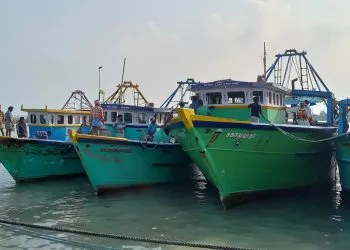
The North Lankan Tamil fishermen have lost their rights in the narrow sea between Sri Lanka and Tamil Nadu State in India due to heavy poaching by Tamil Nadu fishermen. The latter use trawlers which scrape the bottom of the shallow sea and destroy the nets of the local fishermen. Years of complaining for justice and action to stop the poaching and banned fishing methods have had no effect. Successive Indian governments have been reluctant to rein in Indian fishermen for fear of alienating voters in Tamil Nadu. Fishermen are a strong political constituency in the South Indian State.

Every time the poachers are caught by the Sri Lankan navy, politicians in Tamil Nadu would raise a hue and cry and New Delhi would request Colombo to “treat them humanely” and release them. And Colombo would always oblige because, for it, good relations with New Delhi is more important than serving the interest of the North Tamil fishermen.

The Sri Lankan Tamil parties also do not uphold their fishermen’s cause because politics in the Northern Province is dominated by the Vellalas, a land owning caste and not a seafaring caste. Moreover, the typical North Lankan politician is interested only in securing a federal constitution and not in securing their fishermen’s rights vis-à-vis Tamil Nadu fishermen. Sri Lankan Tamil politicians would not alienate the Tamil Nadu or Indian leaders because their support is needed to pressurize the Sri Lankan government to give autonomy to the Tamils.

Left high and dry, the helpless North Sri Lankan Tamil fishermen sometimes attack the Indian poachers. Recently, two of them were killed in a mid-sea clash. In protest against this, the fishermen of Vadamarchchi East have been demonstrating in the streets since January 30.

However, virtually no support has been forthcoming from the North Tamil politicians. In fact, one of them, Suresh Premachandran of the Eelam Peoples’ Revolutionary Liberation Front (EPRLF) has said that it is not proper for Lankan fishermen to indulge in violence against their Tamil Nadu counterparts. Premachandran and other local politicians use the issue mainly to corner their rival, the Minister of Fisheries, Douglas Devananda. They put the entire responsibility of finding a solution to the problem on Devananda.

But Devananda has been able to do precious little in this matter in the absence of help from either the Sri Lankan government or the Indian government. The only way out for Devananda was to find ways to give the affected fishermen an alternative way of making money. With the Chinese Ambassador in Colombo expressing willingness to help, a sea cucumber breeding center and a fish canning factory were set up. In December last, Chinese Ambassador Qi Zenghong visited these facilities and promised more help for the development of fisheries/aquaculture. He also visited some islands lying on the sea route to Tamil Nadu.

But India sees the Chinese interest in North Sri Lanka as a security threat. Recently, India opposed a Chinese solar power project in three islands off the North Lankan coast on security grounds. Sri Lanka stalled the project though it had been secured by the Chinese company by tendering.

But the stalling of the power project is unlikely to deter China from continuing to make inroads into North Sri Lanka, especially the fisheries sector there. If India cannot stop its fishermen from poaching in Sri Lankan waters (and it cannot for political reasons), then it has to woo the Lankan Tamil fishermen with other development and income generating schemes in collaboration with the Sri Lankan Ministry of Fisheries. If it does not do this, and restricts itself to getting the arrested fishermen released, China will secure a foothold among the fishing community before long, and India will lose a strategic asset to China.

The fishermen’s issue may get further complicated if the leader of the Tamil National Peoples’ Front, Gajendrakumar Ponnambalam, carries out his threat to take it to the UN. Meanwhile, the leader of the Tamil Eelam Liberation Organization (TELO) Selvam Adaikalanathan, has suggested that India help fishermen from Sri Lanka and India take to deep sea fishing, by giving them equipment and training. However, this is unlikely to succeed because one of the Chief Ministers of Tamil Nadu, J.Jayalalthaa, had tried this and failed. The fishermen on both sides of the Palk Strait are traditionally coastal and not deep sea fishermen.

Posted in Uncategorized

Sri Lanka to issue on-arrival ETA for several countries

The Civil Aviation Authority of Sri Lanka (CAASL) yesterday announced that on-arrival ETA will be issued to tourists from several countries due to impediments in applying for electronic travel authorisation (ETA).

Issuing a statement, the CAASL Chairman said that the Department of Immigration and Emigration has informed that the tourists from the following countries, who are unsuccessful in making credit card payments for ETA to travel to Sri Lanka, due to the ongoing upgrade and maintenance of the ETA front-end system, will be issued on-arrival ETA (at the port of entry to Sri Lanka) as an alternative channel, with a view to promote the tourism industry: Austria, Belgium, Denmark, the Netherlands, Poland, Italy, Finland, France, Germany, Ireland, Spain, Greece, Sweden, Hungary, the UK, Australia, New Zealand, the US, Canada, Japan, Switzerland, Norway, Portugal, Slovenia, Estonia, Mauritius, Iceland, Cuba, Singapore, Russia, and Ukraine.

He further said that the respective missions/posts accredited or concurrently accredited to the above countries are requested to take urgent action to convey this information to the relevant authorities, travel industry/associations, and intended travellers.

In a separate announcement, the CAASL said that Sri Lankan passport holders do not require the Covid-19 insurance coverage when travelling to Sri Lanka.

However, all tourist visa holders require mandatory Sri Lanka Covid-19 insurance coverage to be purchased online (https://portal.pionline.lk/covidinsurance/) or on arrival.

All tourist visa holders require travel insurance coverage for a minimum of $ 50,000, including cover for hospitalised treatment for Covid-19 infection, it was stated.

The Covid-19 insurance coverage is not required to board an aircraft, but upon landing in Sri Lanka if the tourist visa holder is not carrying the Covid-19 insurance coverage for a minimum of $ 50,000, they must purchase the policy prior to leaving the respective airport in Sri Lanka, it said.

Posted in Uncategorized

Cardinal will not take part in Independence day celebrations

Archbishop of Colombo His Eminence Cardinal Malcolm Ranjith is to boycott independence day celebrations tomorrow as a protest against the shortcomings in the investigations carried out on the Borella Church hand grenade case and the Easter Sunday bomb attack, member of Colombo Archdiocese Communication Unit Rev. Fr. Cyril Gamini Fernando told journalists today.

Fr. Fernando said Cardinal Ranjith has decided to cancel the service he usually holds on the Independence Day.

“We are disturbed as to why the caretaker of the church is being continuously detained despite the proof that he has nothing to do with the All Saints’ Church grenade issue. CCTV Camera footages have made it clear that this person has nothing to do with the grenade episode,” Fr. Fernando said.

All the other suspects expect for the caretaker of the church were released recently.

Between preventing and countering terrorism

It’s all becoming increasingly predictable. With the UNHRC in February-March scheduled to discuss Sri Lanka, the Tamil side especially commenced its global campaign weeks and months ago. The government, in its defence, has now unveiled what it claims is an improved law against terrorism, compared to the much-hated law, which was enforced as a temporary measure, 43 years ago.

The TNA sent a delegation to the US, Canada and the UK, both to meet its constituents there and more so the host governments. The three nations are the real movers and shakers behind the UNHRC resolution(s) against the Sri Lankan State, institutions and individuals connected with Establishment Sri Lanka. In their capital, the TNA is believed and claimed to have discussed the future pressures that the international community can apply further to get the Sri Lankan State to cough up, on war crime probe, other accountability issues and also a political solution.

Independent of this and running parallel to these efforts was a half-baked Tamil effort to rope in the Indian neighbour all over again. What started off as a larger pan-Tamil effort seeking the full implementation of the India-facilitated 13-A beyond the TNA brand got botched up right royally in between. What has since emerged is a common appeal by most Tamil groups but endorsing the TNA’s 13-plus position.

Fair enough, the exercise brought back most TNA splinters back to the fold, yes. But it has also triggered the equally avoidable ACTC-TNPF’s protests of parliamentarian Gajendra Kumar Ponnambalam, as if to make it out that the TNA wanted 13-A and nothing more. Through all these, the Tamil parties have embarrassed Indian Prime Minister Narendra Modi much more than any incident/initiative of theirs in the post-war past.

The closest that could be recalled in this regard is the 13-A rebuttal that the TULF as it stood at the time issued after they had encouraged then Indian Prime Minister Rajiv Gandhi to sign on their behalf. Their pre-eminent position was not even that they had to represent the nation’s Tamils vis a vis the Government of President J R Jayawardene, who was a co-signatory along with Rajiv Gandhi. They were keener that LTTE’s Prabhakaran did not sign – and thus stood equal to them in legal and technical terms.

It thus proved easy for them to distance themselves from the Indo-Sri Lanka Accord 1987 only days after it was signed. Enough material is available to the principled ideological differences of the LTTE to the Accord, and ignominy in the way his Indian handlers treated Prabhakaran while in Delhi to be briefed about its contents. But has emerged about the TULF’s opposition to the Accord until the signed statement appeared after the TULF leadership had returned to Colombo.

Clearly, the TULF, rather the principal ITAK partner, came under societal pressure after the LTTE’s position got leaked and spread. The ITAK is at present the leading partner in the TNA, and both came under pressure when they were half-way through the post-war political negotiations with the then Government of President Mahinda Rajapaksa, who is now the Prime Minister.

The civil society, then identified with the then Mannar Bishop, Rev Rayappu Joseph ensured that the talks collapsed. Aiding from the sides was the international community, with the US leading, wanting to haul Sri Lanka over the UNHRC coals. Today, the UNHRC has expanded the scope of the Sri Lanka resolutions to include current levels of alleged human rights violations and institutional weaknesses.

At this rate, the original Tamil cause could very well be pushed to the background with every-day events under the present regime of President Gotabaya Rajapaksa increasingly taking international space, until such time the former becomes as moth-eaten as many other UNHRC/UN initiatives of the kind. The Tamils of that future generation can sit back, lament and repeat their worn-out one-liner, “Meendum pizhai vittutom…” Translated it means that they had failed themselves one more time.

Draconian law

It is in this background that the government has come up with a new anti-terrorism bill to replace the draconian law that has been in place for four-plus decades. It is anybody’s guess why Foreign Minister G L Peiris, and not Justice Minister Ali Sabry, had to pilot the Cabinet paper in this regard, but then, the former is even more of a legal academic than Minister Sabry can be. But critics are already claiming that Sabry may have felt embarrassed to move a bill draft that is in no way going to offer relief to fellow Muslims, facing and likely to face harassment from law-enforcement, as under the existing law.

TNA’s lawyer-parliamentarian M A Sumanthiran was the first to tear the new draft bill to pieces. As he has pointed out, the draft is not greatly different from the existing one, especially when it comes to operational clauses. He has a very valid point.

As Sumanthiran and other critics have pointed out since, the bill has reduced the detention period without judicial access and bail, from 18 to 12 months. First it is cosmetic change. But on the important clause of the freedom for the arrested person to be detained indefinitely once the charge-sheet had been filed, there is no change. This has led to many Tamil political detainees especially being held under custody for 20-30 years, it is said, with no hope or scope for fast-tracking their trials. This is also a point on which the Tamil parties and society have been agitating in the post-war decade.

The Government has also highlighted a provision in the new draft, facilitating jurisdictional judge to visit the PTA detenus in prison every month. Critics, especially Tamil political parties and media, have argued that such a provision now exists even under the criminal procedure code. They need to acknowledge that this provision was not applicable to PTA detenus earlier.

The critics however have a point when they say that there is no mandatory provision for such jail-visits by judicial magistrates for PTA detenus. Nor is there any prescribed punishment for judicial officers who do not undertake monthly visits and record complaints, if any. If there are any complaints, of physical assault, harassment, etc, who is to follow-up on those complaints and what punishments would be applicable to the perpetrators, that too under the new PTA, too needs to be clarified.

Real-life, real-time

The Tamils at least missed a chance when the predecessor ‘reformist yahapalanaya’ government sought to replace the PTA with a counter-terrorism law, addressing some of the concerns of the international community but with real-life, real-time validation nearer home. It was becoming increasingly clear at the time that the incumbent Sirisena-Wickremesinghe government would not get a second term, and not certainly in the same configuration.

So complete was that perception, the chances of their much-hated Rajapaksas coming back to power despite the collective minorities opposition too was already written on the wall. As the results showed, Gota won despite the near-wholesale rejection by the three minority ethnicities, namely, the Sri Lankan Tamils, Muslims and Upcountry Tamils, all three speaking the same language.

It meant that Gota would – and he did – win the presidency, near-exclusively as the President of the Sinhala-Buddhist majority constituency. If only the Tamil polity, their Diaspora ideologues and also backers in the international community had strategized better, they would have had the then anti-terrorism law on the statute, and worked on for further improvements, then, now or even later.

Today, the Tamils are complaining about the new anti-terror law, and also a political solution. They want the West to do it for them. What they and also their international backers don’t acknowledge is that the latter have had their own Guantanamo Bays and laws that facilitated had facilitated the same!

Posted in Uncategorized

Post-war national reconciliation: Austin questions govt. strategy, lambasts doublespeak

One-time Defence Secretary and former Secretary to President Maithripala Sirisena Austin Fernando says having repeatedly undermined previous efforts meant to reach consensus with civil society and Tamil Diaspora, the incumbent dispensation seems to be following the yahapalana strategy.

Fernando said that the current strategy should be examined against the backdrop of the Pohottuwa administration’s much touted pullout from the Geneva process several months after the last presidential election in Nov 2019.

Referring to front-page report titled ‘Prof. Peiris denies Geneva sessions influenced their Jaffna visit’, Fernando, who had also served as Sri Lanka’s High Commissioner in New Delhi has sent the following response: “On the basis of the report on visit to Jaffna undertaken by ministers, Prof. Peiris and Ali Sabry, PC, it appears the ministers are doing ‘needs assessments.’ According to some sections of the media, the President had not met the TNA and other Tamil parties or the Diaspora, (unless stealthily in Yugadanavi syle!!!) having promised such consultation at the UNGA and to UNSG. If the President meets them at least now he will hear the needs from one Tamil group. Therefore, the question is ‘why this ‘mighty indecent hurry’ of ministers, when the President has no hurry?’ No wonder people interpret at their will!

The OMP and RO were legalised by the Yahapalanaya. The credit goes to President Sirisena, PM Wickremesinghe, and late Minister Mangala Samaraweera. I cannot understand why the Yahapaalanaya does not react to statements by these Ministers. Piggybacking on them now by incumbent ministers looks as eyewash. I am disturbed as a team member who worked to establish these mechanisms. Now kudos are to Ministers Pieris and Sabry! Another Pieris- Saliya -Chirman of OMP- went to the people in the north and did what Prof. Pieris does now. Additionally, in 2020 Minister Dinesh Gunawardena withdrew from the UNHRC Resolution 30/1 on a Cabinet decision, and Ministers Pieris and Sabry of the same Cabinet now hang on to by-products of 30/1 – the OMP and RO, to which they cannot have allegiance after the quoted withdrawal. If they wish, they can tag all these as flowing from Mahinda Rajapaksha era 11/1 UNHRC Resolution of 26th May 2009!

We know that the Yahapalanaya wished to have a TRC. I was on a committee that worked on it. A Cabinet Memo for a TRC was submitted by PM Ranil Wickremesinghe on 18th October 2018, and the Constitutional Coup happened. Hence it was probably not considered by ‘the 52- Day, SC decided illegal government.’ and thrown away to the dustbin. For two years they slept over it, and suddenly after the deepest slumber now indicate the appropriateness of it! Are they joking or really do not know what happened in the past? One need not employ rocket science to restart the process. Ask Lalith Weeratunga and Gamini Senarath, I know for certain they have the capacity to prepare the papers for the next Cabinet. It will add more marks in Geneva too! The problem is the government needs the will only.

Non-recurrence was a separate “Pillar of reconciliation” to be achieved through constitutional means which was followed by a Parliamentary Select Committee. An Interim Report is available. There were six sub-committees. Bandula Gunawardane, Susil Premajayantha, and D Siddhaarthan did work on Finance, Public Administration, and centre-periphery relations respectively. What happened to those reports done by present Pohottuwa members, plus one TNA member? Politicians have bungled the relationships, and now they seem to be trying to repair- in technical terms ‘integrate’! That too is on a wrong footing, without continuity.

Mere eyewash! Let these people be serious about reconciliation. It matters to the total population, whole country, at a very difficult time. On top of the economic crisis, let us not be dragged into sanctions or other international crises.”