Colombo must adopt rational policies -Statesman

Headstrong and misguided leadership have brought Sri Lanka to a sorry pass. The Fitch Rating agency has downgraded Sri Lanka to a rank of CC. This reflects its view of an increased probability of a default event in coming months in light of Sri Lanka’s worsening external liquidity position and drop in foreign exchange reserves.

The government has responded by finding fault with the ratings agency for being biased and not looking at the entirety of the country’s financial situation and likely sources of foreign exchange inflows. The governor of the Central Bank had stated that the fast-depleting foreign reserves will receive a boost before the end of the year.

On the other hand, the grim reality is that with every passing month the country’s foreign reserves have been shrinking and positive predictions to the contrary have not materialised. A similar situation obtained for over six months in the case of the ban on chemical fertiliser. The government stubbornly stuck to the position of a total ban on the import of chemical fertiliser for use in agriculture and its replacement by organic fertiliser.

The fact that there is no country in the world that relies solely on organic fertiliser for farming was disregarded. Instead, the government-held to the ideal that organic agriculture was the best practice, from both a health perspective and in terms of protecting the environment. There was no instant solution. In practical terms, this meant a drastic reduction in the country’s agricultural production as hybrid crops that respond best to chemical fertilisers did not receive adequate quantities of nutrients.

A similar phenomenon can be seen in the bid to keep the price of dollars low by artificially restricting demand for them. A basic feature of economic theory is that if the price of a commodity is kept artificially low by means of price control, its supply will shrink.

On the other hand, if the price of a commodity is allowed to rise, based on the demand for it, the supply of that commodity in the market will also increase. This is an economic reality that applies in the case of dollars as much as it will apply in the cases of any other commodity traded in the market. Due to the price control imposed on dollars, there is a shortage of dollars in the market.

We are nearing the parameters of a failed state, when the state is unable to restrain companies from selling gas cylinders that explode, killing and maiming dozens, and ships are berthed in the harbour awaiting payment to be made in dollars for the goods they have transported. Today the prices of fruits, vegetables and grain are at an all-time high due to short supply. Adding to the woes of citizens is the shortage of essential commodities such as milk powder and kerosene oil. There is a need for rational thinking at the present time.

The government demonstrated rational thinking when it ended the ban on chemical fertilisers in the face of farmer protests and expert agricultural advice emanating from Sri Lanka’s academia and practitioners. It reaffirmed that its longer-term policy was one of pursuing organic fertiliser but agreed that the ending of the ban on chemical fertilisers was the rational thing to do in the prevailing circumstances.

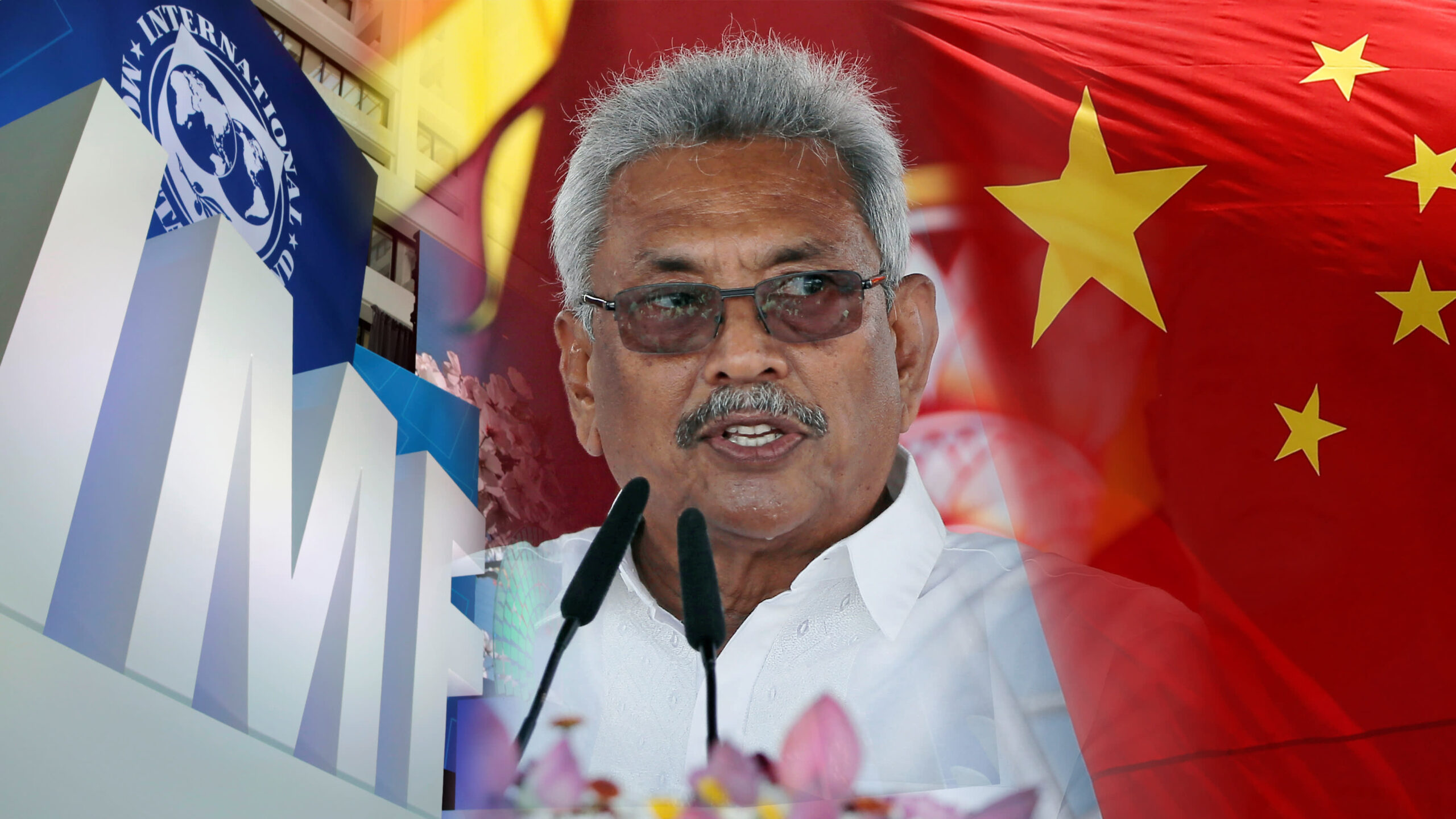
In a similar manner, the government needs to deal with the foreign exchange crisis. Instead of denying the fact that a serious problem exists and hoping that hoped for future flows of foreign exchange would ease the situation, the government needs to take concrete steps to rectify the situation immediately. In a rationally argued position paper, the Pathfinder Foundation has recommended that the government goes to the IMF to secure financial
assistance.

So far, the government has refused to go to the IMF on the grounds that it imposes its own conditions on the loans it grants which are costly to the people of the country. According to this analysis, an IMF programme could include strengthening the government’s revenue base (widening the tax base and improving tax administration); improving the primary balance in the budget (revenue-expenditure-interest payments)); proactive, data-driven and non-interventionist monetary policy and a flexible and realistic exchange rate policy to assist in building up external reserves.

The analysis also makes the point that other countries might be more willing to support Sri Lanka if they were confident that the country would come out of the economic doldrums. It says: “The package of assistance offered by India is an encouraging start and needs to be finalised as soon as possible. It has to be supplemented by financing from other friendly countries, like Japan. There is scope for India and Japan to work together to support Sri Lanka at this critical juncture. Their willingness to step forward is likely to be greater if it is known that Sri Lanka has taken a decision to approach the IMF.

While our development partners will be wary of having to make an open-ended commitment, they are likely to find bridging finance more palatable.” The appointment of Foreign Minister Prof G L Peiris as acting Finance Minister increases the possibility of rationality in the decision-making process. As Foreign Minister, he has been tasked with winning more international support for the government. This would include ensuring that foreign policy and human rights pressures on the government do not lead to an adverse outcome.

The international community, especially Western countries, are looking for signs that the government will pursue some reforms. Among the initiatives that Minister Peiris has been leading is the amendment of the Prevention of Terrorism Act. In recent weeks, as chairman of the ministerial subcommittee on amending the PTA, he has invited both sections of civil society and the Bar Association for discussions where the proposed amendments have been presented and responses to them obtained. Several PTA detainees, whose cases had received international visibility, have been released on bail.

There are other indications of rationality emerging in choices being made in different areas. One would be the reinstatement of Dr Shihabdeen Mohamed Shafi and pay his salary arrears after it was suspended in 2019. The surgeon was falsely accused of sterilising thousands of Sinhalese women without their knowledge in the operating theatre during a time of nationalist frenzy that had been whipped up for political reasons. This is not the time for nationalist politics.

The new appointments made to independent institutions that are expected to play a watchdog role are also likely to send a message that the government is getting serious about charting a new path. If the current changes are shown to be sustainable, the government will be able to generate greater confidence both locally and in the international community which is crucial for economic development.
Posted in Uncategorized

CBK lauds Colombo Uni. Students’ denial to receive degrees from Ven. Muruttettuwe Ananda

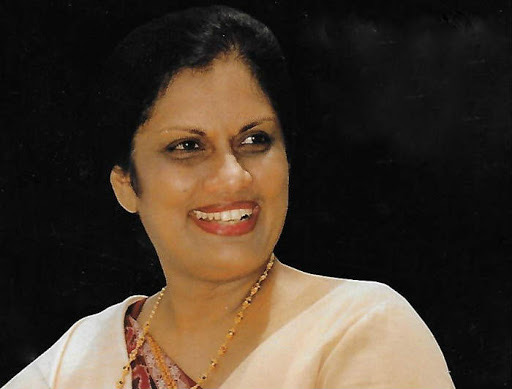
While appreciating the moves by the graduates of the Colombo University at the recent graduation ceremony where they refused to receive the degree award certificates from the Chancellor Ven. Muruttettuwe Ananda Thera, former President Chandrika Bandaranaike Kumaratunge said today that it was the day when the democracy was upheld in the country.

Posting a video on social media, she said that the graduates had demonstrated their protest in a decent and polite manner without resorting to protest or violent manner.

“How those graduates acted that day was very polite. They demonstrated their protest politely and silently. Various people have expressed different opinions on the incident. I see this as the day when democracy was upheld in the country. They acted democratically to uphold the democratic values of all the people without taking weapons or using foul language,” she said.

Ms. Kumaratunge said people in a democratic country have a right to express their opinion if the government or the rulers were taking wrong decisions concerning the people without a proper social discussion.

“I appreciate their move. What they did was exactly right irrespective of what others say,” she said.

Posted in Uncategorized

Tamil and Muslim parties urge India to implement the 13th Amendment

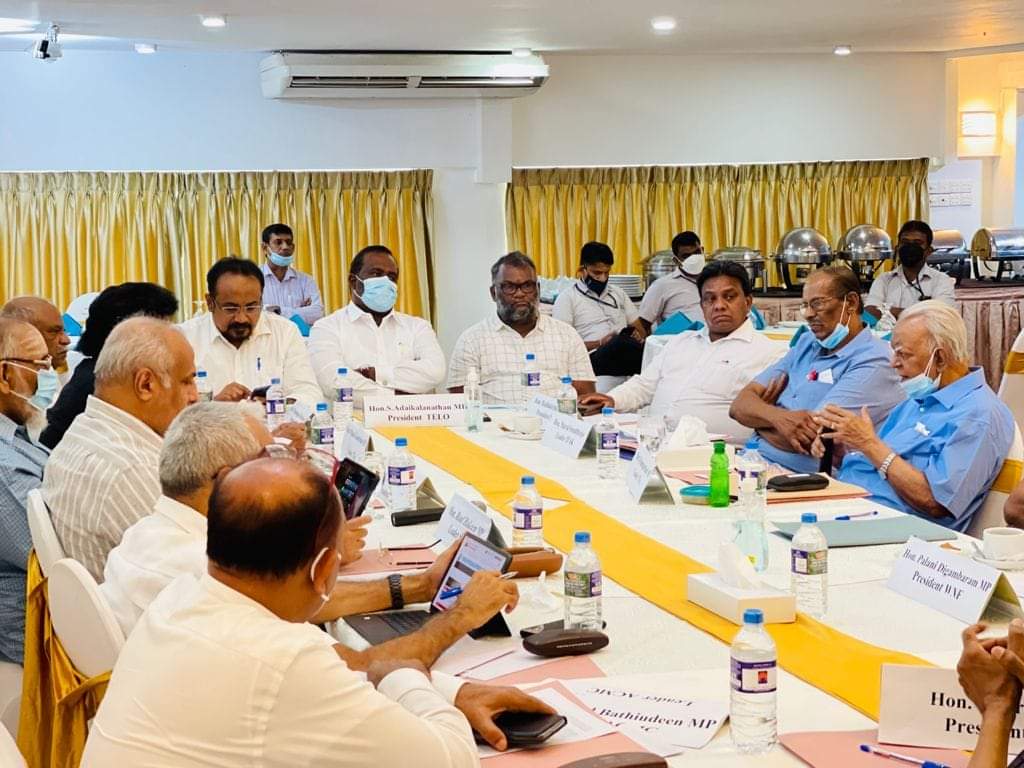
A meeting of leaders of the most important North, East, Upcountry and Muslim Tamil speaking people’s parties led by Sampanthan kicked off today at 11.00 am at the Global Tower Hotel in Colombo.

The meeting is a continuation of the November 2nd and December 12th meetings.

The signatories of the documents will be MP R. Sampanthan representing TNA, MP Mano Gansean representing TPA, mavai Senathirajah representing ITAK, C. V. Vigneswaran representing TMK, TELO President Selvam Adiakanathan, President DPLF Tharamalingam Sithartan, Up Country Peoples’ Front President Radhakirisnan, President National Workers Federation President MP P Digambaram, President EPRLF Suresh Premachandran, TNP President N. Srikantha. SLMC leader Rauff Hakeem and ACMC Leader Rishad Bathiudeen.

The meeting is being held in an attempt to finalize the draft request to the Government of India to urge the Government of Sri Lanka to fully implement the 13th Amendment to the Constitution and hold provincial council elections soon.

China reaches out to Lankan Tamil fishermen in a bid to upstage India -The Citizen

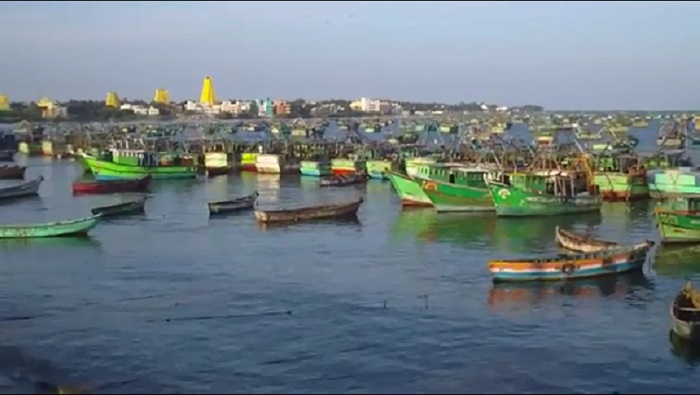
China is assiduously cultivating North Sri Lankan Tamil fishermen in an effort to fill a gap created by India’s inaction in regard to the suffering these fishermen undergo as a result of massive poaching and bottom trawling indulged in by Tamil Nadu fishermen in the Palk Strait, Palk Bay and the Gulf of Mannar.

In a strategic move aimed at getting the support of the Tamil-speaking fishermen of the Northern Province, China has set up a sea cucumber hatchery and a foodstuff factory and has also gifted fishermen with fishing gear worth Lankan Rupees (LKR) 6 million. The Chinese embassy tweeted that during his visit to the Northern Province recently, Ambassador Qi Zhenhong took local officials and reporters on a study tour of the “New Silk Road” Foodstuff factory at Mannar. The factory employs 100 plus local workers, 85% of whom are females from nearby villages. Every month the factory produces 300,000 cans of fish and provides income to thousands of fisher families in the area, the tweet said.

Ambassador Qi and Sri Lankan Fisheries Minister Douglas Devananda, accompanied by dozens of media personnel, visited the Guilan Sea Cucumber Hatchery & Farm in Jaffna. The company has created thousands of jobs for local fishermen, brought millions of US Dollars income and transferred technology to Sri Lanka, the Chinese embassy tweet added.

The Tamil daily Virakesari reported that while in Mannar, the Chinese Ambassador went into the sea with the help of the Sri Lankan navy to see the Rama Sethu or the series of shoals between Sri Lanka and India which, it is believed, were the little islands created by Hanuman to help Lord Rama’s army crossover from India to Sri Lanka in the epic Hindu Ramayana.

Clearly, China is making calculated inroads into the North Lankan Tamil fishing community, which faces many economic problems.

Economic Issues

North Lankan Tamil fishermen have suffered great economic losses and desperately need the help of Colombo, Chennai and New Delhi to alleviate their condition.

The Jaffna-based economist Dr. Muttukrishna Sarvananthan, writing in 2019 in the state-owned Daily News notes that the areas around the Gulf of Mannar, Palk Bay, and Palk Strait are home to large stocks of marine resources. The shallow seas are rich grounds for high value shrimp species, and sedentary, demersal fish.

After the end of the anti-terror war in 2009, Jaffna district should have experienced an increase in fish production, but it experienced a fall of 34%. This is because of poaching by Indian fishermen using bottom trawlers, Sarvananthan says. The fish catch in Mannar declined by 17 % between 2012 and 2013 and by another 12% between 2014 and 2015.

Bottom trawling has also been “mass killing” the under-grown fish (called ‘by-catch’) as trawlers shovel the bottom of the seabed indiscriminately. The trawlers also irreparably damage or destroy fishing nets used by fishermen in Sri Lanka, thereby causing the latter to avoid fishing on days that Indian trawlers are expected to poach in Sri Lankan waters, consequently incurring a livelihood opportunity cost.

In addition to the direct monetary losses incurred by the fishing communities in the Northern Province, there are indirect losses incurred by the entire supply chain of the fisheries sub-sector, the economist points out.

Quoting Oscar Amarasinghe, Sarvananthan says that over a three-year period (2006–2008), five estimates of loss ranged from US$ 16 million (lowest) to US$ 56 million (highest) per annum. The average of these five different estimates is US$ 41 million or LKR 5,293 million per annum.

Appeals Fail

Repeated appeals by the North Lankan fishermen to the Sri Lankan and Indian governments to stop the Indian fishermen from poaching and bottom trawling have failed.

The Indians keep promising to restrain their fishermen from crossing the International Maritime Boundary Line (IMBL) and from bottom trawling in Sri Lankan waters, but have been unable to deliver because fishermen are a powerful political constituency in Tamil Nadu. Previously, the Sri Lankan navy used to shoot, and sometimes even kill the intruders, but this is no longer done on appeal by India to treat the intruders humanely. This weekend 43 poachers were arrested. And as in the past, these would be released (only to go back and come again).

The governments of India and Sri Lanka have set up a Joint Working Group to meet periodically and discuss the fishing issue, but these meetings have not been productive. Efforts by the Tamil Nadu and Indian governments to divert these fishermen to deep ocean fishing have failed.

Political Factors

The North Lankan fishermen’s appeals to Lankan Tamil politicians and successive Lankan governments to take up the matter with India strongly, have fallen on deaf ears. While Colombo has not been sufficiently interested in the issue, as it affects only the minority Tamils, Lankan Tamil politicians do not want to antagonize or alienate their counterparts in Tamil Nadu because the latter support the larger Lankan Tamil demand for provincial autonomy.

Some recent incidents of Lankan Tamil fishermen attacking the Indian intruders did not get local political support as such attacks would spoil the Lankan Tamils’ fraternal ties with Tamil Nadu.

Suggested Solution

To prevent China’s entry into the Northern fisheries sector to the detriment of Indian interests, and to enable both Indian and Sri Lankan fishermen to jointly fish in the narrow sea, India could consider a proposal made by a former Principal Scientist at the Madras Research Centre of the Central Marine Fisheries Research Institute of India, Dr. Mohamad Kasim.

According to Dr.Sarvananthan, Dr. Kasim envisaged the construction and deployment of artificial reefs for the restoration of the coastal ecosystems; improvement of biodiversity; and increasing the biological resources. The artificial reefs should complement the natural coral reefs as they do in the coasts of Kerala, Tamil Nadu, Pulicat, and various other places in India.

The biodiversity of the bottom living bio-foulers could be greatly increased by increasing the sea bottom substratum. Sarvananthan quotes Dr. Shinya Otake, a Marine Biologist at Fukui Prefectural University in Japan, to say that some of the artificial reefs built in Japanese waters support a biomass of fish that is 20 times greater than similarly sized natural reefs.

He also quotes a study undertaken at the Occidental College in Los Angeles which confirmed the foregoing claim by revealing that the weight of fish supported by each square meter of seafloor by oil and gas rigs off the Californian coast was 27 times more than that supported by each square meter of seafloor by the natural rocky reefs.

Adoption of these steps would improve the livelihood of coastal fishing communities of both Tamil Nadu and North Sri Lanka, as there would be enough fish for the fishermen of both areas.

Posted in Uncategorized

Sri Lanka to sign treaty banning nuclear weapons

Sri Lanka has decided to sign the Treaty on the Prohibition of Nuclear Weapons, the first multilateral legally-binding instrument for nuclear disarmament.

Foreign Minister, Professor G.L Peiris proposed to the Cabinet that Sri Lanka sign the accord and initiate the applicable national legal formulation review with the objective of finalizing the ratification process as soon as possible.

The agreement on banning nuclear weapons globally was signed on the 07th July 2017 at the United Nations with the support of 122 countries.

The accord was effective since 26th January 2021. While 86 countries have ratified the accord 57 countries have disengaged. Sri Lanka had voted for the accord and supported the endeavour.

The treaty prohibits a full range of nuclear-weapon-related activities, such as undertaking to develop, test, produce, manufacture, acquire, possess or stockpile nuclear weapons or other nuclear explosive devices, as well as the use or threat of use of these weapons.

The Government says signing the accord is in accordance and stands with Sri Lanka’s nuclear disarmament policy.

Posted in Uncategorized

India expresses concern over detention of fishermen by Sri Lanka

India on Tuesday expressed concern over the detention of 68 of its fishermen from Tamil Nadu by Sri Lankan authorities and said the issue of their “early release” has been taken by its mission in Colombo.

India’s External Affairs Ministry Spokesperson Arindam Bagchi said the Indian High Commission in Colombo has taken up the issue of “early release” of these fishermen and their boats with the Sri Lankan government.

“We are concerned at the detention of Indian fishermen from Tamil Nadu by Sri Lankan authorities between December 18 to 20. As per our information, 68 fishermen and 10 boats have been taken into custody,” he said.

He said officials from the Indian Consulate General in Jaffna have met the detained fishermen and are providing all necessary support.

“This includes clothes, toiletries, snacks, dry essentials and masks, besides facilitating phone calls to relatives. They are also arranging legal representation,” he said.

Bagchi was responding to media queries regarding the detention of the Indian fishermen.

“In the case of one fisherman who was indisposed, the Indian Consular officer has visited him in the hospital to check on his welfare,” Bagchi said.

He said Indian External Affairs Minister S Jaishankar has received representations on this issue from various political parties.

“He was also called on the matter by the Chief Minister, Tamil Nadu. He has apprised them all of the current situation and underlined government of India’s efforts to secure early release,” Bagchi added. –Agencies

Source: PTI

Sri Lanka cabinet debates IMF bailout for second week

Sri Lanka ministers had “exchanged views” on an International Monetary Fund bailout for the second week in a row but no decision had been made, a minister said as the country continued to face an external amid money printing.

He said “different views” (vividher adahas) were expressed by ministers.

“Ministers expressed their individual views (thummer-tha-mun-gay muther) clearly at this cabinet and the last one,” co-cabinet spokeman Dallas Allahapperuma said.

“There was no collective decision. Especially when the Finance Minister (Basil Rajapaksa) is out of the country there is no possibility of reaching a decision in any case.”

Rajapaksa is currently visiting the US.

Dallas Allahapperuma said in 2008 when Sri Lanka’s civil war was peaking, oil prices were soaring and there was a global crisis, the administration headed by President Mahinda Rajapaksa had gone to the IMF.

“To discuss a program is one thing, to accept their conditions is another matter,” Allahapperuma said.

Sri Lanka has been resisting going to the IMF saying unacceptable conditions would be imposed on the country.

Trade Minister Bandula Gunewardene told reporters on Monday that the IMF would ask to cut the bloated public sector, reduce the budget deficit, make state enterprises profitable, and raise fuel and electricity prices.

It was before fuel prices were raised at midnight on the request of the central bank.

A few days earlier, Dayasiri Jayasekera, a minister representing ruling coalition partner Sri Lanka Freedom Party said after last week’s cabinet meeting that the IMF imposes conditions such as making state enterprises profitable.

“It is a good thing to do that,” Jayasekera said.

Finance Minister Basil Rajapaksa had already said the state workers and state enterprises were a big burden on the economy.

Older IMF baiout programs typically involve cutting the deficit with tax hikes (revenue based), trimming expenses (spending based) expressed as a net domestic finance target, a foreign reserve target and a reserve money target.

However Sri Lanka’s last failed extended fund facility from IMF program where money was printed within the program to create forex shortages and worsen foreign debt, an inflation target was given and the budget target was defined as a primary deficit.

Instead of a measurable reserve money or ceiling on central bank credit an inflation target was given, allowing the trigger happy central bank to print money and trigger a currency crisis within the program.

Under revenue based fiscal consolidation, state spending soared and the currency collapsed from 151 to 183 under a so-called flexible exchange rate where the exchange flipped from pegged to floating rapidly and interventions were sterilized on top of it.

Posted in Uncategorized

Why was Sirisena-Gota assassination plot not probed?: Catholic church

The Catholic church has questioned President Gotabaya Rajapaksa and the Government as to why they are not investigating the alleged plot to assassinate then President and incumbent Government Parliamentarian Maithripala Sirisena and current President Rajapaksa, which led to the arrest of then Terrorism Investigation Division (TID) Director Deputy Inspector General of Police (DIG) Nalaka de Silva, who is said to have been working to arrest the late National Thowheeth Jama’ath (NTJ) Leader Zahran Hashim in 2018.

Addressing a media briefing held yesterday (21), National Catholic Social Communication Centre Director Rev. Fr. Cyril Gamini Fernando claimed that when Zahran was about to be arrested, DIG de Silva was arrested and detained based on a statement made by one Namal Kumara that there was a conspiracy to assassinate Sirisena and Rajapaksa.

“(DIG) de Silva was arrested following a statement made by Kumara about an alleged conspiracy. He came and said that there was a conspiracy to assassinate Sirisena and Rajapaksa, the latter of whom was not even a presidential candidate at the time. After the arrest of (DIG) de Silva, all attempts to arrest Zahran were halted and then no one came forward to arrest him (Zahran),” he said.

However, Rev. Fr. Fernando said that although Kumara had spoken publicly about such an assassination plot with evidence, it was not and is not being investigated. He claimed that there was no and is no investigation into matters such as who was to be assassinated in the conspiracy in question and who was involved in it.

“Now the question we are asking is, where are the investigations into this conspiracy? If there was a conspiracy to assassinate him, didn’t Sirisena have a duty to expose to the country as to who sought to carry it out or to investigate it?” he questioned.

Rev. Fr. Fernando further claimed that Rajapaksa is also not investigating the matter even after assuming the presidency.

He said: “Rajapaksa is also not looking for who conspired to assassinate him. Either this is a suppression of the truth, or this conspiracy was a complete drama. If it is a drama, then there is nothing to be investigated. Why was such a drama staged when there were preparations to arrest Zahran? Was it to prevent Zahran from being arrested? Shouldn’t these things be properly investigated and told to the country? Why hide these matters – to protect whom?”

He also commented on the ongoing investigation into the Easter Sunday terror attacks of 21 April 2019, stating: “To this day, neither we nor the victims know the truth behind these attacks. What we understand is that the truth is not allowed to be revealed. Seemingly, it is being hidden.”

Meanwhile, Rev. Fr. Cecil Joy Perera, during the same media briefing, commented on the remarks made by several parties regarding forgiving the Easter Sunday attacks’ perpetrators.

“Prime Minister Mahinda Rajapaksa had referred to this at a function in Kegalle, but it is not only the Premier, there have been many other requests also. People have been asking this in the recent past, too. So it is not pointed to one person, but there have been requests. People have been asking ‘you are Catholics, you are Christians, so why don’t you forgive?’”

Claiming that they are prepared to forgive, Rev. Fr. Perera, however, said that even to forgive, they must know who the culprits behind the said terror attacks are. He noted: “We are prepared to forgive, but let us know who the culprits are, who exploded these bombs, and the reason why they did that. Let us know if there was any political plot and who did that. Then, of course, we can consider forgiveness. We are people of forgiveness and love; there is no doubt about it. However, we must know whom to forgive. Otherwise, how to forgive?”

On 21 April 2019, Easter Sunday, three churches (St. Sebastian’s Church in Katuwapitiya, St. Anthony’s Church in Kochchikade, and Zion Church in Batticaloa) and three luxury hotels in Colombo (Cinnamon Grand Colombo, The Kingsbury, and Shangri-La Colombo) were targeted in a series of co-ordinated suicide bombings. Later that day, another two bomb explosions took place at a house in Dematagoda and Tropical Inn Lodge in Dehiwala.

A total of 269 people excluding the bombers were killed in the bombings, including about 45 foreign nationals, while at least 500 were injured. All eight of the suicide bombers in the attacks were Sri Lankan citizens associated with NTJ founded by Hashim, who was one of the suicide bombers at Shangri-La.

Another cabinet reshuffle on the cards?

Rumors are rife that another cabinet reshuffle by President Gotabaya Rajapaksa is on the cards, this will most likely happen upon the return to the country of Finance Minister Basil Rajapaksa, the Daily Mirror learns.

Political sources said that some key ministers might face a shuffle, in a last-minute announcement by the President, similar to the cabinet reshuffle which took place in August.

Sources said that this was discussed before Minister Basil left the country and is likely to be carried out upon his return.

Several key ministers when questioned last night said they were unaware of the reshuffle but confirmed that they too had heard the rumors circulating within the government.

However, who will face changes or come under the axe is yet to be revealed. In the cabinet reshuffle in August, the cabinet of ministers were left in the dark till a last-minute announcement was made by President Rajapaksa.

GMOA on islandwide strike today against Health Ministry

Following a one-day strike in five districts yesterday (20), the Government Medical Officers’ Association (GMOA) has decided to launch an islandwide strike today (21), alleging that officials of the Ministry of Health had acted arbitrarily in granting appointments to post-internship medical officers.

Doctors attached to the GMOA had decided to strike in hospitals and other health institutions in the Mannar, Trincomalee, Ratnapura, Nuwara Eliya, and Polonnaruwa Districts yesterday.

The GMOA Central Committee, which met last evening, has decided to commence an islandwide strike from 8 a.m. today. However, the GMOA announced that doctors from all hospitals islandwide will continue to provide emergency care at the respective hospitals without any hindrance.

In addition, the GMOA stated that the strike action will not be effective in maternity hospitals, paediatric hospitals, cancer hospitals, and kidney treatment units, and that Covid-19 treatment services and Covid-19 vaccination will continue uninterrupted.

Commenting on the strike action at a media briefing held yesterday, GMOA Central Committee Member Dr. Prasad Colombage claimed that officials of the Health Ministry have acted arbitrarily in granting post-internship appointments.

“Health Ministry officials have forgotten the procedure for making post-internship appointments through transfer boards and acted in an arbitrary manner. This strike is launched in protest of the arbitrary appointment of doctors to remote areas and transfers,” he mentioned.

However, the Health Ministry has stated that the strike launched by the GMOA was an act of sabotage.

Speaking at a media briefing yesterday, Deputy Director General of Health Services (DDGHS) Dr. G. Wijesuriya claimed that there was no political or other personal influence in granting post-internship appointments. He added that neither Minister of Health Keheliya Rambukwella nor Ministry Secretary Dr. Sanjeewa Munasinghe has any ability to exert such influence.

“These appointments are being made taking into account the list of vacancies and the areas identified as having the highest need for services. The relevant list of vacancies has even been signed by the GMOA representative and the appointments were made accordingly. Therefore, there is no reason for a strike to be launched. This action can be termed as an act of sabotage,” he said.

Rambukwella and Dr. Munasinghe were not available for comment.