The currency swap deal from Bangladesh – FT.LK

Four days ago (28 May) I read a news item that appeared in the Daily FT of which the heading was ‘Bangladesh became a lender for first time thanks to SL’. This news item took me to my banking career of 1970/80s, which reminded me of the credit norms that we were practicing in the bank, as credit officers when a customer requested for a credit facility or a loan.

On receipt of the loan application, we evaluated the financial healthiness of the borrower to ensure whether the borrower possessed a sound repayment capacity. Then we weighed up the borrowing records through various sources available, to ensure whether he was a defaulted borrower and was he in a position to financially breathe well irrespective of unaffordable debt burden.

If response for those two were positive, then we sought for any security which in case to be used to recover the loan if the loan was not repaid as expected due to the reasons beyond the control of the borrower.

If the repayment capacity is not sound or if it proved that the borrower was not in a position to repay the loan, irrespective of the security he offered we refused to grant the loan. In case the repayment capacity was sound but his past borrowing records were not satisfactory or he was reported as a defaulted borrower, we directly refused to grant the loan unless he proved satisfactory arrangements that he had made with those creditors to repay those defaulted loans. Security was not considered as vital to grant the loan if those factors mentioned above were not satisfactory.

When the bank refused a loan based on the above norms, the borrower has a propensity to look for the assistance of ‘Private Money Lenders’ (PML) at an exorbitant interest rate. When the borrower is unable to repay the loan with a normal rate of interest, how he pays at an exorbitant rate was not a matter to PML since such lenders used unethical ways to recover the loan.

As reported in the above news item, Bangladesh grants this loan of $ 200 million to our country from its foreign reserves and this is the first time that Bangladesh is going to make such an investment in a country through a currency swap deal. I do hope the lender Bangladesh should have definitely evaluated the repayment capacity of the borrower that is Sri Lanka and its past and present borrowing records. In order to assess the repayment capacity, the lender would have used the global ratings.

S&P a world’s rating agency has cut Sri Lanka’s long-term foreign currency credit rating to ‘CCC+ from B-’ for 2020, which exposed the risk of default. Another global rating agency Moody also downgraded Sri Lanka’s credit ratings to ‘Caa1 from B2’ in September last year. No doubt this fragile situation of Sri Lanka would have now significantly weakened, as consequence to the present rapid outbreak of COVID-19.

Further it is reported that Bangladesh is going to grant this loan deviating its Internal Treasury Investment Guidelines since the borrower does not comply with the standard rating requirements.

As I stated above, if the borrower does not possess a sound repayment capacity and the borrower’s past and present borrowing records are very bad, no lender will choose such a borrower to grant a loan involving an intolerable high risk. Knowing well that Sri Lanka is a debt-ridden country and presently the repayment capacity is not sound, with no way of repaying the said loan without new borrowings, one would wonder what made the Bangladesh Central Bank (BCB) opt for this loan even deviating from its own Internal Treasury Investment Guideline as the borrowing country does not comply with the standard rating requirement.

Has Sri Lanka offered any valuable security to moderate the high risk? As reported, the agreed security was ‘to exchange our currency with Bangladesh Bank equivalent to the amount of dollars they will be given and the Guarantee of SL Government’. It seems the borrower’s guarantee has been taken as security to secure a high-risk loan granted to the same borrower violating their own (BCB) guidelines.

However, it appears one plus point for the lender (BCB). That was the high rate of interest applied.

The BCB will grant this facility at 2% interest, which is higher than other current global rates. However, charging a comparatively higher rate of interest will pose another issue. A borrower who shows a poor repayment capacity to pay a loan with a lower rate of interest (market rate), how can he pay such a loan when the interest was increased?

As reported this facility will be for one year during which the fund will be provided. After getting the fund, Sri Lanka will have to repay it by three months. Does the BCB anticipate that Sri Lanka would be in a position to re-pay this within three months from the date of grant?

The history of Sri Lanka is intertwined with the history of the broader Indian subcontinent. The historical period begins roughly in the 3rd century, based on Pali chronicles like the Mahawansa, Deepawansa, and the Choolavansa. The first Sri Lankan ruler of the Anuradhapura Kingdom was Pandukabhaya is recorded for the 4th century BCE.

From the 16th century, some coastal areas of the country were also controlled by the Portuguese, Dutch and British.

The ancient Romans called Sri Lanka ‘Taprobane,’ while Arab sailors knew it as ‘Serendib.’ Then we have been named as ‘Ceylon’ and then Sri Lanka.

Independence was finally gifted in 1948 but the country remained a dominion of the British Empire until 1972. In 1972 Sri Lanka assumed the status of a Republic. A Constitution was introduced in 1978 which made the Executive President, the head of state.

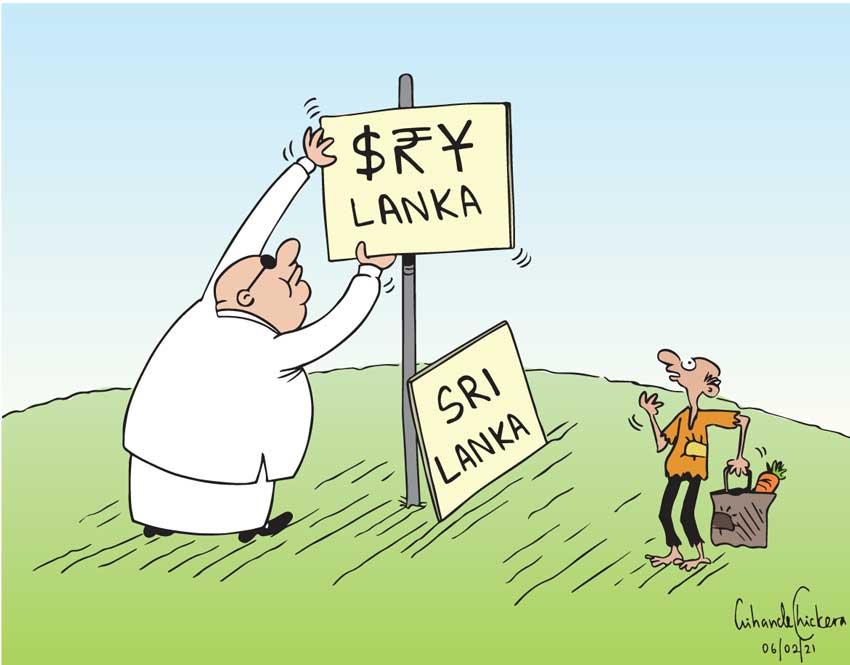
Such a country with such proud history is today looking for financial assistance from the country, Bangladesh.

The borders of modern Bangladesh were established with the separation of Bengal and India in August 1947. Proclamation of Bangladeshi independence in March 1971 led to the nine-month-long Bangladesh Liberation War that culminated with East Pakistan emerging as the People’s Republic of Bangladesh. After independence, Bangladesh also endured famine, natural disasters and widespread poverty, as well as political turmoil and military coups. The restoration of democracy in 1991 has been followed by relative calm and rapid economic progress.

Within such a short period Bangladesh courageously came to the present position to grant a credit facility of $ 200 million to a country which had the proudest history and abundant natural resources. Who brought Bangladesh to this emerging situation? No one else other than the inspirational leaders who loved the country while ruling the country during a very short period of five decades. We had a period that foreign leaders who visited our country have been inspired and wanted to be like us. But where are we today?

Most of the people in our country view this borrowing, as a nature sarcasm caused due to robbing the State funds by those who ruled the country since independence.

The expectation was not to underestimate the emerging Bangladesh but to highlight the weaknesses of our past and present leaders who were not matured and didn’t have required revolutionary strength and visionary forward look to lead our beautiful country despite all the resources gifted by nature. It is not only one leader or one party that ruled this country who is responsible. But all those who ruled or rather ruined the country since independence is responsible for this heartbreaking situation. With greatest reluctance we have to accept without any iota of doubt, all those who ruled this country are individually and collectively responsible. We pray for a better Sri Lanka although no visionary leaders are at least to be imagined.

(The writer is a former banker. He is an Associate of the Institute of Bankers and a

Fellow of the Institute of Credit Management Sri Lanka and currently serves as a visiting (online) lecturer of the Institute of Credit Management, Sri Lanka. He could be reached via wimaleb@gmail.com.)

Posted in Uncategorized

Daily coronavirus case count climbs to 2,845

The Epidemiology Unit of the Health Ministry reports that another 856 persons have tested positive for COVID-19 in Sri Lanka, moving the daily total of new cases to 2,845.

This brings the total number of confirmed cases of coronavirus reported in the country to 189,241.

As many as 153,371 recoveries and 1,484 deaths have been confirmed in Sri Lanka since the outbreak of the pandemic.

The Epidemiology Unit’s data showed that 34,386 active cases are currently under medical care.

Sri Lanka confirmed 43 deaths due to COVID-19 on Monday, May 31, 2021.

The Director General of Health Services Monday confirmed 43 deaths that included four deaths that occurred on Monday and 39 deaths occurred from 20th May to 30th May due to Covid-19 virus infection.

The total number of deaths due to Covid-19 infection in Sri Lanka is 1,484 by now.

Posted in Uncategorized

Hyatt, Hilton and Gaffoor Building to be offered to investors

The Grand Hyatt in Colombo, Hilton Hotel and the Gaffoor Building are to be offered to private investors.

Multiple properties in Colombo are to be opened up for investments under a Private Public Partnership (PPP) model through a new company formed with Cabinet approval.

Selendiva Investments Limited has been formed with Cabinet approval under which three clusters have been created.

The properties to be open for investments will be included in the three clusters, namely the Colombo Fort Heritage Square, Immovable Property Development, and Government Owned Hospitality Sector.

Selendiva Investments Limited, Chief Executive Officer (CEO) Shamahil Mohideen said that the intention of the new company is to make underperforming and underutilized assets more profitable.

He said the properties identified for investments include the Grand Hyatt in Colombo, Hilton Hotel, the Gaffoor Building, the building occupied by the Ministry of Foreign Affairs and Water’s Edge,

The Ministry of Urban Development and Housing said that nine properties in and around Colombo City have been identified to be open for investments.

Additional Secretary to the Ministry, Dr. Sugath Yalegama said that more properties will be added to the list later.

He said the intention is to make the public owned properties more profitable through private investments while the Government continues to control majority shares.

Under the new model, private investors will get 49 percent of the shares while the Government holds 51 percent.

Mohideen said that the 49 percent will be open to a single investor or multiple investors.

Twin fears for India over the Colombo Port City – N SATHIYA MOORTHY

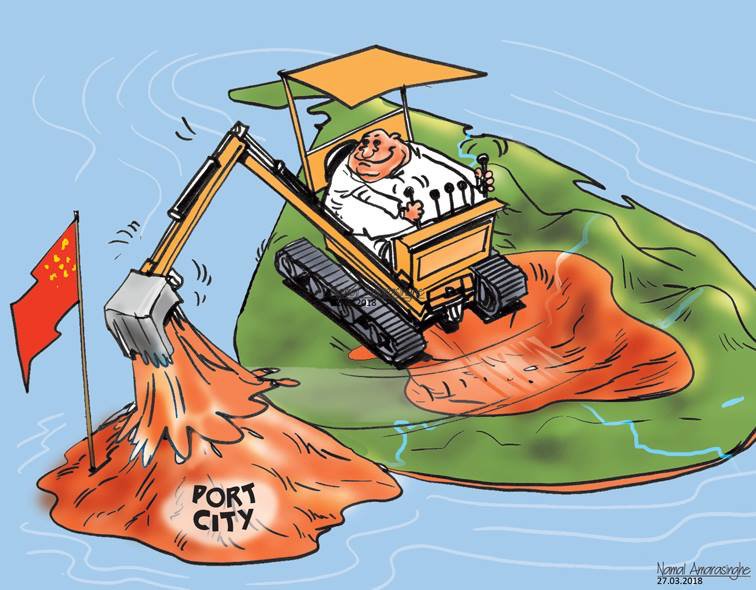
In light of the Sri Lankan Parliament passing a new legislation for China’s near-complete control in an ongoing Special Economic Zone (SEZ) project, neighbouring India has additional causes for concern on the security and economic fronts on this score too, apart from the existing ones from the southern Hambantota Port. While Indian concerns on the security front are obvious, the economic ills befalling the northern neighbour may be hidden until it becomes too late, unless New Delhi applied correctives in non-fashionable areas like job creation and ski training.

The Parliament passed the Port City Bill 148-59 in the 225-member House, after the ruling Rajapaksa dispensation presented an amended bill, to address the concerns numbered in the mandatory pre-passage ‘determination’ by the Supreme Court. The Sri Lankan process can be recommended for nations like India, where passage of bills without obtaining judicial opinion often leads to prolonged litigation later on, thus, defeating the very purpose of such legislation.

In the current instance, the Colombo Port City (CPC) Economic Commission Bill empowers the nation’s President to create a single-window management committee for the SEZ, which is on 269 hectares of reclaimed land along with massive tax and duty concessions for both domestic and foreign investors. After the government went ahead with the amendments without complying to the process of two-thirds vote in the Parliament or a national referendum, some concerns remain over the presidential powers to induct ‘foreigners’ into the management commission.

With the CPC originally planned under the earlier Rajapaksa government of President Mahinda (2005-2015), the current Prime Minister, critics of the incumbent administration of President Gotabaya, the former’s brother, say that the idea was to co-opt China (alone) on the board. From an Indian perspective, the form, content, and spirit of the law goes against the Rajapaksa arguments made for the unilateral cancellation of the predecessor regime’s tri-nation memorandum of cooperation (MoC) with India and Japan for joint development of the Eastern Container Terminal (ECT) in the Colombo Port and also decided against signing the US $480 million investment plans under the ‘Millennium Cooperation Corporation’ (MCC) of the US.

For the Rajapaksas, both the ECT and MCC were legacy issues, inherited from the previous right-liberal government of Prime Minister Ranil Wickremesinghe, who green-flagged the projects without concluding the final agreements. The Rajapaksas had the option of taking either or both of them forward or go back on a sovereign commitment—only because they were ‘non-Chinese’. The on-and off Sri Lankan invitation for Indian pharma companies to set up SEZ units in Sri Lanka over the past one decade has also not come to fruition.

The Rajapaksas had the option of taking either or both of them forward or go back on a sovereign commitment—only because they were ‘non-Chinese’. The on-and off Sri Lankan invitation for Indian pharma companies to set up SEZ units in Sri Lanka over the past one decade has also not come to fruition

Hound-and-hare analogy

Flowing from the ECT-MCC cancellation, Colombo should have celebrated the CPC as a ‘national asset’ too and stood firmly against ‘foreigners’ on the Port City administration—but that has not been the case. Opposition MPs voted against the bill but still reiterated that it “will catalyse the next phase of growth … we want to make sure that it is done right”.

The Opposition’s doublespeak had become clear even on the Hambantota issue, when then Prime Minister Ranil Wickremesinghe of the United National Party (UNP), blamed the predecessor Rajapaksa regime for pushing the nation into a ‘Chinese debt-trap’, to justify the debt-equity swap-deal and the handing over of the Sri Lankan territory to China—at the same time borrowing on a large scale, from Beijing to construct highways. The present-day Opposition ‘Samagi Jana Balawegaya’ (SJB) is a breakaway chip of the old block, with not many policy changes despite the ideological orientation of the new leader, Sajith Premadasa. With the result, barring the divided Tamil polity with its own reason, and the inconsequential left-nationalist Janatha Vimukthi Peramuna(JVP), the mainline Opposition has been hunting with the hounds and running with the hare whereever China is involved.

Critics of the Port City idea/law also point out how Sri Lanka was fooled by China’s commitments on annual business and revenues at Hambantota, and the final figures did not measure up. Given similar experiences of other Third World Chinese investment destinations like Mauritius, they are not sure if the Port City will end up as another ‘debt-trap’ of the Hambantota kind, one way or the other.

Given similar experiences of other Third World Chinese investment destinations like Mauritius, they are not sure if the Port City will end up as another ‘debt-trap’ of the Hambantota kind, one way or the other.

Jobs and investments

Leading the parliamentary debate on the amended CPC bill, Prime Minister Mahinda reiterated the promise of US $ 15-billion investments in five years. Separately, the government representatives told a parliamentary panel that a local investor has brought in US $100-million, though there is no information if he has an overseas finance-partner, and if so, who it might be.

Also, if the government cited stiff opposition from powerful trade unions as the cause for cancelling the ECT deal with India, they are said to have pulled back only after the Port City proposal promised new jobs in a big way. In his parliamentary intervention, PM Mahinda also reiterated big time job creation—200,000 during CPC construction and 85,000 permanent ones—skilled, semi-skilled, and unskilled, later on. The figure is impressive, as Sri Lankans working elsewhere are expected to return home, if they have not already done so post-pandemic, with their remittances heading the list of forex-earners.

The job figures are the same as in Budget-2021, presented in November last year. It shows how possibly the government has tied its economic hopes and youth aspirations to the CPC, more than any other. But there is a catch. Speaking on the bill in Parliament, Youth Affairs Minister, Namal Rajapaksa, told the youth that they had to acquire the ‘required skills’ to obtain those Port City jobs. If this was an indication that high-paying, top-rung jobs could still go to the Chinese (or, other foreigners?) on this one criterion, he did not mention it.

Through the past decade and more, China accounts for most of the investments in the country, including those by domestic entrepreneurs. As is their wont, the Chinese brought in all equipment and men from their homeland, thus depriving local enterprises and job seekers any share in their own nation-building and also in the incomes generated. This is saying a lot in terms of Sri Lanka’s continued economic ills, worsened by COVID-19, and at least a part of which the Port City accord seems wanting set right.

As if to address Minister Namal’s concerns even earlier, the opening paragraphs of Budget-2021, presented by PM Mahinda as Finance Minister, focused extensively on skills training for the youth, but without mentioning the Port City as the sole job provider. FDI providers to the region, barring China, would thus be watching the Sri Lankan skills programme keenly as the Indian promise of the past decade of two different regimes has not lived up to the commitments even in a small way. This will come on the top of the effective single-window clearances in Sri Lanka even without the Port City, where again the Indian performance is dismal.

Should the CPC really take off, especially with promised jobs, family incomes, and government revenues, the Rajapaksas’ politico-electoral positions could become unassailable within the country, as much for the next polls as in the recent past. This is different from the ‘friendly competition’ offered by Bangladesh to India, with the former now the fastest-growing economy in these parts.

Should the CPC really take off, especially with promised jobs, family incomes, and government revenues, the Rajapaksas’ politico-electoral positions could become unassailable within the country, as much for the next polls as in the recent past

‘India First’, still?

Coinciding with the Port City Bill’s passage and without naming China, President Gotabaya reiterated that “no one will be allowed to jeopardise the security of India”. Addressing the 26th international conference on ‘The Future of Asia’, organised by the Nikkei Forum from Tokyo, he said, “We understand their (India’s) security concerns and sensitivities … We will work closely with India and all regional partners to ensure that the Indian Ocean remains secure for the benefit of all countries.”

Gotabaya also reiterated that Sri Lanka will continue to forge economic ties with China and defended the Hambantota project, whose swap-deal he had unilaterally proposed to cancel at one time, but explained it away as a ‘commercial deal’ after coming to power. It remains unexplained as to why but the SJB/UNP Opposition, the only other political grouping with hopes of returning to power sometime in the future, too shares this view, overall. However, their commitments on the ‘security front’ sounds less hollow than that of the Rajapaksas, at least on paper—as no real issue had cropped up for New Delhi to test either, when it was in power.

President Gotabaya’s reiteration of security commitments to India has to be seen in the context of the tri-lateral meeting of the National Security Advisors (NSA), including Maldives, in December last year, when they broad-based and upgraded the moribund ‘Maritime Security Agreement’ to ‘Maritime and Security Agreement’, with Colombo as the seat of its secretariat. In turn, it was also a take-off from Gotabaya’s Foreign Secretary, retired navy admiral, Jayanth Colombage’s stand who propounded an ‘India First’, foreign and security policy, in August 2019. Yet, there is no denying the continued Indian apprehensions over the constant ‘shifting of goal-posts’ by Sri Lanka, be it on the economic or the security front.

The views expressed above belong to the author(s).

Posted in Uncategorized

Sri Lanka Police Headquarters to move to Attidiya, Dehiwala

Sri Lanka’s Cabinet of Ministers has granted approval for the construction of the new Sri Lanka Police Headquarters in Attidiya Road, Dehiwala.

According to a document released by the Department of Government Information, the new Sri Lanka Police headquarters will be moved to a 14-acre land located at No. 142., Bellantota Junction in Attidiya Road.

The Sri Lanka Police Headquarters is currently operating in three buildings which are more than 100 years old, connecting York Street and Chaithiya Road and has also rented buildings due to the lack of space at the premises.

It added that on the 11th of July 2021 approval was granted by the cabinet to construct the Sri Lanka Police Headquarters Complex in Mirihana, however, the necessary steps were not taken in accordance with the cabinet decision.

Posted in Uncategorized

Sri Lanka petrol, diesel deals won by PetroChina International

Singapore based PetroChina International has won contracts to supply diesel and petrol to state-run Sri Lanka Petroleum Corporation (CPC) for eight months from June 01, 2021, the State information office said.

The Cabinet of ministers had cleared a recommendation by a special standing procurement committee to award the contracts to PetroChina International from June 01, 2021, to January 31, 2022.

PetroChina International will supply 1.12 million barrels of Diesel (maximum percentage of Sulphur 0.05) which will be unloaded at the Muthurajawel Single Point buoy Mooring system (SPM).

PetroChina International will also supply 1.12 million barrels of Diesel (maximum percentage of Sulphur 0.05) to be unloaded across Colombo Dolphin Tanker Birth (DTB) and the Muthurajawela SPM.

PetroChina International will supply 1.341 million barrels of Petrol (92 Unl) and 459,000 barrels of Petrol (95 Unl).

Members appointed to Port City Economic Commission

President’s Counsel (PC) Gamini Marapana has been appointed as the Chairman of the Port City Commission.

Treasury Secretary S R Attygalle, Dr. Priyath Bandu Wickrama, Saliya Wickramasuriya, Kushan Kodithuwakku, Jerad Ondachchi and Rohan De Silva have been appointed as the members of the Commission.

Speaker Mahinda Yapa Abeywardane last week signed and validated the Colombo Port City Economic Commission Bill.

Thereby the Colombo Port City Economic Commission Act will be implemented in full.

The Colombo Port City Economic Commission Bill was passed with amendments in Parliament on 20th May 2021.

The Bill was passed with 149 parliamentarians voting in favour and 58 against it during the third reading.

Posted in Uncategorized

40th Anniversary of BURNING JAFFNA LIBRARY, AN INTENT OF GENOCIDE

At midnight on May 31, 1981, the Jaffna Public Library, the crucible of Tamil literature and heritage, was set ablaze by Sri Lankan security forces and state-sponsored mobs. The burning has since been marked by Eelam Tamils as an act of genocide.

Where they have burned books, they will end in burning human beings.” – Heinrich Heine – a German poet, writer and literary critic.

Today is the 40th anniversary of the burning down of Jaffna library on 31st May 1981 by the Sinhala mob brought down from the South of Sri Lanka by senior ministers of the Sri Lankan state.

Over 95,000 unique and irreplaceable Tamil palm leaves (ola), manuscripts, parchments, books, magazines and newspapers, housed within an impressive building inspired by ancient Dravidian architecture, were destroyed during the burning. Some texts that were kept in the library, such as the Yalpanam Vaipavamalai (a history of Jaffna), were literally irreplaceable, being the only copies in existence. It was one of the largest libraries in Asia.

The destruction took place under the rule of the UNP at a time when District Development Council elections were underway, and two notorious Sinhala chauvinist cabinet ministers – Cyril Mathew and Gamini Dissanayake – were in Jaffna. Earlier on in the day, three Sinhalese police officers were killed during a rally by the TULF (Tamil United Liberation Front).

The burning continued unchecked for two nights.

Homes and shops across Jaffna town were also set alight by the mob, including the TULF headquarters and the offices of the Eelanadu newspaper.

Virginia Leary wrote in Ethnic Conflict and Violence in Sri Lanka – Report of a Mission to Sri Lanka on behalf of the International Commission of Jurists, July/August 1981, that “the destruction of the Jaffna Public Library was the incident, which appeared to cause the most distress to the people of Jaffna.”

This is a key event in the history of the Sri Lankan state’s genocide against Tamils, as the library was attacked in an aggressive act of biblioclasm, the deliberate destruction of books. By intentionally burning one of the oldest and respected collection of ancient Tamil manuscripts in the whole of south Asia, Sri lankan state deprived Tamils of their immeasurable treasure of cultural heritage.

This was intentional as there was no provocation in the area in which the library stood. The Jaffna district Police Headquarters was in the vicinity of the library when this occurred which shows intent as they were led by former ministers Gamini Thissanayake and Cyril Matthew. These are evidence that the burning of Jaffna Library was an intentional act of cultural genocide as the Sri Lankan government purposefully wanted to erase parts of Tamil history.

70 years of acts of genocide against Tamils calls for the need of justice through an international judicial mechanism and a process to protect the Tamils in the North-East of Sri Lanka.

Nurses go on Strike

The All Ceylon Nurses’ Union launched a trade union action by reporting sick leave this morning (May 31).

This is due to the failure to provide proper solutions to the issues faced by nurses engaged in COVID-19 treatment, the General Secretary of the Union H. M. S. B. Mediwatta said.

Accordingly, a trade union action launched today will conclude tomorrow morning (June 01), he added.

adstudio.cloud

If govt. had cared to order vaccines in Jan. country would have been safe now

The JVP yesterday said that the Covid vaccination drive was doomed to fail owing to the government’s inefficiency and political interference.

JVP Propaganda Secretary MP Vijitha Herath, addressing the media, at the party headquarters, said that the government had not made timely decisions to launch the vaccine rollout. “There is a vaccination crisis. The government could not place orders in time for the vaccines. Even countries much poorer than Sri Lanka have done better. Morocco obtained its stock by Jan 21. Myanmar had purchased 3.7 million vaccines, Bangladesh purchased seven million vaccines. They were among the first countries to place orders with vaccine producing companies. Some ministers said that the government would vaccinate half of the population by the end of May.

MP Herath said that if the government had made right decisions at the right time and implemented them, the present crisis could have been averted. The Indian Foreign Minister visited the country on Jan 5 to 7 and stated that his country was willing to accommodate Sri Lanka on priority list to give vaccines. However, at that time the Medical Research Institute had not given approval for the vaccines from any country. “So we missed the bus.”

It was on Jan 22 the approval was granted for AstraZeneca vaccine. But the government placed the orders much later. If the government had done so in January, there would not have been any crisis situation now. Even the vaccines that had been procured were not given to people properly. They were given to people who carried chits from politicians. Political leaders of various levels were messing up with the inoculation process.

“During the first round of inoculation 600,000 doses were given to people but the government did not stock enough doses for booster shots. People in Colombo who had their first dose gathered at the Abhyaramaya temple even overlooking health regulations. Finally, the monks there too admit that the government’s vaccination drive was a failure.

“It is heartening to see that in some places health officials openly disregarded the chits and requests of favours by politicians. We should appreciate their courage and be proud of the fact that we still have brave health workers with backbone to stand against the unjust.”