

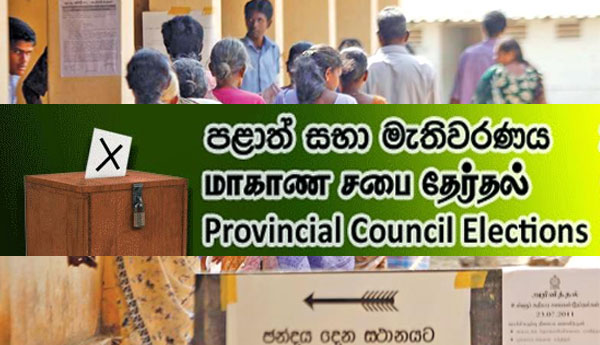
As 2026 draws to a close, one promise that the National People’s Power (NPP) Government made with considerable confidence has slipped past its deadline. In August last year, Minister Bimal Rathnayake told the country that the Government aimed to hold Provincial Council (PC) elections within the first six months of 2026. That window closed in June without nominations being called, and the year will now end the same way. More than a decade has passed since most provinces last elected their councillors, and yet there is still no date, no gazette and, it would seem, little sense of urgency.
To be fair, the Government has not been short of reasons, and some of them are genuine. Cyclone Ditwah, which tore through the country a year ago, forced the Government to find around Rs 500 billion for relief and reconstruction. It is understandable that money set aside for an election was diverted to families who had lost their homes and livelihoods, and no responsible voice would argue that ballot boxes should have come before shelters. Similarly, the legal tangle over the electoral system is not of this Government’s making. The amendments of 2017 left the PC election law in a state of paralysis, and successive administrations were content to let it remain so.
However, the explanations offered this year have a familiar ring. In May, JVP General Secretary Tilvin Silva announced that the polls could not be held in 2026, adding that they might take place next year “if no further issues come our way”. It is worth pausing on that. A party official, rather than the Election Commission or a Minister speaking in Parliament, effectively informed the public that an institution created by the Constitution would remain without elected members for yet another year. Then, in August, the Cabinet Spokesman said that the Government intended to hold the elections as soon as possible, provided Parliament passed the necessary laws and delimitation was completed within 2026. With barely six weeks of the year left, neither condition appears close to being met.
Meanwhile, the Election Commission has made its own position plain. It is ready to conduct the polls once Parliament enacts the required legal provisions. The ball, therefore, is not in the Commission’s court, nor in the courts of law. It sits squarely with a Government that commands a two-thirds majority in the House and has shown, on other matters, that it can move legislation briskly when it wishes to.
Last week’s Budget only deepened the doubts. In a speech that ranged across energy, infrastructure and trade, there was not a single mention of the Tamil national question, an omission that at least one legislator was quick to protest. Silence on devolution in the year’s principal policy statement cannot be brushed aside as an oversight. For many in the North and East, the Provincial Councils, flawed as they are, remain the only tangible form of power sharing that the Constitution offers. Leaving them dormant sends a message that the Government may not intend, but which will be heard all the same.
There is also a wider democratic cost. In the absence of elected councils, the provinces are run by Governors appointed by the President, answerable to the centre rather than to the people they serve. The Centre for Policy Alternatives has warned that this risks concentrating authority in a manner that blurs the line between party and State. The Campaign for Free and Fair Elections has gone further, urging the Government either to hold the polls or to abolish the system altogether. That challenge deserves an honest answer. If the NPP believes the Provincial Councils have outlived their usefulness, it should say so openly and make its case to the public. What it cannot credibly do is leave the system in limbo while professing commitment to it.
The NPP came to power promising to break with a political culture that treated elections as an inconvenience, to be postponed whenever the timing was unfavourable. Previous Governments delayed these very polls for years, and the public grew weary of it. That history is precisely why the present delay matters. A Government that asks the people to trust its word on the economy, on corruption and on reconciliation must also keep its word on something as basic as letting citizens elect their representatives.
What is required now is a timetable. The Government should table the necessary amendments early in the new year, publish a firm schedule for delimitation and ring-fence funds for the polls in the 2027 Budget so that they cannot be quietly redirected. Without these steps, “as soon as possible” will remain what it has already become: a phrase that commits no one to anything.