

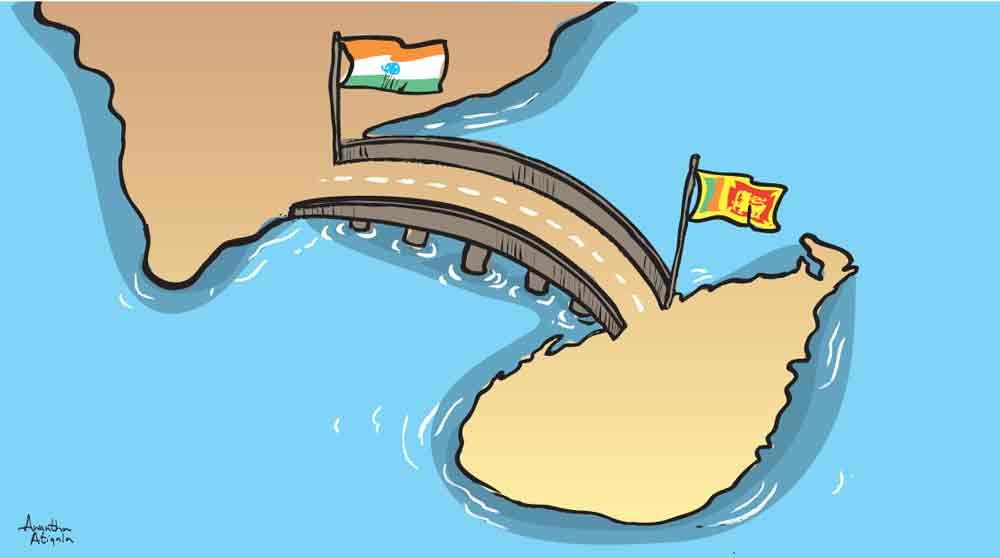
Indian High Commissioner Santosh Jha renewed the call for the need to build a land link between Sri Lanka and India and said the time for wavering is over.
He said the distance between Colombo and Chennai by sea is roughly 300 kilometres, but the distance between Rameswaram and Talaimannar, the closest points of our two countries, is about 30 kilometres.
“Yet, there is no direct road. No railway. No ferry service that runs at scale. No energy grid connection. No pipeline. It is, frankly, an anomaly. It is as if two neighbouring rooms are connected only through a corridor outside, even when there is a door that can be built between the two rooms, right in the shared wall of the two rooms,” he said.
He said, “Land connectivity via a bridge or tunnel across the Palk Strait has been discussed for decades. There are enough examples of such corridors across the world. The engineering is well understood. The economics are compelling. The benefits, wherever such bridges have been built, are unmistakable. But we continue to waver. But let me say clearly: the time for wavering is over. A fixed link between India and Sri Lanka would transform the economic geography of this entire region. It would make Sri Lanka a hub, it aspires to become, in a way that no port expansion or airport upgrade can achieve on its own.”
He made these remarks at the Global Innovation and Leadership Summit here in Colombo.
India today is Sri Lanka’s largest trading partner.
“India is the top source of tourists visiting Sri Lanka, a fact that endures despite challenges of a natural calamity like Ditwah or a conflict in West Asia. India is also among the largest sources of foreign direct investment into this country, last year Indian investments in Sri Lanka, including those directed from third countries, and exceeded 50% of the total. Indian companies have invested in telecommunications, energy, digitisation, financial services, and transport and infrastructure,” he said.