Arrest Ratwatte under Firearms/Prisons Ordinances: Committee for Protecting the Rights of Prisoners

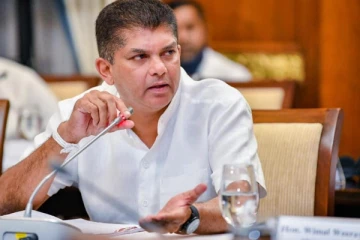
The Committee for Protecting the Rights of Prisoners (CPRP) will lodge a complaint with the Criminal Investigations Department (CID) today (16), calling for the immediate arrest of the recently resigned Prison Management and Prisoners Rehabilitation State Minister Lohan Ratwatte, citing provisions under the Firearms Ordinance and Prisons Ordinance.

The provisions which will be cited are with regard to taking a firearm into the premises of prisons and engaging in criminal intimidation using it, The Morning learnt.

Ratwatte resigned from the post yesterday (15) following The Morning’s revelations of the latter’s recent engagement in both illegal acts and acts of misconduct within the Welikada and Anuradhapura Prisons.

The CPRP also called on President Gotabaya Rajapaksa to appoint an independent, non-partisan entity, without representation from the Prisons Department and the Police Department in its membership, to probe the matter, and for the Government to give a guarantee regarding the protection, safety and security of all prisoners.

Sources who spoke to The Morning, on 6 September, alleged that Ratwatte and a group of friends that reportedly included a beauty pageant winner (who had driven the vehicle in which the group had arrived at the prison), who were all inebriated and inappropriately dressed, forcibly entered the Welikada Prison premises after 6 p.m. and proceeded to view the gallows.

As per Section 39 of the Prisons Ordinance, a Parliamentarian who wishes to pay a visit to a prison can only do so between the hours of 5.30 a.m. and 5.30 p.m. However when Prison officials had, according to the sources, requested that the female accompanying the group not go past the cells where male prisoners are housed – which is en route to the gallows, where the group was headed – owing to her being female, Ratwatte and his inebriated friends had verbally abused the Prison officers, stating that they should not stop her entry and subsequent passage.

While the CPRP alleged that the female in question was Mrs. Sri Lanka 2021 Pushpika De Silva, speaking to The Morning, De Silva has vehemently denied her involvement in this incident.

On 12 September, a similarly inebriated and pistol brandishing Ratwatte had, according to sources, flown in a helicopter to the Anuradhapura Prison where he had summoned a group of Tamil prisoners detained under the Prevention of Terrorism (Temporary Provisions) Act, No. 48 of 1979 as amended (reports state between eight to 16 such prisoners), and ordered them to kneel, and had proceeded to threaten two of them including Sulakshana (Prisoner Number 141 whose case is being heard at the Vavuniya High Court) at point blank range, telling them to accept their offence/s and to submit to authority.

The CPRP also informed that they intended to file a Fundamental Rights (FR) petition in the Supreme Court on behalf of Sulakshana.

Article 11 of the Constitution guarantees freedom from inhuman or degrading treatment or punishment while Article 13(4) holds that no person can be punished except by an order made in accordance with the procedure established by the law, by a competent court, whilst following the due process safeguards. Prisoners are entitled to all the Constitutionally guaranteed Fundamental Rights.

However, when contacted, Prisons Department Media Spokesman and Commissioner Chandana Ekanayake claimed that he knows nothing regarding these incidents. Despite attempts by The Morning, Ratwatte and the Prisons Commissioner General Thushara Upuldeniya were unavailable for comment. When contacted by The Morning, the former Prison Management and Prisoners Rehabilitation State Minister’s Media Secretary said that there is no need to give a comment on these incidents since no such incidents as claimed by the media had occurred.

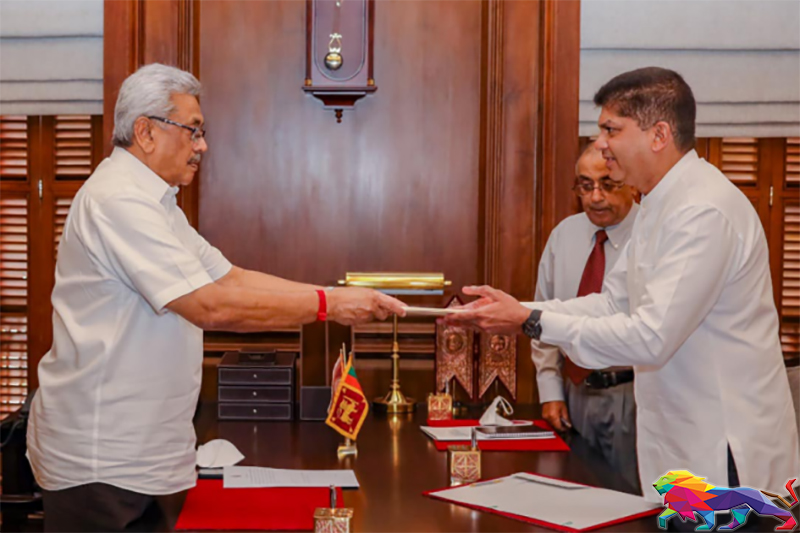
Ratwatte, who hails from a powerful political family, has since resigned after claiming to have, as per a tweet by the President’s Spokesman, accepted responsibility for the incidents at the Welikada and Anuradhapura Prisons. President Gotabaya Rajapaksa, the same tweet mentions, has accepted the said resignation.

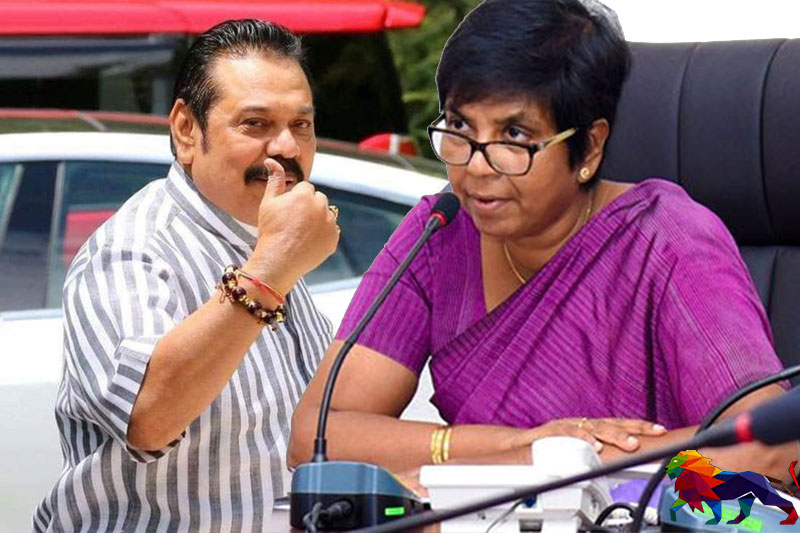
Convening a media briefing yesterday, CPRP Chairman, Attorney-at-Law Senaka Perera noted that Ratwatte’s threats to prisoners who are within the custody of prisons as per judicial orders, constituted acts of contempt of court.

Perera also accused Prisons Department officials including Commissioner General Upuldeniya and Commissioner Ekanayake of dereliction of duty as public officers of the State by both aiding and abetting in Ratwatte’s actions and cowardice by attempting to cover up the matter through the suppression and destruction of evidence by way of seeking to delete closed circuit television (CCTV) camera footage at the two Prisons. Also addressing the same press conference, CPRP Secretary Sudesh Nandimal Silva however noted the obstruction of duty on the part of Ratwatte. Citing their alleged kowtowing to the whims and fancies of the political authority, Perera called on both Upuldeniya and Ekanayake to resign or for them to be removed from their posts by the relevant authorities.

Speaking further regarding the firearm related offence, Perera pointed out that not even the Prisons Commissioner General could not carry a firearm during a visit to a prison. “There is no need to carry and take a pistol if one is going to show the gallows. Therefore, we have a suspicion as to whether Ratwatte was attempting to hunt a political opponent.”

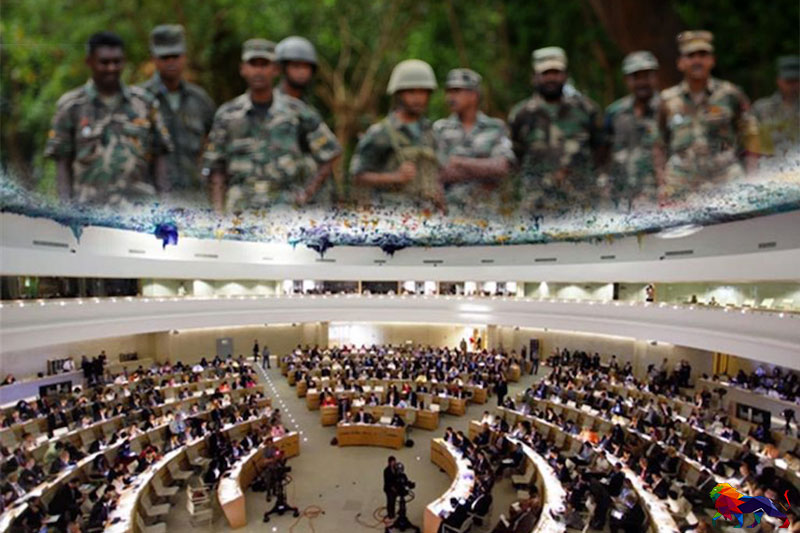
Perera also noted that the selection and targeting of a particular ethnic group from among the prisoners, in this case Tamils, was proscribed under the law including the International Covenant of Civil and Political Rights Act, No. 56 of 2007 as amended. Silva described the said selection and targeting of these prisoners from a national minority, which also violates Article 12 of the Constitution which enshrines the right to equality before the law and equal protection of the law, as a great blow to national reconciliation that was racially motivated and racist in nature. He queried the inopportune timing of Ratwatte’s actions, coming at a time when Sri Lanka’s human rights situation is under international scrutiny including at the United Nations Human Rights Council. He observed further that such incidents would only prove the international community’s view of Sri Lanka’s dire human rights condition.

“What destruction is Ratwatte attempting to wreak? Is bloodshed what he wants? What is the President doing while all this goes on? We would like to ask the Viyath Maga (Professionals for a Better Future) organisation which is an influential force within the Government which talked of assigning Ministries on the basis of science, as to whether giving such an important portfolio to someone like Ratwatte, is scientific. Prisons are correctional institutions to rehabilitate prisoners, and similarly, Ratwatte should be rehabilitated,” Silva opined.

“Ratwatte has kicked the rule of law aside and abused and misused his State Ministerial portfolio. Since when did Ratwatte get judicial powers? He is playing with the lives and rights of the people and the law. This is a dangerous situation. This is the law of the jungle. Under the law, Ratwatte has no immunity. Therefore, the criminal law should be enforced against Ratwatte,” Perera emphasised.

The CPRP informed that the relatives of the affected prisoners who brought the injustice faced by the prisoners to the Committee’s notice and discussed with the Committee in this regard, had pledged to take all necessary legal action concerning such. “Together with the victims’ relatives including parents, we are prepared to take this struggle for justice to the streets if we have to,” Silva noted in conclusion, while Perera added that they would also raise the matter at the international leve
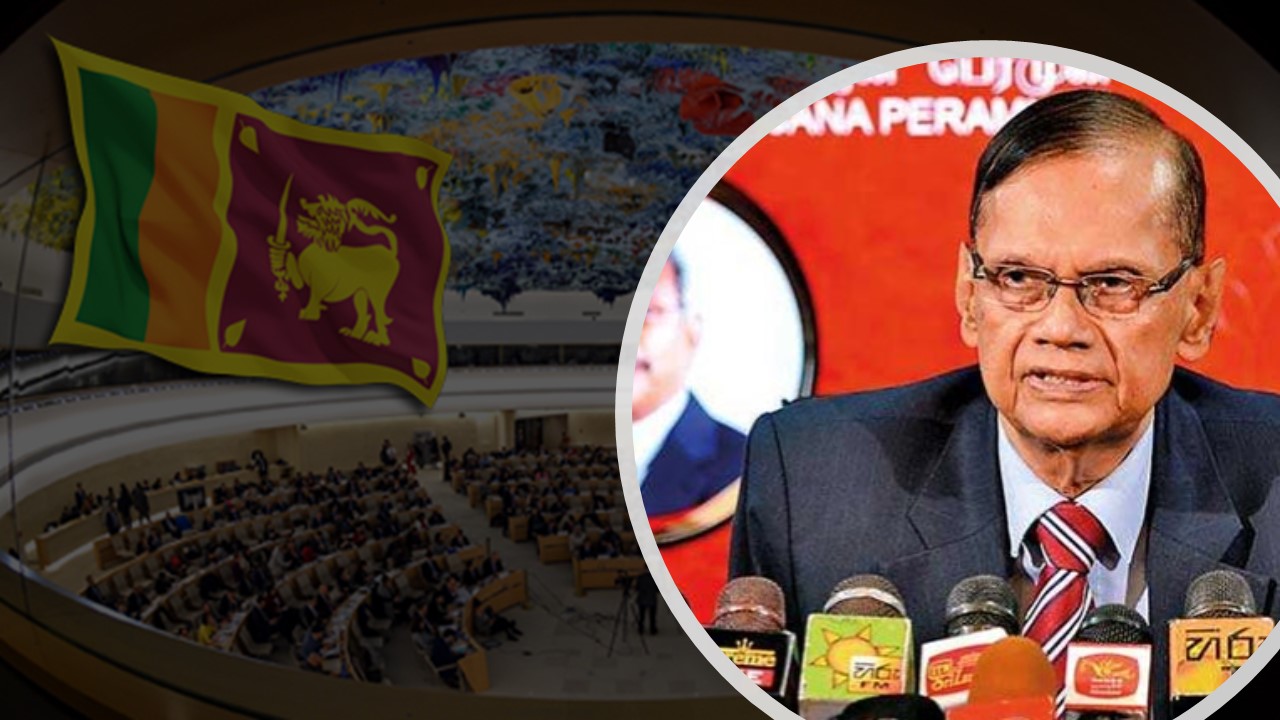
Sri Lanka rejects proposal for any external initiatives, Foreign Minister tells UNHRC

Sri Lanka rejects the proposal for any external initiatives purportedly established by Resolution 46/1, Minister of Foreign Affairs, Prof. G.L. Peiris told the 48th Regular Session of the UN Human Rights Council (UNHRC) today.

In response to the oral update on Sri Lanka by the UN High Commissioner for Human Rights Michelle Bachelet, the minister stressed that domestic processes are vigorously addressing the relevant matters.

“This will polarize our society, as we experienced with Resolution 30/1. The Council must adhere to its founding principles.”

External initiatives embarked upon without the cooperation of the country concerned cannot achieve their stated goals, and will be subject to politicization, the foreign minister added.

He went on to point out that the resources expended on this initiative are unwarranted, especially when they are urgently needed for humanitarian and other constructive purposes in many parts of the world.

Further, Minister Peiris emphasized that under the challenges of the COVID-19 pandemic, the government considers it a basic duty to ensure the uninterrupted supply of commodities essential to the life of the community.

“We are open in acknowledging our challenges and as a responsible and democratic government, we are committed to achieving tangible progress on the entire range of issues relating to accountability, reconciliation, human rights, peace and sustainable development.”

He also stated that Sri Lanka continues to investigate and prosecute the perpetrators of the appalling terrorist attack on Easter Sunday in 2019 in compliance with due process of law in all respects.

The full statement delivered by Prof. G.L. Peiris is as follows:

Madam President,

Let me begin by reiterating our strong and continued cooperation with this Council and the United Nations mandated human rights system, in keeping with our Constitution and our international obligations voluntarily undertaken.

Twelve years ago, Sri Lanka eradicated LTTE terrorism on its soil. We have restored peace, security and stability for the benefit of our people. We held firm to our democratic traditions and elections were held at regular intervals with high levels of voter participation – most recently at the 2019 Presidential and 2020 Parliamentary polls. The Government is committed to holding the Provincial Council elections at the earliest.

We are dealing with post-conflict recovery from the perspective of healing. Most recently, 16 LTTE cadres convicted of serious terrorist crimes were granted Presidential pardons. The success of post conflict demining, reconstruction and resettlement programs has contributed immensely to national reconciliation.

Despite the daily challenges of the devastating COVID-19 pandemic, let me highlight the progress made in the domestic processes:

• The Office on Missing Persons (OMP) as its core function, is finalizing the list of missing persons in collaboration with other agencies.

• The Office for Reparations (OR) has processed 3775 claims this year.

• The Office for National Unity and Reconciliation (ONUR) continues its 8-point action plan.

• The National Human Rights Commission is carrying on its mandate.

• A steering committee on SDG 16 is working towards enhancing peace, justice and strong institutions.

• A Cabinet Sub Committee was appointed to revisit the PTA and to bring it in line with international norms and best practices. A report will be submitted to the Cabinet of Ministers at the end of this month. An Advisory Board was appointed to look into cases of detention under the PTA and to make recommendations to deal with such cases expeditiously. Speedy disposal of cases under the PTA is also taking place.

• A Commission of Inquiry headed by a sitting judge of the Supreme Court was established to address issues on accountability and missing persons and to revisit recommendations by previous Commissions. The COI submitted its Interim report to the President. The final report will be submitted within the next 06 months.

• We are maintaining vigorous engagement with civil society to obtain their insights and to harness their support in achieving reconciliation and development.

Madam President,

Sri Lanka continues to investigate and prosecute the perpetrators of the appalling terrorist attack on Easter Sunday in 2019 complying with due process of law in all respects. As always, we will remain vigilant in combatting terrorism and protecting Sri Lankans of all religions.

Madam President,

We reject the proposal for any external initiatives purportedly established by Resolution 46/1 while domestic processes are vigorously addressing the relevant matters. This will polarize our society, as we experienced with Resolution 30/1. The Council must adhere to its founding principles. External initiatives embarked upon without the cooperation of the country concerned cannot achieve their stated goals, and will be subject to politicization. The resources expended on this initiative are unwarranted, especially when they are urgently needed for humanitarian and other constructive purposes in many parts of the world.

Madam President,

Under the current and pressing challenges of the COVID-19 pandemic, we consider it a basic duty of a government to ensure the uninterrupted supply of commodities essential to the life of the community. We are open in acknowledging our challenges and as a responsible and democratic government, we are committed to achieving tangible progress on the entire range of issues relating to accountability, reconciliation, human rights, peace and sustainable development.

I thank you, Madam President.

Posted in Uncategorized

EU expresses regret over govt’s decision to not support UN framework

The European Union (EU) has expressed its regret over the decision of the Sri Lankan Government to no longer support the UN framework to address the legacy of the past conflict, to ensure acknowledgements for victims, and to foster accountability, reconciliation and human rights.

The EU also stressed the need for continued efforts for reconciliation, accountability and human rights pursuant Council resolution 46/1.

“The EU notes the declared intent of the Government of Sri Lanka to maintain a sustainable reconciliation process, including by ensuring the effective work of the Office for Missing Persons and the Office for Reparations, and calls on the government to implement its commitments in that regard and to guarantee the independence of these institutions,” Ambassador, Permanent Representative of the Republic of Slovenia on behalf of the European Union Mrs. Anita Pipan said at the UN Human Rights Session today.

She also said that the EU continues to stress the importance of amending the Prevention of Terrorism Act, bringing it in line with international norms and human rights standards. The EU reiterates that a fully empowered, resilient and inclusive civil society, as well as independent media, are crucial for democracy.

“The EU encourages the government of Sri Lanka to remain engaged with the UN in relation to resolution 46/1, as well as with international partners, and will continue to support Sri Lanka’s efforts in this regard as well as with a view to further strengthen the dialogue on governance, rule of law, devolution and human rights,” she added.

UNHRC Session: Core Group raises concern on current HR development in SL

The Core Group of Sri Lanka (Canada, Germany, North Macedonia, Malawi, Montenegro and the UK) today raised its concern about current human rights developments in Sri Lanka, including accountability, ongoing PTA detentions and increased limitations on civil society space.

“We continue to stress the importance of a comprehensive reconciliation and accountability process. We note Sri Lanka’s declared intent to promote reconciliation and to ensure the continuity of the work of the Office of Missing Persons and the Office for Reparations. We call on the Government to ensure the political independence of these institutions,” the UK’s Ambassador to the UN and WTO in Geneva, Simon Manley, said delivering the statement at the ongoing UN Human Rights Session on behalf of the Core Group of Sri Lanka.

“We are disappointed that even the limited progress made on accountability on key emblematic cases has regressed. Recent developments on the case involving the disappearance of 11 youths in 2008-2009 is of particular concern,” he said.

The Core group also recognised the challenges Sri Lanka is facing due to the COVID 19 pandemic and express group’s condolences to the people of Sri Lanka for the many lives that have been lost.

“We continue to stress the importance of a comprehensive reconciliation and accountability process. We note Sri Lanka’s declared intent to promote reconciliation and to ensure the continuity of the work of the Office of Missing Persons and the Office for Reparations. We call on the Government to ensure the political independence of these institutions. We are disappointed that even the limited progress made on accountability on key emblematic cases has regressed. Recent developments on the case involving the disappearance of 11 youths in 2008-2009 is of particular concern.”

“We are deeply concerned about current human rights developments, in particular increased limitations being put on civic space including reports of surveillance and intimidation of civil society groups, intimidation of journalists and reprisals against those protesting peacefully. We stress the importance of providing a safe and enabling environment for civil society actors.”

“We further reiterate our request made at the 47th session for independent and impartial investigations into deaths in police custody.”

The Government of Sri Lanka’s outreach to the international community and statements of intent regarding reforming the Prevention of Terrorism Act is welcome, though our longstanding concerns about this legislation still remain. We urge the Government of Sri Lanka to bring its counter-terrorism legislation in line with its international human rights obligations. We call on the government of Sri Lanka to reconsider their intention to introduce a rehabilitation process under the Prevention of Terrorism Act that lacks judicial oversight. In this context we remain concerned about the ongoing detention of human rights lawyer Hejaaz Hizbullah and the poet and teacher Ahnaf Jazeem under the PTA.

“We call on Sri Lanka to cooperate fully with the High Commissioner and remain ready to support the Government on the implementation of resolution 46/1,” Mr. Manley added.

Posted in Uncategorized

Sri Lanka Rejects UNHRC’s Charge of Military Expansion In Country’s Civilian Functions

The United Nations High Commissioner for Human Rights on Monday expressed concern on the state of economic emergency declared in Sri Lanka amid deepening recession.

Sri Lanka on Tuesday rejected a charge by the UN rights body that the military may expand its role in civilian functions, saying there is no militarisation in the island nation and the government’s move was aimed at ensuring food security amid soaring inflation. Giving an oral update on Lanka’s human rights situation in Geneva, the United Nations High Commissioner for Human Rights Michelle Bachelet on Monday expressed concern on the state of economic emergency declared in Sri Lanka amid deepening recession.

“A new state of emergency was declared in Sri Lanka on August 30, with the stated aim of ensuring food security and price controls, amid deepening recession. The emergency regulations are very broad and may further expand the role of the military in civilian functions,” she said.

Bachelet said that her office will be closely monitoring the application of the new laws by the Sri Lankan government.

Reacting to the comments, government spokesman and Information Minister Dulles Alahapperuma said, “there is no militarisation which we know in practical terms. What the government did was to amend just two clauses in the emergency regulations to ensure food security. Alahapperuma said there will be a limited role for the military in the issue of food security, while the defence forces had successfully handled the vaccination programme of the COVID-19 pandemic.

Bachelet’s comments came as Sri Lankan President Gotabaya Rajapaksa on August 31 declared an economic emergency to contain soaring inflation after a steep fall in the value of the country’s currency caused a spike in food prices. The action is aimed at preventing hoarding of essential items.

The government has appointed a former Sri Lankan Army general as commissioner of essential services, who will have the power to seize food stocks held by traders and retailers and regulate their prices.

The military will oversee the action which gives power to officials to ensure that essential items, including rice and sugar, are sold at government-guaranteed prices or prices based on import costs at customs and prevent hiding of stocks. The government, at the time of enactment of the new food security law under the charge of a retired military officer, had said it was aimed at giving relief to the public by preventing hoarding by some traders.

The emergency move followed sharp price rises for sugar, rice, onions and potatoes, while long queues have formed outside stores because of shortages of milk powder, kerosene oil and cooking gas. The wide-ranging measure is also aimed at recovering credit owed to state banks by importers.

In recent weeks, the prices of most essential goods have been skyrocketing due to the falling local currency and high global market prices driven by the COVID-19 pandemic. The government blames traders for hoarding.

The Sri Lankan rupee has fallen by 7.5 per cent against the US dollar this year. The Central Bank of Sri Lanka recently increased interest rates in a bid to shore up the local currency. The UNHRC’s 48th session got underway on Monday with Sri Lanka on its agenda. Bachelet was presenting an update on her annual report, while the general debate on her update is due to start on Tuesday and will conclude on Wednesday.

Posted in Uncategorized

Why is there a food emergency in Sri Lanka? BBC

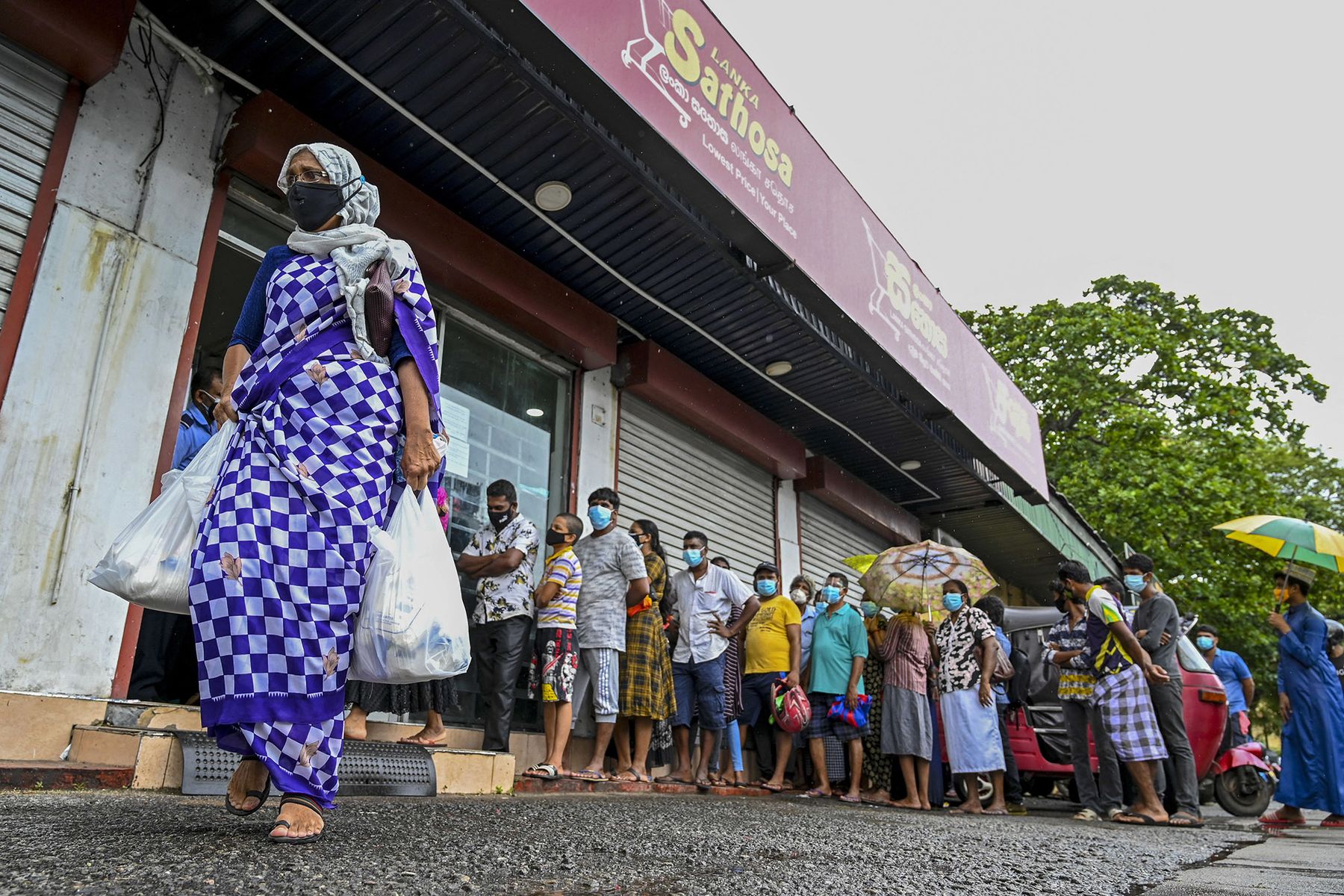
Sri Lanka has seen long queues to buy essential items amid tight lockdown measures to control the spread of Covid-19.

Shelves at government-run supermarkets have been running low – some even empty – with very little stock remaining of imported goods like milk powder, cereal and rice.

The government denies there are shortages and blames the media for stoking fears.

It follows the government declaring a state of emergency and Sri Lanka’s Central Bank chief stepping down amid a foreign exchange crisis.

What has the government done?

On 30 August, President Gotabaya Rajapaksa announced strict controls on the supply of essential goods.

The government said this was needed to prevent traders hoarding food items and control inflation.

Sri Lanka is grappling with a depreciating currency, inflation and a crippling foreign debt burden. There has also been a slump in foreign tourism due to the pandemic.

The economic slowdown is of particular concern as until recently, Sri Lanka had one of the strongest economies in South Asia.

In 2019, it was upgraded to an upper middle-income country by the World Bank.

But at the same time, the country’s debt burden has also been growing – from 39% of Gross National Income (GNI) in 2010 to 69% in 2019, according to the World Bank.

What’s happened to food prices and supplies?

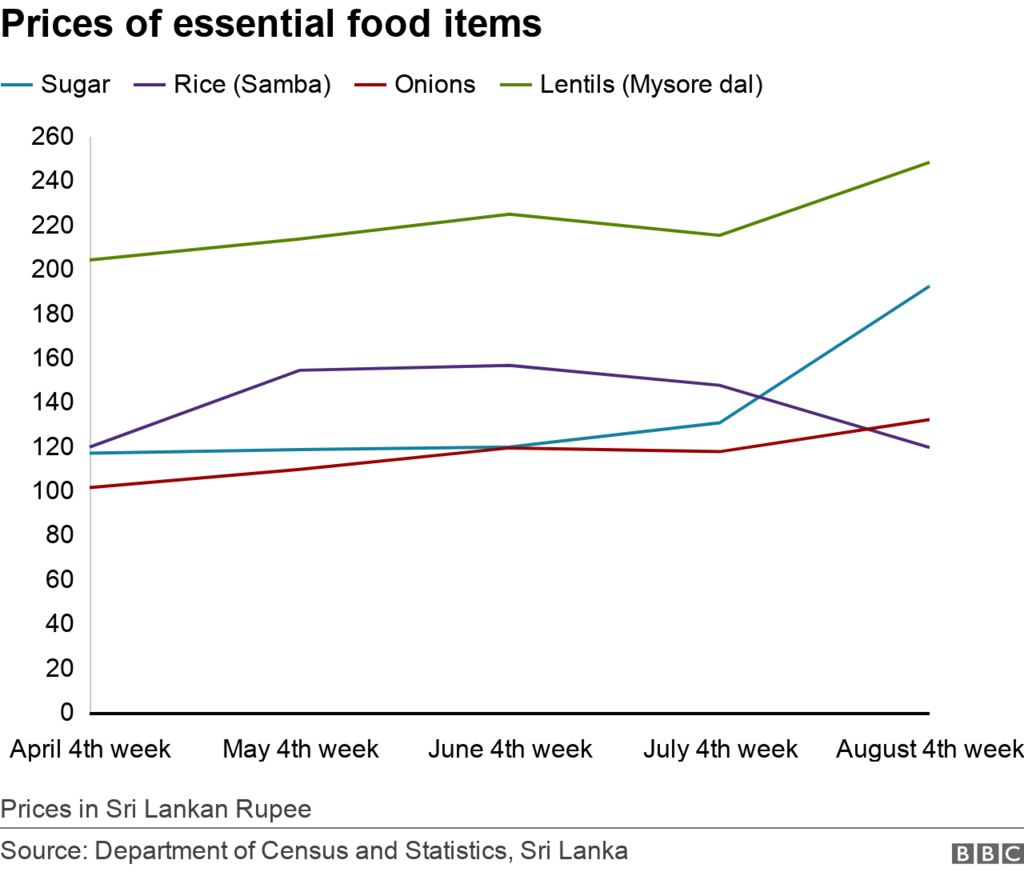
As a result of the economic crisis, the prices of some essential food items have been rising.

Chart on prices of essential items

In recent months, items such as sugar, onions and lentils have been rising in cost.

Meanwhile, after rising in May, the price of rice fell and has continued to drop following the imposition of a retail price cap from the start of September.

The emergency regulations allow the government to provide food items and other essentials at fixed prices by buying up stock from traders.

In regard to shortages, the country’s finance ministry told the BBC in a statement that these were “artificial”.

“The creation of an artificial shortage by unscrupulous elements will obviously lead to increases in prices of those items.”

The government has strongly denied that shortages are imminent.

“We can give a categorical and firm assurance that all essential items would be readily available at all times,” the finance ministry said in its response to the BBC.

Members of parliament critical of the government’s policy have said other laws to monitor hoarding and price rises were already available and the decision to declare an emergency was made in “bad faith”.

​​”[The crisis] is merely a manifestation of a power struggle where the president and government are callously risking lives of citizens, with the hope of consolidating power,” Eran Wickramaratne, from the opposition SJB party, said in the Sri Lankan parliament.

Could organic farming be to blame?

In April, the government banned imports of chemical fertilisers, pesticides and herbicides, to encourage organic farming.

But the move and its implementation have been criticised.

“We are not against organic farming, but against sub-standard chemical fertilisers which were being imported,” said Namal Karunaratne, national organiser of All Ceylon Farms Federation.

However, he added that “the answer to that is not banning imports overnight.”

Some farmers say the rapid switch could significantly cut production.

“The productivity of the organic fertiliser is less than chemical fertilisers, it would decrease our production and make our survival more difficult,” said HC Hemakumara, President of Ampara district joint farmers association.

About 90% of Sri Lanka’s farmers use chemicals, according to a survey in July.

And the highest dependence on chemical fertilisers was among those growing rice, rubber and tea.

Tea accounts for 10% of export income, and some producers have said they may lose up to 50% of their crop production.

Prof Sabine Zikeli, of the Centre for Organic Farming at the University of Hohenheim in Germany, says a rapid transition to organic could threaten a country’s food security.

“You can’t simply change these conventional cropping systems, you need transition periods,” she says.

“In organic farming, the normal transition period to adapt….about three years or even longer, depending on the country.”

In 2008, Bhutan introduced a policy of going 100% organic by 2020.

But it fell a long way short of achieving this target and a recent study shows yields from the organic farming it has introduced have been substantially lower, leading to a rise in dependence on imports.

Sri Lanka could now face a similar situation, Prof Zikeli, who co-authored this study, says.

And its current economic crisis could add to the threats to its food security.

State Minister Ajith Nivard Cabraal has blamed the opposition for “false reports” about food shortages.

However, long queues have been observed for items such as sugar, rice, lentils and milk powder.

Ramya Sriyani, who was in the queue at a state-run supermarket in Gampaha near Colombo, said that she had had to wait about an hour, and then was not able to buy rice or milk powder as they had run out.

Sri Lanka is running low on foreign exchange – and the money it has is going towards debt settlement.

Its foreign reserves stood at $2.8bn (£2bn) at the end of July, down from $7.5bn in November 2019, when the government took office.

And it has outstanding foreign debts of about $4bn, on which it has to pay interest.

And that could affect essential imported items – such as sugar, wheat, dairy products and medical supplies – which might all face growing supply problems.

Posted in Uncategorized

Lohan Ratwatte breaks into Anuradhapura Prison

State Minister of Prison Management and Prisoners’ Rehabilitation Lohan Ratwatte who, as exclusively reported by The Morning on Monday (13), who had forcibly entered the Welikada Prison premises with a group of his friends whilst under the influence of liquor, had similarly entered the Anuradhapura Prison on Sunday (12) evening.

According to sources, the pistol-brandishing State Minister, who hails from an influential political family, had attempted to degrade and punish Liberation Tigers of Tamil Eelam (LTTE) suspects by ordering them at gunpoint to kneel down in front of him. It is learnt from the sources that he was under the influence of alcohol during this time as well, and that he had entered the Anuradhapura Prison premises in a helicopter.

Tamil National People’s Front (TNPF) MP Gajen Ponnambalam published a post on his official Twitter handle yesterday (14), claiming that his party could confirm that Ratwatte had indeed entered the Anuradhapura Prison, summoned the Tamil political prisoners, and made two of them kneel before him at gunpoint, threatening to kill them on the spot.

On behalf of the TNPF, Ponnambalam called for Ratwatte’s immediate resignation, and that he be stripped of all portfolios. The Tamil National Alliance followed suit, calling on the Government to immediately remove Ratwatte as State Minister and “have him arrested and charged after an immediate inquiry for allegedly threatening to kill prisoners in Anuradhapura prison on Sunday”.

Meanwhile, it is learnt that the said State Minister, who had entered the Welikada Prison premises by force, had allowed a group of his friends to visit and view the gallows, and that among this group was a beauty pageant winner who made national headlines a couple of months ago.

According to sources, the said beauty pageant winner had driven the vehicle in which the group, including the State Minister, had come in. When the group tried to visit the gallows, prison officials had, according to the sources, requested that she not go past the cells where male prisoners are housed owing to her being a female.

However, the only route to the gallows is past the cells where male prisoners are housed, as per the sources. At this juncture, the State Minister and his inebriated friends had verbally abused the prison officers, stating that they should not stop her entry and subsequent passage.

According to the sources, the State Minister’s friends had also been inebriated. Many of them, according to the sources, had also been dressed in short trousers (shorts).

“They were so drunk that some of them couldn’t even stand straight and fell on the ground,” the sources claimed.

When contacted, Prisons Department Media Spokesman and Commissioner Chandana Ekanayaka claimed he knew nothing regarding these incidents.

Similarly, when contacted by The Morning, State Minister Lohan Ratwatte’s Media Secretary said that there is no need to comment on these incidents since no such incidents as claimed by the media had occurred.

Posted in Uncategorized

Sri Lanka reports 136 Covid-19 deaths on Tuesday, toll rises to 11,567

The total number of people who fell victim to COVID-19 infection in Sri Lanka soared yet again as 136 more fatalities were confirmed by the Director-General of Health Services on Monday (September 13).

The new development has pushed the official death toll from the virus outbreak in Sri Lanka to 11,567.

According to the data released by the Department of Government Information, the latest victims include 76 males and 60 females.

As many as 106 deaths were reported among elderly people who are aged above 60 years.

In addition, 28 individuals aged between 30-59 years and 02 below 30 years have also succumbed to the virus infection.

Country will reopen after next Monday: Sudarshani

Claiming that the Covid mortality and infections have reduced during the lockdown period, State Minister Sudarshani Fernadopulle said today that the Government will take steps to reopen the country after next Monday.

She told reporters that the four-week lockdown was more than enough to curtail the spread of the disease and that there has been a decrease in Covid mortality and infections during this period.

“I don’t think the country will be locked down after next Monday. The country should be reopened gradually, adopting to a new lifestyle with Covid while continuing health practices and the vaccination programme,” she said.

The Minister rejected rumours that Covid vaccines would cause infertility and sexual dysfunction.

Sri Lankan detainees tortured while in custody, rights group alleges -CNN

Political detainees in Sri Lanka are being tortured while in police and military custody, a human rights lawyer who wrote a report on alleged abuses said on Friday, days ahead of a United Nations human rights summit.

The International Truth and Justice Project (ITJP), a rights group documenting alleged abuses in Sri Lanka, gave details in its report of 15 members of the minority Tamil community, who said they were beaten, burnt, suffocated and sexually assaulted by authorities over the past two years.
Together, their testimony is the most detailed account of alleged new abuses in the island nation since former wartime defense chief Gotabaya Rajapaksa became president in 2019.

“We are dealing with a country where torture is savage, and there is no inclination on the part of the government to do anything about it,” Yasmin Sooka, a rights lawyer who co-authored the report, told Reuters.

“What you have is a kind of tacit approval, really, of those at the highest levels who condone what is happening.”

The government denied the accusations.

“We completely refute the allegations in this report,” Keheliya Rambukwella, the health minister who also serves as a senior government spokesman, told Reuters.

Some previous allegations of kidnapping and torture had been made by “vested interests” and later proven to be false, he said, without elaborating.

Spokespeople for Sri Lanka’s military and police declined to comment on the report.

Government critics

Sri Lanka ended a 25-year civil war between separatist insurgents from the ethnic Tamil minority and government forces in 2009. Rights groups accused both sides of abuses during the war.
The 15 alleged victims — one woman and 14 men — were not identified in the report. They had taken part in commemorations for people killed in the war, worked as volunteers for Tamil political parties or received funds from abroad on behalf of people under surveillance.

Three of the 15 were members of the Liberation Tigers of Tamil Eelam, the main group that fought the government during the war, though many were children at the time.

After being detained, the alleged victims said they were subjected to treatment including being suffocated with petrol-soaked plastic bags and penetrated with an iron rod.

The alleged victims, who fled Sri Lanka are now seeking asylum in Britain, all took part in interviews over the course of several days with lawyers and human rights investigators.
Nine of the 15 cases had supporting medical reports compiled by independent experts confirming torture, the ITJP said.

Those that had not been medically examined were photographed to show their scars.
None had been charged with any crime.

US scrutiny

The report has been released ahead of a session of the United Nations Human Rights Council (UNHRC), which begins on Monday and will look at Sri Lanka.

The United Nations has given its human rights boss, Michelle Bachelet, a mandate to collect evidence of crimes against humanity committed during the civil war.

Rajapaka has put at least 28 serving or retired military and intelligence figures in key administrative posts, including some mentioned in UN reports on alleged war crimes and crimes against humanity, Bachelet said in January.

“Sri Lanka will present its point of view at the upcoming United Nations Human Rights Council sessions later this month and show the progress that has been made in taking forward reconciliation,” Rambukwella said.

The ITJP has previously assisted in two civil lawsuits against Rajapaksa, proceedings for one of which were served in a California parking lot in 2019. Rajapaksa was a US citizen at the time.
Both cases were withdrawn after Rajapaksa was granted diplomatic immunity upon becoming president later that year.

Posted in Uncategorized