

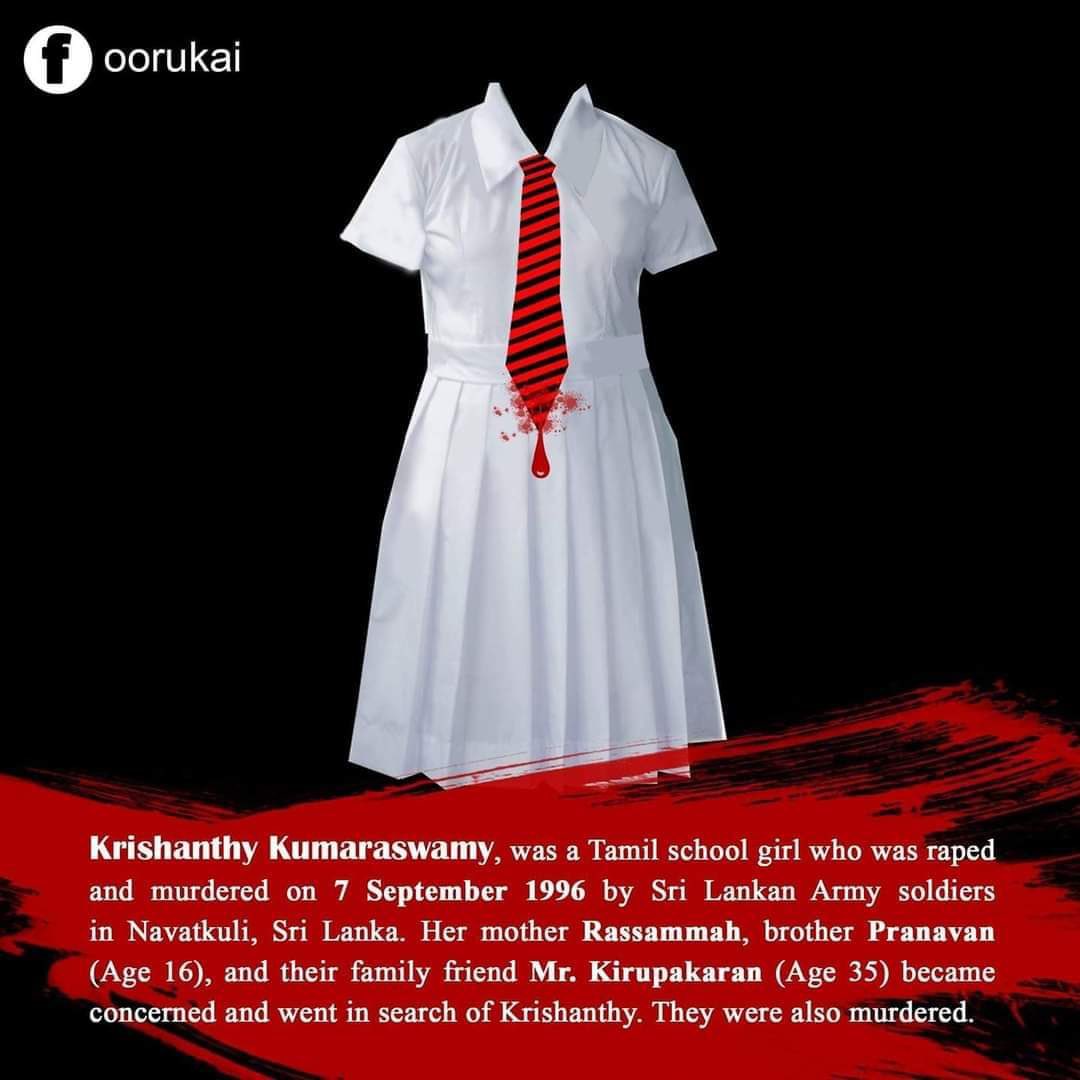
Today marks 30 years since Tamil school girl Krishanthi Kumaraswamy was gang raped and killed by Sri Lankan army officers on her way home from school.
Krishanthi Kumaraswamy was an A Level student at Chundikili High School who was kidnapped, gang raped and viciously murdered by Sri Lankan soldiers and police officers on September 7 1996. Three of her family members who went in search of her were also brutally murdered.
Krishanthi was forced to stop at Kaithady Army checkpoint in Jaffna for ‘questioning’, when eleven officers kidnapped and gang raped her before killing her and burying her dismembered body in a ditch. Krishanthi’s 16 year old brother, Pranavan, her mother, Rasamma and a family friend, Kirupakaramoorthy who went in search of Krishanthi were also strangled with a rope and buried in a ditch behind the checkpoint.
Following the outrage that ensued after the murders, then Sri Lankan president Chandrika Kumaratunge ordered an investigation. All four bodies were exhumed from a ditch near the checkpoint. It was found that Krishanthi was gang raped, killed and dismembered whilst Rasamma, Pranavan and Kirupakaramoorthy were strangled with a rope.
In October 1996, 11 members of Sri Lanka’s security forces were arrested. In September 1997, nine of them were indicted whilst two Reserve Police Constables, A.H. Nazaar and P.A. Samarawickrema, agreed to turn state witnesses and received conditional immunity for their cooperation.
In an unprecedented move at the time, the Sri Lankan government convened a Trial-at-Bar, a special high court with three judges, to hear the case.The trial began on November 8, 1996 in Colombo.
During the trial, Corporal Somaratne Rajapakse, who was found guilty of abducting, raping and killing Krishanthi, her mother, young brother and neighbor, revealed that there were at least 300 to 400 other bodies buried in Chemmani.
“Almost every evening, dead bodies were brought there [to the Ariyalai SLA camp] and the soldiers were asked to bury them,” Rajapakse told courts – he denied taking part in the killings and claimed he only helped bury the victims.
After nearly two years on July 3, 1998, the Colombo High Court sentenced Corporal Somaratne Rajapakse, Lance Corporal Mudianselage Jayatileke, Mudianselage Jayasinghe, Priyantha Perera and Reserve Police Constable Pradeep Priyadharshana to death for rape, disappearance and murder. W.S.V Alwis died during the course of the trial whilst D.G Muthubanda and A.P were acquitted. D.V Indrajith Kumara absconded from the trial.
This is the only case that has seen its perpetrators prosecuted in Sri Lanka while countless instances of widespread sexual violence by Sri Lankan forces against Tamils have gone unpunished.
Mass graves
Following Rajapakse’s confession, the Sri Lankan authorities initiated an investigation in 1998–99. The Sri Lankan Human Rights Commission requested UN assistance, and the Colombo High Court authorised efforts to locate the graves.
A total of 15 bodies were exhumed from multiple sites in Chemmani during the excavations. Some of the skeletons were found blindfolded and bound, grim evidence that these were executions or murders.
By December 1999, the Sri Lankan government asserted that experts reached “a unanimous decision that there are no such graves as originally alleged” beyond those already found and closed the investigation.
In February 2025, Chemmani returned to the spotlight following the discovery of another mass grave in Chemmani. Skeletal remains were found during construction work near a Hindu cemetery in Chemmani.
Excavations began in May 2025 under the direction of Dr. Raj Somadeva, a senior archaeologist appointed by the court. The third excavation phase concluded in August 2026, bringing the total number of skeletal remains to 583.
Professor Somadeva’s archaeological report, together with a report by Judicial Medical Officer Sellaiah Pranavan on nine sets of remains recovered from principal excavation site 2, is expected to be submitted and reviewed at a meeting scheduled for 14 October.