

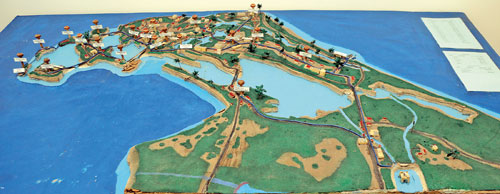
For decades, families across the Jaffna peninsula and surrounding islands have relied on wells and rationed pipe schemes for water that was often salty, hard, or unsafe to drink – a daily reality shaped by the region’s thin rainfall and absence of any river or reservoir.
However, this reality changed with the construction of a Sea Water Reverse Osmosis (SWRO) desalination plant at Thalaiyadi, as part of the Jaffna-Kilinochchi Water Supply Project (JKWSP), funded by the Asian Development Bank (ADB). It was the first large-scale seawater desalination plant built in Sri Lanka and among the first of its kind that the ADB has financed anywhere as well.
The SWRO desalination plant project treats and purifies seawater into freshwater, providing a reliable source that is independent of the district’s limited and often contaminated groundwater.
The contract was awarded in January 2021 to Suez International, and preliminary work began in March 2021, although feasibility studies and research into alternative water supply mechanisms had been underway for many years prior. The project design and build were completed by September 2024, and by October, operations had already begun.
Under the terms of the contract, Suez International will operate the plant for seven years, transferring full operational control to Sri Lanka’s National Water Supply and Drainage Board (NWSDB) by October 2031.
The SWRO plant was developed under the Jaffna-Kilinochchi Water Supply Project (JKWSP), backed by $210m in ADB funding and $56m in government funding, out of which $15m ADB funds were used to rehabilitating and strengthening the Iranamadu irrigation reservoir as an earlier, complementary component of the water supply strategy from which 55,000 farmers have benefited as well.
Jaffna Peninsula’s chronic water crisis stems from a fundamental hydrological deficit. To put this into perspective, the region gets only 1,200mm of annual rainfall against 1,800mm of potential evaporation, with no rivers or reservoirs, leaving its 600,000 residents dependent on groundwater that can safely yield only 13,000 to 35,000 cubic metres per day against demand exceeding 50,000 cubic metres of water every day.
A 2007 government feasibility study revealed that the groundwater itself was heavily compromised, with nitrate levels from fertiliser and pesticide use, hardness and iron content in 99% of tested wells, and faecal contamination near densely populated areas, including the hospital, all exceeding national drinking water standards.
However, a large portion of this water crisis has been alleviated through the SWRO plant.
Currently, the SWRO plant, located in Thalaiyady, Jaffna, is designed to produce 24,000 cubic metres of clean water per day, equivalent to 24 million litres. However, producing this amount requires extracting at least 50,000 cubic metres of raw seawater.
Out of it, only 24,000 cubic metres are converted into clean drinking water; the remaining volume, now a concentrated brine, is pumped back into the sea in a procedure in accordance with the Central Environment Authority and the Marine Environment Protection Authority standards.
A total number of 15,000 households benefit from the SWRO plant as of now, including hospitals and universities, which has impacted the lives of many in the region positively with twenty elevated tanks completed across the peninsula.
For instance, R. Kavitha, an Advanced-Level student, used to fetch water from a common public well located far away.
However, since the introduction of the SWRO plant, Kavitha no longer has to walk that distance to fetch water, conserving her time and energy.
As a result, with more time on her hands now, Kavitha is able to spend it more productively and earns a living as a tailor, stitching saree jackets to the customers in the neighbourhood.
Murugan Sugandi, a primary school teacher, had to fetch three categories of water separately in three different locations – water for drinking, pipe water, and saline water from wells for other purposes – before the SWRO project.
Drinking water had to be fetched at odd times, between 2 am and 6 am, from a location half a kilometre away from where she lived, as the water would evaporate and the well would go dry after 6 am. In addition to this hurdle, Sugandi and the others like her had to also face the long line of people at the well near the kovil. Now, this laborious chore has ended.
Although currently only 15,000 households are connected to the SWRO, with new connections being added as consumers apply, this is not its full capacity. The target is about 60,000 households.
At the current pace, it is expected to take roughly two to three years to reach the full target number of connections, and the planned coverage area extends from near Kodikamam to the islands off the peninsula, said JKWSP Chief Engineer V. Vijayakanth.