

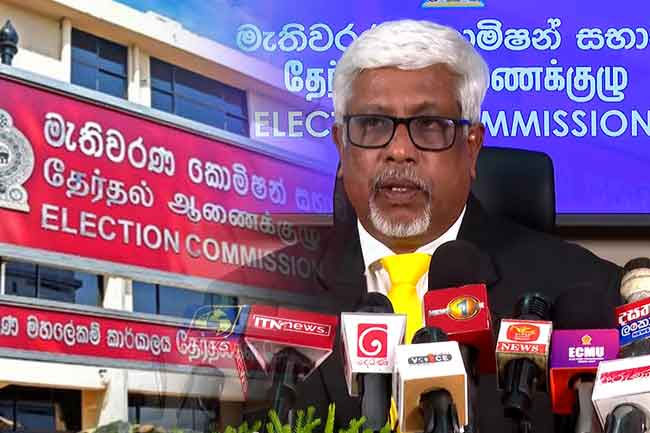
The Election Commission (EC) on Thursday (15) urged Parliament to expedite legal amendments required to hold long-delayed Provincial Council Elections (PC), saying it is prepared to conduct the polls as soon as the necessary legislative framework is in place.
The PC Elections have been stalled because Parliament has yet to complete the legislative work relating to amendments to the electoral system and the delimitation of constituencies.
Election Commission Chairman R.M.A.L. Rathnayake said that the commission had made five submissions to the special Parliamentary Select Committee appointed to examine the steps needed to hold the elections.
“We made special submissions, both verbally and in writing, on the systems required to ensure 25% representation for youth and women through the mixed proportional system,” Rathnayake said.
He said the commission was also expecting to approach President Anura Kumara Dissanayake to request that the necessary legal amendments be prepared without further delay.
Addressing a media training programme, Rathnayake outlined the commission’s ongoing electoral reforms, including the revision of the electoral register, advance voting, voting rights for Sri Lankans living overseas, political party registration, and the regulation of social media during elections.
The commission received 41 applications for political party recognition after calling for applications in January this year. Of these, 16 parties have been called for second-round interviews, while seven have been called for final-round interviews. Rathnayake said that the recognition process was expected to be completed soon.
The commission has also been reviewing shortcomings in the laws governing political party registration, including provisions relating to deposits and the need to update legislation to reflect current requirements.
The 2026 electoral register revision process has been completed, with the first supplementary register certified on 15 September, the main register on 22 September, and the second supplementary register on 1 October. The third supplementary register was scheduled to be certified on 31 January 2027, Rathnayake said.
Over the past three years, the commission has also worked on electoral law reforms. Draft amendments intended to improve voter identification have been submitted to Parliament, while proposals for legislation on advance voting have been submitted to the Legal Draftsman’s Department.
The proposed advance voting arrangements aim to facilitate voting by people engaged in essential services, including health, electricity, highways, and aviation, as well as persons with disabilities. A special committee appointed by the Ministry of Public Administration, Provincial Councils, and Local Government is working on proposals to enable Sri Lankan citizens living overseas to vote.
The committee, chaired by an Additional Commissioner of Elections, has studied international experience, including through a conference held in August with election officials and experts from Australia, Bangladesh, the Philippines, Nepal, and the Maldives. The commission is now preparing a roadmap in consultation with relevant stakeholders.
Meanwhile, a social media policy is being drafted to establish a framework for monitoring and regulating social media activities during elections. Rathnayake said the commission had sought the views of experts and stakeholders, including Asia-Pacific representatives of major technology platforms such as Meta and TikTok.
Discussions with officials at the companies’ regional headquarters in Singapore had also informed the drafting process.
The commission is separately preparing draft legislation to address shortcomings identified in the Regulation of Election Expenditure Act, following discussions with district-level election officials.