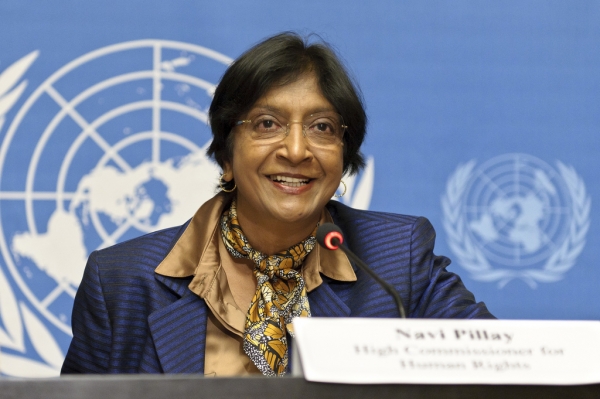
When Navanethem Pillay, who served as the UN High Commissioner for Human Rights from 2008 to 2014, won this year’s Nobel Peace Prize on last Friday we saw mixed reactions from Sri Lankans.
Many including Tamil leaders and anti-war campaigners welcomed it, while many in the southern parts of the island deplored it.
Among the UN High Commissioners for Human Rights, Navanethem Pillay, commonly known as Navi Pillay, can be described as the most familiar figure to the people of Sri Lanka. This is because it was during her tenure that the UN and its Human Rights Council began taking decisive actions regarding the human rights situation in Sri Lanka.
One cannot say definitively that she was the sole reason for these actions, or that her Tamil heritage was the cause. The secessionist war in Sri Lanka ended during her tenure and the final stage of the war was highly catastrophic. Under those circumstances, even if someone else had been the High Commissioner for Human Rights, the UN would have still been compelled to handle the Sri Lankan human rights issue with high priority.
Navi Pillay is the fourth person of Tamil or Tamil-descent to receive a Nobel Prize. The other three are C.V. Raman, who won the Nobel Prize for Physics in 1930; Subrahmanyan Chandrasekhar, who won the Nobel Prize for Physics in 1983; and Venkatraman Ramakrishnan, who won the Nobel Prize for Chemistry in 2009.
Among them, C.V. Raman belonged to Tamil Nadu. His nephew, Chandrasekhar, was born in Lahore (a city in present-day Pakistan) and later acquired American citizenship. Ramakrishnan, who is of Indian origin, holds British and American citizenship.
First non-white high court judge
According to Wikipedia, Navi Pillay’s grandparents were taken from Tamil Nadu to South Africa as indentured labourers to work in sugarcane plantations. Her father, Narayansamy Naidu, worked as a bus driver in South Africa. In 1965, Navanethem Naidu married Paranjothi Anthony Pillay, thus becoming Navanethem Pillay. Navi Pillay was the first non-white judge appointed to the High Court of South Africa.
This year’s Nobel Peace Prize was awarded to her for her services to world peace and international law. Her long-term contributions to these fields were taken into consideration for the award.
Examining genocides
When Hutus massacred around eight hundred thousand Tutsis in Rwanda in 1994, UN established the International Criminal Tribunal for Rwanda in 1995 to investigate it. Navi Pillay was appointed as one of its judges and in 1999, she became the President of the tribunal. In 2003, she was appointed as a judge of the International Criminal Court (ICC). In 2008, she was appointed as the UN High Commissioner for Human Rights.
Following the end of her term at the Human Rights Council in 2014, Pillay served as a judge on the International Court of Justice (ICJ) regarding the Rohingya genocide in Myanmar. Subsequently, she was appointed as a member of the UN Independent International Commission of Inquiry on the Occupied Palestinian Territory, established in 2021.
In 2023, this commission concluded that Hamas had committed war crimes, and in 2024, it determined that Israel was engaged in genocide. Due to this ruling on Israel and her work at the International Criminal Court, Navi Pillay earned the resentment of certain Western countries, including the United States. Therefore, when she won the Nobel Peace Prize this time, US President Donald Trump expressed his dissatisfaction regarding it.
Although many High Commissioners for Human Rights took various actions concerning Sri Lanka during and after the war, Navi Pillay attracted the most attention. In particular, while the Tamil people praised her actions, the majority of the Sinhala population severely criticised her. This was because many viewed her actions through the lens of her being a Tamil woman rather than as the head of an international organisation.
Pillay was not the UN High Commissioner for Human Rights who took the harshest action against Sri Lanka. The most stringent action was taken in 2021 when Michelle Bachelet was the High Commissioner. An evidence-gathering mechanism was established then to prosecute those accused of human rights violations in Sri Lanka in foreign courts. Yet, Pillay remains the most disliked figure by successive Sri Lankan governments and the majority community.
It was during her tenure at the Human Rights Council that passing of annual resolutions on Sri Lanka was begun. Sri Lanka was censured twice every year through this process regarding its human rights record. The Sri Lankan government and the majority community strongly opposed this. On those occasions, some did not forget her Tamil heritage, either.
Yet, the first resolution passed by the Human Rights Council in 2012 merely urged the government to implement the recommendations of the Lessons Learnt and Reconciliation Commission (LLRC), appointed by President Mahinda Rajapaksa in 2010. While subsequent annual resolutions included several other conditions, the Sri Lankan government, except during Yahapalana period,” vehemently opposed all those resolutions.
Consequently, when Navanethem Pillay visited Sri Lanka in 2013, Mervyn Silva, a minister in Mahinda Rajapaksa’s government at the time, insultingly stated that he wished to marry Pillay. Later, while she was still in Sri Lanka, President Mahinda Rajapaksa, Cabinet spokesman Dullas Alahapperuma, and Leader of the House Nimal Siripala de Silva expressed their regrets over the incident.
Having experienced severe racial discrimination in South Africa during apartheid, it would not be surprising if Navi Pillay viewed the issues of Tamils in Sri Lanka with a unique sense of empathy. At the same time, she might have approached the issues in Sri Lanka from the perspective of being a Tamil.
However, the reports on human rights violations in Sri Lanka published during her tenure did not solely highlight the excesses of the Sri Lankan armed forces. They mostly referred to the human rights violations of “both parties”— the armed forces and the Liberation Tigers of Tamil Eelam (LTTE).
In 2014, her office conducted an investigation into the alleged human rights violations committed by “both parties” and the report of it was published in 2015. With the exception of sexual offenses, all other allegations leveled against the armed forces in that report were also leveled against the Tigers.
The investigation was conducted based on specific international laws including international criminal law, which encompasses crimes such as genocide. This means allegations of genocide had been taken into consideration during the investigation. However, the report did not accuse any belligerent party of genocide.
Ultimately, along with a long list of recommendations for the government to implement, the report also stated that: “There must be recognition within the Tamil community, for example, of the destruction and harm inflicted on civilians and communities by the LTTE.”
Accordingly, the Tamil National Alliance (TNA) issued a statement then saying, “We will use this moment as a moment of introspection into our own community’s failures and the unspeakable crimes committed in our name.” However, the government of the day failed to understand these positive signals and take steps toward reconciliation.
Also, we don’t recall her mentioning ‘both parties’ in Sri Lanka after leaving the UNHRC.