Ranil, Sajith clash in Parliament over economic crisis

President Ranil Wickre-mesinghe and Opposition leader Sajith Premadasa yesterday clashed in Parliament after the former blamed the latter for the current crisis.

Wickremesinghe accused Premadasa of being a responsible party to the crisis and suggested that the country’s outcome might have been different if Premadasa had agreed to assume the Prime Minister position in April 2022.

Wickremesinghe made these remarks in response to questions posed by Opposition leader Sajith Premadasa after the Samagi Jana Balawegaya (SJB) sought an explanation on his speech delivered earlier.

In requesting a clarification, Premadasa remarked that despite the President’s assertion that conditions have returned to normal, the reality is that a new normal has emerged, marked by the persistence of various issues. “The new normal has been created by putting a great burden and pressure on the general public,” Premadasa remarked.

However, the President in response said that in 2022 he willingly took on the challenge of rejuvenating both the nation and its economy.

“At that pivotal juncture, no one else stepped forward to undertake the responsibility of rescuing the country. Instead, various conditions were proposed. I wholeheartedly accepted the duty of guiding the country, even though my party held just one seat in Parliament. I embarked on this endeavour amid daunting circumstances,” he affirmed.

Initially, the President agreed to provide an explanation, but later walked out, suggesting that a debate could be held if necessary.

The tense situation arose, and Premadasa questioned Wickremesinghe’s sudden exit. He accused Wickremesinghe of being afraid to confront the Opposition.

“Why are you leaving? Are you afraid? Are you afraid? Can you not answer?” Premadasa asked.

When accused of attempting to make a speech instead of seeking clarification, Premadasa questioned if he had no freedom of speech. He asserted that he had every right to respond to the President’s statement.

Posted in Uncategorized

Majority MPs call for General Election first

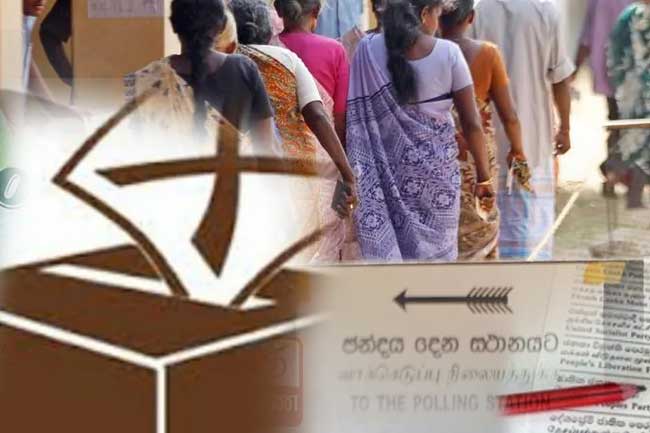
In the wake of the Election Commission officially announcing that the Presidential election will be held between September 17 and October 16, a faction of both government and opposition MPs have expressed concerns as they prefer a parliamentary election first, Daily Mirror learns.

This follows the remarks by the founder of Sri Lanka Podujana Peramuna (SLPP) Basil Rajapaksa who reiterated that his party maintains its stance that the general election should take place before the presidential election.

In addition to government MPs, a significant number of opposition MPs, the majority of whom are from the Samagi Jana Balawegaya (SJB), prefer a general election, citing the potential to attract a broader voter base.

Against this backdrop, President Ranil Wickremesinghe is reported to have attempted to convince the government parliamentary group that the Presidential election must take place this year in accordance with the Constitution.

According to the Election Commission, the Presidential election should be held this year while the parliamentary election is slated for 2025. However, the President, as the Head of the State, is vested with the authority to dissolve Parliament and call for a snap general election.

Nonetheless, informed sources suggest that it is highly improbable for the President to dissolve parliament, paving the way for a parliamentary election ahead of the Presidential election.

Meanwhile, speaking to Daily Mirror, Election Commission chief R.M.A.L. Ratnayake stated that the presidential election will be declared between the end of July and the early part of August.

Furthermore, the nominations will be called within the specified timeframe in terms of the provisions of the Constitution of Sri Lanka and the Presidential Elections Act No. l5 of 1981.

Two retired army officers arrested for illegally recruiting Sri Lankans for Russian forces

Two retired officers of the Sri Lanka Army have been arrested for illegally recruiting Sri Lankan army soldiers to be employed in the Russian military.

Accordingly, a retired Major General and a retired Sergeant were apprehended by the Criminal Investigation Department (CID) in Kurunegala on Wednesday (08).

Earlier on Wednesday, the Ministry of Defence announced the launch of an operation to arrest the suspects implicated in directing retired Sri Lankan Army soldiers to join Russian or Ukrainian forces by illegal means.

Defence Secretary, General (Rtd) Kamal Gunaratne had emphasized that the operation was initiated jointly with the Criminal Investigations Department (CID) and the Intelligence Units.

9 key points from the President’s speech in Parliament on Sri Lanka’s economy

President Ranil Wickremesinghe making a special statement in Parliament today said that the country has witnessed positive outcomes of entering into a programme with the International Monetary Fund (IMF), including the appreciation of the rupee against the US dollar.

9 key points from the President’s speech:

1.Economic growth is forecasted at a minimum of 3%, with the figure being supported by various national and international institutions, President Wickremesinghe said. Inflation reduced to 1.5%, the primary account balance, which had been in deficit for many years, has turned into a surplus of 0.6% of GDP in 2023. A surplus in the current account of the balance of payments was recorded in 2023 & interest rates have decreased to between 10% & 13% over the year. Foreign reserves meanwhile surpassed USD 5 billion, the President said elaborating on several economic indicators.

2.Government employees received an allowance increase from Rs. 5000 in January to Rs. 10,000 in April, while pensioners were given a Rs. 2500 allowance. President Ranil Wickremesinghe acknowledged that these allowances are insufficient relative to the cost of living, but stated that the government cannot afford further increases.
“There have been numerous requests to revise salaries, but the government revenue is not sufficient to consider such requests. The truth is that government salary revisions can only be considered next year, based on the 2024 economic growth and state revenue.”

3.Outlining the key milestones of Sri Lanka’s debt restructuring efforts, the President said that government revenue was earlier at 8% of the GDP while state expenditure was 20% of GDP. By December 2022, total national debt was 128% of GDP.

4.President Wickremesinghe said that Sri Lanka has agreed in principle with foreign creditors to restructure its debt and is in ongoing discussions with the official creditors committee and the EXIM Bank of China.
“Sri Lanka entered an agreement with the Paris club official creditors as well as China, who is not a member of the Paris Club. China opted out, so we are dealing independently with China,” the President said.

5.By November 2023, Sri Lanka secured agreements to restructure debt with creditor countries including those from the Paris Club and China. While formal agreements with these creditors are pending, Lazard and Clifford Chance are facilitating ongoing dialogues on behalf of Sri Lanka. The goal is to conclude discussions by mid-2024, President Wickremesinghe said

6.Debt restructuring aims to reduce national debt to 95% of GDP by 2032, down from 125% President Ranil Wickremesinghe said as he detailed the targets and challenges in achieving debt sustainability during this period of time.

7.Making note of the Governance Diagnostic Report introduced to minimize corruption as per conditions agreed with the IMF, the draft law for the Proceeds of Crimes Act was approved by the Cabinet, President Wickremesinghe said.

8.The Aswesuma welfare scheme allocated Rs. 205 billion in 2024, tripling the funds compared to the previous Samurdhi scheme. The President emphasized the government’s efforts to provide relief to various vulnerable groups through these economic revival programs. Direct financial assistance has been allocated to kidney patients, the elderly and disabled individuals, with a 50% increase effective from April 2024.

9.Several new laws aimed at strengthening the government’s economic reform efforts will be presented in Parliament soon. The Economic Transformation Bill, the Public Finance Bill and the Public Debt Management Bill are some of the key laws anticipated, the President said.

Diana Gamage becomes 12th MP to be out of 2020-elected parliament

Diana Gamage became the 12th Member of Parliament to be out of the island nation’s legislature that was elected in the 2020 general elections either due to death or resignation or legal actions, official data showed.

A three-judge Supreme Court bench on Wednesday decided that State Tourism Minister Diana Gamage is not eligible to hold an MP post after a legal case challenging her eligibility over holding the MP post due to her citizenship.

Gamage was accused of breaching immigration laws and hiding credentials over her citizenship.

Gamage entered the parliament through the national list under the main opposition Samagi Jana Balawegaya (SJB)

Sri Lanka constitution has barred duel citizens for foreign citizens holding MP post in its latest amendment.

With Gamage’s removal, the current parliament has witnessed seven MPs from ruling Sri Lanka Pudijana Party (SLPP), four from opposition SJB, and one from minority Sri Lanka Muslim Congress (SLMC) have lost the seats from the parliament.

The details of the MPs are out of the current parliament elected in 2020:
K H Nandasena (SLPP, died) Amarakeerthi Athukorala (SLPP, murdered), Sanath Nishantha (SLPP, died), Ranjan Ramanayaka (SJB, lost the seat due to legal action), Ajith Nivard Cabraal (SLPP, resigned), Mahinda Samarasinghe (SLPP, resigned), Basil Rajapaksa (SLPP, resigned), Mujibur Rahuman (SJB, resigned), Chaminda Wijesiri (SJB, resigned), Uddika Premarathne (SLPP, resigned), and Naseer Ahamed (SLMC, lost due to court ruling.

Posted in Uncategorized

Tamils faced torture in Sri Lanka long after war

Sri Lanka’s security forces abducted men and women from the ethnic Tamil minority and tortured them in custody long after the end of a bloody civil war in the South Asian island nation, a human rights group said in a new report.

The 26-year civil war between separatist Tamil insurgents and government forces ended in 2009. Rights groups accuse both sides of abuses during the conflict in which 80,000-100,000 people died, according to United Nations estimates.

In its report, the London-based International Truth and Justice Project (ITJP) which has been documenting alleged abuses in Sri Lanka, cited details of 123 Tamils who said they were beaten, burnt, suffocated and sexually assaulted by Sri Lankan authorities between 2015-2022.

Sri Lanka rejects the ITJP allegations, a government minister said on Wednesday.

The report, titled ‘Disappearance, Torture and Sexual violence of Tamils, 2015-2022’, which will be published on Thursday, said 11 of the 123 were allegedly detained after Ranil Wickremesinghe took over as Sri Lanka’s president in July 2022.

Wickremesinghe was appointed after large-scale protests triggered by a spiralling financial crisis forced President Gotabaya Rajapaksa to flee the country and later resign from his post.

“The analysis in the current report confirms … arbitrary and unlawful detentions between 2009 and 2015 were systemic and structurally entrenched, (and) could just as well have been written about the seven-year period between 2015 to 2022,” the report said, adding that the alleged victims were seeking asylum in Britain.

“It is unlikely to stop unless the international community exerts greater pressure on Sri Lanka to deal with security sector reform and to root out those officials responsible for this culture of violence directed against Tamils,” said Yasmin Sooka, ITJP’s executive director.

Asked by Reuters about the report, Tharaka Balasuriya, state minister of foreign affairs, said Sri Lanka had taken multiple steps since the end of the war to address human rights concerns and promote reconciliation including releasing land to Tamil owners, limiting the military to camps in the north and east of the country, and appointing officials to look into cases of people reported missing.

“We look at human rights as a continuous process… and we are committed to engaging with international partners including non-governmental organisations to take the reconciliation process forward,” Balasuriya added.

Sri Lanka is also working towards appointing a commission for truth, unity and reconciliation, as outlined before the United Nations Human Rights Commission, he said.

(Courtesy Reuters)

Posted in Uncategorized

EC writes to Prez Secy. on LG polls

The Election Commission (EC) has informed President’s Secretary Saman Ekanayake and the other relevant authorities that it is better to hold the Local Government (LG) elections than establishing community advisory committees to oversee development projects under LG bodies.

The Government recently announced plans to establish these committees, with the alleged intent of having them oversee development projects within LG bodies. Former LG representatives are also slated to be considered for inclusion as members of these committees.

When contacted by The Daily Morning, EC Chairperson R.M.A.L. Rathnayake mentioned that the EC had examined the issue and sent a letter to the President’s Secretary outlining important considerations for setting up the committees in question.

“We recommended that candidates who have submitted nominations for the LG elections should not be included in these committees, given that the electoral laws are still in effect.” He noted that the need to establish these committees arose because the LG bodies currently lack public representatives due to the delay in holding the LG Elections. As a solution, he said that they (EC) recommended to the relevant authorities, including the President’s Secretary, that holding the LG elections would be a better approach than establishing committees to fill the gap left by the absence of public representatives. When queried as to whom the relevant notification was made, Rathnayake said that it was informed to the President’s Secretary, the Prime Minister’s Secretary, the Provincial Governors and their Secretaries, and the District Secretaries.

The Government’s preparation to establish community advisory committees has raised significant concerns, with the main Parliamentary Opposition, the Samagi Jana Balawegaya (SJB) alleging that the Government plans to conduct their election campaigns disguised as community advisory committees overseeing development projects in LG constituencies.

“This move is an attempt to gain political advantage. Arbitrarily empowering Governors to form these committees could allow them to steer public resources toward their own political ends,” noted SJB and Opposition Leader Sajith Premadasa yesterday (8). “It’s not the first time that we’ve seen this Government manipulate systems to its advantage,” he added, referencing a previous effort where power was prepared to be given to the former Mayors and Chairpersons of LG bodies — a strategy that he claimed was eventually withdrawn after legal challenges.

Premadasa also questioned the true purpose of these committees, querying as to why their objectives could not be met through existing regional mechanisms like Divisional and District Secretariats, and District Coordination Committees. He also said that the SJB would legally challenge the establishment of these committees, raising concerns that candidates who had submitted nominations for the LG elections could be chosen to fill these committees’ roles.

The LG elections were initially set for March 2023, but were delayed because the Finance, Economic Stabilisation, and National Policies Ministry and the General Treasury did not release the necessary funds. The EC rescheduled the elections to April 2023, but the funding issue persisted, resulting in the indefinite postponement of the LG elections.

EC nods for int’l observer requests

The Election Commission (EC) is to accommodate requests made by several international organisations such as the European Union (EU) to observe the upcoming elections including the Presidential Election, in a timely manner.

Local election monitoring body, the People’s Action for Free and Fair Elections, had recently requested the EC in writing to urgently make necessary arrangements to invite a delegation of election observers representing the international community.

When contacted by The Daily Morning, EC Chairperson R.M.A.L. Rathnayake said that several international organisations such as the EU had recently met him, and had expressed their willingness to observe the upcoming elections, particularly the Presidential Election.

“A delegation from the EU and representatives of several other organisations met with us recently and handed over formal letters expressing their interest in coming as observers. They informed me that they would like to be informed once the election schedule is confirmed,” he said.

He further said that requests received from several such organisations prompted them (EC) to plan a structured communication process with them. “We’ve taken the necessary measures to manage these requests. We’ve sent letters to those who reached out to us, letting them know that when the election date is announced, they will be informed in due time with formal notices.” While the exact timing of the elections is yet to be determined, he estimated that the country is “six to seven months away” from the polls.

Since its inception, the EC has played a significant role in ensuring a fair and transparent election process. Among its key responsibilities are voter registration, processing nominations, managing logistics, and election monitoring. It usually invites both domestic and international observers to monitor the electoral process, with regard to elections, particularly the Presidential and Parliamentary elections.

Basil reasserts general election first, yet President braces for presidential race

Sri Lanka Podujana Peramuna (SLPP) founder Basil Rajapaksa reasserted yesterday that his party still believes the general election should precede the presidential elections but President Ranil Wickremesinghe has a contrasting stand, according to an informed source of the party.

Mr. Rajapaksa addressed the parliamentary group of the party and spelled out his opinion in this regard. Earlier, he met with the President and held talks about the latest political developments.

According to the SLPP, a fair number of its MPs stand for the conduct of the snap general election ahead of the presidential elections scheduled for October, this year in terms of the Constitution. The next parliamentary election is scheduled for 2025 only. However, the President has the constitutional authority to dissolve Parliament prematurely and declare a snap election.

Mr. Rajapaksa is reported to have instructed the MPs to brace for any election no matter what. The MPs were reportedly asked to start political work in preparation for any election that might come first.

Meanwhile, SLPP MPs who hold ministerial responsibilities in the government stand for the presidential elections to be conducted first. Earlier, Mr. Rajapaksa told the media that he would not leave room for any rift with the President over his stand.

Posted in Uncategorized

Over 200 Sri Lanka ex-soldiers dead in Russia-Ukraine frontline as drone fodder, escapee says

Hundreds of Sri Lanka ex-soldiers recruited by multiple teams were dying in their hundreds in the killing fields of the Russia-Ukraine border amid drone warfare, according to a fighter who escaped the region.

Over 200 Sri Lankan ex-soldiers are believed to have died and a similar number are being treated in hospitals in regions like Donetsk, he said in an interview broadcast by Sri Lanka’s Derana Television.

The retired soldier said he went to Russia after paying 1.6 million to recruiting team made up of retired senior military officers who said they were to be ‘camp helpers’ providing support services

The kingpin behind the recruitment operation appeared to be an Indian national named Ramesh, he said. They were also received in Russia by a Tamil speaker, he said.

Sri Lankans who arrived on tourist visas and were then asked to sign a contract in Russian language for the ‘Wagnet’ (sic) mercenary group supervised by an Indian lady who appeared to be a lawyer who assured them that it was a one-year camp helper contract.

Escalating Recruitment Op

He and 33 other Sri Lankans were then taken to a training camp in Rostov where they underwent a 14-day course. There were about 70 Sri Lankans in the training camp at the time he was there/.

He had learned that around 600 to 700 Sri Lankan may have been taken to Russia over the past few months, most of them in the past three months.

About 200 to 300 are believed to have died and a similar number are in hospitals in areas like Donetsk, he said.

There were a larger number of mercenaries from countries like Cuba.

The recruitment process had gathered pace in the last three months, after only 3 or 4 were believed to have been recruited each month last year, he said.

Daily 10 to 15 tourist visas were being issued in Colombo, he said. The passports came back with the stamped visa within a week and they were dispatched to Russia in the next two days.

Sri Lanka’s Foreign Minister Ali Sabry told reports Wednesday that there was no official count of citizens fighting for Russia or Ukraine, but attempts were being made to help them.

“We don’t know,” Minister Sabry told reporters. “None of them go through formal or official channels.

“So your guess is as good as mine.

“We are trying to see what we can do wherever possible. We can deal with the government of any other country. We are being asked to deal with a mercenary group which is not a formal government. It’s a very difficult task.”

Cash Extraction

The soldier said he had to pay 1.6 million rupees to his recruiters while sending ex-soldier to almost certain death, he learned from fellow Sri Lankans that other recruitment teams charged less.

Some had been charged 350,000 rupees, while others were charged 1 million. It was not clear whether other recruiters told the ex-soldiers that they would have to go to the frontlines.

When his group protested that they were hired as camp helpers and refused to take up active duty the Russian officials had said they had to go to the frontlines as a one year contract had been signed.

At the mercenary camp he was told that recruiters were paid the equivalent of 2.5 million Sri Lanka rupees for each person sent to Russia.

They were then broken up into three teams and sent to the frontlines.

His group was shifted around four camps where he encountered Sri Lankan soldiers who also showed him dog tags from dead colleagues. Families back home were apparently not informed of their death, he said.

At the frontline, the Russian soldiers or mercenaries were high on drug ice, apparently to maintain their fighting spirit and Sri Lankans were not in a position to refuse to go to battle any longer for fear of being shot out of hand, he said.

Drone Fodder

That night they were ordered to take over a Ukrainian ammunition dump but he refused to go without knowing about the terrain. After his insistence, he was taken to a signals room where terrain was shown to him through a drone camera.

Asked about possible risks to guard against he was informed that there were only drones and snipers and not to worry.

As soon as they stepped out of the bunker, five Ukrainian drones hit them and one Sri Lankan was hit as they jumped back in.

The fallen Sri Lankan was heard screaming and groaning in pain but no one helped him. He then went out with another Sri Lankan colleague under drone fire and dragged the wounded Sri Lankan back into the bunder. He learned later that the wounded person was in hospital.

They were then pushed out of the bunker and told to take the ammo dump. They entered the ammunition going through open ground under drone fire, where one person died and a Pakistani was wounded.

Killing Fields

They gave him what first aid as they could with the medical kits they had and also injections that they had to relieve his pain.

After four days they were asked to return and leave one soldier with the Pakistani fighter. An older Sri Lankan fighter who was also slightly wounded elected to stay with him.

After they returned to the Russian bunker braving drones, they were sent 1.5 kilometers back from the frontline to rest and were told to return for a second operation in the night. They were fed and kept under armed guard.

The Sri Lankan ex-soldier and two others then escaped in the night while going to the toilet by distracting the sentry. He later learned that his two friends were captured.

The Russian used drones to track escapees and re-capture them. He however lay low and later managed to escape to Moscow with the help of Russian and Ukrainians in the Donetsk region and contact the Sri Lankan embassy.

He said he decided to speak out to stop others from falling into the same trap. Sri Lankans were also fighting for Ukraine, he said.