Erik Solheim returns to Jaffna after over 20 years

Former Norwegian peace negotiator Erik Solheim returned to Jaffna after over 20 years and said that the struggle for Tamil rights will continue.

Solheim, who negotiated peace talks between the LTTE and the Sri Lankan Government during the war, said that his return to Jaffna was very emotional for him.

“I came numerous times during the war in Sri Lanka. So many of my good friends and colleagues were killed, both Singhala and Tamil. Huge human suffering! This is first time I am back to Jaffna and Kilinochchi. It was great too visit today with my friend Norwegian MP Himanshu Gulati and Kavin Kumar Kandasamy from ProClime,” he said on X (Twitter).

Solheim said that he was also happy to discuss the latest political developments with the new leader of the Illangai Tamil Arasu Katchi (ITAK) S Shritharan.

He said he also touched base with his old friend from the peace process Jay Maheswaran who is running a spiritual center.

“I wish to thank Governor PSM Charles for inviting us! Northern Sri Lanka is at peace and that is wonderful. Security is good. No one want to go back to the war days,” he said.

However, Solheim said that several Tamil aspirations are yet to be fullfilled and thousands of families are still in the dark on what happened to their loved ones who disappeared during the war.

“Land is not fully restored to old owners. Disputes over historic religious sites and temples must find peaceful settlement. Northern Sri Lanka needs jobs and prosperity. The Sri Lankan state will have to devolve power. The struggle for Tamil rights will continue, but with non violent means,” he said.

Solheim earlier had talks with President Ranil Wickremesinghe and the Sri Lanka Podujana Peramuna (SLPP) in Colombo.

Posted in Uncategorized

Land bridge with India to bring mutual benefits: Sagala

Chief of Staff of the President, Sagala Ratnayake said the proposed land bridge with India will benefit both countries.

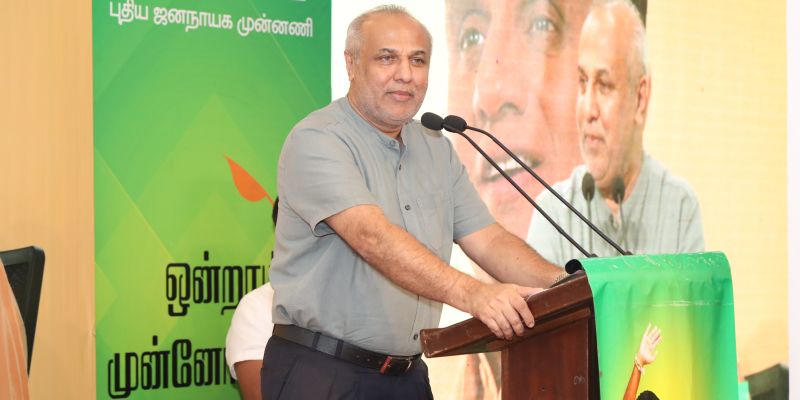
Making his remarks at the UNP May Day rally, he said it is economical for India to use the Sri Lankan ports to unload India-bound containers and then transport them by road to their destinations.

“It will reduce their costs. More than that, Sri Lanka will benefit in the whole economic process,” he said.

He said the country will benefit even further in terms of power grid and pipeline connectivities.

SJB govt will amend Sri Lanka’s IMF agreement – Sajith

Samagi Jana Balawegaya (SJB) leader Sajith Premadasa has reiterated that Sri Lanka’s debt agreement with the International Monetary Fund (IMF) would be amended under an SJB government in the future.

“We will definitely work to create a new, amended IMF agreement that is populist, philanthropic, people-friendly and that would guide the country on the correct path,” he said.

The Opposition Leader made this pledge while addressing the SJB’s May Day rally at Chatham Street, Colombo on Wednesday (01).

Premadasa also vowed to bring everyone who is behind the Easter Sunday terror attacks before the law and to ensure maximum punishment is meted out to those involved as well as those who tried to cover it up.

He also said that they will implement a ‘National Youth Project’ that will give prominence to the youth and will also introduce an entrenched clause to establish new independent agencies to help eradicate corruption in the country.

SLFP selects Wijeyadasa Rajapakshe as Presidential candidate

Former President Maithripala Sirisena said today that Justice Minister Dr. Wijeyadasa Rajapakshe will be the Presidential candidate representing the Sri Lanka Freedom Party (SLFP).

He made this revelation during the commemoration ceremony of the late T.B. Ilangaratne.

The former President said that Wijeyadasa Rajapakshe has the support of the majority of party members.

Sirisena said he has previously served as President and pledged not to contest for the Presidency again.

“Wijayadasa Rajapakshe will run for the upcoming Presidential election and we will offer him our full support,” he said.

Passenger ferry service between Tamil Nadu and Sri Lanka to resume on May 13

The passenger ferry service between Nagapattinam and Kankesanthurai in Sri Lanka, which resumed in October 2023 after almost 40 years only to be stopped days later, is set to recommence on May 13. Online ticket sale for the service, which will be handled by a new operator, will go live on Monday.

On October 14 last year, Indian Prime Minister Narendra Modi virtually flagged off the service between Nagapattinam and Kankesanthurai. The HSC Cheriyapani operated by the Shipping Corporation of India under KPVS Private Limited, however, stopped service after about a week allegedly due to monsoon. After a gap of six months, the service is set to resume. This time though, a Chennai-based travel operator, IndSri Ferry Services Private Limited, would handle the international service through the ship, ‘Sivagangai’.

“The service will be offered daily. Ticket sale is open from Monday through our website sailindsri.com for voyages between May 13 and November 15,” said S Niranjan Nanthagopan, managing director of IndSri Ferry Services Private Limited. A ticket from Nagapattinam port to Kankesanthurai is currently priced at USD 50 plus taxes (about `4,920). The pricing is the same for the return service.

Passengers are allowed to carry 60 kg of baggage on board without charges. Further, they are allowed to change their date of travel 72 hours before the scheduled trip. Full refund is also available on cancellation only during the period.

Source: The New Indian Express

Posted in Uncategorized

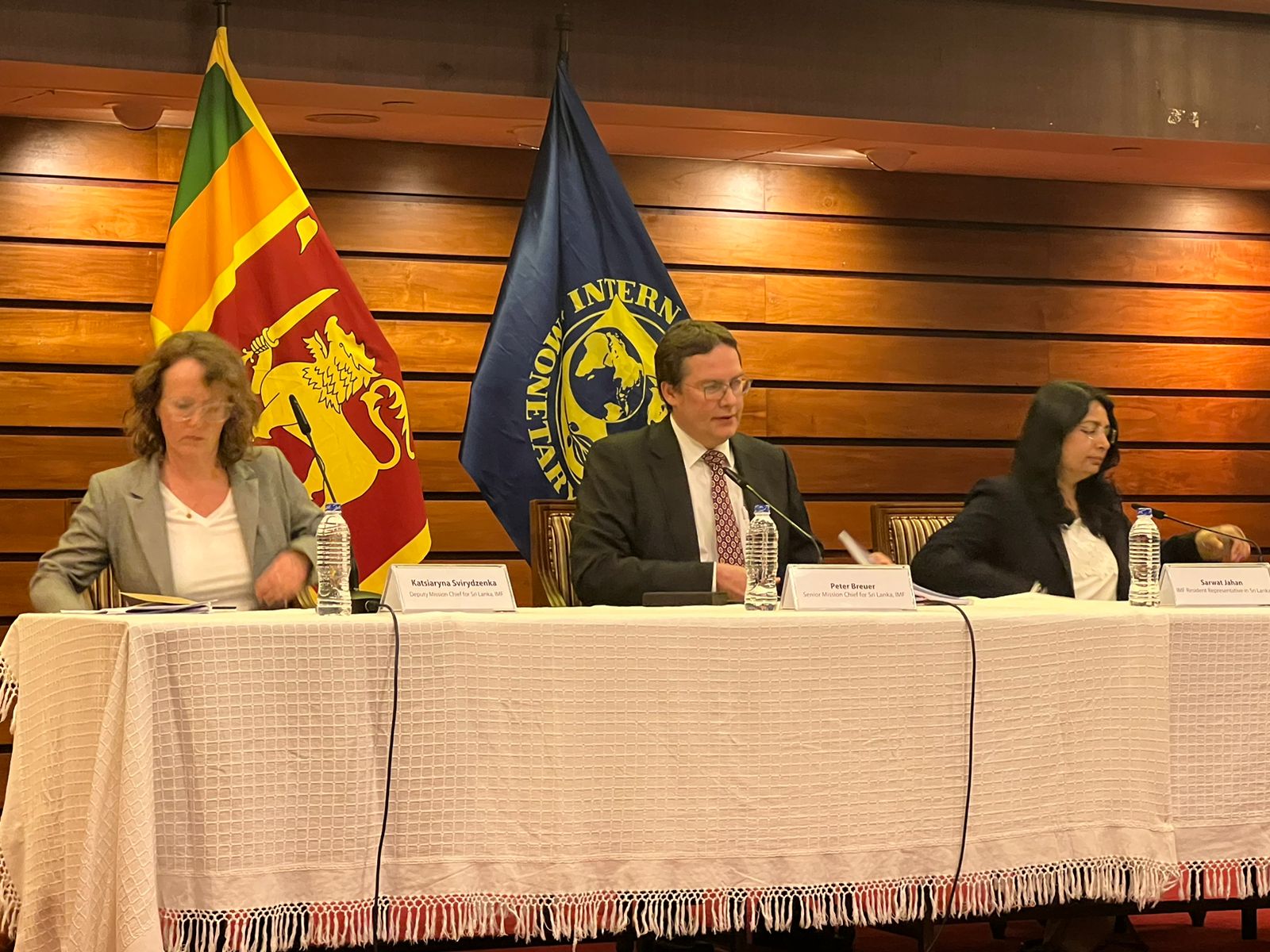
IMF Urges Sri Lanka to Stay On Course

The International Monetary Fund says that it is vital for Sri Lanka to continue with it’s program for economic recovery.

Speaking to reporters in Singapore, Krishna Srinivasan, the Director of the Asia and Pacific Department of the International Monetary Fund noted that the IMF program for Sri Lanka is working and is delivering results, however, he warned that the road head is going to get tough.

He was responding to a question raised by News 1st’s Zulfick Farzan following the opening remarks at the press conference on the release of the IMF’s Regional Economic Outlook for Asia and Pacific.

Opening Remarks On IMF’s Regional Economic Outlook for Asia and Pacific:

1. The Asia-Pacific region is marked by both resilient growth and rapid disinflation.

2. Growth is better than previously projected but will slow from 5 percent in 2023 to 4.5 percent in 2024. The region remains inherently dynamic and accounts for about 60 percent of global growth.

3. Drivers of growth are as heterogenous as the region, straddling from resilient domestic consumption in most ASEAN countries, to strong public investment in China and, most notably in, India, and to a sharp uptick in tourism in the Pacific Island countries.

4. Disinflation has advanced throughout the region, albeit at different speeds—in some, it remains above target (e.g., Australia and New Zealand), in others, it is at or close to central bank targets (EMs and Japan), while in some there are deflation risks (e.g., China and Thailand).

5. China is a source of both upside and downside risks. Policies aimed at addressing stresses in the property sector and to boost domestic demand will both help China and the region. But sectoral policies contributing to excess capacity will hurt China and the region. Geoeconomic fragmentation remains a significant risk.

6. Asian central banks should continue to focus firmly on domestic price stability and avoid making policy decisions overly dependent on anticipated interest rate moves by the Federal Reserve.

7.Asian countries are well placed than before to cope with exchange rate movements (fewer financial frictions and better macro-fundamentals and institutional frameworks) and should continue to allow the exchange rate to act as a buffer against shocks.

8. Advancing fiscal consolidation is an urgent priority both to lessen the burden of higher debt levels and interest costs and to rebuild the fiscal space needed to address medium-term structural chal-lenges.

9. Supervisors should continue to vigilantly monitor the buildup of risks associated with the pass-through of tighter monetary policies to corporate and household balance sheets.

10. Industrial policies, which have been on the rise in Asia and the Pacific region and globally, can lead to unintended consequences, such as trade distortions which risk reinforcing fragmentation.

Posted in Uncategorized

Special notice to voters regarding electoral register

The Election Commission calls on the members of the public to ensure that their names are listed in the electoral register.

Accordingly, the citizens who were born before 31 January 2007 are urged to immediately enquire their respective Grama Niladhari officers if their names are in the electoral register.

The public can also view the electoral register from the official website of the Election Commission (http://ec.lk/vrd).

Wither the Muslim parties – FT.LK

As elections approach, the two Muslim parties, Sri Lanka Muslim Congress (SLMC) the senior and its breakaway junior All Ceylon Makkal Congress (ACMC), are on a bargain hunt looking for profitable deals with any of the national parties so that they could coalesce. This is not something new but had been the history of these ethno-religious adjuncts right from their inception.

In fact, SLMC’s founding leader Ashraf’s whole strategy was to capture Muslim votes en bloc to bargain for privileges with competing national parties. In this he was imitating the strategy of Thondaman with his monopoly over plantation Tamil votes. After Ashraf’s tragic death in September 2000 at the hands of suspected LTTE assassins his successors practiced that strategy with added vigour. In the end, all they could achieve were one or two cabinet positions and governorships for themselves and jobs for their relatives and apparatchiks while problems of the Muslim community continued to mount.

The political summersaults and betrayals of SLMC/ACMC parliamentarians in the interest of personal gain were shocking. For example, after their shameful silence when COVID-dead Muslim bodies were cremated in their hundreds and when innocent Muslim men and women were thrown into prison without trial after the Easter massacre, these notables raised their hands in support of the 20th Amendment when few of them were tempted with money and positions. The Muslim community was aghast at the cowardice of these parvenus. While the Catholic Cardinal agitating tirelessly for justice to Christian victims SLMC/ACMC notables remained inactive and are opening their mouths only now as election approaches. They may deceive some Muslims all the time and all Muslims sometime but not all Muslims all the time.

There is a new generation of Muslim voters now who, like their counterparts among Sinhalese and Tamils, are waking up to the challenge that unless the old guards with their self-centred profit making politics are thrown out and a new genre of leaders with patriotism and dedication to build a united but plural democracy with economic justice there would be no salvation to this country in general and Muslim communities in particular. These young voters belong to the Aragalaya generation which initiated the call for system change two years ago.

That call is echoing all over the country now and at least one political party, NPP is promising to institute that change if it comes to power, and the odds seem to be in its favour. This is why the forthcoming election is hoping to be a direct confrontation between the old and new systemists. If that change happens the two Muslim parties are destined to wither away. They are an aberration to the politics of pragmatism practiced by former Muslim leaders.

To start with, do Muslims need a separate political party in this country? The argument in favour of it was inspired by two prominent Muslim personalities, one a philosopher and poet Abdul Cader Lebbe (1913-1984) from Kattankudy and the other a District Judge M.A.M. Hussain (1911-1998) from Kalmunai. These two idealists were in a sense eye witnesses to the struggle for Pakistan during the closing decades of the British Raj. Muhammad Iqbal the national poet of Pakistan and Muhammad Ali Jinna the brilliant barrister and leader of the Indian Muslim League were the model leaders of the two idealists. But the fact that the history and politics of Muslims in British India were totally different from the history and politics of Muslims in independent Ceylon seem to have escaped the minds of the two thinkers.

In India, Muslims came as conquerors with the sword but in Ceylon they arrived as peaceful traders and pilgrims. Indian Muslims enjoyed their zenith of power during the Mogul rule, but in Serendib the Muslim community enjoyed from the beginning an unparallelled era of tolerance, hospitality and respectability from the island’s Buddhist monarchs and their Sinhalese subjects. In fact, Serendib was a shining example of Islam’s theological dar al-sulh (territory of treaty) without any treaty. How and why did this happen and what made Muslim minority experience in Sri Lanka so unique in the annals of history are questions yet to be explored by historians.

This is why the history of Muslims in Sri Lanka still remains an unwritten chapter, and without accessing Arabic sources that chapter cannot be written to know the whole truth. Even after the 1915 riots the Muslims did not run away to Arabia as demanded by certain pseudo nationalists but remained rooted in Ceylon and became more integrated with the majority community. This was why in independent Ceylon with its Westminster model of parliamentary democracy Muslim leaders never felt the need for a Muslim party to advance the welfare of their community. Perhaps, Muslim love for commercial pursuits, island-wide demographic spread and an otherworldly attitude towards life contributed to this development and discouraged interest in organising political parties of their own.

Historians and political scientists have anointed this disinterestedness as ‘politics of pragmatism’. What that meant in practice was Muslims always stood with the winning majority, and that strategy did bear benefits. In comparison to what was achieved without a party those achieved, if any, with SLMC/ACMC were miniscule or zero. The history of Muslim education in this country would speak volumes about Muslim politics of pragmatism.

But the situation began to change after 1977 with the JR interregnum. Although Muslims voted en masse in favour of JR and his UNP they failed to read his communal agenda. JR actually feared the power and influence of minorities in national politics, and the reason why he introduced proportional representation was to ensure that the majority community would always dominate governments. The 1983 pogrom and the rise of an armed LTTE with its uncompromising stand to divide the country with the creation of Tamil Eelam were actually JR’s legacies.

However, in the violence that ensued LTTE’s armed struggle Muslims in the North and East suffered the most and the Colombo centred Muslim leadership at that time was indifferent at best or uninterested at worst regarding the plight of their brethren. This was the political background for the birth of SLMC.

Even before these developments the two idealists, Lebbe and Hussain, used to meet frequently in Badulla and Guruthalawa where the poet was a school principal for 18 years in the first and 10 in the second, and after that in Matale where he spent most of his retired life until his death. It was during those conversations that they identified the leadership potential of a young and budding attorney from the Eastern Province, Muhammad Ashraf who happened to be Hussain’s nephew. Already in late 1970s Ashraf was found making his mark as a public orator and an emerging politician when he joined the conservative mullahs and campaigned against the then Minister of Education Badiuddin Mahmud’s decision to introduce music and fine arts as curriculum subjects in Muslim schools.

This author happened to be present in one of those protest meetings chaired by Ashraf at Colombo Zahira College. Ashraf also had a love for Tamil poetry which won the heart of Lebbe. Thus, the young attorney was groomed by the two idealists to take up the mantle of Muslim leadership from the Eastern Province. But by the time SLMC was registered as a political party in 1998 Lebbe was no more and Hussain was in his final stage of life. But whether these idealists had any direct input into constitution of SLMC is not clear at least from the collection of letters the poet wrote to Ashraf, copies of which are now in the possession of a Muslim journalist. What is certain is that the ideological seedling of SLMC grew in hilly Matale in Central Province before it was transplanted in the alluvial soil of the Eastern Province.

Without further guidance from the two idealists their posthumous child SLMC turned out to be more a liability than an asset to the community. The two idealists would be turning in their graves at the way SLMC and its breakaway ACMC have become political nests for self-seeking petty nabobs. How these parties have prostituted Islam to gain votes from the Muslim masses is another story. That they are a party to the growth of Muslim self-alienation in this country is indisputable. And, it is their alliance with religious conservatives that has jeopardised the chances of Muslim women to win their battle for matrimonial reforms. SLMC in particular also has blood in its hands for deteriorating relations between Tamils and Muslims in the Eastern Province. It is time these parties fade away.

(The writer is attached to Business School, Murdoch University, W. Australia.)

SJB catches up with NPP in Sri Lanka general, presidential election surveys

Sri Lanka’s main opposition the Samagi Jana Balawegaya (SJB) has overtaken the leftist National People’s Power (NPP) in a voting intent poll for a future parliamentary election while SJB leader Sajith Premadasa has closed a gap with NPP leader Anura Kumara Dissanayake for this year’s presidential election.

The Institute for Health Policy (IHP) which carried out the two surveys for March 2024 found that its revised SLOTS MRP model, confirm an increasing trend in support for the SJB at the expense of the NPP.

“The SJB on 38 percent (+4) took the lead with all voters for the first time since 2022, ahead of the NPP/JVP on 35 percent (-2), the SLPP at 8 percent (unchanged) and President Ranil Wickremesinghe’s United National Party (UNP) at 5 percent (unchanged). The March estimates are provisional and are associated with a margin of error of 1–3% for the four leading parties,” the IHP said in a statement

In a separate statement, the institute said provisional estimates of presidential election voting intent in March 2024 show support for Premadasa increasing to 41 percent (+2), reducing the gap with Dissanayake who leads on 44 percent (-2). Support changed little for Wickremesinghe at 8 percent (unchanged), and a generic Sri Lanka Podujana Peramuna (SLPP) candidate at 7% (-1).

Commenting on the poll on general election voting intent, IHP director Ravi Rannan-Eliya said compared to IHP’s February release, IHP estimates of NPP and SJB support in February were revised -7 and +5 points. He noted that this was an unusually large revision driven by a large uptick in SJB support in the early April interviews. Rannan-Eliya cautioned, however, that it would be best to wait a couple of months to see if this was just noise or a real trend.

With regard to the presidential poll, he said a large uptick in support for Premadasa in recent interviews is making the MRP model increasingly favour the possibility of a more general upward trend. He again cautioned that it would be best to wait one
or two months to confirm.

The IHP said that these estimates are for all adults and not for likely voters. They are based on the 01/ 2024 revision of the IHP Sri Lanka Opinion Tracker Survey (SLOTS) Multilevel Regression and Poststratification (MRP) model.

“IHP is working on improving its likely voter model and will resume release of voting intent in likely voters in a future update. But it should be noted that differences in voting intent shares between all adults and likely voters have typically been 1–2% for most estimates in the past two years,” it said.

This March 2024 updates for both surveys were based on 16,671 interviews conducted with adults across Sri Lanka since October 2021, including 527 interviews carried out in March 2024, with 100 bootstraps run to capture model uncertainty. Margins of error are assessed as 1–3% for March, the IHP said.

Posted in Uncategorized

Slain Tamil journalist Sivaram remembered in North-East

Slain Tamil journalist Dharmeratnam Sivaram was remembered in Batticaloa, Jaffna and Vavuniya today to mark 19 years since his abduction and murder.

Sivaram, popularly known under his nom-de-plume Taraki, was abducted in front of Bambalipitiya police station in Colombo on April 28 2005 and was found dead several hours later in a high security zone in Sri Lanka’s capital, which at the time had a heavy police and military presence due to the ongoing conflict. His killers, highly suspected to be linked to the government of then-president Chandrika Kumaratunga, were never caught.