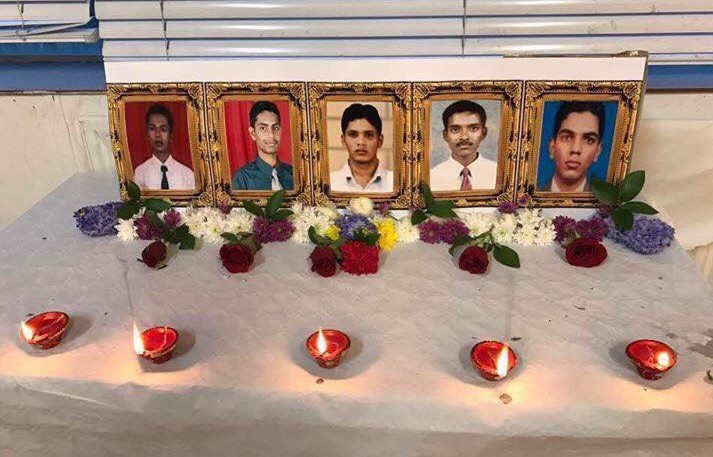
On this day 18 years ago(02-Janauary 2006), five Tamil students were summarily executed by Sri Lanka’s Special Task Force, whilst they spent an afternoon on the beach in Trincomalee.
To date, no one has been held accountable for the murder.
The case – known as the ‘Trinco 5′ – remains one of the highest-profile killings in Sri Lanka to receive international attention, listed in 2014 by the then UN High Commissioner for Human Rights’ report on the island as one of four ‘emblematic cases’ of the government’s failure to ensure accountability and having been raised repeatedly in international forums.
In June 2019, 13 Special Task Force members who were suspected of executing the five Tamil youth were acquitted. Fifteen charges were filed against suspects and they were released due to the lack of evidence.
“Sri Lankan authorities have proven unable to obtain justice for the murders of five young people and the resulting coverup despite the considerable evidence available,” said Meenakshi Ganguly, South Asia director at Human Rights Watch. “The failure to convict anyone in this emblematic case after 13 years demonstrates the need for a court with international participation that can properly protect victims and witnesses.” President of USTAG, Seetharam Sivam said, “Sri Lanka has perfected the art of protecting its security forces and the political leadership by creating a complex maze of lies, deceit, distrortions, fear and intimidation.” “In such an environment, Tamil victims receiving justice in an exclusively Sri Lankan judicial system is next to impossible,” he added.
In February 2018, then High Commissioner for Human Rights, Zeid Ra’ad Al Hussein told the 37th session of the UN Human Rights Council that the killings were among several on the island that demonstrate ongoing impunity. His report said,
“As mentioned in the previous reports of the High Commissioner, the failure to show major progress in these emblematic cases strengthens the argument for the establishment of a specialized court to deal with the most serious crimes committed by State actors… staffed by specialized personnel and supported by international practitioners.”
No such accountability mechanism has yet been set up, despite numerous resolutions passed by the UN Human Rights Council.
Promises of accountability through domestic mechanisms have borne little fruit and the struggle for justice for the Trinco 5 has stalled. To this day, it remains an inescapable reminder of the prevalence of impunity and the long arduous struggle for justice on the island.
The five slain students, who were all 20-years-old when killed, are:
Manoharan Ragihar (22.09.1985)
Yogarajah Hemachchandra (04.03.1985)
Logitharajah Rohan (07.04.1985)
Thangathurai Sivanantha (06.04.1985)
Shanmugarajah Gajendran (16.09.1985)
18 years on from the killings, we re-examine the events of that fateful day, its widespread impact and the long continuing struggle for justice.
An evening by the beachfront
“The last time I heard from my son, Ragihar, was a mobile phone text message,” said Dr Kasippillai Manoharan, recalling the details of that evening. “It just said: “DAD”
“That was 2 January 2006. He had been on the beach with four of his friends in Trincomalee, Sri Lanka, near our home.”
The spot where the students had gathered was a popular location on Trincomalee’s Dutch Bay beachfront, where a statue of Mahatma Gandhi sits amidst a backdrop of the ocean. Ragihar had left home that evening to pray at the nearby temple, and on his way back had met with some friends from his high school, the Koneswara Hindu College. Whilst the group sat and talked on the concrete seats facing the waves, at approximately 7:35pm a green auto rickshaw rode towards the group.
“Suddenly a grenade was thrown and fell near my feet,” said Yoganathan Poongulalon, a survivor of the massacre. “I ran about 10 metres south and fell down injured.” At least four others had also been hurt. “The auto rickshaw from which the grenade was thrown went towards the Fort,” he added, referring to Fort Frederick, where the Sri Lankan Army Headquarters was based. After passing both the Pansala army and police checkpoints, witnesses state that the rickshaw drove into the base.
The students on the beachfront frantically began searching around for help. Immediately after the rickshaw had sped off though, navy personnel had closed off all exits to the beach – no one was allowed in or out. Instead a military jeep rolled closer, with 10 to 15 uniformed armed men shouting in Sinhalese. The men, later identified as members of Sri Lanka’s police Special Task Force (STF), proceeded to assault the students with their rifle butts.
Meanwhile, at his home on St Mary’s Road near the beach, Dr Manoharan heard the grenade explode. “I knew it was a bomb blast,” he said. “I had previously lived in Jaffna for a number of years and I have learnt from experience to recognise the difference between a gunshot sound, bomb blast and firecrackers.” His other two sons had returned home, but Ragihar was yet to be seen.
Minutes later, Ragihar rang Dr Manoharan’s phone. “Daddy,” he said, “the forces are around me.”.” “He meant the security forces,” explained Dr Manoharan. “That was all he said. After that, I got the text – my last contact with my son.”
He rushed towards the beachfront, a few hundred metres from the family home. As he made his way, three navy troops stopped him at a checkpoint. “I can’t allow anyone to go inside,” said the soldier in Sinhala. Exasperated, Dr Manoharan continued to argue with the soldiers, telling them that he was searching for his son. “I don’t know what I can do doctor, I am under orders not to let anyone in,” replied one of them. He could go no further.
“I was not able to see anything unusual at that time because of the light,” he recalled. The lights which normally illuminated the Gandhi statue had unusually been switched off. “Visibility was approximately 50 – 75 metres and I could only see soldiers, not civilians, moving around and vehicles.” Amidst the mass of vehicles and soldiers that Dr Manoharan could see, one stood out.
A grey unmarked pick up vehicle had been sat parked further ahead, watching whilst events were unfolding. Inside sat SP Kapila Jeyasekera.
By this point, parents of the other students too had attempted to reach the area. Ponnuthurai Yogarajah, the father of Hemachandran, was also stopped by Sri Lankan troops at a nearby checkpoint. Mr Yogarajah though, was received a much rougher treatment. He told UTHR-J of how he was struck by military personnel who forced him to the ground. “One man pointed the gun at us and shouted aloud in Sinhalese, “All are Tigers and must be shot”,” continued Mr Yogarajah. “I fell down and lay with my chest down. I saw 20 to 25 persons there in that condition.” Soon after masked men, possibly belonging to the STF, arrived and began to beat him. The rest of Hemanchandran’s family desperately tried to get in contact with his friend Lohithathasan Rohan. They tried ringing his phone, but twice the call was cut. The third time a stranger picked up, speaking Sinhala. The male voice that answered asked the family for their names and addresses, and then assured them that Rohan was with them. He then hung up the phone.
Flashes of gunfire
“I spent a long time talking and arguing with the soldiers at the check-point trying to get through,” said Dr Manoharan. “And then I heard voices crying in Tamil: “Help us! Help us!”.”
“Suddenly there was gunfire. I looked toward the Gandhi statue and saw with my own eyes flashes of gunfire, pointing down toward the ground, the firing was rapid bursts of fire – automatic fire.”
The shots had rang out across the area and were heard by Mr Yogarajah too, who was still lying face down on the ground. “I heard gunshots, he said. “They were not shots fired upwards, but had the distinct pound of shots fired at the ground. I realised that a tragedy had taken place.”
The students had been pushed on to the road. They had then been forced to lie face down and shot.
Poongulalon and Pararajasingham Kokularaj, the only other survivor of the massacre, managed to escape by feigning death. Kokulraj later told a court that as he lay on the ground, he saw his friend Rohan being shot. He felt cold in his stomach and passed out.
The cover up
An anxious Dr Manoharan, still stuck at the checkpoint, demanded to know what was happening. He saw SP Jayasekera’s pick up unmarked truck leave the area. “I saw that there were about six or seven armed soldiers being carried in the open backed rear section,” he described. “They were wearing full-face masks, which we call ‘monkey masks’ – only holes for the eyes.”
“If you are looking for your son you should go to the hospital and check for him there,” the navy soldier at the checkpoint told him.
Mr Yogarajah had already frenetically made his way there and was waiting at the hospital entrance as the military jeeps pulled up. “I went near and peeped inside,” he said. “I saw two bodies and nothing else at the back… I turned the bloodstained faces to see if either was my son. My son was not there.” As he sat more military vehicles began arriving, carrying bodies. “In the third, I saw one, which from the features and the dress I recognised as my son. I began screaming.”
A few minutes later, Dr Manoharan arrived, seeing SP Jayasekera’s vehicle parked outside whilst armed men in camouflage uniforms were patrolling the hospital corridors. “This could only happen in Sri Lanka,” he commented, as police officials attempted to stop him from entering. After forcing his way through, a nurse suggested that Dr Manoharan visit the mortuary. “When I entered the first sight was the body of my dear son Ragihar,” he said. Ragihar’s pockets had been pulled out. His wallet, chain, ID cards and some petty cash had all been taken from him. “His eyes were wide open and blood was coming out of an ear. There was a gaping hole of 2 to 2 ½ inches at the back of his head.”
Three uniformed police officers and six or seven masked men with guns approached him. They demanded that he sign a statement admitting his son was an LTTE cadre who had been killed in an explosion. An angry Dr Manoharan refused. He left the hospital and later returned with the head of the Sri Lanka Monitoring Mission (SLMM) in the Trincomalee district Arthur Tveiten. The SLMM chief exclaimed, “This is murder, these boys have not been killed by explosion these are gunshot wounds”.
Yet, in the days following the killing the Sri Lankan military maintained the students were LTTE cadres. Sri Lanka’s Army Commander for Trincomalee Major General Tissa Jayawardena said they had plotted to attack a security checkpoint and accidentally exploded bombs they were carrying. An army website carried the same story, whilst BBC Sinhala published an article just two hours after the incident, claiming that five LTTE cadres had been shot dead by security forces. “It appears the Navy briefed BBC Sinhala,” said UTHR-J.
The funeral of one of the slain students.
‘We know the STF did it’
The killings came a month after then Sri Lankan President Mahinda Rajapaksa assumed office and the island began to slide towards all-out war. As tensions escalated in the North-East, a special Defence Ministry advisor and JHU senior member H.N.G.B. Kotakadeniya, reportedly allocated a squadron of STF commandos to Trincomalee, with an order to crack down on dissenting activity. The move was approved by the president’s brother and infamous Defence Secretary Gotabhaya Rajapaksa.
The unit of STF troops present on the day were overseen by SP Jayasekera, the officer who sat in his vehicle as events unfolded that evening. Vas Perera, part of the STF contingent sent to Trincomalee and Udawatte Weerakody a navy officer with criminal affiliations and linked to potentially supplying the weapon that was used in the killings, have also been named as key individuals linked to the crime.
Looking back, Dr Manoharan became increasingly convinced that the killing had been planned in advance. With tensions growing in Trincomalee, the arrival of the STF unit added to pressure in the area. Locals had already warned him on the day not to let his children out that evening, he recollected. As his third son was coming home that evening, certain roads had already been cordoned off he said, before any explosions had reportedly occurred.
The STF’s involvement in the murder was confirmed in a leaked US Embassy cable from Colombo in October 2006, after the then US Ambassador to Sri Lanka Robert O. Blake met with Sri Lankan Presidential Advisor Basil Rajapaksa.
The cable stated,
Speaking with surprising candor, Rajapaksa explained the GSL’s efforts to prove that members of the Security Task Force (STF) murdered five students in Trincomalee in January:
“We know the STF did it, but the bullet and gun evidence shows that they did not. They must have separate guns when they want to kill someone… We know who did it, but we can’t proceed in prosecuting them.”
Witness intimidation
The killings sparked outrage amongst Tamils, with a near-continuous hartal declared in Trincomalee.
However, the widespread call for the killers to be brought to justice, did little to spur the state into action. Instead, it brought increased pressure from the military on witnesses and relatives of those killed, as intimidation ramped up. After Dr Manoharan gave evidence before a magistrate a week after his son’s death, the family home was pelted with stones and he received death threats over the phone. Armed men would frequently visit his house, and the unmarked pick-up truck of SP Jeyasekera was once seen parked outside.
Weeks later, Dr Manoharan would receive an anonymous letter in broken Tamil warning him against giving further evidence.
“We shot your five sons because they are supporters of the Tigers who are attempting to link our Eastern Province with the North,” the letter read. “This land (the East) belongs to the Sinhalese. All Tigers, Tiger supporters and besides Tamil loyalists (pattalarkal) will soon be evicted or killed.”
The letter, which was also sent to the families of all the murdered students, was signed off by “The Vigilant group for the Elimination of the Enemy”.
Whilst military personnel intimidated Dr Manoharan, Sri Lanka’s minister for human rights Mahinda Samarasinghe tried a different tact. He called the doctor and offered him a “nice house Colombo for you and your family” in exchange for dropping pursuit of the perpetrators. “We can find a nice school for your children,” said Mr Samarasinghe, a politician who would go on to represent Sri Lanka at the UN Human Rights Council in Geneva.
Dr Manoharan refused. “Of the crowd of people on the seafront that night, Ragihar’s father was the only one prepared to speak out,” said Amnesty International’s Secretary General, Salil Shetty in 2012. “Others were too scared.”
The harassment of his family continued and he eventually suspended his medical practice and his children stopped attending school. He was forced into exile.
He was not the only person who had to flee. A year later and thousands of miles away, a 20-year-old asylum seeker being held on Christmas Island described how he was a witness to the events that evening. He was beaten, imprisoned and eventually forced to leave.
More deadly consequences followed for others. Weeks after the murders, Sudar Oli journalist Subramaniyam Sugirdharajan was shot dead. He had accompanied Dr Manoharan to the mortuary and published photos showing the bodies with point-blank gunshot injuries, disproving government claims that they were killed by a grenade explosion.
The family of Subramaniyam Sugirdharajan mourn besides his body after he was gunned down in Trincomalee
Mr Yogarajah would suffer another loss just months later. His other son Kodeeswaran, was murdered in Muttur – one of 17 relief workers with the French non-governmental organisation agency Action Against Hunger (ACF) shot dead by Sri Lankan security forces.
“A Buddhist priest who publicly condemned Ragihar’s murder was also killed,” said Dr Manoharan, speaking on the death of leading Buddhist monk, Handungamuwe Nandarathana. The monk, who spoke Sinhala and Tamil, had worked towards peace and had attended both a memorial for the slain students, as well as Pongu Thamil events. He was shot dead by Sinhala speaking gunmen. “This shows how far the authorities were willing to go to hide the truth about what they had done to my son,” added Dr Manoharan.
Buddhist monk Handungamuwe Nandarathana at a memorial service for the slain students.
Still searching for justice
“I have no doubt that Mr Kapila Jeyasekera is responsible for killing my son” said Dr Manoharan, seven years after the murder.
In 2015, 12 people, including an Assistant Superintendent of Police, were remanded over the killings. However to date, none have been brought to trial. Instead, 2013 saw Kapila Jayasekara, who reportedly spearheaded the executions, promoted to DIG in the Amparai district.
The case has continued to become a rallying point for activists demanding justice for human rights violations, with over 700 activists in New York demanding justice for the killings in 2012 and condemnation from human rights organisations across the world.
Despite Dr Manoharan’s courageous and tireless efforts, justice has still not been delivered for the killings.
Speaking at the UN Human Rights Council in Geneva, Dr Manoharan told member states,
“With all the pain of losing my son Ragihar, I seek your help and that of the Human Rights Council to move the investigation of the murder of the five young men in Trincomalee to the international level because I have no hope for justice in Sri Lanka”.
Last year, Mrs Manoharan – the mother of Manoharan Ragihar – passed away. “Despite the prolonged struggle and injustices that the victims and their families have endured, the fact that the families have not been granted a fair trial and justice against those implicated in the killings, brings us great sadness,” said the Tamil National Alliance. “The long list of our people that are dying following years of relentless pursuit for justice is sad. Mrs Manoharan’s passing without witnessing justice for her son’s murder, has brought us great sorrow.”
The OHCHR Investigation on Sri Lanka (OISL) subsequently determined that “there are reasonable grounds to believe that security force personnel, including STF personnel, killed the five students”. “This case demonstrates again the challenges in pursuing accountability for such alleged crimes at the domestic level in the context of Sri Lanka,” it continued.
“The Trinco five massacre is not such a difficult case,” commented James Ross, Human Rights Watch’s Legal and Policy Director. “The ability of the government to prosecute it has broader implications for justice in Sri Lanka.”
“Many things can be buried on a white sandy beach. The memory of five students should not be one of them.”
_____
This report was compiled with testimonies collected by Together Against Genocide (see here), UTHR-J (see here) and Amnesty International (see here).