Before TRC, do follow-ups on established emblematic cases

The Batticaloa Peace Committee, Batticaloa Justice Walkers, and Family Members of the Disappeared said, before establishing the Truth and Reconciliation mechanisms, the Government must follow -up on the already-established findings related to a number of emblematic cases in Batticaloa, that were presented to the Presidential Commissions and take concrete action on them.

They also demanded to fast-track process to provide every affected family member with copies of key documents related to the incidents or losses they have experienced which includes copies of police reports, records from various public commissions, and complaint records submitted to the Human Rights Commission (HRC), among others.

They said in cases where the original police complaint cannot be located in the police records, they propose recording new complaints linked to the original ones under this accelerated process.

They also demanded, in the absence or death of the family members who originally had made complaints, recognise the right of the next of kin in that family who is continuing the struggle for truth and justice to claim these documents.

The documents issued under the fast-track process must be guaranteed to have the same credibility for legal and administrative purposes as a police report made at the time of the event.

He also noted that as the follow-up on the already-established findings related to a number of emblematic cases in Batticaloa, which were presented to Presidential Commissions on numerous occasions with clear and credible evidence, including eyewitness accounts. Thorough inquires and investigations must be conducted within one year, and results of these must be made public.

They also recalled that many families have already identified to numerous commissions which camps their loved ones were taken. A list of those who are responsible mast be published. This way, families can make specific demands with regards to the whereabouts of their loved ones, and for overall accountability for enforced disappearance.

Also brought to light was that credible inquiries must be initiated into the role and culpability of all armed groups in abductions and enforced disappearances, including by groups such as PLOTE, EPDP, Karuna Faction and TMVP that worked alongside the government forces. Meanwhile, multiple civil society groups have written to the Government and even submitted a copy of the letter of concern to Foreign Minister Ali Sabry, expressing the victim community’s lack of confidence in any local commission or tribunal, including the recent National Unity and Reconciliation Commission (NURC). These commissions have a history of obstructing truth-seeking and preventing the victims from attaining accountability. The groups have also highlighted that prominent officials and politicians consistently affirm their commitment to supporting war heroes and patriotic forces. The civil society said if the Government is interested in winning the public’s trust it should review the existing recommendations from previous commissions and develop a plan to implement them with a time frame.

Another group has also written to the Government stating that the Truth and Reconciliation Commission by the Government should with the support of the International Community urged to fast-track a process of giving every affected family member copies of the key documents that relate to the incidents or losses they have experienced.

By Sulochana Ramiah Mohan

Prez meeting Tamil N-E MPs: Constitutional amendment mooted for 13A

In efforts to full implementation of the 13th Amendment to the Constitution, to safeguard the full powers of the Provincial Councils (PC) as mentioned under list one in the said Amendment with the exception of Police powers, a constitutional amendment has been mooted along with the inclusion of specified functions in list III in the PCs list subject to agreement among political parties in the Parliament.

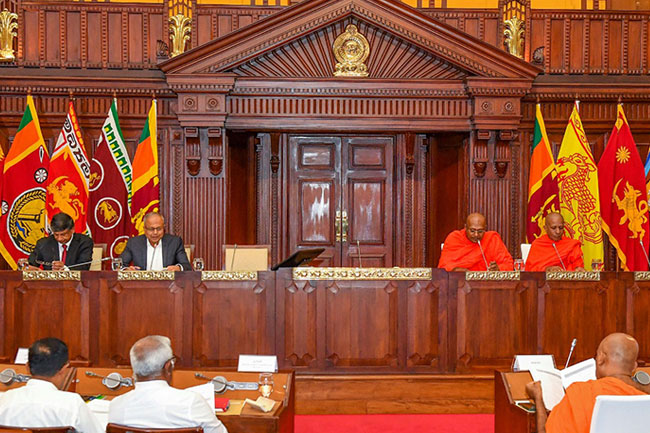
This has been discussed during a meeting held yesterday (18) between Tamil Parliamentarians from the North and East and President Ranil Wickremasinghe. The discussion was held in order to discuss the issues relevant to the community in the Northern and Eastern Provinces such as ethnic issues, infrastructure development and the reconciliation process.

According to sources within the Presidential Secretariat, several important matters such as the implementation of the water for the North programme, the development of tourism in the Northern and Eastern Provinces, developing Jaffna as a University town, and the development plan for renewable energy had been taken into discussion.

Apart from that, it was revealed in the discussion that a draft law for the Office of National Unity and Reconciliation (ONUR) has been sent to the Attorney General for constitutionality review and is to be presented to the Parliament shortly. The national action plan on reconciliation drafted by the ONUR is also to be presented to the Cabinet of Ministers soon.

As per the President’s Media Division, the Interim Secretariat for the Truth Seeking Mechanism was established with the Director General and applications are invited for key staff to facilitate stakeholder consultations and draft guidelines.

Meanwhile, President Wickremesinghe told Tamil MPs that the Anti-Corruption Law will undergo Committee Stage amendments in the Parliament today (19) and that amendments which were proposed by the Supreme Court will also be considered.

The discussion was held on the eve of President Wickremesinghe planning his first visit to India since he became the President of Sri Lanka, next week.

Since December 2022, Wickremesinghe had opened up a dialogue with the TNA in a bid to settle the long standing Tamil minority demand for political autonomy. Wickremesinghe mooted the idea for the full implementation of the India backed 13th Amendment which came to be opposed by the Buddhist clergy.

The 13th Amendment provides for the devolution of power. India has been pressing Sri Lanka to implement this which was brought in after the Indo-Sri Lanka agreement of 1987. The Tamil people’s side insisted on resolving the immediate issues of concern such as the release of private lands held for military purposes, the release of Tamil political prisoners and conflict reparations.

Although some of the lands came to be released and a few prisoners were also released, the Tamil community’s side remains largely dissatisfied. A few former militant Tamil parties who are not part of the TNA, have also written to Indian Prime Minister Narendra Modi urging him to pressure Wickremesinghe into the full implementation of the 13th Amendment.

Meanwhile, a group of religious leaders, educationists, and professionals from Sri Lanka’s Tamil majority from the North and East have written to Modi, urging him to “persuade” President Wickremesinghe to call for PC Elections, without further delay. The civil society members handed over their letter at the Indian Consulate in Jaffna. Sri Lanka’s PCs have been defunct for about five years now, with all nine Provinces under Governors’ rule since the elected Councils’ terms have expired in 2018 and 2019.

Complaints against police over Kurunthurmalai incident

Complaints have been lodged against the police over a use of force against Hindus involved in religious activities at Kurunthurmalai archaeology site in Mullaitivu.

Thurairasa Raviharan, a politician, and three people’s activists complained to Mullaitivu police on July 14 over the incident earlier in the day.

The Vavuniya office of the Human Rights Commission too, has been notified.

The Mullaitivu magistrate permitted a Pooja at the site, notwithstanding a police request for a ban based on a complaint by a Buddhist monk residing there.

Monks and Buddhists who had gathered objected to the Hindu religious activity.

With tensions flaring, police ordered both sides to vacate, but neither relented.

Using force, police tried to drag the Hindus and Tamil political activists present there.

Despite the attempts, the religious function went ahead and the Hindus dispersed around half an hour later.

The incident comes in the wake of an assurance by president Ranil Wickremesinghe to resolve the controversy surrounding the site claimed by both Hindus and Buddhists.

Religious affairs minister Vidura Wickramanayake said they were awaiting a court ruling in that regard.

Posted in Uncategorized

July – the most momentous month

The month of July has had an uncanny relationship with landmark events in recent Sri Lankan history. The latest took place only last year. A cataclysmic mass movement (“Aragalaya”) resulted in an elected President fleeing the country and being replaced in an unprecedented manner by one whose party had been comprehensively defeated in the preceding parliamentary elections.

However, the truly epoch-making series of events took place way back in July 1983.

The July 83 anti-Tamil riots ripped Sri Lanka apart. They triggered the mass exodus of Tamils who came back to haunt Sri Lanka as the formidable “Tamil Diaspora”. The riots led to Indian political and military intervention. But most importantly, the riots gave birth to Tamil terrorism and a full-scale war for 26 years.

Sharvananda Commission

In 2001, eight years after the riots, President Chandrika Kumaratunga set up a three-man commission to go into the causes of violence in Sri Lanka between 1981 and 1984. Headed by S. Sharvananda, the commission had S.S.Sahabandu and M.M.Zuhair as its other members.

The commission reported that the violations of human rights directed against the Tamils were “unquestionably the worst in Sri Lanka’s modern history.”

“The killings, torture and harassment of unarmed Tamils went hand in glove with the more widespread destruction of and damage to Tamil homes, businesses and industries. Over 75,000 Tamils in Colombo alone and nearly 100,000 in all, were temporarily located in nearly 27 refugee camps. Refugees in large numbers were sent to the North by ships since the government had failed to stop the violence which raged for a period of ten days.”

On the death toll, the report noted that the government acknowledged 350 dead even as the Tamils claimed over a thousand dead. The toll included 51 killed in the North by the army on July 24, the 35 Tamil prisoners killed by fellow prisoners in Welikade on July 25 and another 18 prisoners killed on July 27.

More than 18,000 houses and numerous commercial establishments were destroyed, and hundreds of thousands of Tamils fled the country “though many Sinhalese and Muslims courageously sheltered Tamils against the politically-backed hoodlums,” the report noted.

The pogrom was triggered by the killing of 13 Sri Lankan soldiers by the Liberation Tigers of Tamil Eelam (LTTE) in Tirunelveli (Jaffna) on July 23.

But trouble was brewing even before July 23. The Sharvananda report quotes President J.R.Jayewardene’s telling the London-based Daily Telegraph of July 12: “I am not worried about the opinion of the Jaffna people now. Now we can’t think of them. Not about their lives or their opinion about us on terrorist issues. We are going to deal with them ourselves, without any quarter being given”.

Civil servant Devanesan Nesiah said in an article in Groundviews in July 2013, that the regulation permitting the police to get rid of bodies without a judicial inquiry was extended island-wide with effect from July 18, well before the commencement of the pogrom.

On July 28 in the midst of rioting, President Jayewardene appealed for calm over television, but he had no message for the victims or apologies, the Sharvananda noted.

First Suicide Bombing

On July 5, 1987, Sri Lanka saw its first suicide bombing. Vallipuram Vasanthan alias Capt.Miller, an LTTE cadre, drove a truck laden with explosives into an army camp in Nelliady (Jaffna) killing 40 soldiers. This day was observed every year as ‘Black Tiger Day’ by the LTTE till its decimation in 2009. Between 1987 and 2008, 356 called ‘Black Tigers’, had laid down their lives in suicide missions.

The India-Sri Lanka Accord was signed by President Jayewardene and Indian Prime Minister Rajiv Gandhi on July 29, 1987. It aimed at ending the fighting between the Sri Lankan armed forces and the LTTE and laying the foundation for the devolution of power to the provinces, principally to the Tamil-speaking North and East.

But the opposition Sri Lanka Freedom Party (SLFP) led an agitation and the Janatha Vimukthi Peramuna (JVP) took to violence against the Indian intervention. On July 30, Rajiv Gandhi was hit on the neck by a naval rating Wijemuni Vijitha Rohana de Silva who was participating in the Guard of Honour. He took a swipe at the Indian leader’s head with his rifle butt, but only managed to graze his neck.

Rohana de Silva faced a Court Martial that charged him with attempted murder, but his defence team, made up of top lawyers like Sarath Wijesinghe, Susil Premajayantha, Stanley Thilakaratne and Nalin Laduwahetty, argued that he was not aiming to kill Rajiv Gandhi since he did not stab him with the bayonet affixed to his rifle but only hit him with the butt.

The court martial found him guilty of culpable homicide not amounting to murder and sentenced him to six years in prison. But he was pardoned by President R. Premadasa two and a half years into his prison term. Subsequently, he became a graduate, a professional astrologer and a seller of Buddhist and Hindu religious videos. He even contested the 2000 general election as a “Sinhala Urumaya” candidate.

On July 18, 1996, the Mullaitivu army base in the North was overrun by the LTTE, killing 1,400 Sri Lankan troops. This was a major blow to the army which had wrested Jaffna from the LTTE only a year earlier. On July 24, 1996, bombs placed by the LTTE in four railway carriages in Dehiwela killed 64 and injured 400.

The next major LTTE strike was at the Bandaranaike International Airport cum air force base at Katunayake on July 24, 2001. Fourteen LTTE Black Tiger cadres destroyed or damaged 26 military aircraft including jet fighters and choppers. Parked Airbus civilian aircraft were also damaged causing a loss of US$ 350 million. Tourism caved in and the GDP growth became negative as a result of the attack on the country’s only international airport.

On July 29, 2017, a controversial agreement was signed by Sri Lanka and China with the former leasing out Hambantota port for 99 years to a Chinese company for US$ 1.1 billion. India and the West harboured apprehensions about the use of the port by China for its military expansion, though the Lankans and the Chinese insisted that it would be a commercial port.

Exit of Gotabaya

The dramatic and ignominious end of the Gotabaya Rajapaksa Presidency took place in July 2022. President Gotabaya would go down in history as the first Sri Lankan Head of State and government to flee from the country as a result of a public uprising.

His mismanagement of the COVID-hit Sri Lankan economy made Gotabaya Rajapaksa’s ambition of opening “Vistas of Prosperity” for Sri Lankans, a tragic farce. In July 2022 the offices and residences of the President and the Prime Minister were stormed and occupied by mobs. Prime Minister Ranil Wickremesinghe’s personal residence, housing thousands of books and works of art, was burnt to ashes by a mindless rabble.

President Gotabaya had a tough time getting out of the country as the airport and airline staff did not allow him to take a flight. He had to be flown to Maldives secretly by an Air Force plane. With the Maldives allowing him to land only as a transit passenger, he flew to Singapore by the next available flight. But even Singapore allowed him only a temporary sojourn. On July 13, he sent in his resignation by email.

July 2022 also saw Ranil Wickremesinghe becoming President, not by a popular vote but by a vote of parliament in which his party had no elected member. Wickremesinghe had been appointed Prime Minister by President Gotabaya in May following the resignation of Prime Minister Mahinda Rajapaksa. Wickremesinghe became Acting President on July 13 and was elected President by parliament on July 21, bringing the curtains down on the most unusual political turmoil in Sri Lanka in recent times.

By P.K. Balachandran/Daily Mirror

Embarkation levy of 50% on Jaffna Int’l Airport extended for another 6 months

The government today approved the extension of the 50% Embarkation Levy for Jaffna International Airport (JIA) for another six months.

Addressing the weekly cabinet briefing, Cabinet spokesman Minister Bandula Gunawardana said the period ended on July 11 and therefore the Cabinet approved the proposal presented by the Ports, Shipping and Aviation Minister to extend this period.

With the extension of the period the passengers using the JIA can purchase air tickets at an affordable price and it will also promote the Jaffna International Airport, Minister Gunawardana said.

Posted in Uncategorized

Sri Lanka Agri minister frowns at groups stopping “monkey business” with China

Sri Lanka ‘s Agricultural Minister criticized the move by environmental groups to stop proposed “monkey business” with a Chinese firm through a court order and demanded the same groups to find a solution for crop damage by the animal.

Sri Lanka made global headlines when Minister Mahinda Amaraweera said he was in discussion with a Chinese firm to export 100,000 monkeys for some zoos in China.

Thirty petitioners including some environmental organizations filed action in the Court of Appeal against the statement made by Amaraweera regarding the exporting of toque macaque monkeys to China. On June 26, the Attorney General stated that the Department of Wildlife and Conservation had issued instructions mentioning that they would not be taking steps to export the monkeys to China.

Amaraweera wanted to export toque macaque monkeys because of excess crop damage caused by them.

“We have to ask about the damage by monkeys from those (environmental organizations),” Amaraweera told a media briefing in Colombo on Monday (17) when asked about the crop damaging monkeys.

He said with the monkey exporting story, Sri Lanka got requests from many other countries to provide them the crop damaging animals as well.

“But unfortunately there are organizations which are based in Colombo and receive dollars from foreign countries. They have now stopped the move by going to the court,” the minister said.

“But there is significant crop damage. If we get an opportunity tomorrow, we are ready to act on the idea. This is not something I should only do. Many ministries should get together and do this. From our side, I suggest somehow either by sending them to other countries or through any other means, control them.”

He said the Chinese company in writing asked for 100,000 toque macaque monkeys in several batches and the first batch was to consist of 2000.

“It is for the zoos and they have around 20,000 zoos. But a lot of environmental organizations in our countries started to shout that this was to eat monkey’s brain and meat. They influenced China, its embassy here, protested and did all sorts of things. While we were trying to verify the company, they have also gone to the courts. The court has now stopped it.”

Export of wild animals is banned by Sri Lanka, but the government earlier this year removed several species, including monkeys, from a protected list allowing farmers to kill them because of excess crop damage.

Sri Lankan authorities have estimated the monkey population at two to three million in the South Asian nation of 22 million people. Monkeys are considered pests by farmers.

Posted in Uncategorized

All country passports for Sri Lankans in rehabilitation camps in Tamil Nadu

All country passports are to be issued for Sri Lankans living in Rehabilitation Camps in Tamil Nadu, the President’s Media Division said.

The Department of Immigration and Emigration has received a list of 2,678 Sri Lankans living in rehabilitation camps in South India.

Of the 2,678, those with both a Sri Lankan birth certificate and national identity
card can be issued all country passports, the President’s Media Division said.

The matter had been discussed at a meeting between President Ranil Wickremesinghe and Tamil political parties held today.

“A decision has to be taken to issue all country passports to the rest of the list of Sri Lankans living in rehabilitation camps in South India,” the President’s Media Division said.

Posted in Uncategorized

Sajith accuses Govt of attempting to influence judiciary & Election Commission

Opposition Leader MP Sajith Premadasa has revealed alleged action by the government to influence the judiciary and the Election Commission.

In a special statement issued today (17), the Opposition Leader charged that the government has suddenly convened the meeting of the Committee on Parliamentary Business today and has submitted a motion to appoint a ‘select committee’ to investigate the way the Election Commission and its members worked on the country’s election program.

Stating that the motion will be taken up in Parliament tomorrow (18), he also claimed that the government is in a hurry to take up this motion only to apply pressure on the newly appointed Election Commission and the hearings before the court in order to coerce the court and the Election Commission to implement the government’s agenda instead of implementing the democratic agenda.

The opposition leader said that a select committee will be appointed in Parliament tomorrow to investigate how the Election Commission dealt with the local government election affairs to give a hint and an indirect threat to the current Election Commission that it should work according to the government’s agenda, or else, it would have to appear before a Parliamentary Select Committee.

He also said that this also gives a hint that if the judges do not act according to the whims and fancies of the government and the court decisions are not implemented accordingly, even the judges can be brought before a select committee and put under pressure.

The opposition leader pointed out that at a time when everyone is talking about a system change in a bankrupt country, the decrepit and outdated system is being implemented through this select committee by playing this political game and political magic.

While pointing out that this government, by its activities, has already deprived the people of their sovereignty, freedom and universal franchise, MP Sajith Premadasa said that the government is going to put pressure on the judiciary and the Independent Election Commission, adding that it is not Members of Parliament of People’s Alliance whose privileges have been infringed but 22 million people in the country.

Stating that no room will be given to take away the independence of the judiciary and apply undue pressure on the independent and impartial Election Commission, MP Premadasa vowed that he will work for the upliftment of the 22 million people by strengthening the independence of the judiciary and the Election Commission and democracy by bringing together all parties of the Opposition.

MP Sajith Premadasa further emphasized that they will defeat all these insidious attempts on the part of the government to destroy democracy.

Posted in Uncategorized

Lankan Tamil civil society seeks justice from Modi

Members of the civil society in the Tamil-speaking Northern and Eastern provinces of Sri Lanka have written to the Indian Prime Minister Narendra Modi seeking his intercession with Sri Lankan President Ranil Wickremesinghe for finding solution to their long-pending problems.

The letter was handed over to Ram Mahesh an official of the Indian Consulate General in Jaffna by a delegation headed by Dr.Balasundaram Pillai, Emeritus Professor at Jaffna Univedrsity on July 12.

Here is the full text of the letter:

“We the undersigned members of Civil Society living in the Northern and Eastern Provinces of Sri Lanka wants to bring our following concerns to your kind attention.

Firstly, we thank the Government of India for their immense support and cooperation for the Government of Sri Lanka, particularly during the last sixteen months in providing the much needed financial and other necessities to ease the hardships the people of Sri Lanka faced.

We are also grateful for the generous support your government gave in rebuilding the infrastructure in the Northern and Eastern Provinces and other connectivity projects such as Jaffna- Colombo Railway, Palaly – Chennai flights and proposed Tamil Nadu- Jaffna ferry services. These projects along with the many intended investment programs will certainly help to regenerate the stagnant economy of Tamil Provinces along with the other Provinces and generate desperately needed employment opportunities.

It is fourteen years since the war ended but the social and economic conditions of our people have not progressed as expected. In addition to the hardships all Sri Lankan people are facing due to the bad management of the economy, Tamil people are facing additional difficulties. For example, education standards are rapidly going down in Tamil Provinces.

Agricultural sector made hardly any progress mainly due to the occupation of fertile lands in Tamil provinces under various pretexts.

The vast majority of the people and many leading members of various civil society organizations feel there is a need for an approachable Tamil administration at Provincial level to plan and manage all sectors efficiently. At present this is only feasible by having an elected Provincial Governments in the Northern and Eastern Provinces.

It is unfortunate that our Tamil political leaders are disunited merely for political reasons and this continues without having any meaningful working program to attain the aspiration of Tamil People. However, majority of the people desperately need a Tamil administration at provincial level. This was amply demonstrated by the fact that since the end of the war, the largest number of people voted in any elections, was only in the 2013 Provincial elections.

We are fully aware that the Government of India has been consistently calling for the full implementation of the 13th Amendment and to have a functioning Provincial Councils in the Tamil Provinces.

We earnestly appeal to you to reiterate that position and use this opportunity to persuade the visiting President Hon Ranil Wickremasinghe to call for an early Provincial Council election Sri Lanka.”

Thank You.

Signed:

Srila Sri Gnanasampantha Paramachariya Swamigal, Nallur Atheenam. Srila Sri Vasutheva Kurukkal, Veenagana Kurupeedam.

Bishop Kingsley Swampillai, Retired Bishop Trincomalee. Bishop Joseph Rassiah, Bishop of Batticaloa.

Rev. P. J. Jebaratnam, Vicar General, Bishop House, Jaffna.

Bishop Dr. V. Gnanathayalan, Bishop, Church of South India- Jaffna. Prof. S. Pathamanathan, Chancellor of Jaffna University.

Dr. V. Vivekanandarajah, Former Chancellor of Eastern University. Dr.K.Premakumar, Former V.C, Eastern University.

Prof. Pon Balasundarampillai, Former V.C., Jaffna University. Prof. C.Arulmoli, Eastern University.

Prof. T. Krishnamogan, Eastern University.

Prof. S.Mounaguru, Former Dean, Faculty of fine arts, Eastern University Prof. S.Padmanaban, Dean, Faculty of Hindu studies, University of Jaffna. Kosalai Mathan, Deen Facultry of Law, Jaffna University.

Rev. S.V.B. Mangalarajah, Justice & Peace Commission of Jaffna.

Rev. J.C.Paul Rohan, Dept. of Christian Civilization, University of Jaffna. S.Ethirmanasingam, Former Cultural Director, Eastern Province.

S.Samithamby, Retired SLAS officer – Batticaloa.

A.S.Yogarajah, Retired Principal of Teachers Training College, Batticaloa. Dr. K.Parathan Kanthasamy, Retired Assist. Director of Education, Kalmunai.

A.Jathindra, Executive Director, Centre for Strategic Studies – Trincomalee (CSST) T.Thavasilingam, Chairman, Consortium of NGO, Trincomalee.

K.Yoganathan, Retired Principal, Trincomalee.

O.Kulenthiran, Retired Additional Director of Education, Trincolee. K.Sivanathan, Retired Senior Superintend of Surveyor, Trincomalee. Dr. C.S.Jamunanantha, Teaching Hospital, Jaffna.

R.Jeyasegaram, President, Jaffna Chamber of Commerce. E.S.P.Nagaratnam, Chairman, ESP Nagaratnam Group, Jaffna. R.Perinpanayagam, Trastee, Chelvanayagam Memorial Foundation. S.Laleesan, Principal, Kopay Teachers College, Jaffna.

Malini Ajanthan, Jounalist, Woman Activist, Jaffna,

S.Mahalingasivam, Director, Eelanadu Daily. E.Chelvachandran, COO, Ask Group of Companies, Jaffna.

K.Senthilkumaran, Deputy Principal, Kopay Teachers College, Jaffna. K.Balashanmuhan, Lecturer, Kopay Teachers College, Jaffna.

R.Rajabalan, Lecturer, Kopay Teachers College, Jaffna. S.Manoharan, Lecturer, Kopay Teachers College, Jaffna. T.Thavasegar, Lecturer, Kopay Teachers College, Jaffna. Mrs B.Sharminila, Lecturer, Kopay Teachers College, Jaffna. Ms S.Rajeetha, Lecturer, Kopay Teachers College, Jaffna.

Ms Dharshini, Lecturer, Kopay Teachers College, Jaffna. S.Pramanathan, Jaffna National College of Education.

T.Elankumaran, Jaffna National College of Education. T.Tharmasivan, Jaffna National College of Education. V.Narenthiran, Jaffna National College of Education. S.Mavirathan, Jaffna National College of Education. J.Uthayakumar, Jaffna National College of Education. R.Sharmija, Jaffna National College of Education.

M.Gayathiri, Jaffna National College of Education. V.Sutharshini, Jaffna National College of Education. C.Vijayan, Jaffna National College of Education.

K.Jothirajah, Jaffna National College of Education. S.R.Sathiyanatha Pillai, Jaffna National College of Education. S.Mugunthan, Jaffna National College of Education.

S.Pathmarajah, Jaffna National College of Education. P.Viyavasuman, Jaffna National College of Education. T.Vageswaran, Jaffna National College of Education. S.Kugan, Jaffna National College of Education.

G.Cinthuja, Jaffna National College of Education. M.Anantharajha, Jaffna National College of Education.

Dr (Mrs) C.Nagendra, Jaffna National College of Education. S.Vaasavan, Jaffna National College of Education.

G.Sutharsan, Jaffna National College of Education.

A.Loganathan, Jaffna National College of Education. A.James Mary Shan, Jaffna National College of Education. M.J.T.Sheltan Jude, Jaffna National College of Education. K.Uthayasanther, Jaffna National College of Education.

T.Sivageesan, Jaffna National College of Education. G.Gajooran, Jaffna National College of Education.

P.Velnith, Jaffna National College of Education.

Mrs S.Subathirai, Jaffna National College of Education. N.Ambigan, Jaffna National College of Education.

N.Nanthakumar, Jaffna National College of Education. M.Bagetharan, Jaffna National College of Education. T.Mohan, Jaffna National College of Education.

P. Nagendran, Social Activist, Mankulam

Pon. Thanabalasingam, Princilal- Jaffna Hindu College Primary.

S.S.KUHANATHAN (Chairman, Ask Group of Companies) Coordinator of the People’s Petition.

40 Racca Lane, Jaffna. Tel: +94 773343320

Email: sskuhanathan@gmail.com

Pakistan PM appreciates President Wickremesinghe’s support to secure IMF deal

Prime Minister of Pakistan Shehbaz Sharif has appreciated President Ranil Wickremesinghe for the support extended to Pakistan pertaining to the country’s agreement with the International Monetary Fund (IMF).

The Pakistan Premier acknowledged President Wickremesinghe’s support during key discussion with the IMF.

The Pakistan High Commission in Colombo said, Prime Minister Shehbaz Sharif also discussed the current economic situation in Sri Lanka and Pakistan during a phone conversation with President Ranil Wickremesinghe.

“You have played role of a true friend and a well wisher of Pakistan, and I thank you on behalf of the people of my country,” the Pakistani Prime Minister had told President Wickremesinghe.

The High Commission said the Prime Minister paid tributes to Sri Lanka for its role in promoting regional peace and development.

He also hoped that both Pakistan and Sri Lanka would come out of the economic crisis very soon