SJB to hold protest on Monday against bid to put off polls

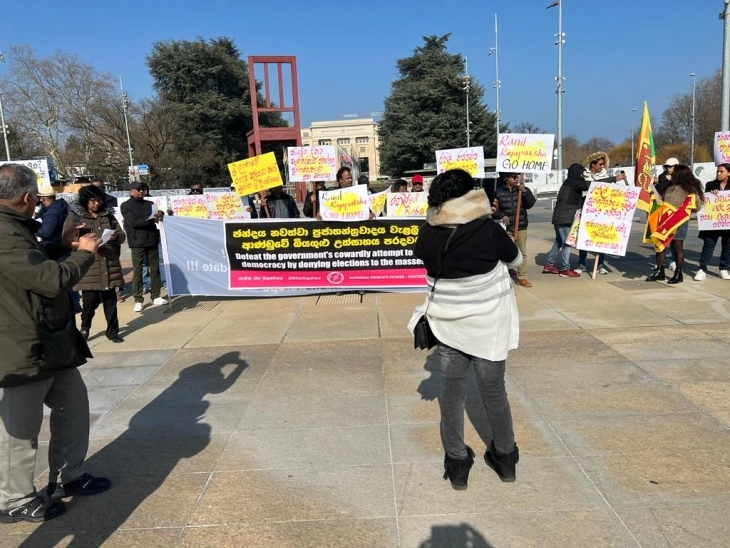
The Samagi Jana Balawegaya (SJB) will on Monday (20) hold a demonstration against the Government’s attempts to delay Local Government elections which are scheduled to be held on 9 March.

The demonstration will be held opposite the Presidential Secretariat and the Ministry of Finance.

SJB General Secretary Ranjith Madduma Bandara invited the public to participate in the demonstration. “We ask the people to fight for their rights. The President might next claim there are no funds for a Presidential election. Therefore, we ask the people to join us on 20 February to protest against this,” he said.

He assured the party will fight alongside the people. “The Government is attempting to curtail the people’s right to franchise. The Government is now trying to bankrupt democracy in a bankrupt country,” he said, adding that the Government is acting in this manner as it is aware the SJB will emerge victorious at the polls.

Posted in Uncategorized

BASL charges: Concerted effort to prevent elections and endanger sovereignty of the people

The Bar Assocation of Sri Lanka has charged that there is a concerted effort to prevent elections, to undermine the franchise of the people, and endanger the sovereignty of the people of Sri Lanka.

FULL STATEMENT:

“The Bar Association of Sri Lanka (BASL) expresses its deep concern over recent attempts by state authorities to disrupt the Local Authorities Elections, which are mandated by law to be held prior to March 19th, 2023. The BASL emphasizes that all elections are a vital part of Sri Lanka’s democratic process and must not be hindered.

The BASL notes several decisions by the government in recent weeks, purportedly aimed at managing public funds, have had the effect of preventing the Elections Commission from conducting the elections. These include a demand by the Government Printer for the release of funds prior to the printing of ballot papers and the Secretary to the Treasury claiming that there are no funds available for the elections. This is despite a budget allocation of Rupees Ten Billion for the purpose of elections

The BASL states that the conduct of the Secretary to the Treasury, the Government Printer, and other government officials and institutions over the last few weeks clearly demonstrates a concerted effort to bring the elections to a halt, thus undermining the franchise of the people and endangering the sovereignty of the people of Sri Lanka. Such attempts to prevent elections mandated by law represent an unprecedented attack on democracy and the rule of law and pose a grave threat to the electoral process in the future.

The BASL warns that such actions could set a dangerous precedent for an unpopular executive or legislature to obstruct the allocation of resources for an election and prevent the people of Sri Lanka from choosing their representatives and leaders.

The BASL also points out that Article 104 B (2) and 104 GG (1) of the Constitution make it clear that all state authorities are duty bound to cooperate with the Elections Commission and that refusing or failing to do so is a criminal offense punishable with imprisonment. In terms of Article 33 (c) of the Constitution the President too is empowered to ensure the creation of proper conditions for the conduct of free and fair elections, at the request of the Election Commission.

On the 15th December 2017 the Supreme Court in SCFR 35/2016 on 15th December 2017 has clearly explained the importance of conducting timely elections for local authorities and the importance of the franchise as follows:

“Franchise is a fundamental right enjoyed by people. According to Article 3 of the Constitution “In the Republic of Sri Lanka sovereignty is in the people and is inalienable. Sovereignty includes the powers of the government, fundamental rights, and the franchise”. Franchise is a fundamental right recognized under Article 10 and 14(1) of the Constitution. The failure to hold elections on the due date or postponing is a violation of a fundamental rights of the people . Under Article 4(d) of the Constitution the fundamental rights which are by Constitution declared and recognized shall be respected, secured and advanced by all organs of the Government and shall not be abridged, restricted or denied save in the manner and to the extent hereinafter provided. In the present case the legislature as well as the executive had violated this Article.”

On 11th January 2023, the BASL warned that any move to interfere with the franchise will have far reaching consequences. Previous attempts by different administrations over the years to interfere with the franchise of the people have resulted in disastrous consequences for the country and its people.

It is the sacred duty of the Government to ensure that funds are provided for the conduct of the elections which are an essential function in the country. The BASL calls on the government and all State Officials to respect the Constitution and the law and ensure that the Local Authorities Elections are held as scheduled, without any further attempts to disrupt or interfere with the process.

The BASL is of the view that all attempts to interfere with the electoral process must not only be defeated but all those responsible for such interference must be dealt with in accordance with the law.”

SL cannot afford to plunge into another crisis over LG polls

The upcoming Local Government (LG) is deemed to be one of the most decisive elections in the history of Sri Lanka, which could result in a massive breakthrough. However, the possibility of holding the election is getting uncertain day by day with the recent statement made by the Secretary to the Ministry of Finance that it is difficult to release funds for holding the LG polls given the current economic challenges.

In addition, the Supreme Court has also given green light for the Election Commission (EC) of Sri Lanka to hold the election as scheduled. In this context, it is imperative that the political hierarchy and citizens set the tone for the smooth conduct of the election without causing any sort of hindrances resulting in putting off the polls and creating chaos in the country.

The EC in struggle

Finance Ministry officials have informed the Chairman of the Election Commission, Nimal Punchihewa that due to a circular issued recently, it is possible to allocate money only for essential services, adding that election activities have not been designated as an essential service under the said circular.

Accordingly, Finance Ministry officials have pointed out that if funds are to be issued to institutions that do not come under the category of essential services, the approval of President Ranil Wickramasinghe as the Minister of Finance must be obtained.

At the same time, an estimated sum of Rs. 770 million is reportedly required for the month of February, in order to meet the basic expenses incurred for the upcoming election due to be held on March 09. The Commission has requested the Ministry of Finance in writing to allocate
However, the EC is in a struggle to carry out its essential and urgent election duties as the Treasury has given only Rs. 100 million to the EC in spite of demanding Rs. 770 million for its day-to-day tasks.
According to the EC Chairman, if the Treasury continues to delay the provision of required funds for the EC, the Commission has no option other than reporting to the Supreme Court.

“The budget 2023 has allocated Rs. 10 billion for the EC in a special vote in Parliament as the EC is an independent Commission. We are hopeful that the EC could successfully conclude the Local Government (LG) polls with a budget of Rs. 3 or 4 billion by March 9. The Commission last week requested only Rs. 770 million out of Rs. 10 billion for the month of February to carry out immediate tasks related to the March 9 LG polls. The underfunding has put the EC in a severe financial constraint,” the Chairman of the Commission, told reporters recently.

Moreover, the EC will have to extend another request to the Treasury for election expenses for the month of March after calculating the cost to complete the election on March 9. The EC requires a minimum of Rs. 3 billion to conclude the LG polls on March 9 as most of the expenses are borne by other state establishments like the Police Department, and Government Printer, and payments to public officials for election duties are made after the conclusion of the election.

More confusion popping up

Meanwhile, Government Printer Gangani Kalpana Liyanage has said that initial printing activities in preparation for the 2023 Local Government Election have been completed adding that, the Government is yet to provide security for the smooth conduct of the ballot paper printing activities.

According to Liyanage, the Police have deployed only three police officers despite the request made to the police chief to deploy 60 police officers to oversee the security measures during ballot paper printing.
In this context, the Election Commission stated that if the ballot papers are received on time, the postal voting of the LG polls can be held on February 22, 23, 24, and 28 as scheduled. However, if the ballot papers are not provided on time, the Commission has to decide on new dates for the postal voting of the LG election, which could delay the entire proceedings.

For a free and fair election

In a backdrop where the Supreme Court has given the green light to the EC to go ahead with the LG election, a free and fair election is very much on the cards. However, the EC is yet to make an official statement with regard to the election in the wake of the statement of the Secretary to the Ministry of Finance. Nevertheless, the Treasury and the Finance Ministry have a constitutional and official obligation to transfer sufficient funds to the EC in time to ensure democracy and a free and fair elections.

In addition, as it is evident, the policies implemented by incumbent President Ranil Wickremesinghe do not reflect the mandate of the people as he was not elected by the people. In addition, the present composition in Parliament is also in a mess. In this context, the political analysts are of the viewpoint there an election is the need of the hour and in the event of no election, there is a tendency and possibility that people would rally around and come to the streets to show their agitation.

However, in spite of whether the election being held or not, the country cannot afford to go for another uprising, which would definitely aggravate the current crisis in the country. Therefore, the people of Sri Lanka should be mindful of the fact that the country needs to move on and stick to its priorities while ensuring democracy.

Local Govt polls: EC to file special motion before Supreme Court

The Election Commission has decided to file a special motion before the Supreme Court citing difficulties it is facing while preparing to hold the 2023 Local Government Election on March 09.

The election body has cited inadequate funds, inadequate supply of fuel for transportation, the inability to print the ballot papers by the Government Printer and several other issues as obstacles to going ahead with LG election preparations.

Posted in Uncategorized

Ex-deputy minister Myown Mustapha jailed for 6 months, loses civic rights for 7 years

The Colombo High Court has sentenced former deputy minister Myown Mustapha to six months in prison for trying to buy out National Freedom Front’s Mohammed Muzammil to support 2010 presidential election candidate Field Marshal Sarath Fonseka.

Further, Mustapha’s civic rights were also suspended for seven years.

The case was called before Colombo High Court Judge Aditya Patabendige on Friday (Feb 17).

On January 15, 2010, Muzammil, who convened a media briefing, disclosed that Mustapha had attempted to bribe him with a sum of Rs. 42 million to back Fonseka in the 2010 presidential election.

Following a lengthy trial, the Colombo High Court delivered the verdict of the case, 13 years after indictments were filed against Mustapha by then-Attorney General.

Delivering the verdict, the high court judge stated that the charges against the accused have been proven beyond a reasonable doubt after taking into consideration the telephone conversations, voice recordings and CCTV footage submitted as evidence in the case.

He also expressed regret about not being able to impose a severe punishment on the accused despite the severity of the offence he has committed.

Posted in Uncategorized

German companies may withdraw from SL if import ban continues

German companies operating in Sri Lanka have raised the red flag with some warning they will be compelled to withdraw from the country if the import ban continues, Daily Mirror learns.

Sri Lanka has slapped an import ban on several items owing to the shortage of US dollars, but Germany has urged the Government to relax the ban.

The German Ambassador to Sri Lanka Holger Seubert told a group of journalists in Colombo today that some German companies have raised concerns over the import ban.

He said that if the import ban continues for another 2 years then some companies may withdraw from the country. A number of German companies are operating in Sri Lanka and promote German products, including vehicle spare parts.

Just recently leading Japanese companies Mitsubishi and Taisei announced they will be scaling back operations in Sri Lanka owing to the economic crisis. Germany has also suspended issuing loans to Sri Lanka after the island declared bankruptcy.

However, the German Ambassador said that they hope the situation will improve once Sri Lanka’s deal with the International Monetary Fund (IMF) gets approved. Seubert said that there are also concerns over the overall business environment for German investors.

Discussions in this regard have been held with the Sri Lankan authorities, including the Board of Investment (BOI).

IMF mulls loan approval to Sri Lanka, even without China’s assurance

The International Monetary Fund (IMF) is considering approving a loan for Sri Lanka, even without China’s assurance of debt-restructuring support, Bloomberg News reported on Friday (Feb 17).

Under a rarely used policy, the global lender may consider approving the island nation’s loan, as the only prerequisite hindering the go-ahead is China’s formal assurance, Bloomberg reported, citing people familiar with the matter.

“The Sri Lankan authorities continue to seek from their official bilateral creditors financing assurances so that the Fund’s Executive Board can consider their request for an IMF arrangement,” an IMF spokesperson said in a statement to Reuters.

The lender said it was premature to discuss the precise IMF policy modalities that could be applied, adding that IMF staff continue to engage with Sri Lankan authorities on completing upfront policy measures.

Sri Lanka has been fighting its worst economic crisis since gaining independence from Britain in 1948, amidst a shortage of dollars, surging prices and a lack of essential items, such as fuel and medicine. It has defaulted on loans and been forced to seek a bailout from the IMF.

The news the IMF may consider extending aid without assurances from China comes ahead of US Treasury Secretary Janet Yellen’s visit to India next week for G20 finance meetings, where the United States is reportedly going to focus on unblocking debt restructuring for distressed countries.

Earlier in February, the IMF said Sri Lanka’s US$2.9 billion bailout package was set to be approved as soon as the country obtained adequate assurances from bilateral creditors and met remaining requirements.

Posted in Uncategorized

Writ petition against holding LG elections for Matara Municipal Council dismissed by SC

The writ petition filed by an Independent Group seeking an order preventing the Election Commission from holding the local government elections in respect of Matara Municipal Council was today dismissed by the Supreme Court.

The three petitioners including the leader of the Independent Group Chaminda Prasanga Gunasekera filed this writ petition seeking an order quashing the Election Official’s decision to reject their nomination papers submitted for the Matara Municipal Council.

Supreme Court three-judge-bench comprising Justices Buwaneka Aluwihare, Janak de Silva and Priyantha Fernando decided to dismiss the petition taking into account the preliminary objections raised by the Election Commission.

Counsel Nuwan Bopage appeared for the petitioners. Senior Counsel Dharshana Weraduwage with Dhanushi Kalupahana and Ushani Atapattu appeared for the Election Commission.

How Independent are the Independent Commissions? By M.S.M.Ayub

With the postponement of postal voting on Tuesday, the local government elections seem to be hanging in the balance. The main hurdle to the smooth functioning of the Election Commission in respect of the LG polls is the government’s reluctance to release the funds allocated to the Commission by the national budget.

Irrespective of whether the government has the capacity to fund the LG elections which were postponed by one year in February last year, it has been hell-bent on preventing them from happening as scheduled. The reason is obvious and well-known. The popularity of both the ruling parties – the Sri Lanka Podujana Peramuna (SLPP), the party that dominates the Parliament and the United National Party (UNP) led by President Ranil Wickremesinghe – is at a low ebb, owing to the current economic crisis.

The government leaders first attempted to postpone the election through legal means. President Ranil Wickremesinghe said he wants to downsize the LG bodies from over 8,000 to 4,000 members. Then, despite a Parliamentary Select Committee having presented a report on electoral reforms in June last year, they wanted to appoint another one in November for the same purpose. Thereafter, a private member’s Bill on the LG elections which provided for the inclusion of 25 per cent of youth members in local government bodies was presented by SLPP member Premnath C. Dolawatte. Another Bill (The Regulations of Election Expenditure Bill) was passed in Parliament last month.

In spite of the merit of these new laws, one has to infer the motive of presenting them at a time when an election has been announced. These things happened while the leaders of the government were arguing against holding the LG election at this juncture, citing economic hardships faced by the government and the people.
The government leaders made several other attempts other than creating legal hurdles. President Wickremesinghe on January 6 summoned the members of the Election Commission to his office and requested them to resolve the conflicts of opinion among them and it was given wide publicity. However, no such conflicts have been evident so far. He also made a subtle warning that the elections and the GCE Advanced Level examinations might clash which was also proved to be an unfounded fear.

Meanwhile, Secretary to the Ministry of Public Administration, Neil Bandara Hapuhinna had sent a letter to the Returning Officers on January 9 instructing them to stop accepting deposits from the candidates contesting the LG elections. Media reported that Hapuhinna had sent this letter in accordance with a decision by the Cabinet. Later Hapuhinna apologized to the Election Commission for this.

On January 18, two members of the Election Commission, namely S. B. Diwaratne and K. P. P Pathirana, had received death threats, demanding that they resign from their posts. Another Commission member M. M. Mohamed, also had received similar death threats on January 27, to resign from his position. It was said that a CID investigation has been initiated, but the outcome of it is yet to be revealed by the authorities. In fact, one member of the Commission, P.S.M Charles who worked in the North and East during the war as a District Secretary, handed over her resignation to President Ranil Wickremesinghe on Wednesday, January 25 which was accepted by the President on February 7.

Irrespective of whether the government has the capacity to fund the LG elections which were postponed by one year in February last year, it has been hell-bent on preventing them from happening as scheduled

It was against this backdrop that the funding for the election has come to the fore. Though Commissioner General of Elections, Saman Sri Rathnayake stated on January 8 that Rs.10 billion has been allocated for the Local Government polls, Treasury Secretary Mahinda Siriwardena, in relation to a writ application filed by a Retired Sri Lanka Army Colonel, W. M. R. Wijesundara seeking an order to delay the LG polls, had informed the Supreme Court via an affidavit on January 19 that sourcing funds for the election has become a challenge. The petition will again be taken up for hearing on February 23.

This series of events validly raises the question how independent the Election Commission is. In fact, recent events had raised the same question in respect of some other “Independent” commissions as well. Especially, the current power crisis exposed the vulnerability of the independence of two commissions, the Public Utilities Commission of Sri Lanka (PUCSL) and the Human Rights Commission of Sri Lanka (HRCSL).

The conflict of opinion between the PUCSL Chairman Janaka Ratnayake and the Power and Energy Minister Kanchana Wijesekara has emerged over the demand by the Ceylon Electricity Board (CEB) to raise electricity tariffs for the second time. It was only in September last year that the CEB increased the tariff by 75 per cent. The row between the PUCSL Chairman and the Minister escalated with the announcement by the former not to interrupt power supply during the GCE A/L examination between January 23 and February 17.

The CEB ignored the PUCSL Chairman’s announcement. The latter challenged the CEB’s action in the Court of Appeal, but the court rejected it on February 10. Earlier, on January 24 the HRCSL had summoned the PUCSL Chairman Janaka Ratnayake and the Secretary to the Ministry of Power and Energy among others for an inquiry as to why they failed to prevent the implementation of power cuts during the ongoing examination. During the discussion, it was agreed that no power cuts will be imposed from January 25 until 17 February.
When the CEB continued with its power cuts ignoring the agreement, the HRCSL filed a case in the Supreme Court on January 30 for contempt of the commission. The court rejected it. Though one cannot challenge the court ruling, it was a fact that the CEB reneged on the agreement its representative arrived at with other relevant parties on power cuts.

Sometimes the members of independent commissions themselves act in a manner that erodes their independence. Three days after Gotabaya Rajapaksa was sworn in as the President on November 18, 2019, the then Criminal Investigation Department (CID) Director SSP Shani Abeysekara was transferred to Galle by the National Police Commission. It was well known that Abeysekara handled so many high-profile cases against incidents that took place during the previous Rajapaksa government. Subsequent incidents including his arrest very clearly showed the attitudes of Rajapaksas towards him.

The Chairman of the National Police Commission Chandra Fernando and another commission member P.P. Perera had gone to the VIP terminal of the Katunayake airport on November 20 last year when there was a welcome party for former minister Basil Rajapaksa on his return to the country from the US. Whatever the subsequent reasoning of the Police Commission Chairman on his presence at the venue, pictures of him worshipping Rajapaksa had gone viral.
During the last Parliamentary election, one of the members of the Election Commission Professor Ratnajeevan Hoole created a controversy with a comment he made during an interview with the Jaffna-based DAN TV. His comment in Tamil was clearly against the SLPP, but the inadvertent jumbling flow of the comment and the lack of Tamil knowledge of his accusers finally saved his skin.

The independent commissions were established by the 17th Amendment to the Constitutions in 2001 during President Chandrika Kumaratunga’s tenure in order to dilute the executive powers of the President over State machinery. Hence, President Mahinda Rajapaksa, in 2010 made them redundant by way of bringing them under his purview through the 18th Amendment. Again they were detached from the President’s direct control by the 19th Amendment during the so-called Yahapalana government in 2015, but only to reverse it by another Rajapaksa, President Gotabaya Rajapaksa using the 20th Amendment in 2020. Last year’s Aragalaya, the public uprising compelled the current government to somewhat release them again from the clutches of the President.

Every time when they were strengthened they were expected to pave the way for the public service and the judiciary to act independently and without the fear of penalisation by the Executive. However, recent incidents raise the question about the degree of independence of independent commissions.

LG Election: Monitors have their say on lack of funds

The National Center for Election Monitoring of Sri Lanka has urged the National Election Commission to hold discussion with stakeholders to solve the issues related to the provision of funds for the Local Authorities Election.

The NCEMS issuing a statement said the Election Commission should solve the possible problematic situations related to the provision of funds before it turns into a major crisis, through negotiations between the relevant factions.

The NCEMS in a letter has also cautioned that such a situation might arise and requested to hold a discussion between the government, the Treasury and the Election Commission immediately.

The Monitoring Body noted that instead of threatening government officials and intimidating them, relevant officials should hold talks to solve the issues related to lack of funds to conduct the election.

The National Center for Election Monitoring of Sri Lanka added that the threats and intimidation of state officials have an effect on holding a free and fair election and that there is a possibility of very negative effects on the election.

Therefore, the NCEMS requested that according to a specific time schedule, a programme to obtain the funds required for the election should be made through agreements between all parties.