The process of ethnic assimilation, common in the pre-British era, largely ceased under colonial rule when communal identities were fostered and emphasized. It can arguably be said modern Sinhala nationalism emerged in the nineteenth century as a counter colonial movement that used Buddhist identity to mobilize popular support. Buddhism was portrayed as under threat, first from Christian missionaries and later from British capitalist interests, especially in the form of the plantation industry and its perceived deleterious effects including the rising use of alcohol.
As a challenge to the missionaries and a response to the state’s failure to provide the “traditional” patronage to Buddhism, monks began to challenge Christians to religious debates (e.g. Panadura debates of 1862). Pioneering Sinhala nationalists such as Anagarika Dharmapala developed a revivalist movement, which began publishing journals dedicated to promoting Buddhism, Buddhist religious (Dhamma) schools, a Buddhist flag, codes of disciplinary conduct, the codification of Buddhist dogma in opposition to popular folk religious practices and the empowerment of laity to engage actively in Theravada Buddhism and of the Sangha to participate in social and political action.
This early Sinhala Buddhist revivalism deliberately mixed nationalist politics and religion. Its leaders agitated for restoring the tie between state and religion. Their interpretation of history propounded a sense of mission in which the Sinhalese were bound to protect Sri Lanka as an outpost of Buddhism against invaders, colonizers and other religions. This world view was partly informed by the Mahavamsa chronicle. The Mahavamsa gave rise to what can often called a “majority with a minority complex” vis-à-vis the millions of Tamils in India. The perception was that Tamils are essentially tied to a homeland in Tamil Nadu, India. This has remained, and remains, quite widespread. By 1910, there were more than 400,000 Indian immigrant plantation workers and by 1931, 651,000 – a fifth of the island’s population. The first major act of government after independence in 1948 was to deny citizenship and voting rights to some 800,000 Indian workers. This was supported by parts of the Sri Lankan Tamil leadership, undermining their own later claims for minority rights.
Against this backdrop, the aim of the present article is to follow in broad outline the various constitutional provisions for the interaction between Buddhism, the religion of the majority and other groups. Sri Lanka’s political system has been shaped by its history as a British colonial possession, dating from 1801. The British attempted to develop a representative government on the island through an 1833 constitution that created a legislative council. This council was largely powerless, however, and resigned in 1864 when their censure of the British government was ignored. The British attempted several other Constitutions to appease the populace in 1910, 1920 and 1924 but these constitutions did not provide for local governance by the native population.
Provisions of 1910
The Crew-Mcallum constitutional reforms of 1910 show some distinct features. In the history of the constitutional development of the country, for the first time the principle of electing members to the Legislative Council was introduced. However communal representation was not abandoned.
The Sri Lankans were not satisfied with the nominal power granted by the reforms of 1910. Therefore in 1919, they formed the National Congress and began to agitate for systematic constitutional reforms. In response to this in 1920, once again the Legislative Council was reconstituted. Meanwhile on behalf of the Ceylon National Congress which was the organization of those who were clamoring for constitutional reforms, Sir James Peris, submitted proposals to Governor Manning.
Donoughmore Constitution of 1931
The Donoughmore Constitutional reforms were a long stride in the process of the march towards independence of Sri Lanka. This came into operation in 1931. The following are some of the main features of the Donoughmore Constitution. The extension of territorial representation, grant of universal franchise, the establishment of the State Council, the setting up of the Executive Committee system and establishment of a cabinet, curtailment of the Governor’s powers. Communal representation was done away with.
The Donoughmore Constitution, which was in operation from 1931-1947, did not satisfy the aspirations of the Sri Lankans. They continued to clamor for a fully responsible government or dominion status. As a result, the Soulbury Commission, which was sent to Sri Lanka in 1944, proposed a new constitution. Its main features: the position of Governor was abolished and it was replaced by a position of Governor General and a bicameral legislature with a House of Representatives and Second Chamber or Senate was introduced, the appointment of a Cabinet of Ministers with the Prime Minster as its head and the establishment of the Public Service Commission and Judicial Service Commission.
Soulbury Constitution
The Soulbury Commission’s 1945 report, which advocated the British Westminster parliamentary model for the island, explained some of the reasons behind its decision: “It must be borne in mind that a number of the political leaders of Ceylon have been educated in England and have absorbed British political ideas. When they demand responsible government, they mean government on the British parliamentary model and are apt to resent any deviation from it as ‘derogatory to their status as fellow citizens of the British Commonwealth of Nations and as conceding something less than they consider their due”. To put it more colloquially, what is good enough for the British people is good enough for them.
1972 Constitution
Ceylon achieved the status of an independent dominion within the British Commonwealth of Nations on February 4, 1948. Its leaders who inherited power did not deem it necessary to enact a new constitution and preferred to be governed by the Soulbury Constitution of 1946. Initially the major reason for this seemed to be the fact that the Soulbury Constitution was mainly based on the proposals drawn by the ruling elites who, joining hands under the banner of a newly created United National Party (UNP) continued in power when the country attained independence. During 1948-55 the ruling United National Party did not deem it necessary at all to question the efficiency of the Soulbury Constitution. During 1955 however, the question of making Ceylon a republic (a perennial demand of the left parties since 1948) was however discussed inconclusively by the party’s parliamentary group.
In 1970, the Joint Election Manifesto of the United Front asked the voters to permit the Members of Parliament to function co-terminously as a Constituent Assembly to draft, adopt and operate a new constitution which would declare Ceylon a free sovereign and independent Republic. This was reiterated in the Governor General’s Address on 14 June 1970. Consequently on 24 June 1970, a resolution proposing the formation of the Constituent Assembly was passed without division. The draft was finalized and promulgated on May 22, 1972.
In regard to Buddhism, Chapter 2 states:
6. The Republic of Sri Lanka shall give to Buddhism the foremost place and accordingly it shall be the duty of the State to protect and foster Buddhism while assuring to all religions the rights granted by section 18 (1) (d)
18 (1) (d) under fundamental rights reads
(d) every citizen shall have the right to freedom of thought, conscience and religion. This right shall include the freedom to have or to adopt a religion or belief of his choice, and the freedom, either individually or in community with others and in public or private, to manifest his religion or belief in worship, observance, practice and teaching;
It needs to be stated that these freedoms under fundamental rights could according to the proviso of the same article be curtailed
(2) The exercise and operation of the fundamental rights and freedoms provided in this Chapter shall be subject to such restrictions as the law prescribes in the interests of national unity and integrity, national security, national economy, public safety, public order, the protection of public health or morals or the protection of the rights and freedoms of others or giving effect to the Principles of State Policy set out in section 16.
Since its introduction in 1972, the range of interpretations of the Buddhism Chapter has expanded, keeping pace with and reflecting a growing number of political and social concerns. The very mechanisms designed to expand the availability of public law remedies – protocols of judicial review and fundamental rights jurisdiction inspired by traditions of liberal constitutionalism – have made available channels for making public, constitutional claims about Buddhism. In fact, today one even finds a consistent, almost routinized, legal format for Buddhist-interest litigation. In many cases, litigants use judicial review or fundamental rights petitions to advance specific arguments about how to protect Buddhism: they claim that a certain bill or a certain government initiative contravenes or is likely to contravene the state’s duties to Buddhism and/or certain fundamental rights. The most extensive interpretations of Buddhism’s foremost place remain the majority and dissenting opinions of the Rev. Sumana case in 1977 (an application of Rev. Sumana to be admitted and enrolled as an Attorney-at-Law to the Supreme Court).
1978 Constitution
It could be argued that the second Republican Constitution of 1978, introduced by the United National Party government of J.R. Jayewardene was more autochthonous in character than its predecessor. The constitution adopted several features from the French and American Constitutional traditions while preserving several British traditions as well and to that extent was a creative document which according to its champions, suited the needs of Sri Lankan society, but according to its detractors, “the Constitution of the Second Republic like that of the Fifth French Republic was Gaullist not only in the similarity to it of its institutional arrangements, so in that it was designed to suit the personal vision of one man – Junius Richard Jayewardene. The constitution of the Second Republic embodies a profound and cynical realpolitik, a contempt for ideology and a deep concern for that kind of “stable” executive that was believed conducive to development”? Stability for rapid economic development seemed to be the dominant consideration of the framers of the new constitution. Jayewardene himself pleaded for the need to establish political stability and provide for ‘strong’ leadership, an executive freed from the “whims and fancies” of parliament. Apart from the issue of whether the executive should be thus insulated from the whims and fancies of the representatives of the people in a liberal democratic society, it is pertinent to ask whether the Ceylon/Sri Lanka prior to 1978 was particularly unstable. The changing of governments through peaceful, free and fair elections at periodic intervals should surely not be considered a symptom of instability.
Chapter II Buddhism
9. The Republic of Sri Lanka shall give to Buddhism the foremost place and accordingly it shall be the duty of the State to protect and foster the Buddha Sasana, while assuring to all religions the rights granted by Articles 10 and 14(1)(e).
Article 10 (again under fundamental rights)
10. Every person is entitled to freedom of thought, conscience and religion, including the freedom to have or to adopt a religion or belief of his choice.
14. (1) (e) the freedom, either by himself or in association with others, and either in public or in private, to manifest his religion or belief in worship, observance, practice and teaching;
It should be noted that 14 A(3) envisages limitations on these fundamental rights
(2) No restrictions shall be placed on the right declared and by Article, other than such prescribed by law as are necessary in a democratic society, in the interests of national security, territorial integrity or public safety, for the prevention of disorder or crime, for the protection of health or morals and of the reputation or the rights of others, privacy, prevention of contempt of court, protection of parliamentary privilege, for preventing the disclosure of information communicated in confidence, or for maintaining the authority and impartiality of the judiciary.
Choosing Buddha Sasana rather than Buddhism (Sinhala: buddhagama) highlighted the distinctiveness of the Buddha’s dispensation; everything else was simply religion. Choosing Buddha Sasana also supported those who favored a territorialized definition of Buddhism because Buddha Sasanaya implicated not only the Buddha’s teachings but his entire legacy, which included properties, shrines, statutes, temples, other material objects and geographic spaces. The language of protecting and fostering Buddhism was chosen because it neither implied nor denied the possibility of state oversight over Buddhist institutions and monastic life.
Litigants rendered this view of protecting Buddhism – as explicitly including the protection of Buddhist spaces – nationally visible and legally influential in three cases from 1987, 2003 and 2008. In each case, Buddhists petitioned the Supreme Court, requesting that it require the government to guard Buddhist places (temples, historic sites, villages) from threats by Hindu Tamils, Christians and Muslims, respectively. Basically the litigation covered four areas – protecting Buddhist autonomy from the state, protecting Buddhist orthodoxy, protecting Buddhist places and protecting Buddhism from profanation.
A committee of experts under Romesh de Silva was established to prepare a draft Constitution for Sri Lanka and handed it over in July 2022. Currently, it seems to be only of academic interest but it points out the direction of the development of the relation between Buddhism and the minorities.
Draft of 2022 Constitution
Ch 2: 10 The republic of Sri Lanka shall give to Buddhism the foremost place and accordingly, it shall be the duty of the state to protect and foster the Buddha Sasana, while assuring to all religions the rights granted in Articles 26 and 27
In Chapter on Fundamental Duties and Rights
26 (1) Every person is entitled to freedom of thought, conscience and religion
(2) Every person shall have the freedom to have or to adopt a religion or belief of his choice. No person shall be subjected to coercion which would impair his freedom to leave or to adopt a religion or belief of his choice.
(3) Subject to the provisions of the Constitution and any law, parents and guardians as the case may be, have the right to provide for the religious and moral education of their children that is in accord with their own convictions
(4) In this article “coercion” shall include the use of force, allurement and fraud.
27 Every citizen has the freedom either by himself or in association with others, either in public or in private, to manifest his religion or belief in worship, observance, practice and teaching.
It should be noted that #49 broadens the range of the possible restrictions to fundamental rights guaranteed by article 24 (freedom from torture or cruel, inhuman or degrading treatment of punishment) and 26 (freedom of thought and religion). Why these two rights are specifically mentioned is questionable. The range of situations in which the rights can be restricted, arguably can be extended to cover any whim of the executive and legislature.
In Ch 3: Directive Principles of State Policy
13 (1) A council of the Maha Sanga is established to advise and guide the Government in fulfilling the constitutional obligation embodied in Chapter 2 (Buddhism) and 7 (Protection of National Heritage of the Republic of Sri Lanka) and on any other matter the Government may seek the advice of the Council.
235 (4) provides for the National State Assembly to provide special courts for matters dealing with the Buddha Sasana.
Finally, one cannot omit to mention the draconian provisions of 79 under the title “People not to be deprived of their Sovereignty”
79 (1) Whoever within or outside the Republic
Deprives or attempts to deprive or conspires or encourages of promotes the deprivation of the People of the Republic of their Sovereignty
Encourages, promotes, or instigates the United Nations or any organ of the United Nations, any other international organization, any State of person to apply any measures involving the use of armed force against the Republic of Sri Lanka or for the termination or suspension or the interruption of economic relations with the Government of Sri Lanka, or to prosecute, charge or punish any citizen of Sri Lanka in any other jurisdiction, for any offence alleged to have been committed by such person within the territory of the Republic
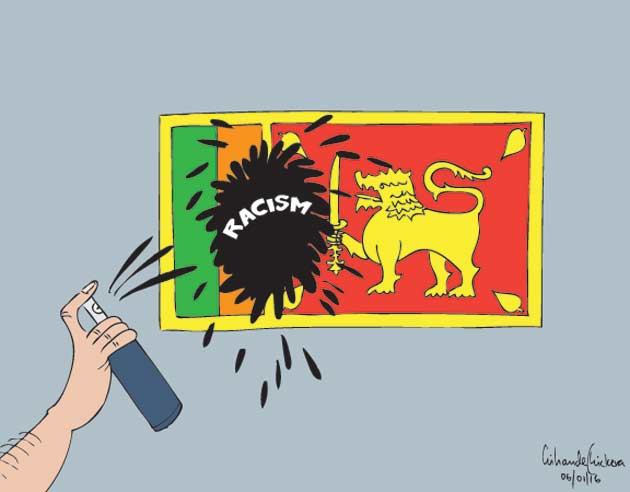
(h) by words either spoken or intended to be read or by signs or by visible representations, cause insult or show disrespect of the National Flag, National Emblem or National Anthem, of the republic of Sri Lanka commits an offence and upon conviction be punishable with imprisonment of either description for a term not exceeding twenty years and forfeiture of property.
(2) Any person convicted of any offence under paragraph (1) shall be subjected to civic disability for such period not exceeding twenty years.
(3) In this Chapter “war” includes acts of terrorism
The brief outline of the development of constitutional embodiments of the place of Buddhism and the role of the state, on the one hand, and the place of other religions on the other remains unbalanced. There is a clear predominance for Buddhism and additionally in 1978 and the draft the Buddha Sasana. This situation engenders the possibility of conflict and even violence. Gehan Gunatileke suggests that three vital drivers remain at the core of ethno-religious violence in Sri Lanka.
First, the Sinhala-Buddhist community has undergone decades of socialization that has led to a distinct entitlement complex. This complex has prompted many within this community to view themselves as the rightful owners and hosts of Sri Lanka. Any serious threat to this hegemonic status by a minority community has been met with sharp resistance and has often led to violence. Second, global identities pertaining to Tamils, Christians and Muslims have engendered a minority complex among Sinhala-Buddhists, who essentially see Sri Lanka as their only homeland. Thus, local discourses such as Tamil demands for autonomy, Christian proselytism, and Islamization have created existential fears among the Sinhala-Buddhist community. Such fears explain why the nationalist rhetoric of militant groups often resonates with Sinhala-Buddhists, and how ethno-religious tensions can so easily escalate to violence. Third, the Buddhist clergy remains a powerful socio-political force that state law is often subordinate to. This monastic exceptionalism has led to a culture of impunity, as law enforcement agencies have remained reluctant to hold perpetrators of ethno-religious violence to account – particularly at the local level where such violence is often at the behest of Buddhist monks. These three factors combine to entrench ethno-religious violence within cultural, socio-political and state structures in Sri Lanka. The development will go ahead. It is more based on emotional conviction than rational understanding of the issue in other parts of the world.
The draft Constitution concludes by citing a Pali verse which in the translation provided reads:
May the rain be timely
May the crops be bountiful
May the people be happy
May the ruler be righteous.
We add our agreement and hope that this wish may be realized.
Source:Ground Views