Ali Sabry holds talks with US Under Secretary Uzra Zeya

Minister of Foreign Affairs Ali Sabry has called on United States Under Secretary for Civilian Security, Democracy, and Human Rights Uzra Zeya.

The two parties discussed Sri Lanka’s work to ensure political reforms in detail.

Zeya said they also discussed protecting the most vulnerable, advancing human rights, transitional justice, and reconciliation for all.

During Minister Sabry’s meeting with US Secretary of State Anthony Blinken, the US urged Sri Lanka to continue its efforts toward economic and political reforms focused on transparency, inclusion, and good governance.

Secretary Blinken congratulated Foreign Minister Sabry on the approaching 75th anniversary of Sri Lanka’s independence.

They held productive discussions at the Department of State on Friday 02, focused on further elevating Sri Lanka – U.S. relations in diverse spheres, including the 75th Anniversary of diplomatic relations which will be marked in 2023.

The two discussed the United States’ support for Sri Lanka during its economic crisis, including nearly $240 million in new U.S. government assistance, and the importance of comparable treatment for all creditors as critical to debt restructuring and securing an IMF program.

Secretary Blinken urged the Government of Sri Lanka to continue its ongoing efforts toward economic and political reforms focused on transparency, inclusion, and good governance.

The Secretary also welcomed Sri Lanka’s agreement to join the Global Methane Pledge. Both sides affirmed their common interest in tackling the climate crisis by accelerating the reduction of greenhouse gas emissions, transitioning to clean energy, and strengthening resilience to climate impacts.

The leaders also discussed the two countries’ shared commitment to advance democratic principles, including respect for human rights.

In addition to the meeting with Secretary Blinken, the Embassy of Sri Lanka to the U.S. facilitated further interactions during the visit which included meetings with key U.S. interlocutors including political leaders from both the House of Representatives and the Senate representing both major parties and high officials of the State Department.

Minister Ali Sabry met with a member of the Senate Committee on Foreign Relations, Senator Bill Hagerty, (Republican – Tennessee).

He had talks with members of Congress Rep. Bill Johnson (Republican – Ohio), Co-Chair of the Caucus on Ethnic and Religious Freedom in Sri Lanka and Rep. Raja Krishnamoorthi (Democrat – Illinois) who has shown an interest in Sri Lanka.

The Minister also had a meeting with Administrator, United States Agency for International Development (USAID) Samantha Power and expressed his appreciation of USAID for their generous support to Sri Lanka.

The Ambassador of Sri Lanka in United States Mahinda Samarasinghe along with diplomatic officers of the Embassy of Sri Lanka and officials of the Ministry of Foreign Affairs were also associated with the Foreign Minister at the meetings.

Posted in Uncategorized

Billions of dollars in foreign income stashed overseas

Sri Lanka is losing billions of dollars of much needed foreign exchange as a result of hoarding in earnings overseas by exporters without repatriating it, going against the directive of the Central Bank (CB).

According to a report compiled by an official think-tank tracing illicit financial flows, corruption and illicit trade, Sri Lanka has lost a staggering $53.5 billion during the past 12 years following this practice of parking money overseas.

The CB says that exporters are estimated to have hoarded nearly a staggering $3 billion in earnings overseas without repatriating last year.

The country has received US$ 1450 million of export earning in October 2022 and, of it $1199 million dollars were hard goods and of this only $326 million dollars was converted.

It was less than 23 per cent, CB Deputy Governor Yvette Fernando recently disclosed at a media conference adding that services sector earnings was $251 million.

As per the available official data, if all the export earnings are repatriated and converted, the average monthly export foreign exchange flow would have been $985 million.

The Revenue Monitoring Unit of the CB is continuously monitoring the export conversion and the dollar earnings using a tracking mechanism since July.

It has been revealed that the CB recently sent a questionnaire to exporters requesting information of their export performances, forex earnings and expenses etc since without data no assumptions can be made on this issue.

But only 57 per cent of them responded making it difficult to collect data and arrive at a conclusion.

Some of these traders either over-price or underprice the declared value of imports or exports, and transfer money overseas by hiding it within the regular payments for commerce in the international trading system, a high ranking official of
Sri Lanka Customs told the Business Times.

The CB issued regulations by gazette notification to oversee the export earning repatriation in February 2021. Until then export proceeds repatriation had not been monitored at all.

All licensed banks are required to submit reports relating to the repatriation of export proceeds to the Director of the Foreign Exchange Department of the Central Bank.

However the total merchandise export value of Sri Lanka is still calculated based on the statistical value submitted to the Customs via Export CusDecs, an official said.

He emphasised the need of implementing the shipment-wise export remittance monitoring system already developed by the ICT Division of Customs through the Customs ASYCUDA system.

R. Sampanthan: ‘We cannot go on like this’

Member of Parliament Rajavarothiam Sampanthan, who has kept together a diverse coalition of Tamil political parties under the umbrella of the Tamil National Alliance since 2001, has witnessed many phases of the struggle since Sri Lanka became an independent country in 1948. Now 89 and largely confined to his official residence in one of Colombo’s well-guarded areas, Sampanthan still pins his hope on India and the international community to encourage Sri Lanka to arrive at an amicable solution to the issue of the Tamils’ hopes and aspirations.

In a rare interview, Sampanthan, who had the distinction of being the Leader of the Opposition in the Sri Lankan Parliament from 2015 to 2018, outlines what the priorities of the government should be. Excerpts:

Q: What is your assessment of the aragalaya (struggle in Sinhalese)? I see that all those who were in power are back in Sri Lanka and thriving.

A:The aragalaya was successful in the sense that they were able to make the main wrongdoer realise that he could not continue in office [President Gotabaya Rajapaksa]. Unfortunately, Ranil [Wickremesinghe], for his own personal reasons, supported the government. And by virtue of this support he was able to become Prime Minister. Now, he is the President. He became President with the support of those whom he opposed [earlier].

The aragalaya was partly successful, and the main offender, President Gotabaya Rajapaksa, was compelled to resign. Now the question is do we have a government? Which is the government? Who is supporting whom? What is their stand on the economy? No one knows. It is all very confusing. I don’t know what policies they are pursuing. [Wickremesinghe is the lone member of his United National Party in Parliament. He survives with the support of MPs of the Sri Lanka Podujana Peramuna (SLPP), Rajapaksa’s party].

As of now, what is inevitable and what should happen is there should be general elections. The people should be asked to decide who should be given the mandate to rule.

Q: I think President Ranil Wickremesinghe is following the same policies as the SLPP.

A:The credibility of Mahinda Rajapaksa [former Prime Minister], Gotabaya Rajapaksa [former President], and Basil Rajapaksa [former Finance Minister] were seriously questioned. They were the ones ruling the country. Mahinda Rajapaksa had to go into hiding in Trincomallee [at a naval base] at the peak of the aragalaya. The time has come for the people to be given the opportunity to decide who should govern this country because this [the current state of SLPP controlling despite people wanting the party out of power] should not continue. It will only get worse.

I don’t think the economic debacle is being tackled in any sensible way. They [the government] had gone to the IMF for a bailout. So far, the IMF has said nothing. This is of great concern.

Q: So you think that the only solution is going back to the people?

A: I really don’t know how they continued because the whole country was against them. It was the peak of opposition to any government. I don’t know why it [ aragalaya] did not continue [after Wickremesinghe took charge as President]…. The people wanted this government to go. Hence, they should go back to the people for a mandate.

Q: A negotiated settlement to Tamil political aspirations is the dream that is fast turning into a mirage. We do not see any gains for the Tamils. In fact, they are losing out because of demographic and cultural changes in the north and the east. Tamil political parties have not been able to make much headway.

A: The resolution of the Tamil national question has been a big issue since [Sri Lanka’s] independence. The Tamil people supported independence. They were compelled to change their stand after the citizenship law and the resettling of Sinhalese in large numbers in the east and the north. This changed the demographic composition in those areas.

The Tamil people demanded autonomy and devolution of power in those areas. This was the basis of the [1957] Bandaranaike-Chelvanayagam pact and the [1987] Indo-Sri Lankan accord. Both contained provisions on identity of the Tamil people, the territory, and arrangements with regard to self-determination, or the right to determine their own destiny. Unfortunately, the Sri Lankan government breached the agreements.

As far as Sinhala politicians are concerned, whichever political party they belong to, they are primarily concerned about gaining the support of the Sinhala people on the basis of an anti-Tamil stand. As long as this continues, nothing can be done. Sri Lanka is party to the international covenant on civil and political rights, and to the covenant on economic, social and cultural rights. Both covenants give the people the right to self-determination.

We don’t want the country to be broken in any way; we stand for an undivided Sri Lanka. At the same time, we cannot go on like this. We have no alternative but to approach the international community, which is well aware of the issue. There should be some arrangement regarding the north and the east. It is the duty of the international community, including India, the US, and the UK, to take the lead and push for an arrangement in the north and the east.

The Sri Lankan government is not delivering on the political question. On one side, the Sinhala population in the north and the east is being increased by resettlement, and on the other side, the Tamils are fleeing because of the violence and the unstable political situation. If this goes on, the people will be unable to maintain their identity, self-respect, and even their dignity. The international community should not permit that. It will set a bad example to the world. If they want peace in the region, and peace in this country, this problem must be resolved.

(The Frontline)

Paris Club proposing a 10-year moratorium on Sri Lanka’s debt -Report

Paris Club creditor nations are reportedly proposing a 10-year moratorium on Sri Lankan debt.

A report published by India’s Hindustan Times said in addition to the debt moratorium, the Paris Club has proposed another 15 years of debt restructuring as a formula to resolve the current financial crisis in Sri Lanka.

According to the report, the Paris Club has hinted that global south should also take a hair cut similar to the global north notwithstanding the inequitable distribution of wealth.

The proposal will impact both India and China with Sri Lanka currently in the process of hold discussions to restructure its external debt.

Sri Lanka has already reached a staff-level agreement with the International Monetary Fund but will be required to obtain debt assurances from countries like China and India to secure the bailout package.

The Paris Club has already indicated that it is prepared to restructure Sri Lanka’s debt.

Posted in Uncategorized

UNP gearing for an election

The General Secretary of the United National Party, Palitha Range Bandara says they are preparing the party to face the next election.

Speaking to media at the UNP headquarters Sirikotha, General Secretary Palitha Range Bandara said they are in the process of selecting party organizers.

He said several rounds of interviews will be held to select new organizers.

Former State Minister Palitha Range Bandara said they are hoping to introduce new faces at future elections.

He added several members of other parties are in discussion to join the UNP.

UNP General Secretary Palitha Range Bandara added that party leader President Ranil Wickremesinghe has taken up the challenge of rebuilding the country.

Posted in Uncategorized

SL refugees in Vietnam: Govt. in discussions to repatriate remains

The Government has begun discussions with the International Organization for Migration (IOM) and the Vietnamese authorities regarding options for the repatriation of the remains of a 37-year-old Sri Lankan male refugee who had died last month.

According to the Sri Lankan Embassy in Hanoi, the refugee, one of the 303 who were rescued while adrift in the South China Sea and handed over to Vietnam, had died of organ failure while receiving treatment at a local hospital after he had consumed hand sanitiser with another refugee.

When contacted, Sri Lankan Ambassador to Vietnam Prasanna Gamage told The Sunday Morning that the wife of the deceased had requested that the remains be repatriated to Sri Lanka.

“We are in discussions with local authorities and the IOM regarding possible options to repatriate the remains of the deceased,” Gamage said.

However, Gamage disputed allegations that the deceased and another refugee had attempted to take their lives.

“The information we have received so far from the local authorities and the IOM does not support that view,” he said, adding that the second person who had also consumed hand sanitiser had done so after diluting it in water and as such, he had been released from hospital after treatment. Gamage pointed out that repatriation of human remains was an expensive matter.

According to Gamage, some of the refugees had expressed their desire to return to Sri Lanka, in a shift away from their previous stance of wanting to make their way to Canada.

“Some have expressed their desire to return to the IOM. We have to wait for the process to be completed to know how many are keen to return. Then the embassy can finalise matters and explore repatriation options. This is normal. Also, it takes time to talk to them and for trust to build for them to express their desire of returning home,” Gamage said.

Blinken and Sabry discuss debt restructuring and IMF deal

US Secretary of State Antony J. Blinken and Sri Lankan Foreign Minister Ali Sabry had talks in Washington on debt restructuring and the International Monetary Fund (IMF) deal.

Speaking to reporters ahead of his meeting with Sabry, Blinken noted that Sri Lanka and the US had almost 75 years of partnership with Sri Lanka.

“We’ll celebrate that next year, and of course we are working very closely together on issues of global import, including the climate crisis, where Sri Lanka has been taking some important steps to help the world address it. And of course the United States has been working closely with Sri Lanka in the midst of the serious economic challenges that Sri Lanka is facing,” he said.

Blinken said the US has provided some $240 million in assistance and loans, and both countries are also working together both to support economic stability but also political stability and progress.

Foreign Minister Ali Sabry said the US was one of the first countries to recognize Sri Lanka.

He appreciated the support given by the US during a very testing time for Sri Lankans.

“We were very happy. And then we have had a very good relationship. I must take this opportunity, Secretary, to pay my gratitude for American people and your administration, Biden administration, for a lot of support during a very testing time for Sri Lankans. So we are grateful particularly for your humanitarian support – loans, grants – and technical support. We are extremely grateful, and we are looking forward to work for even better relationship and particularly in the Indian Ocean and eastern Pacific,” he said.

The Sri Lankan Foreign Minister also thanked the US Treasury for playing a leading role in facilitating Sri Lanka to approach the IMF, restructure its debt, and to go to the board sooner than later in order to get the Extended Fund Facility (EFF) as soon as possible.

Posted in Uncategorized

President’s call for talks on ethnic problem:No compromise, no solution -M.S.M. Ayub

During eighties Dr. Ananda Tissa de Alwis, the State Minister under the J.R. Jayewardene government was the Cabinet spokesman who conducted the weekly press briefings. State Minister was then a Cabinet portfolio that handled the media and related issues. Dr. Alwis then used to relate various interesting stories to the journalists apart from his briefings on Cabinet decisions and other related political matters.

Once he narrated a story off the record about a discussion in New Delhi between former Indian Prime Minister Jawaharlal Nehru and the then Sri Lankan Prime Minister Sir John Kotalawala. The discussion was centered around the issue pertaining to people of Indian origin in Sri Lanka who had become Stateless as a result of the Ceylon Citizenship Act of 1948.

Dr Alwis who was then the Private Secretary to the Sri Lankan Premier quoted the Indian Premier as saying “Mr. Prime Minister, despite your country being very small in size, it is not a huge problem for it to accommodate these people numbering little less than a million. But your Opposition would not allow you to do so. So do our Opposition in spite of our country being an extremely larger one compared to yours. Let’s hand over this problem to our officials who would hold talks on this matter until the end of time.”

We are reminded of Dr. Alwis’s story with the call by President Ranil Wickremesinghe to the political parties in Parliament to start negotiations in order to find a lasting solution to the ethnic problem. The history of the debate on the ethnic issue though involved mainly politicians harks back to 1920s when the ethnic representation was first introduced in the Legislative Council under the British Raj. However, it was a main subject of political discourse since late 1940s.

Since then historical agreements such as the aborted Banda-Chelva Pact, famous struggles like the Satyagraha campaign by the Federal Party leaders in 1962, a thirty-year long war, peace talks between armed groups and various governments, meddling by neighboring and powerful countries, inter-State agreements such as the Indo-Lanka Accord of 1987, so many rounds of negotiations between the minority groups such as the Tamils and Muslims and several Parliamentary Select Committees have marked milestones on the past trajectory of this debate.

After all these violent and peaceful efforts to resolve the ethnic conundrum since 1940s when the issue became a serious national problem, the debate still seems to have not moved from square one. Ironically, leaders of all ethnic groups still raise basic questions pertaining to the problem. Still many Sinhalese people and their leaders question if there is any problem that affects the Tamils just because they are Tamils. It was against this backdrop that President Wickremesinghe invited the political leaders to conduct another round of talks.

This pessimistic view towards the recent history might stand in the way to a negotiated settlement of the problem. Yet, negotiations are the only civilized means to resolve the problem. The pessimism is not due to the lack of trust in the President or any other individual, but the lack of trust in the sincerity of leaders of all communities that has been caused by the so-called efforts to resolve the problem, over a period of more than seven decades.
A mechanism of power devolution has been put in place for the past 34 years. Yet, Tamil leaders still insist on devolution of power as the only remedy for their problems without succeeding to convince the Sinhalese people. Similarly, Sinhalese leaders while representing provincial councils for the past 34 years argue that the concept of devolution would divide the country.

The political rivalry within leaders of same ethnic groups and lack of political will to take up challenges has superseded their genuine need to bring the problem to an end. The Tamil leaders who once rejected a federal solution to the ethnic problem now insist on federalism. If one group among Tamils now indicates at least a faint sign of compromising that stance, other Tamil groups will call them traitors. Similarly, Sinhalese leaders would have to accept the same title if they do the other way around.

Yet, there have been occasions where leaders of both communities have come closer to an agreement, but later they made them missed opportunities. For instance, President Chandrika Kumaratunga had presented a set of proposals in 1995 which was then famously called ‘the package.” Sri Lanka was described in it as a “Union of Regions” instead of a unitary State. Although Tamil leaders rejected it, the senior Advisor to the Liberation Tigers of Tamil Eelam (LTTE), Anton Balasingham during a ceremony to declare open the outfit’s courts complex in Kilinochchi in 2003 said that they could have accepted it. Ironically, it was the LTTE that had killed Neelan Thiruchelvam in 1999 for being one of the two architects of the “package.”

In December 2002 during the third round of the peace talks in Oslo between Prime Minister Ranil Wickremesinghe’s government and the LTTE, it was agreed to explore a solution under a federal framework. Not only Opposition parties refrained from agitating against the agreement, possibly due to war weariness, but also expressed concern when the LTTE announced that they would suspend talks with the government in April 2003. However, the LTTE themselves later rejected the agreement and resumed armed hostilities in late 2005.

Against this backdrop, Prime Minister Ranil Wickremesinghe’s government converted the parliament into a Constitutional Assembly (CA) in January 2016 in order to draft a new constitution with special focus on the ethnic issue. The Steering Committee appointed under the CA and chaired by the Prime Minister presented its interim report in Parliament in September 2017.

The report in its attempt to avert a clash over the concept of federalism described Sri Lanka as a “Ekiya Rajaya” in Sinhala and “Orumiththa Nadu” in Tamil which provoked both the Sinhalese and Tamil groups to reject the report. Although the Tamil National Alliance (TNA) and the ruling United National Party (UNP) had initially accepted the descriptions, the Constitutional reform process died a natural death following the UNP’s humiliating defeat at the 2018 local government elections and the subsequent turbulent political situation

Merger or demerger of Northern and Eastern Provinces is another tricky issue that has become a major stumbling block to the resolution of the ethnic problem. Unless the leaders of all three major communities in the country prepared to apply President Premadasa’s CCC formula (Consultation, Compromise and Consensus) in these issues, it would be difficult to prevent talks from dragging on until the end of time.

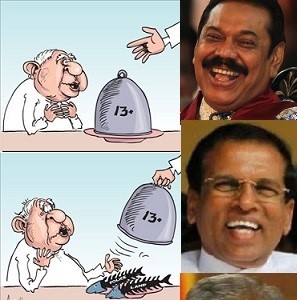
Besides, the President on Tuesday had made a statement which might have raised question about his sincerity in the minds of the Tamil leaders. Responding to a suggestion by former President Maithripala Sirisema that the District Development Councils (DDCs) with powers granted by the Constitution would be the ideal solution to the ethnic problem, President Wickremesinghe said he was prepared to implement it. Tamil leaders’ aversion to the concept of DDC came in a statement by TNA’s Batticaloa District MP Govindan Karunakaram who stated in Parliament that Tamils were disappointed by the statement made by the President who during the same debate in Parliament asked each party if they were prepared to accept “13 plus.”

DDCs had been instituted in 1981 and were replaced by the provincial councils and pradeshiya sabhas in 1987. However, the very party that introduced the system, the UNP did not like to allow the Tamils to experiment it. They sabotaged the first Jaffna DDC election in June 1981 by sending goons from Colombo during which the precious Jaffna Library was also torched. Tamil armed groups also wanted to scuttle the election.

Former President Ranasinghe Premadasa favoured the idea of devolving power to the districts instead of provinces until he started talks with the LTTE in 1989. It would be a gigantic task to convince the Tamil parties now to give up their federal demand for DDCs.

China continuously encouraged IMF to support Sri Lanka -Embassy

China says it had continuously encouraged the International Monetary Fund and other international financial bodies to support Sri Lanka to deal with the current economic crisis.

The Chinese Embassy in Sri Lanka said as a major shareholder of the IMF, China has been encouraging the IMF and other international financial institutes to promptly support Sri Lanka.

It added China had actively participated in all the creditors’ meetings of Sri Lanka in a bid to restructure the country’s debt.

The Embassy also noted that financial institutes of China reached out to the Ministry of Finance and the Central Bank of Sri Lanka in April without delays.

It said working teams of different banks visited the country and bilateral negotiations are continuing.

The statement was issued in response to a claim made by Tamil National Alliance Parliamentarian Shanakiyan Rasamanickam.

Speaking in Parliament recently, MP Rasamanickam said China is not a true friend of Sri Lanka.

UK working with India to address issues in Sri Lanka

The United Kingdom (UK) says it is working with India to address issues in Sri Lanka.

The UK House of Lords discussed the Sri Lanka issue, particularly the economic and human rights issue.

Minister of State Foreign Commonwealth and Development Affairs Lord Tariq Ahmad responded to questions raised on Sri Lanka by members of the House of Lords.

In his response the UK Minister noted what he said was an important role played by India in Sri Lanka.

Lord Tariq Ahmad said that the UK will remain focused on the human rights issue in Sri Lanka.

He said the UK will also help Sri Lanka face the humanitarian issue in the country.