NPPO Issued Non-Compliance Notice to China

Ceylon Today reliably learns that China’s Qingdao Seawin Biotech company has not produced the vital Protection of Phytosanitary Certificate to Sri Lanka and that it is the company’s mistake and not the fault of the two local fertiliser companies that opened the Letter of Credit, nor the National Plant Quarantine Services (NPQS) of the Department of Agriculture that issued a certification that the samples were contaminated.

According to a senior Ministry of Agriculture official, who requested anonymity, it is in the best interests of bilateral ties between Sri Lanka and China, as the Attorney General last week advised to resolve the dispute on trade terms acceptable to both parties.

He added that the shipment from China was deemed an illegal importation due to the lack of a valuable Protection of Phytosanitary Certificate (PPC) from the Chinese company.

The NPQS should have received the PSC of the Chinese and that has nothing to do with the LC the fertiliser companies issued as they don’t combine according, to the sources.

As a result, the National Plant Protection Organization (NPPO), which lacks the legal authority to inspect it, issued a non-compliance notice to the Chinese NPPO based on the results of the sample tests, the official revealed.

The Sri Lankan NPPO fulfilled all legal obligations under the IPPC, but the Chinese party’s NPPO was not involved in this matter because they have thorough knowledge of the IPPC’s legal obligations, according to the official.

“As a result, the supplier and Sri Lankan agent used illegal channels to resolve this dispute, relying on Chinese embassy interference in this incident. This is a violation of the IPPC, and they endanger our sovereignty,” he emphasised.

Because China is a ‘friend’ of Sri Lanka, the AG’s department has agreed to settle the matter amicably before the Court gives a decision.

Under the tender process’s compliance clause, the Chinese were chosen to supply the 20,000 tons of organic fertiliser (first batch of 99,00MT), with the lot to be sent in five consignments, the first of which sparked diplomatic wrangling between Sri Lanka and China.

The Food and Agriculture Organisation of the United Nations states that ‘all parties of the IPPC must respect the sovereignty of each country according to the Article VII which says a) prescribe and adopt phystosanitary measures concerning the importation of plants, plant products and other regulated articles, including, for example, inspection, prohibition on importation and treatment;

b) refuse entry or detain, or require treatment, destruction or removal from the territory of the contacting party of plants, plant products and other regulated articles or consignments thereof, that do not comply with the phytosanitary measures prescribed or adopted under the subparagraph(a); c) prohibit or restrict the movement of regulated pests into their territories;

d) prohibit or restrict the movement of biological control agents and other organisms.

It is purely a mistake by the Qingdao Fertiliser company for NOT obtaining the Permit for shipment too, he said. “The contaminate supply faulted the Letter of Credit (LC) payment and there is no loss for Sri Lanka as the next consignments are agreed upon and they will also be subjected to sample testing,” the official noted.

Posted in Uncategorized

Pakistan Navy ship PNS Tughril departs Sri Lanka after successful naval exercise

The Pakistan Navy Ship (PNS) Tughril which arrived at the port of Colombo on an official visit on 13th December 2021, has departed after a successful naval exercise with Sri Lanka Navy on 16th December.

Concluding a four-day official visit, PNS Tughril conducted the naval exercise with Sri Lanka Naval Ship, SLNS Sindurala off the western coast, adhering to COVID-19 protocols.

As such the two ships conducted preparation drills for Replenishment at Sea (RAS) and maneuvering exercises in seas off Colombo.

The exercise of this nature will pave the way for exchanging best practices and experiences of the two navies, to hone each other’s capacities in the event of responding to common maritime challenges, the Navy Media Unit said.

Intermediate option for crisis management: Indian backstop -By Dr.Dayan Jayatilleka

The Government is in a tight time-crunch. That’s not only because of repayment of debt. That’s because the more explosive time-bomb is the harvest.

If the inevitable peasant unrest which will spill-over by Sinhala-Tamil New Year is suppressed by sending in the STF or 1 Corps by the President or Security Chiefs, there will be no social and political comeback for the Rajapaksas from that. The SLPP and the ruling coalition, starting with the PM, must beseech all the deities of their acquaintance that a military response to people’s legitimate protests is avoided.

Furthermore, a Sinhala Army tasked with suppressing the Sinhala peasantry will not socially survive that traumatic coercive contact; it will begin to disintegrate.

The crisis must be managed urgently, before that time-bomb explodes. There is an intermediate option other than going to the IMF right now, which can either be an alternative to the IMF option or can place Sri Lanka on a better footing before it gets to the IMF some way down the road. I call it an India-led Asian Marshall Plan for Sri Lanka. However, I doubt that the rational alternative will be speedily activated, and therefore we may have to be carried on a stretcher into the IMF “ICU”.

Indian-led Asian Marshall Plan

A version of the option is in play and is well known, but if handled wrongly, can blowback on the Government. It is the road not taken, and that’s the road to Delhi.

That road was not taken for two reasons. The first reason was that the Chinese had more cash and its system was such that it could be injected rapidly into the necessary post-war infrastructure investment. The second reason was that the Indians would raise questions about the political and strategic IOUs we hadn’t paid, chiefly the promise made and repeated at the highest level, to fully implement the 13th Amendment.

MR was willing to make good on the promise and we can date exactly until when. In the first flush of victory, President MR’s team based at Temple Trees published a magazine, courtesy of Sri Lanka Telecom, called TARGET. The strap read ‘Sri Lanka: The way forward’. The cover story of the June 2009 issue was ‘Declaring the end of the Humanitarian Operations’. The cover photo is of President Mahinda Rajapaksa shaking hands with his brother, the Secretary/Defence Gotabaya Rajapaksa. A story on an inside is captioned ‘Indian delegation calls on the President’. The final paragraphs of that story read as follows:

“Both sides also emphasised the urgent necessity of arriving at a lasting political settlement in Sri Lanka. To this, the Government of Sri Lanka indicated that it will proceed with implementation of the 13th Amendment. Further, the Government of Sri Lanka also intends to begin a broader dialogue with all parties, including the Tamil parties, in the new circumstances, for further enhancement of political arrangements to bring about lasting peace and reconciliation in Sri Lanka.” (p 32)

This was of course the famous 21 May 2009 Indo-Lanka Joint Communique. The story featuring in that magazine in June 2009 shows it had been internalised in the system, at least by the Presidency. That was the line we took in Geneva.

June 2009 was the last it was heard of. That policy discourse soon joined the ranks of the disappeared. Since that was the president’s policy as far as I knew, and I advocated adherence to the promises President MR had made internationally, my removal from Geneva in July 2009 was probably both symptomatic and symbolic. A turn had been made, as far as I could tell, under pressure from the other figure on that cover photograph, who was now articulating the hawkish anti-devolution, anti-Indian perspective of the Defence establishment.

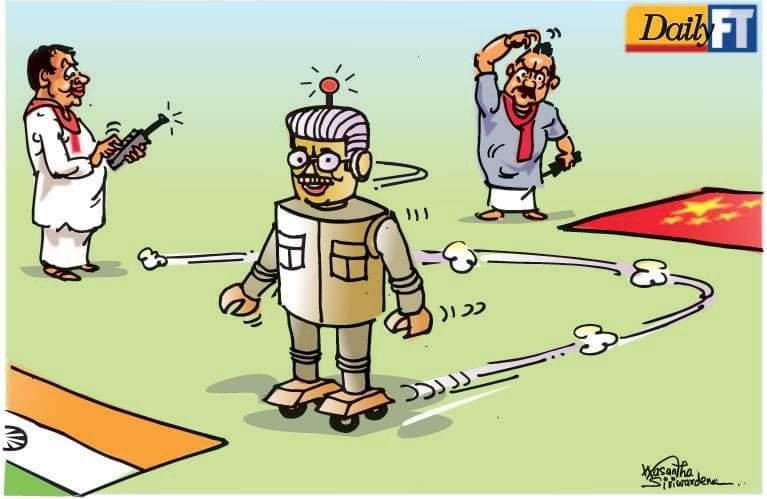
The Rajapaksas went all the way down the Beijing Road, abandoning the balanced ‘India plus China’ formula of the Geneva UNHRC 2007-2009 model. Now they are running out of cash and is running back to Delhi.

Delhi does seem willing to help:

https://m.economictimes.com/news/india/india-working-on-urgent-economic-package-to-help-lanka-tide-over-crisis/articleshow/88213984.cms

India is planning massive bailout package to permanently snatch Sri Lanka out of Chinese hands (tfipost.com)

There are two problems though. Firstly, the scale is inadequate. I would urge an Indian-led Asian Marshall Plan for Sri Lanka. This means, in effect, India, Japan, China, South Korea, ASEAN, i.e., India + ‘ASEAN Plus 3’ (as it is known).

Secondly, even the package in its current size, if it entails (as it probably does) the give-away of strategic national assets, there will understandably be stiff resistance on the part of the trade unions, the JVP and FSP, governmental factions, public opinion and the media. India will become the new China, which has become the old (1987) India as a target of Sinhala patriotism.

Swap, don’t sell-out

This problem has a solution, and MR and BR may see it, but will President GR permit it?

The secret of the solution lies in the nature of the swap.

Consider what India wants from Sri Lanka, then assign a domestic political price-tag to each item on the Indian wish-list.

My guess is that the most expensive items politically would involve Sri Lankan economic space. Paradoxically, the least expensive item politically, would be the political item on the list.

I don’t see trade unions hitting the streets if the Government proceeds to fully implement the 13th Amendment and hold Provincial Council Elections within a compressed time-frame. Furthermore, I expect very insignificant dissent within the government on that issue. However, if there is an economic sell-out, the trade union and intra-governmental unrest will be of a de-stabilising sort.

Logically therefore, the cheapest and safest route to go, is to use the old 13th Amendment credit card, but since this is a BJP government in Delhi and not the old Congress which enabled the Rajapaksas to get clean away without making good on its wartime pledge, the ruling clan will have to implement 13A and hold elections, while incorporating in its entirety the existing 13A in the new constitutional draft, before Indians cough up the cash in the desired quantities. Implementation of 13A may be linked to each tranche.

India may want an economic pay-off as well as implementation of 13A, but even that is more favourable to the Government than a wholly economic price, because 13A upfront can shave-off quite a bit from the economic bill.

It will be quite appropriate if Minister Basil Rajapaksa is the one to do this, because it was he who successfully neutralised the wartime Indian High Commissioner in Colombo who stayed till almost the end of 2009, returning without the fulfilment of a single pledge by the Rajapaksas. I gather that BR pulled the same stunt that J.R. Jayewardene did on (and through) Romesh Bhandari, but BR will find that Dr. Jaishankar and Hardeep Puri know all the Sri Lankan moves.

Multi-alignment/Pluri-alignment

As options go the Rajapaksas are caught between the West, the UNHRC, the IMF, and Delhi. Logically the least bad option is Delhi, not only because accountability is not as high on the agenda as in the West, a devolution swap can cut the price tag, and a deal with Delhi can open doors in Tokyo, Seoul and many other places.

Lee Kuan Yew said Singapore should occupy the spot in the shade where the Chinese and Indian branches touch. Personally, I would extend that and prefer Sri Lanka to be at the point of intersection of as many branches of as many trees as possible: I term it Multi-alignment or Pluri-alignment.

However, if Colombo wants to go the distance and come in under Delhi’s umbrella instead, there are benefits to be had. Colombo’s road to Washington and London, runs through Delhi. India can put in a word with the Quad.

Most pressing of all, a grand bargain with India, arrived at swiftly, would yield two strategic benefits:

(1) India may support a softer landing for Sri Lanka at the critical UNHRC session of March 2022 at which High Commissioner Bachelet presents her written report and pulls the trigger on international prosecution

(2) India can be an important player in any consortium of creditors in a debt re-scheduling for Sri Lanka and give the Sri Lankan economy some cushioning before it sits down with the IMF.

Though this is a rational and viable option for crisis-management, there are two major problems, both located in the realm of extreme ideologies and mindsets. I refer to Sinhala and Tamil ultranationalism(s).

In that he is dualistic, President Gotabaya Rajapaksa is the least hawkish of his crew. His hardcore backers from Milinda Moragoda and Rohan Gunaratne to Sarath Weerasekara and Ven. Dr. Medagoda Abeyatissa would prefer to pay a stiff economic price to India whatever the attendant public opinion cost than implement the 13th Amendment and reduce the economic and consequent public opinion cost. Some would prefer to pay any price to China, no price at all to India, and use the crisis to send in the military to do a Myanmar.

Basil Rajapaksa has his own chauvinist supporters (Dr. Channa Jayasumana, Mahinda Pathirana) and there are lone-wolf supremacists (Gevindu Cumaratunga). Overall, however, the balance in the Pohottuwa and SLFP ranks favour retention and reactivation of the 13th Amendment than its abolition or amputation.

Today’s Parliament potentially has broader support (across Government and Opposition benches) for the implementation of the 13th Amendment than any other parliament. It should therefore be possible for Sri Lanka to make a ‘great swap’ with India: Provincial Councils up and running with the undiluted powers of the 13th Amendment and the retention of the language of the Accord and the 13th Amendment in any new constitutional draft, in exchange for a financial and economic safety-net.

This is a rare moment in which, due to the exigencies of the economic emergency, a win-win solution is possible for the Sinhala majority and the Tamil and Muslim minorities. The citizenry as a whole would have some safety-net or hedge against plummeting material standards of living. As the numerical majority the Sinhalese are being hit hard by the crisis in larger numbers. The system as a whole would be safer if the edge were taken off the crisis, because the Sinhala working people, especially the peasantry could be driven by despair to revolt.

Sinhala sensibilities will not be affected by a grand swap of the implementation of the 13th Amendment in exchange for an Indian economic backstop, because that amendment has been part of the Constitution since 1987 and there is no shock therapy involved unlike in the case of Ranil Wickremesinghe’s CFA or Chandrika’s PTOMS.

This is a rare moment in which, due to the exigencies of the economic emergency, a win-win solution is possible for the Sinhala majority and the Tamil and Muslim minorities. The citizenry as a whole would have some safety-net or hedge against plummeting material standards of living. As the numerical majority the Sinhalese are being hit hard by the crisis in larger numbers. The system as a whole would be safer if the edge were taken off the crisis, because the Sinhala working people, especially the peasantry could be driven by despair to revolt. Sinhala sensibilities will not be affected by a grand swap of the implementation of the 13th Amendment in exchange for an Indian economic backstop, because that amendment has been part of the Constitution since 1987 and there is no shock therapy involved unlike in the case of Ranil Wickremesinghe’s CFA or Chandrika’s PTOMS

Perimeter and parameters

The obstacles will come from two sources, firstly, the handful of Sinhala hawks in power who think that:

(a) A new Constitution which formally redefines Sri Lanka a Sinhala-Buddhist state and abolishes the 13th Amendment, introducing minimalist devolution instead, is the only (polarising) move by which to make a political comeback and

(b) The crisis is the best time to introduce and gradually impose military rule.

The second obstacle comes from the camp of Tamil nationalism. The Tamil nationalist leadership has been so unrealistic in its politics that the issue of devolution and the Tamil ethnic issue which was the heart of the Indo-Sri Lanka accord of 1987 has shifted to the periphery of the Indo-Lanka equation, and instead, the strategic and economic issues which comprised the Annexures and Exchange of Letters (hurriedly) affixed to the Accord, have arrived at centre-stage.

This has of course, been the GR-Moragoda strategy all along: the Israeli model of letting the Tamils tie themselves up in political knots while creating/altering facts on the ground and rolling up any quasi-autonomous Tamil political space.

Correspondingly, an abiding failure of Indian foreign policy in Sri Lanka has been its inability to get the Tamil nationalists within the parameters of—or which are congruent with—India’s vital interests in Sri Lanka. These interests are to erect a buffer against Chinese power-projection within a safe radius of India’s southern flank by reactivating the Northern and Eastern Provincial Councils. The retention and reactivation of the 13th Amendment cannot await ‘federalism’, ‘internal self-determination,’ etc. Even those favourite tropes “13 Plus”, “building on” or “going beyond” the 13th Amendment require the continued existence of the 13th Amendment and its institutional incarnation the Provincial Councils.

Ministers Jaishankar and Puri are cerebral Realists who know that a Tamil insurgency in the 1980s, India’s tough diplomacy, Norway’s peace-bubbles and Prabhakaran’s full-scale war, couldn’t secure anything beyond the 13th Amendment. They and everybody else also know that the UNP-TNA (Ranil-Sumanthiran) tango did not produce a new, post-unitary Constitution but a post-UNP electoral landscape and a deadlocked Provincial Council system just when the Chinese were extending influence on and through Sri Lanka. India’s strategic interests were rendered vulnerable to the vicissitudes of southern politics and external alignments as never before because the TNA and UNP had in effect, deactivated the Indo-Sri Lanka accord and spiked the 13th Amendment by their constitutional and legislative adventurism.

Offering strategic assurance by restoring the buffer, the Northern and Eastern Provincial Councils with the full powers of the 13th Amendment would be an indispensable part of the Great Swap or Grand Bargain in exchange for economic insurance and the resultant prevention of a mass uprising due to deprivation and despair.

Tamil trajectory

Sri Lanka’s Tamil and Muslim political parties and leaders have caucused recently and are in the process of drafting a common platform in the face of a perceived effort on the part of the regime to eliminate the 13th Amendment.

MA Sumanthiran has criticised the effort in public (in Chunnakam) as an effort to limit the Tamil cause, rights and aspirations to the 13th Amendment.

The choice today is losing the 13th Amendment or saving it.

Sumanthiran has reminded his fellow parliamentarians that the Tamil question is no longer an internal one. True, but in its internationalisation there is no more important reality than India. Tamil politicians must realise that whoever they talk to in Washington DC, no one there is going to make a move on India’s southern perimeter outside of India’s policy parameters.

Sinhala politicians and top military brass must know the same about Russia: it won’t make a move on India’s doorstep if it thinks it may cross an Indian red line.

If the ITAK/TNA proceeds on its path of political excess i.e., of ideological demand that far exceeds political supply, it will find that the Tamil question has been traded-in for economic and strategic real-estate and left to the tender mercies of the Gotabaya Government to resolve unilaterally.

If President Gotabaya Rajapaksa obdurately chooses to dismantle the 13th Amendment unilaterally in whole or in part, and for their part the Tamil parties have defended the 13th Amendment taking a realistic stand, then the regime’s hawks will find new fronts opening or old ones newly re-opening on the island’s vulnerable periphery and in the external arena, beginning with the neighbourhood and extending through Geneva, westwards.

“This is just the beginning”, says Chinese Ambassador as Jaffna visit ends

The Chinese Ambassador to Sri Lanka made an open-ended closing remark to News 1st as he concluded his three-day visit this afternoon.

When asked about the end of his visit by News 1st, he said that although this was the end of his visit, it was also a beginning.

The beginning of what remains unanswered.

‘This is the End, but also the Beginning’, is what the Chinese Ambassador to Sri Lanka said following a historic visit to Adam’s Bridge in the North of Sri Lanka on Friday (17).

Ambassador Qi Zhenhong was escorted to Adam’s Bridge by the Sri Lanka Navy and troops by the Sri Lanka Army.

Adam’s Bridge, also called Rama’s Bridge, is a chain of shoals, between the islands of Mannar, near northwestern Sri Lanka, and Rāmeswaram, off the southeastern coast of India.

The bridge is 30 miles (48 km) long and separates the Gulf of Mannar (southwest) from the Palk Strait (northeast).

Ambassador Qi Zhenhong was visiting the Mannar as part of his goodwill tour to the North of the Island.

The Ambassador visited the 3rd shoal on Adam’s Bridge which is located some 17 nautical miles off Sri Lanka’s coast.

According to News 1st correspondent Senitha Senanayake, the Ambassador was escorted close to the 3rd shoal by the Sri Lanka Navy’s Inshore Patrol Craft and he was then transferred to a small battle boat to visit the 3rd shoal, which can be seen from India’s Rameswaram.

The visit to Mannar comes weeks after a delegation from India’s Adani Group visited Mannar to inspect a location for their proposed USD 1 Bn investment for a 1000 MW renewable energy project,

Notably, the Chinese Ambassador was given special military protection during his three-day visit to the North of Sri Lanka.

Posted in Uncategorized

PM officially declares 2022 as ’Navalar Year’ for Tamils

Prime Minister Mahinda Rajapaksa, today declared 2022 as the ‘Navalar Year’ after the ‘Letter of Authorization for the Declaration’ was handed over by him to senior Hindu officials from the Department of Hindu Religious and Cultural Affairs.

Prime Minister’s Coordinating Secretary and government’s special facilitator to the North and East, Geethanath Cassilingham said this was declared in commemoration of the 200th birth anniversary of Hindu Leader Srila Sri Arumuganavalar Peruman who “dedicated his life for the religious harmony in Sri Lanka.”

Cassilingham added that two portraits of Srilasree Arumuganavalar Peruman published by the Department of Hindu Religious and Cultural Affairs were also unveiled by Prime Minister Rajapaksa at the event held at Temple Trees.

Posted in Uncategorized

EU must work to prevent HR abuses in Sri Lanka – HRW

Human Rights Watch says the European Union should work with international partners to prevent more human rights abuses in Sri Lanka.

Human Rights Watch says the European Union has a historic opportunity to press Sri Lanka’s government to meet its human rights obligations.

The European Parliament had recently adopted a resolution, urging the EU Commission to consider the temporary withdrawal of the GSP+ tax relief facility given to Sri Lanka.

The resolution had made specific reference to the Prevention of Terrorism Act and human rights abuses in the country.

Human Rights Watch said the EU should not allow itself to be hoodwinked by a sham PTA reform.

Seven UN rapporteurs have also urged Sri Lanka to amend the Prevention of Terrorism Act in line with international standards.

This comes in the run-up to the 49th UN Human Rights Council sessions set to begin in February next year.

In a joint statement, the UN’s Special Rapporteurs said they regret that the Sri Lankan government has not adopted the recommended corrective measures over the Prevention of Terrorism Act.

It proposed five main recommendations to ensure that the PTA is amended in line with international law obligations.

The UN rapporteurs recommended amending the definition of terrorism and rescinding the language on terrorism.

They added that the PTA could interfere with freedom of speech as it doesn’t define what speech is prohibited.

The joint statement said that provisions on detention should be amended to prevent arbitrary arrests and detentions that go against international laws.

It added that the PTA should be amended to ensure that conditions that increase the likelihood of torture are remedied.

The special rapporteurs also said that the PTA should be amended in line with the International Covenant on Civil and Political Rights and the Universal Declaration of Human Rights.

‘Govt. postponing LG elections owing to political reasons’

Election monitoring body, the People’s Action for a Free and Fair Election accuses the government of planning to postpone the upcoming local government elections owing to political reasons.

Speaking to NewsRadio, on the plans to postpone the local government elections by one year, PAFFREL Executive Director Rohana Hettiarachchi said it was an insult to the voters.

Hettiarachchi said the government will miss out on assessing the public opinion on the policies it had implemented.

He said they received reports that a proposal to postpone local government elections has been submitted to the Cabinet of Ministers adding the elections were supposed to be held at the end of the year or at the beginning of 2022.

He said the subject Minister has the authority to postpone elections by one year.

The PAFFREL Executive Director acknowledged the challenges in moving towards an election under the current COVID-19 situation and economic crisis adding however the 2020 parliamentary election was also held successfully under similar circumstances.

Hettiarachchi said the present administration’s decision to postpone elections was not a democratic move.

He said the public being deprived of the right to appoint their representatives poses a very serious concern.

Posted in Uncategorized

NIA charge-sheets 15 Sri Lankans of attempting to revive LTTE

The National Investigation Agency (NIA) in India has charged 15 Sri Lankans of attempting to revive the activities of the proscribed organisation, the LTTE and waging war against Sri Lanka, The Hindu newspaper reported.

The Sri Lankans had been arrested in connection with the smuggling of arms, ammunition and drugs to India.

Some of the accused were earlier arrested from a fishing vessel in Arabian Sea on March 25 this year and drugs, arms and ammunition were seized from them.

The accused had conspired among themselves and sailed to India from Kudawella harbour at Sri Lanka in the fishing vessel, Ravihansi. They also took with them 300 kg heroin and prohibited arms and ammunition, according to the charge sheet that was filed at the Special Court of the Agency here in Kochi.

L. Y. Nandana, Janaka Dasappriya, Namesh Chullaka Senarath, Thilanka Madushan Ranasingha, Dadallage Nissanka, A. Suresh Raj, L. Y. Nishantha Sudda, A. Ramesh, Satkunam are some of the accused in the case.

Colombo University Students Refuse To Accept Degree Certificates From Chancellor Ananda Thera At Convocation

Graduates of the University of Colombo refused to accept their certificates from Muruththetuwe Ananda Thera, the Chancellor of the university, at their annual convocation ceremony.

According to the tradition, it is the chancellor who presents the degree certificates at the convocation.

This time, however, the graduates refused to accept their certificates from the controversial Buddhist monk forcing the Vice Chacellor to present the degree certificates.

Ananda Thera is a trade union leader and a supporter of the current administration. Addressing a public event recently, President Gotabhaya Rajapaksa said Ananda Thera was appointed the Chancellor as the latter supported their political campaign.

More than 80% canteens, hotels to be closed due to gas issue

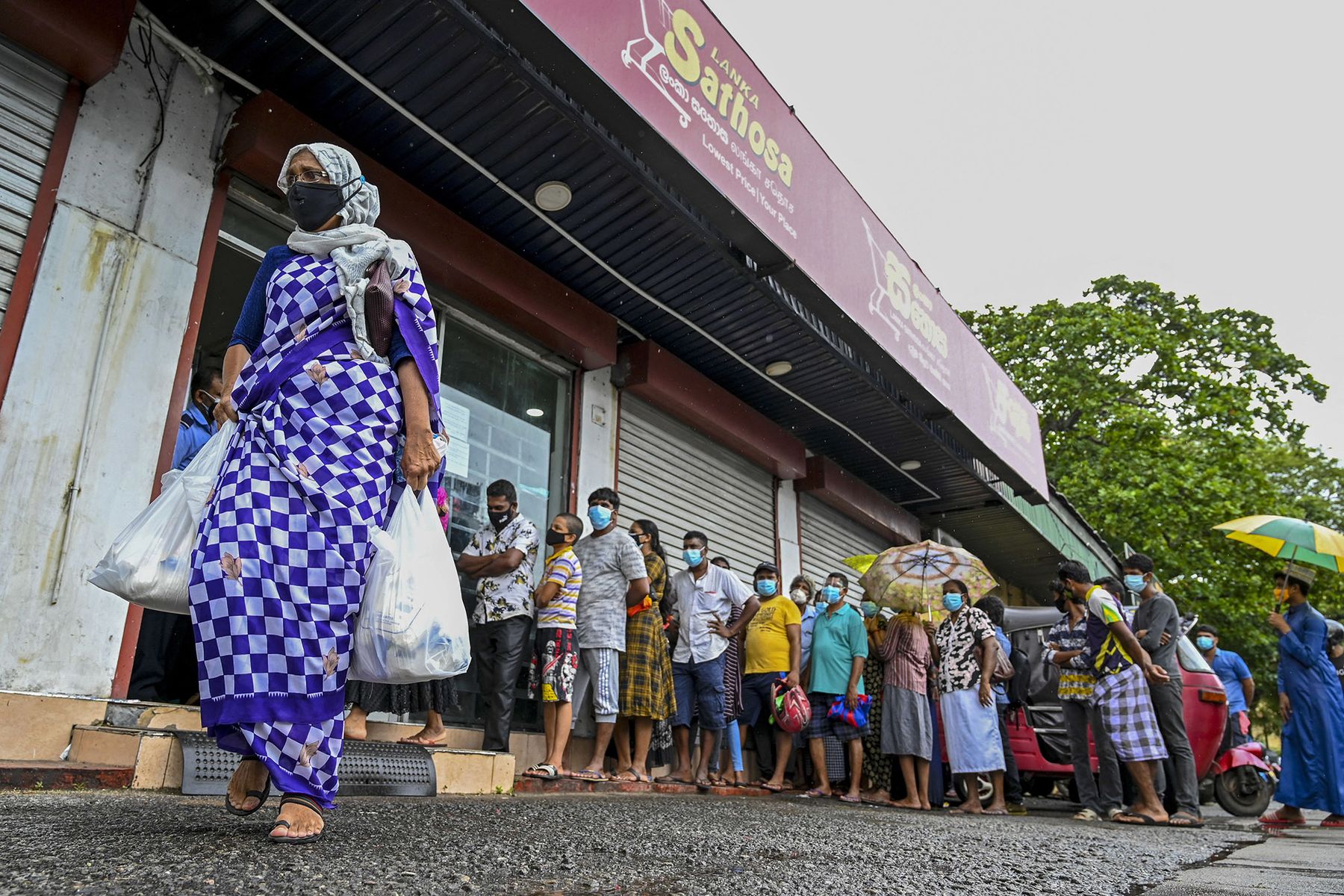
More than 80 per cent of canteens and hotels will be closed from tomorrow due to the shortage of domestic Liquid Petroleum (LP) gas, Chief of the All Island Canteen Owners’ Association (AICOA), Asela Sampath said.

He told the Daily Mirror that the gas shortage in the market had become the main issue, in addition to the increase in vegetable prices.

“The canteen owners are facing a critical situation where they are unable to continue with their services,” he said.

Due to the shortage of gas and the price increase of vegetables, the price of vegetable lunch packets has been increased to Rs.180, the Association said.