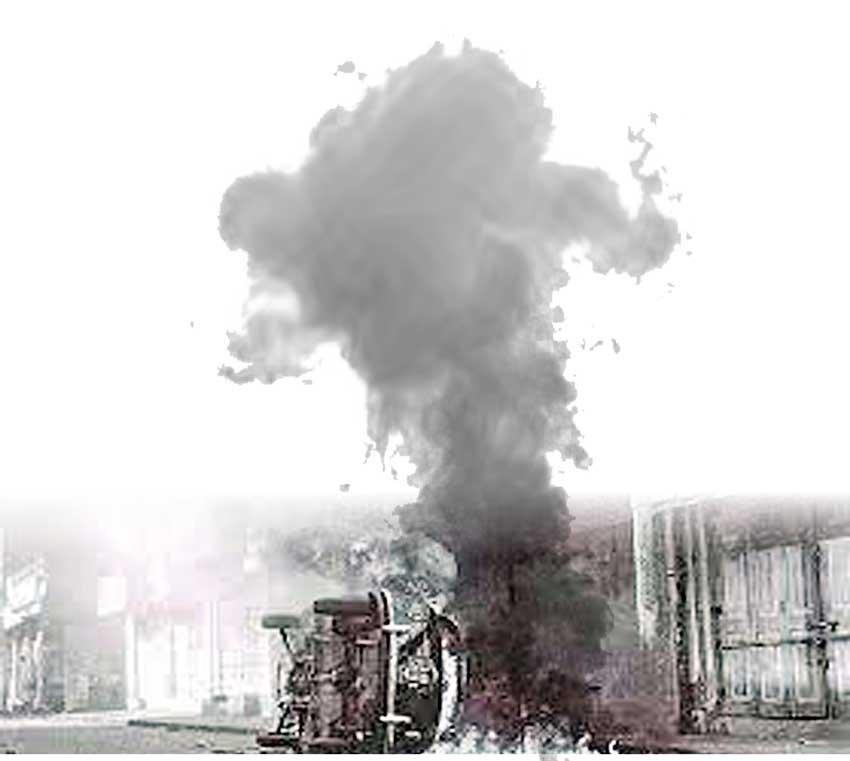
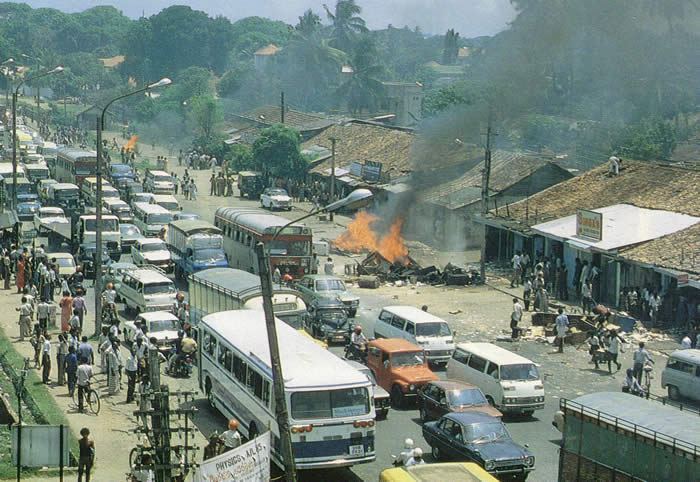
July 24, 1983 was the day on which a destructive spree of anti-Tamil violence commenced in Jaffna in the early hours of the morning and began spreading to Colombo in the later hours of the evening on the same day. It continued to other parts of the Island in the following days. The 38th anniversary of those dark days – etched in history as “Black July” revives bad memories among most Tamils who lived in Sri Lanka during July 1983.
The week long spree of anti-Tamil violence saw over 4,000 Tamils and some Muslims – mistaken for Tamils – being killed. Thousands were injured. Some of the injured were killed in hospitals. There were close upon 300,000 displaced persons as a result. Around 130,000 of these were housed in makeshift refugee camps. More than 2,500 business enterprises ranging from factories to petty boutiques were damaged or destroyed. The number of houses and dwellings and vehicles damaged or destroyed has not been correctly estimated yet.
The anti-Tamil violence of July 1983 was not a mass uprising of Sinhalese against Tamils. Prior to the outbreak of violence, there existed a pre-planned conspiracy to launch a widespread attack against Tamil life, limb and property on a massive scale. All it required was a powerful incident to be the provocative pretext to justify such an attack. The ambush of an Army patrol in the north in the night of Saturday July 23 by the Liberation Tigers of Tamil Eelam (LTTE) resulting in the killing of 13 soldiers by the Tigers reportedly triggered off the violence beginning from Sunday July 24.
‘Four Four Bravo’ Patrol
What happened then was this. On Saturday July 23, 1983, the Army’s ‘Four Four Bravo’ routine patrol proceeded from the Mathagal military base. It consisted of 15 men travelling in a jeep and a half truck. The men were all from the 1st battalion of the Sri Lanka Light Infantry (SLLI). They were commanded by an old Anandian, 2nd Lt. Vass Gunawardane who had a sub-machine gun. The others had self -loading rifles and grenades.
Meanwhile, the LTTE had planned to launch an attack on the Army in Thirunelvely known generally as Thinnavely about two miles away from Jaffna town. Sathasivam Selvanayagam alias Sellakkili of Kalviyankaadu, the newly appointed Tiger Military Commander planned and supervised the operation with the support of Prabhakaran. The spot picked was about 150 metres south of the Post Box junction along the Jaffna-Palaly Road. The road had been already dug up for telecommunications cable laying. This made it convenient for the Tigers to bury land mines.
Four landmines were laid and the wires linked to the exploder were concealed on the back of the roof of a boutique facing the road. Sellakkili perched himself on the roof to explode the mines at the right time. The other Tiger cadres hid themselves behind brick walls in two groups on either side of the road.
The LTTE at that time had only 30 full-time members including its supremo Veluppillai Prabhakaran. Of these 19 were involved in the Thinnavely attack. They were Prabhakaran, Sellakkili, Pulendran, Ponnammaan, Reggie, Ranjan Lala, Kittu, Santhosham, Victor, Appiah, Ganesh, Lingam, Albert, Basheer, Rajesh, Suppanna, Ramu, Gnanam and Raghu (Kundappa).
When the two vehicles approached the landmines were set off. They exploded on the right side of the jeep and in between the jeep and truck. Thereafter the Tigers started firing and lobbing grenades. The soldiers also retaliated. At the end of it all, 13 soldiers including Lt. Vass Gunawardane were dead. The only two Army survivors were Cpl. Perera and Lance Cpl. Sumathipala. From the Tiger side the solitary casualty was Sellakkili, the newly-appointed Military Commander.
Soldiers on the rampage
Once the news of the ambush became known, soldiers of the SLLI went on the rampage. The then SLLI Commanding Officer Lt. Col Upali Dharmaratne was either unwilling or unable to control them. The overall Jaffna Commander Brig. Lyle Balthazar too was unable to exert his authority and instill discipline among troops.
The enraged soldiers went on a violent spree killing 51 civilians in Thinnavely and surrounding areas. This included a university lecturer Kala Parameswaran who was known to me. A mini-van carrying seven passengers was stopped and all eight including the driver were lined up and shot dead in cold blood. Among these was my friend Wimalathasan, a human rights activist and Editor of the journal ‘Manithan’. Later on, the then Army Commander Gen. Tissa “Bull” Weeratunga transferred the SLLI 1st battalion out of Jaffna. Lt. Col. Dharmaratne was replaced by Lt. Col. A.M.U. Seneviratne.
The UNP Government headed by J.R. Jayewardene conducted a mass funeral at Kanatte for the 13 soldiers killed by the LTTE. Large crowds gathered at Kanatte on Sunday July 24. Many were brought there in Government vehicles. The situation took a violent turn around dusk. Mobs began moving in the direction of Borella and Thimbirigasaya from Kanatte. Tamil homes and businesses were attacked and set on fire. As the Esala full moon shone brightly from a not-so-cloudy sky, clouds of smoke from burning Tamil establishments spiralled upwards.
“Sunday Sil, Monday Kill.”
The following Monday July 25 saw anti-Tamil violence spreading like wildfire. The plantation Tamil patriarch Saumiyamoorthy Thondaman known for his pithy comments later described the violence that followed Poya on Sunday as – “Sunday Sil, Monday Kill.”
Despite repeated entreaties by the then IGP Rudra Rajasingham to declare a curfew, President Jayewardene delayed imposing one until the following Monday evening. Even after a curfew was supposedly in force, the violence went on for three days peaking on Wednesday July 27. It began ebbing on Thursday July 28, the day that Indian Prime Minister Indira Gandhi sent the then Indian Foreign Minister P. Narasimha Rao as her Special Emissary to Colombo.
On Friday July 29 saw Colombo and suburbs being terrified by the rumour that the Tigers had come to town. The afternoon of that fateful ‘Koti Dawasa’ (Tiger Day) saw the goon squads massacring Tamils again after being ‘sure’ that no Tigers were in town. Finally 30 and 31 July saw the violence diminish gradually. By August the violence had ceased as international opinion and pressure compelled the J.R. Jayewardene regime to “normalize” the situation.
Indira Gandhi-Narasimha Rao
The role played by India in general and her Prime Minister Indira Gandhi in particular was of crucial importance in curbing the anti-Tamil violence in Sri Lanka then. Indira Gandhi cancelled her trip to Tamil Nadu that had been scheduled earlier. Instead she telephoned President Jayewardene on Thursday July 28 morning and sent her foreign minister PV Narasimha Rao (Later PM) in the evening to Colombo as her special emissary.
Narasimha Rao met with President JR, Premier Premadasa and Foreign Minister ACS Hameed. He spoke on the telephone to Opposition Leader Appapillai Amirthalingam. Rao also had a private “unofficial” meeting in person with cabinet minister Saumiyamoorthy Thondaman. Prior to his return to New Delhi, the Indian Foreign minister “inquired” from his counterpart as to whether Colombo would require Indian security personnel to establish law and order in Sri Lanka if the Lankan Police and armed forces were unable to end the anti-Tamil violence. There was a marked change after Rao’s departure. The organized anti-Tamil violence began diminishing while the law enforcement machinery got re-activated miraculously.
President Junius Richard Jayewardene and other members of the ruling United National Party (UNP) sought to explain the Black July violence as the ‘spontaneous reaction of the Sinhala people to the LTTE attack in Jaffna. ’The Sinhala people were collectively blamed for the violence by the President and his Government. This was done to deflect the blame falling on the Govt.
Blaming Sinhala People
There is, however, a major flaw in attributing blame for the dark events of Black July ‘83 to the Sinhala people on the whole. It is correct that the perpetrators were Sinhalese and the victims Tamils. But it was by no means a mass uprising of the entire Sinhala race against Tamils. If that had happened, only a few Tamils would have been left to tell the tale.
Many Sinhala people were horrified at what happened and were helpless onlookers, while a minority of their ethnicity unleashed havoc in the name of their race and country. It is possible that a section of the people who were non- participants may have been supportive of the anti–Tamil violence and sanctioned it by their silence. But the majority of the Sinhala people were against to what happened then. It cannot be forgotten that a large number of Sinhalese protected and saved Tamils often at great personal risk. Many Muslims too gave shelter and protection to their Tamil neighbours in those dark days. Members of my own family as well as many relatives and friends were aided greatly by decent Sinhala and Muslim people in those troubling times.
The conduct and political role played by the then President JR Jayewardene in the Anti-Tamil violence in July 1983 has been widely criticized. In fact there were many who condemn JR as being responsible for aggravating the situation. The decision to stage a mass funeral for the 13 soldiers at Kanatte in Colombo and the long delay in declaring a curfew resulted in terrible carnage. In order to provide greater insight into the alleged acts of omission and commission by JR during July 1983, I shall reproduce here an electronic mail sent to me by former DIG of Police Ramachandra Sundaralingam.
DIG Sundaralingam
Sunda, as Sundralingam was known, was a very good friend to journalists of my generation in Sri Lanka. If we wanted a good law and order news story, all we needed to do was to contact him. Sundaralingam was serving as Senior DIG in charge of ranges at the time of the 1983 July anti-Tamil violence. Sunda later took up a post at the INTERPOL in Paris and became known as an expert in combatting the narcotics trade. After retirement he took up residence in Chennai, Tamil Nadu. Sunda and I were in regular contact via e-mail and telephone until his demise in December 2018.
While researching for this article I came across an e-mail sent by Sunda in July 2017. What happened then was that he wanted to talk to me about the 1983 July riots and telephoned on my land line. I was away from home and did not respond promptly. An impatient Sunda then sent an e-mail summarizing his thoughts. However, we did converse on the phone subsequently and discussed in detail the points mentioned in the e-mail. However, I feel it is worthwhile reproducing that e-mail as it sheds much light on what had happened then. Here it is:
Sunda’s Electronic Mail
“Dear DBS,
In case we miss each other’s call. Briefly the facts on the Darkest Chapter of the History of Sri Lanka July 1983;
1) Thinnavely LTTE ambush killed 13 soldiers on July 23, 1983. Army HQ informed, President JR via Gen Attygalle ordered Army Commander Weeratunge get to Jaffna immediately.
2) DIG Rajaguru in charge of NP called IGP Rudra Rajasingham and myself stating Army running berserk, Police were helpless.
3) Security Council meeting with all Service Chiefs, Air Force, Naval Commander except Army Chief already in Jaffna to monitor the happenings there and elsewhere. IGP Rudra Rajasingham requested my presence at the meeting as Senior DIG Ranges overseeing NP DIG Rajaguru.
4) Gen. Attygalle hourly discussion (3pm/7pm) with Army Chief Weeratunge. In Jaffna situation was deteriorating with Army revolt in Jaffna, damage to property and injury to several persons, Commander Weeratunge was unable to exercise any control .Gen Attygalle informs JR on the ground situation, JR who in turn informd Gen Attygalle that Army soldiers be buried in Jaffna, as it happens in a war situation. When this message was conveyed to Gen. Weeratunge, his prompt reply, “Sir I will also be buried here, make arrangements to shift the bodies to their native places early.”
5) Security Council decides the bodies be flown to Katunayake Air Force base, after embalming be dispatched to the 13 villages of the 13 soldiers. Police were instructed to organize 13 Air conditioned Ambulances be in readiness at Katunayake on arrival of bodies from Jaffna. This arrangement was approved by JR in his conversation with Gen Attygalle, I am an eye-witness to all these arrangements.
6) Direction received at Police HQ ambulance plan has been cancelled, the bodies will be brought to Ratmalana by air for common burial at Kanatte. In the meantime, tension was mounting in Colombo, with large crowds heading for Kanatte.
7) IGP Rudra Rajasingham, DIG Ernest Perera and I visited Kanatte, everything looked tensed up. I was able to sense the situation as serious. DIG Perera and I strongly advised IGP Rudra Rajasingham to meet the President immediately to impose curfew around 9.00 pm, otherwise the situation would get out of control. IGP left Kanatte to meet JR at Ward Place. Curfew was never declared until next evening by which time serious damage was caused to Tamil persons and their property and it was the worst in the history of country. JR could have averted this situation, but he failed to declare curfew. The big question is, who made the decision to bring the bodies to Kanatte for a common burial? Minister Thondaman told me it was Cyril Mathew who insisted on Kanatte funeral. All this is history.”
The organized violence
An important point to note is that the July 1983 violence was basically an organized act. Several persons may have engaged in the violence on their own but there were core groups at different locations that planned and executed it. As is the case in mob violence, these core groups were joined by others. These groups had absolute impunity and had the protection of important members of the UNP Government then in power.
The mobs had lists of Tamil-owned houses and businesses. They also knew the details of ownership. Wherever premises were owned by Sinhalese, only furniture and goods belonging to Tamil tenants were destroyed and set on fire. The buildings were not torched or damaged.
Many of the mobs were led by functionaries of the UNP trade union Jathika Sevaka Sangamaya (JSS). Several UNP Municipal and Urban councillors and family members were involved. Many prominent supporters and strong-arm men of cabinet ministers were involved. The Police were ordered by UNP politicians in several instances not to arrest the violent elements.
In many incidents, the large groups of thugs and goons were transported in Government-owned Transport Board vehicles or in vehicles owned by semi-Government corporations. Even food parcels and liquor were distributed systematically among those elements.
When some decent UNP leaders such as Shelton Ranarajah and Renuka Herath Ranasinghe got the goons locked up by the Police in Kandy and Nuwara Eliya respectively, and later their release was secured by ministers Cyril Mathew and Gamini Dissanayake. The role of Cyril Mathew and his political lackeys in the violence were well-known. Some of those involved are still in politics and holding high office.
Responses of Govt Ministers
One of the lamentable features of the July 1983 pogrom was the abominable response of J.R. Jayewardene and senior ministers on television. Not even a single word was uttered in sympathy for the victims of the violence. JR indirectly blamed the Sinhala perpetrators, but justified the violence by saying it was a natural and spontaneous reaction of the Sinhalese people. Instead of reaching out to the victimized Tamil people, the President announced that legislation would be brought to forbid secessionism.
State Minister Anandatissa de Alwis spoke about a hidden hand, a foreign hand, being responsible. He said there was a conspiracy to provoke clashes between the Sinhalese and Tamils, the Sinhalese and Muslims and Buddhists and Christians. Lands and Mahaweli Development Minister Gamini Dissanayake warned Tamils that it would require 14 hours for Indian troops to come and rescue them but the Sinhalese could destroy them in 14 minutes if they wanted to. Trade and Shipping Minister Lalith Athulathmudali was sorry that people had to queue up again for essentials as a result of the violence. Finance Minister Ronnie de Mel gave a lecture in history about Sena and Guttiga. Cyril Mathew, the Industries and Scientific Affairs Minister, raised the Indian bogey and saw an alien hand behind the conspiracy that led to the July ’83 violence. His cabinet colleague, Rural Industrial Development Minister Saumiyamoorthy Thondaman refuted it and said elements inside or close to the Government were responsible.
Paul Sieghart
Notwithstanding the efforts of then President Jayewardene to tarnish the Sinhala people as being collectively responsible for this carnage, respected observers such as Paul Sieghart of the International Commission of Jurists exposed the real state of affairs.
As Sieghart himself pointed out in his report (‘Sri Lanka: A Mounting Tragedy of Errors’): “Clearly this (July 1983 attack) was no spontaneous upsurge of communal hatred among the Sinhala people – nor was it as has been suggested in some quarters, a popular response to the killing of 13 soldiers in an ambush the previous day by Tamil Tigers, which was not even reported in the newspapers until the riots began. It was a series of deliberate acts, executed in accordance with a concerted plan, conceived and organized well in advance.”
Planned Pogrom
What happened in July 1983 was not a spontaneous riot but a planned pogrom. A ‘pogrom’ is defined as a form of violent riot, a mob attack, either approved or condoned by Government or military authorities, directed against a particular group, whether ethnic, religious, or other, and characterized by killings and destruction of their homes, businesses, property and religious centres. The word pogrom is of Russian origin and means “to destroy, to wreak havoc, to demolish violently” in the language.
D. B. S. Jeyaraj can be reached at dbsjeyaraj@yahoo.com