India awaits outcome of probe on death of fishermen in Sri Lanka

India is awaiting the outcome of a probe on the death of four Indian fishermen in Sri Lanka.

The External Affairs Minister of India, S Jaishankar told the Rajya Sabha today that India has strongly protested to Sri Lanka over the death of the four Indian fishermen following a collision between their vessel and a Sri Lankan naval craft last month.

Replying to questions in the Rajya Sabha, the Minister also said no Indian fishermen were in Sri Lanka’s custody at present, the Press Trust of India reported.

On January 18 this year, four fishermen lost their lives following a collision between their vessel and a Sri Lankan naval craft.

“We have very, very strongly protested to the Sri Lankans on this matter. In response to that, they have instituted an inquiry. We are awaiting the results of the inquiry. But, I wish to assure…that we will take a very strong view on this matter,” he said.

A strong protest in regard to the incident was conveyed by the Indian High Commissioner to the Sri Lankan Foreign Minister. A strong demarche was also made to the Sri Lankan Acting High Commissioner in New Delhi.

Jaishankar also told the House that “right now, there are no Indian fishermen in the custody of Sri Lanka”. There were nine till recently and they have been released.

“As of now, there are 62 Indian boats which we are trying to get released from Sri Lankan custody,” he said.

Previously, there were 173 boats, out of which 36 were salvageable.

“So, the auction procedures for the unsalvageable boats are currently under discussion. Our endeavour would be, whatever can be returned, we will get them returned and whatever can be salvaged, we will expedite the salvage,” the Minister added, according to the Press Trust of India.

He also said the Indian Government attaches the highest priority to the safety and security of Indian fishermen. He said that as soon as reports of apprehension of Indian fishermen are received, the Government, through diplomatic channels, takes up the matter with the government of Sri Lanka.

Posted in Uncategorized

‘No change in decision to maintain ECT under SLPA’

The government says no change has been made to the decision to maintain the East Container Terminal of the Colombo Port under the Sri Lanka Ports Authority.

Speaking in Parliament regarding the East Terminal Samagi Jana Balawegaya Parliamentarian Hesha Withanage said he hopes the issue has been solved, despite government MPs claiming the Port must be vested with an Indian firm.

He said such statements were being made in public as such persons receive commissions through the deal.

MP Withanage called for all factions to come together and propose a national policy to prevent local assets being sold to foreigners adding that failing which both factions will continue to level allegations at one another.

Responding to claims State Minster Ajith Nivard Cabraal said the government vowed not to sell local assets to foreign nations.

Despite differed opinions among the ruling party, the State Minster stressed a final call on the matter will be taken by the country’s leaders.

In addition, Minister Rohitha Abeygunawardena recalled that negotiations with foreign investors were completed, for the benefit of the country and not for other parties.

Minister Abeygunawardena claimed Sri Lanka withdrew from the accord and confirmed that ownership of the East terminal will not change, while claiming that investors will be called for the West Terminal.

PM seeks Maha Sangha’s advice over UNHRC

Prime Minister Mahinda Rajapaksa has called on the Maha Sangha to discuss resolutions due to be tabled against Sri Lanka at the United Nations Human Rights Council session in Geneva.

The aim of the visit was to seek advice on the report and further action that needs to be taken in this regard.

It has been revealed that the resolutions compiled by the United Nations Human Rights Commissioner include 16 matters which affect Sri Lanka’s sovereignty.

Minister Wimal Weerawansa who was present at the discussion said it is important to increase the number of countries that will back Sri Lanka against the resolutions.

Premier Rajapaksa said the advice of the Maha Sangha will be prioritized when facing challenges as a country.

Posted in Uncategorized

Mahinda’s U-turn : PM not responsible for decisions regarding burials – State Minister for Covid Prevention – The Leader

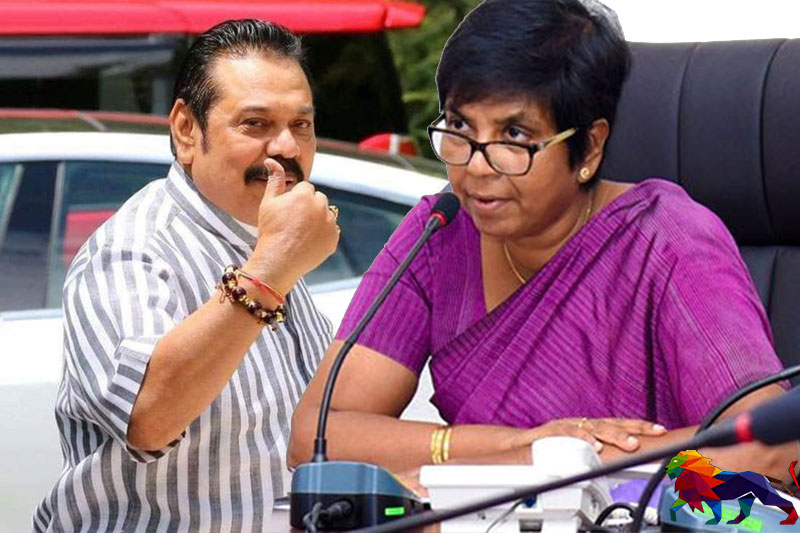
The final decision on permitting the burial of Covid-19 victims will have to be decided by an expert committee, the State Minister of Primary Health Services, Pandemics and COVID Prevention Sudarshanie Fernandopulle said in Parliament today (11).

The State Minister made this statement in response to a question raised by SJB MP Mujibur Rahuman.

He inquired from Minister Fernandopulle as to when the gazette notification pertaining to the burial of Covid victims would be issued.

State Minister Fernadopulle said that the matter will be referred to an expert committee that will make a final decision in this regard.

Prime Minister Mahinda Rajapaksa announced in Parliament yesterday (10) that permission would be granted to bury the bodies of Covid victims.

International community commends decision:

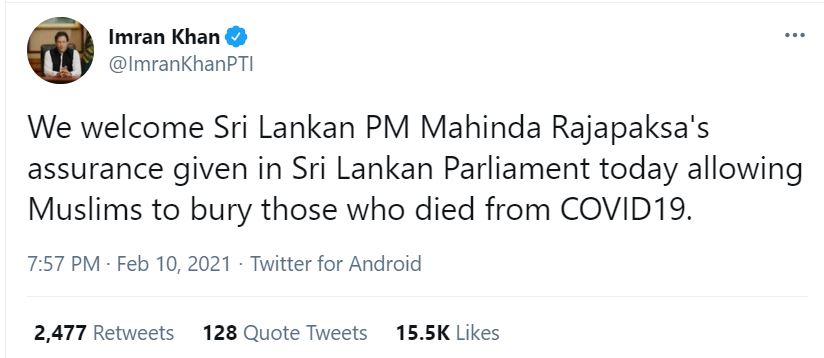
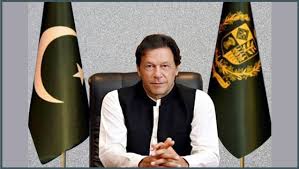
Pakistan Prime Minister Imran Khan welcomed Prime Minister Mahinda Rajapaksa’s assurance to allow burials of Muslim victims.

“We welcome Sri Lankan PM Mahinda Rajapaksa’s assurance given in Sri Lankan Parliament today allowing Muslims to bury those who died from COVID19,” he tweeted.

ImranTw

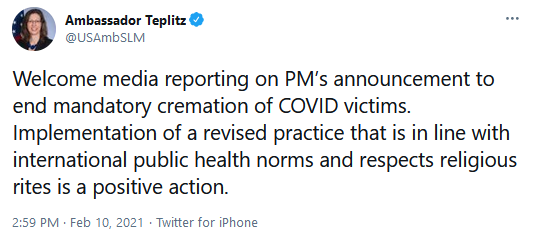
Meanwhile, US Ambassador Alaina B. Teplitz welcomed the Prime Minister’s announcement to end mandatory cremation of COVID victims. She noted that the implementation of a revised practice that is in line with international public health norms and respects religious rites is a positive action.

alaina tweet

Bathiudeen expresses gratitude:

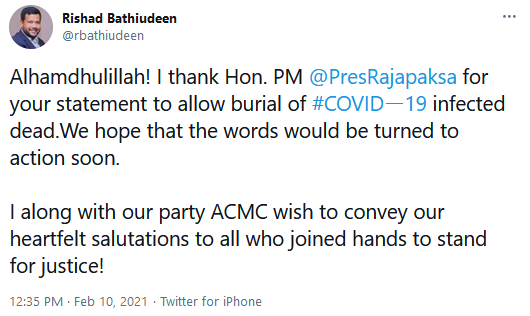
The Leader of the All Ceylon Makkal Congress Rishad Bathiudeen thanked Prime Minister Mahinda Rajapaksa for granting permission to bury the bodies of Covid victims.

“Alhamdhulillah! I thank Hon. PM @PresRajapaksa for your statement to allow burial of #COVIDー19 infected dead. We hope that the words would be turned to action soon. I along with our party ACMC wish to convey our heartfelt salutations to all who joined hands to stand for justice!,” Bathiudeen tweeted.

rishad b tweet

Former Speaker commends decision to allow burials

The National Movement for Social Justice (NMSJ) has commended the decision taken by Prime Minister Mahinda Rajapaksa to allow the burial of Covid-19 victims.

In a statement today (11), the Chairman of the NMSJ Karu Jayasuriya said that the decision taken by the Government is in line with the recommendations of the World Health Organisation, the reports of two expert committees comprising local health professionals, the Human Rights Commission of Sri Lanka as well as the United Nations Human Rights Council.

“This is an important decision with regard to the reconciliation process in the country. At the same time, it will help to alleviate religious and ethnic differences. This can be considered as a decision that was taken based on science.” – Former Speaker Karu Jayasuriya

He pointed out that the decision is a clear indication of the political maturity of Prime Minister Mahinda Rajapaksa.

He noted that this move will help to redress certain grievances that have developed among certain sections of the society in recent times.

“As a civil society organisation that endeavours to create a just society, the National Movement for Social Justice appreciates this decision and fervently hopes that appropriate action will be taken to implement it without delay,” Jayasuriya said.

Under pressure from all corners :

Extremist Sinhala Buddhist groups and pro-government social media activists have lashed out at the government following media reports on the Prime Minister’s decision to reverse Sri Lanka’s mandatory cremation policy.

However, when theleader.lk contacted a senior official of the Prime Minister’s Office, he denied media reports which said that the Prime Minister had approved burials of Covid victims.

SJB MP S.M. Marikkar who questioned the Premier regarding the government’s stance on the burial issue, made the following observations at a press conference today (11).

Posted in Uncategorized

Easter bombings: Cardinal prepared to go to int’l court if Sri Lanka fails to deliver justice

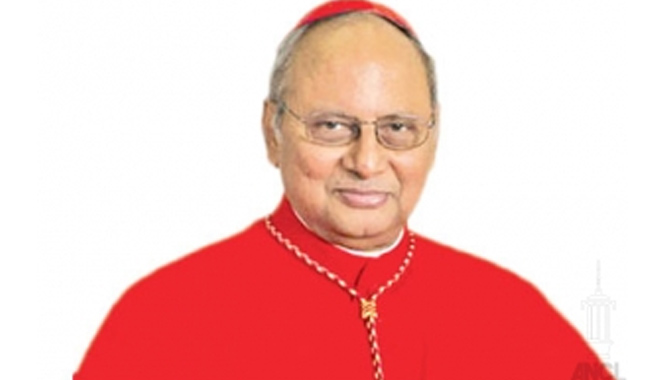
If Sri Lanka fails to bring the perpetrators and masterminds of the 2019 Easter bombings to justice, international judicial assistance will be sought, Archbishop of Colombo Malcolm Cardinal Ranjith said.

“We trust our leaders will prevent such an eventuality. We are hopeful that they will respond favourably to our requests through the [report of the presidential commission of inquiry appointed to probe the attacks] and subsequent court cases,” Ranjith told reporters today.

“We shall have to see what the government does after submitting the report. If this does not happen, there are international organisations abroad, and we will act accordingly, seeking the assistance of those organisations, in order to achieve some justice,” he added.

The archbishop also expressed his dissatisfaction over the Criminal Investigations Department’s inquiry into the attacks.

“Those investigations seemed as if they were carried out for the sake of investigating, with no genuine interest. I have therefore decided on an alternate approach in relation to one specific matter [of the investigation] through the courts. You will learn about it soon,” he said.

The Catholic community can no longer wait around for answers, Ranjith said, adding that the truth about certain specifics of the case must be found.

“We cannot keep waiting. Let us have a copy of the report as soon as possible,” he said.

Recalling his testimony at the presidential commission, the archbishop said that he made a request from the authorities to not limit their investigations to government officials who couldn’t prevent the attacks but to extend it to possible masterminds.

“I’m hopeful that the commission will respond favourably to that request,” he said.

Recent discussions with families of the victims at the Kochichikade and Katuwapitiya churches, he said, want to know who was behind the attacks that killed 267 people and injured at least 500, many of them Catholic or Christian. His people are running out of patience, the cardinal warned.

“If there is no justice from the government or the commission, we will be compelled to take other decisions as a people,” he said.

Posted in Uncategorized

Elections Commission’s stance on PC polls

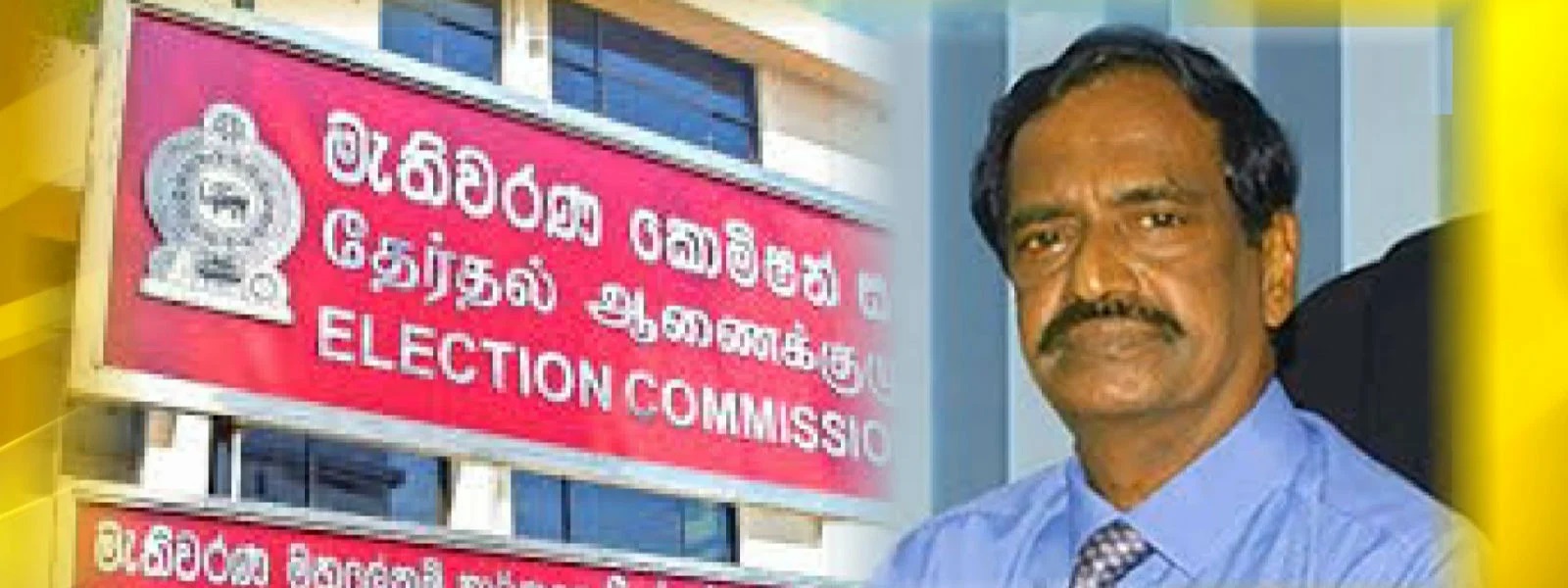
It is possible to hold Provincial Council elections within two months after amending the constitution, according to Chairman of the Election Commission Attorney-at-Law Nimal G. Punchihewa.

He mentioned this speaking to the media after a visit to the Chief Prelates of Malwatu and Asgiriya Sectors.

He added that it was the stand of the Elections Commission that the Provincial Council elections should be held.

Thereby, the request of the Election Commission is to appoint public representatives for the Provincial Councils, said Punchihewa.

He said that the relevant laws should be amended as they have identified several shortcomings in holding free and fair elections.

“For example, in a free and fair election, everyone has the right to vote. Doctors and nurses who are now in essential services in our country do not have the opportunity to vote. There are no postal voting rights under our law. So these have to change. The voting system needs to be changed for these individuals to use the pre-vote. We have been preparing for it since last time. Now it needs to be activated.”

He also added that a methodology is currently being discussed to formulate a control over election expenses.

Military Takeover Of Jaffna’s Cultural Hall: Sinhalese Army To Lead Tamil Cultural Revival?

In a tripartite agreement between the Government of India, Government of Sri Lanka and the Jaffna Municipal Council, Jaffna was gifted an SLRs. 2000 million Cultural Hall. The said hall has been ready for over six months but is not operational for lack of funds for staff, telephones etc.. It was poor planning from beginning to end. The sri Lankan government that gives that as an excuse to keep the centre shut, in a shocking move that has just come to light somehow has found the funds for the army to run the Cultural Centre.

In a letter dated 26 Jan. 2021, S.T. Kodikara, Secretary, State Ministry of National Heritage, Performing Arts and Rural Arts Promotion, has written to Secretary, Ministry of Buddhasasana, Religious and Cultural Affairs, to say

Considering technical requirement to be met with priority, it is recommended to hand over [sic.] management of the newly build [sic.] Cultural Centre in Jaffna to the Chief Executive officer [sic.] of the Nelum Pokuna Theater in order to make arrangements to activate it until the Municipal council [sic.] in Jaffna is ready to take over the management.

Who is this CEO of Nelum Pokuna Theatre whose full name is Nelum Pokuna Mahinda Rajapaksa Theatre? It is part of the Rajapaksa’ grandiose personality cult scheme they seem to have picked up from Mao Tse Tung. As to who this CEO is, the Army website says:

After a formal Guard Turnout at the entrance, the newly-appointed Colonel of the Regiment was received by Brigadier Sujith Balachandra, Chief Executive Officer at Nelum Pokuna Theatre along with Brigadier Janaka Priyadarshana, Commander, Mechanized Infantry Brigade, Brigadier Kumara Wanasinghe, Centre Commandant, Mechanized Infantry Regiment.

If the government verily has the money for the Army to run the Cultural Centre, why could it find no money for the Municipality to do so, asked a Jaffna man. “Indeed, asked an ordinary indignant Tamil teacher, “What has the Ministry of Buddhasasana, Religious and Cultural Affairs got to do with Tamil Culture? Their track record is to take over anything Tamil and call it something that belongs to the Sinalese? India should have anticipated this.”

And what does the army know about our culture except to kill it, asked the same Jaffna man cited earlier. He pointed to the causeway from Jaffna to Poonahari where just North of the new Sangupiddy Bridge, there is a “Check Point.” Employing no Tamils and not wishing to pay a Tamil to translate this into Tamil, the army appears to have used Google’s translator. The Tamil sign as a result now says “Chothanai Pulli” a direct translation of “Point” whereas the usual phrase is “Chothanai Chaavadi.” We laugh but that papers over the cultural danger we face, says an engineer at the Road Development Authority.

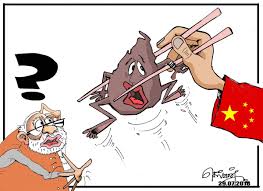
Will such Google Translations characterize the titling of exhibits in out new cultural hall? Why is India so scared to tell off Sri Lanka where to get off, when Sri Lanka acts so brazenly, spurning anything that India gives with charitable motives, including the now shut down airport? Is Prime Minister Narendra Modi being another Neville Chamberlain, keeping quiet as the Chinese are given footholds within a few kilometers of India on the islands? Will Prime Minister Modi need an open challenge to wake up, as happened when Adolf Hitler on 1 Sept. 1939 invaded Poland exploiting Chamberlain’s appeasement policy? What will it take for Modi to wake up?

These are fair questions from different terrified citizens in Jaffna who fear a nuclear clash between India and China on our soil.

Said a long-term Tamil observer and feature writer, “The only silver lining in the dark clouds for us Tamils is that the more mad things Sri Lanka does like spurning UNHRC and its Chief, insulting President Biden, beating up Sri Lankan Tamils, killing Indian Tamil fishermen etc., all the more will it make it impossible for the world to appease the mad Sinhalese government as it goes rogue, and ignore its madness. A part-horrible Sri Lanka has a chance to escape justice. A wholly rotten Sri Lanka as it rots more and more, cannot escape justice. Hopefully that process will not entail more deaths.”

Source:colombotelegraph

Posted in Uncategorized

India losing control over its sphere of influence in South Asia – The FEDERAL

The coming to power of the Rajapaksa brothers in Sri Lanka in November 2019 was viewed with trepidation in New Delhi for their pro-China reputation. Over a year later, the fears seem to be coming true with at least two significant Rajapaksa government decisions that go against India and favour China.

The latest is the awarding of a hybrid renewable energy project off Jaffna in three islands to the north of the country that brings China a smelling distance away from Tamil Nadu coast, a mere 50 km away.

News of the project comes close on the heels of the Rajapaksa government cancelling a joint contract to India and Japan for developing the East Container Terminal (ECT), which is part of the Colombo port.

For India, it is a reconfirmation that Sri Lanka is out of its orbit. China has managed to consolidate its already dominant position in that country, which could have long-term strategic implications for India.

When Gotabaya Rajapaksa was elected president, he visited New Delhi and made all the right-sounding statements in favour of relations between the two countries. But, soon after, his brother Mahinda Rajapaksa assumed the office of prime minister and between the two India finds itself out of favour.

The BJP government, under Prime Minister Narendra Modi, appears helpless at the slipping away of a close neighbour from India’s grasp into China’s lap. The pressure on India from Beijing is all round. To the north of the country, China has been actively challenging India on the border to the east in Arunachal Pradesh and the west in Ladakh.

Since last May, China has moved its troops south towards India and has reportedly occupied land that was earlier patrolled by Indian soldiers. Beijing has used the excuse of a no-man’s land between the two countries. India, waking up a trifle late to China’s incursions, managed to keep China off the southern side of the Pangong Tso lake but was unable to hold on to the north of the lake which was part of its patrolling area. The Modi government’s official response has been confounding too.

Soon after the Galwan valley clash in June last year with China that resulted in the death of 20 Indian troops, Modi in his reaction at an all-party meet said neither had any outsider entered Indian territory in Ladakh nor had any Indian post been captured by foreign forces. The resulting outrage forced the Indian government to backtrack and Modi subsequently made some statements to retrieve the situation. He has, however, until now never named China for its transgressions on the border.

Earlier this week, India’s former Army chief and Union Minister for Road Transport and Highways Gen V K Singh in a statement that contradicted the official Indian position said, “None of you come to know how many times we have transgressed as per our perception. Chinese media does not cover it. Let me assure you, if China has transgressed 10 times, we must have done it at least 50 times.”

Clearly a self-goal, China has seized the opportunity saying that Singh has only confirmed its position on the border issue.

The foreign policy fires meanwhile are all round. With Nepal in the midst of a proxy battle between India and China, and Bangladesh doing a balancing act between the two countries, New Delhi’s foreign policy manoeuvres seem questionable and bereft of any inspired moves to get back the initiative.

Amidst this, the replacement of Donald Trump by Joe Biden as United States president is another development with implications for India. Though Trump did take a couple of decisions that went against India on the trade front and on the issue of immigration, on foreign policy the Trump administration was unabashedly articulate in backing New Delhi in its tussle with China.

But Biden, a more seasoned politician with decades of experience in foreign policy, is not expected to give India a carte blanche on issues that New Delhi considers its internal matter such as Kashmir and the farmers’ protest.

Already, a powerful India caucus in the US Congress close to the Biden administration has advised India to maintain the norms of democracy and allow farmers to protest peacefully while asking the government to restore Internet connectivity. For the Modi government sensitive to comments from foreign powers about what it terms India’s internal issues, the US Congress group’s statement is something it can ill-afford to ignore given its dependence on Washington.

What is visibly missing is a robust Indian counter to the foreign policy mishaps in its neighbourhood. There has been some action. India’s bureaucrat turned foreign minister S Jaishankar has travelled to Sri Lanka, Nepal and has been involved in talks with China. But, there is as yet no positive sign for India. The minister, on the contrary, was quoted by the media as saying that 2020 was a year of “exceptional stress” for India in its ties with China.

If at all there was some positive news for India’s foreign policy establishment, it was the split in the ruling Communist dispensation in Nepal. Though a pyrrhic victory, it goes some way in retrieving the pro-China tilt that Nepal had acquired. The split put paid to Beijing’s hopes of retaining total control over the Nepali government.

The only neighbour that appears to have had a comparatively non-controversial relationship with India is Bangladesh but it hides the fact that Dhaka’s biggest trading partner is China. India lost its pre-eminent position in Bangladesh to China five years ago. Bangladesh too, however had its share of complaint against India over the citizenship amendment act that has sought to exclude Muslims from its ambit of special privilege.

That does not leave the Modi government much to preen on the foreign policy front. Rather, the BJP and the mandarins in South Block find themselves in an unenviable position of having to preside over India’s loss of control in its traditional sphere of influence in South Asia.


Pakistani PM to address Lankan parliament amid Muslim human rights concerns – ARAB NEWS

Sri Lankan Muslim community leaders were on Tuesday pinning their hopes on Pakistani Prime Minister Imran Khan addressing their human rights concerns during his historic visit to the island nation later this month.

Premier Khan is due to arrive in the capital Colombo on Feb. 23 where he is expected to hold talks with key government officials and party leaders.

Sri Lanka’s parliament speaker, Mahinda Yapa Abeywardena, on Tuesday said that the Pakistani PM was slated to address the legislature the following day.

Khan will become the third Pakistani head of state to address the Lankan parliament, after former President Gen. Mohammed Ayub Khan (1963) and Prime Minister Zulfikar Ali Bhutto (1975).

Former Indian premier, Jawaharlal Nehru, also addressed the Lankan parliament in 1962, followed by British Prime Minister Margaret Thatcher in 1985. More recently, Indian PM Narendra Modi spoke to the legislature in 2015.

During his two-day visit to the country, Khan is expected to hold talks with Sri Lankan President Gotabaya Rajapaksa, Prime Minister Mahinda Rajapaksa, and Foreign Minister Dinesh Gunawardena.

Prominent representatives of the island’s 2 million Muslims, who make up 9 percent of the total population, said they were banking on “great Muslim leader” Khan to “speak on our behalf.”

President of the Muslim Council of Sri Lanka, N. M. Ameen, told Arab News: “The community wishes to welcome a great Muslim leader who is coming as his country’s prime minister for the first time. He is in a vantage position to speak on behalf of the Sri Lankan Muslims.”

Rishad Bathiudeen, former minister and leader of the All-Ceylon Makkal Congress, who met with the charge d’affaires of the Pakistan High Commission in Colombo on Tuesday, told Arab News: “We have expressed the concerns of the Muslim community, especially regarding the forced cremation policy of the government (for COVID-19 victims).”

Last year, the Sri Lankan government was accused of forcing the cremation of anyone confirmed or suspected to have died from the coronavirus disease (COVID-19).

The move outraged Muslims who said it breached their religious rights, and medical experts argued that there was no evidence that COVID-19 could be contracted from dead bodies.

Shreen Saroor, a women’s rights activist and co-founder of the Women’s Action Network, told Arab News: “Our legitimate rights to bury our dead must not undermine the rights of our Tamil and Sinhala brothers and sisters to protect their rights or know the truth about the death of their family members and to be allowed to mourn them.”

“Prime minister Khan must use his visit to assist in our struggles for human rights, justice, and accountability for all in Sri Lanka,” she said.

Saroor added that there were “concerns” that Khan might “negotiate a deal with the Sri Lankan regime to restore Muslim burial rights while in turn offering Pakistan’s support to Sri Lankan diplomatic efforts to reject the (UN) Human Rights Council resolution.

“This would not be the act of a friend to Sri Lanka and would be at the cost of the Tamil community’s legitimate struggle for truth and justice. Like Muslims, Tamils have been facing many challenges. The failures of domestic justice have prevented reconciliation in our country and stopped the nation from moving toward a stable and prosperous future.”

A Jan. 27 report by UN High Commissioner for Human Rights Michelle Bachelet, highlighted the need for a “strong human rights resolution” to address Sri Lanka’s “deteriorating human rights situation” and “pursue accountability for past and recent violations.”

It also set out steps for the UN Human Rights Council to “confront the growing risk of future violations.”

In response to the report, the Human Rights Watch organization said: “Since the government of President Gotabaya Rajapaksa has withdrawn its support for the 2015 consensus resolution seeking justice and reconciliation, and shown general disregard for upholding basic human rights, the council should act to protect those most at risk and advance accountability for grave international crimes.”

Toward the end of the 2009 civil war between the government and the separatist Liberation Tigers of Tamil Eelam (LTTE), both groups committed atrocities which led to the deaths of tens of thousands of civilians.

Thousands March for Justice in Sri Lanka, Despite Ban -HRW

In Sri Lanka, families like those of Mariyasuresh Easwary, whose husband was forcibly disappeared by the authorities, have been waiting a long time for answers—and for justice.

“We have approached the courts, we did not get justice there. We approached commissions of inquiry, we did not get our justice there either,” she told reporters.

Now, many families of Sri Lanka’s “disappeared” are joining others to call upon the United Nations Human Rights Council to support international accountability efforts for grave violations committed during the 26-year civil war that ended in 2009. “We need the international community and the United Nations to deliver justice for us,” she said.

Sri Lankan officials immediately tried to muzzle victims’ groups, issuing numerous court orders against a five-day protest march around the country’s independence-day celebrations on February 4. For example, the Kalavanjikudi Magistrates Court on February 1 issued an order to “prohibit protests planned in support of the accusation of human rights violations at the Geneva sessions.”

A sinister threat followed with the public security minister warning that the protesters would be arrested. “Now we have their photographs and we have their vehicle numbers, we know who these individuals are,” the minister said in a television interview.

Thousands of Tamil civilians were killed in the final months of fighting between the Sri Lankan government and separatist Liberation Tigers of Tamil Eelam, when both sides were responsible for numerous atrocities. With Sri Lanka having failed to uphold commitments to prosecute alleged perpetrators, the Human Rights Council later this month is expected to consider measures to promote international accountability.

Instead of addressing concerns, President Gotabaya Rajapaksa’s government has denounced international efforts for justice, adopted discriminatory measures against Tamils, and harassed victims’ groups. For a second year, the singing of the national anthem in Tamil, an official language, was dropped from the government’s independence-day parade. In January, authorities demolished a memorial to Tamil civilians killed during the war.

UN human rights commissioner Michelle Bachelet has warned that the government’s policies of protecting alleged perpetrators while persecuting minority groups are a “warning sign” of future violations.

Human Rights Council members should now pay heed to the victims and their families who are trusting them to pass a strong resolution to advance accountability and deter the government from committing further abuses.