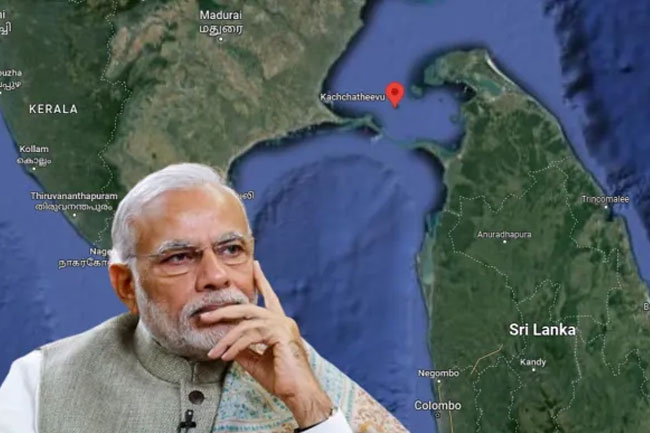
Narendra Modi is the first Indian Prime Minister in half a century to stir up controversy over India’s “ceding” of Katchatheevu to Sri Lanka.
Having been in office for ten years, he has never said anything controversial regarding that tiny islet in the Palk Strait, but now as India is bracing for the Lok Sabha elections his comments have become a major talking point in the political arena.
It is strongly believed that Modi, who is a leader with overwhelming popular support in North India, will become the Prime Minister for the third time. But Modi’s Bharatiya Janata Party (BJP ) has been unable to garner significant support in southern states, particularly in Tamil Nadu, which has been ruled by two major Dravidian parties for nearly seven decades. Modi and the BJP are keen to use the Katchatheevu issue, which has been a sensitive issue many decades in Tamil Nadu, to attack the Congress Party and the Dravida Munnetra Kazhagam (DMK), both long-time allies.
This is not the first time that Modi has used the Katchatheevu issue to attack the opposition. During a speech in Parliament in August last year, Modi criticised former Prime Minister Indira Gandhi for ceding of Katchatheevu to Sri Lanka when she was in power. That speech did not spark a controversy like the current one.
The heat of the Lok Sabha election campaign has naturally turned the spotlight on the current controversy. While interested parties in India are taking sides on the issue depending upon their political likes and dislikes, it has ruffled feathers in Sri Lanka, even though Foreign Minister Ali Sabry has dismissed the issue as a matter of Indian electoral politics which has no bearing on Sri Lanka or Indo-Lankan relations.
The Sri Lankan government is acting with great diplomatic prudence without any official response. Apart from Foreign Minister Sabry, Water Supply Minister Jeevan Thondaman and Fisheries Industry Minister Douglas Devananda have expressed their views.
It is interesting to note that the common view expressed in newspaper editorials both in India and Sri Lanka was that sensitive issues like Katchatheevu should not be exploited for electoral politics in a manner that would affect bilateral relations between India and Sri Lanka.
A Colombo-based English daily wrote that the Indian Prime Minister’s stirring up an issue that has been sensitive in Tamil Nadu will force Sri Lanka to seek friends and security guarantees elsewhere in other regions. The general impression among India’s reputed English newspapers was that Prime Minister Modi had started an unhealthy trend by trying to use an issue that had been resolved years ago for political gain and that he should exercise responsibility when commenting on emotive issues.
Rejecting External Affairs Minister Jaishankar’s comments, The Hindustan Times said that there is no connection between the safety of Indian fishermen and the Katchatheevu issue.
Of course, it is true that the Dravidian parties in Tamil Nadu have been continuously demanding the retrieval of Katchatheevu from Sri Lanka. There had been occasions when former Chief Ministers Karunanidhi and Jayalalithaa had approached the Supreme Court to seek redress. But, it has been the firm stand of the Central Governments, whether they were under Congress or BJP, that the Katchatheevu Agreement could not be reversed. But even under new leaderships, the Dravidian parties continue to insist on retrieving the island.
Forced to compete with China in safeguarding its strategic and economic interests in Sri Lanka, it is imperative for India not to engage in actions that could unnecessarily antagonise Colombo.
It should be noted that as national elections are approaching in Sri Lanka also, there is a danger that Sinhalese nationalist political forces may intensify their anti-India propaganda.
In this context it is worth pointing out that though Modi is using Kachchatheevu to attack Congress and DMK, he is not saying that he will retrieve the island.
Be that as it may, the comments made by former Sri Lankan High Commissioner to India and experienced Administrative Service officer Austin Fernando’s to the Indian Express last week are noteworthy. He said: ” The Bharatiya Janata does not have enough people’s support in Tamil Nadu, so it seems that they have stirred up the Katchatheevu issue now. But since the Bharatiya Janata Party will win nationally, it will be difficult for the central government to get out of the Katchatheevu issue after the elections. We and they should think about this.”
In its editorial, Colombo-based Sunday Times said: “It was a matter of time before the upcoming general election campaign rhetoric in India was to spill over to Sri Lanka. This time it was no less a persona than its Prime Minister who obliged with his choir of senior ministers in the ruling Bharatiya Janata Party (BJP) joining in singing from the same hymn sheet.”
“It was a marked departure from the usual. Normally, it is the Tamil Nadu politicians who use the ‘Sri Lanka card’ for electioneering. This time it has come from the Centre itself. Snubbed by the southern parties that have refused to join in an electoral alliance with the BJP, the ruling party has dusted off old archival material relating to a 1974 bilateral agreement between India and Sri Lanka over the sovereignty of the islet of Katchatheevu and slammed the Opposition Congress Party and the Tamil Nadu regional party, the DMK for it.”
“Regardless of the ‘Neighbourhood First’ policy it otherwise professes, India’s Foreign Minister made his way to the BJP headquarters wearing the party hat rather than his ministerial hat to give a news conference early one morning this week following his Prime Minister’s tweet over what the PM called was the ‘callousness’ of the Congress/DMK combine over the Katchatheevu agreement. The Minister gave his own version of history selectively quoting speeches from yesteryear to argue his brief – slamming the long departed Nehrus and the DMK leaders for what, according to him, amounted to treachery on their part.”
“In doing so, the Minister not only insulted his predecessors in office, both the senior officials and politicians but gave the impression that the then Indian Government gave Katchatheevu on a platter to Sri Lanka. In the process he lost sight of his own Government’s stance on a ‘rules-based world order’, touted at the recent G20 summit and elsewhere.”
“The Minister rattled off statistics showing the number of Indian fishermen and fishing boats that have been detained by Sri Lanka in the past five years to pin the blame on the 1974 agreement on the sovereignty of Katchatheevu and a subsequent 1976 agreement on fishing rights. It was a self-admission that these fishermen and their boats were violating those operative treaties – and in the past five years, when his party was in Government.”
“It was also an admission that all the years of talks on the continuing fishing disputes in the waters around Katchatheevu in Sri Lankan territorial waters are bogus discussions as far as his Government is concerned. That their only concern is the livelihood of the fishermen on their side of the IMBL (International Maritime Boundary Line), not the livelihood of the Sri Lankan fishermen in North Sri Lanka about whom they shed tears from time to time demanding Colombo see to their self-respect and welfare.”
“Whether this is all election rhetoric and posturing for the Tamil Nadu elections that begin later this month is to be seen. The Indian Foreign Minister stopped short of outlining his Government’s intentions other than saying a ‘solution’ must be found.”
“What transpires from the latest comments by the Indian Centre is that there seems little sacrosanct value attached to its international treaties. Pacta sunt servanda (agreements must be kept), is the oldest principle in international law. Ten to 50 years later, to question treaties its own Government had signed with sovereign countries is a dangerous precedent. Particularly when the Indian Government of today is pressing Sri Lanka to sign a number of agreements with it for the future.”
“Only last week, we wrote of India’s latest moves to make a bid to explore for minerals on the seabed in a patch of the ocean that Sri Lanka has already claimed under the UN Convention of the Law of the Seas.”
“As India pursues an aggressive foreign policy, ‘Why Bharat Matters’ is significant for Sri Lanka. In his 2024 book with that title, the Indian Foreign Minister makes it clear that: “A nationalist outlook will naturally produce a nationalist diplomacy, and it is something that the world will need to get used to.”
“Meanwhile, the seas around the Palk Strait and the Gulf of Mannar on Sri Lanka’s side very soon will be a Dead Sea with the rape of its marine resource due to over-fishing by bottom trawling; pair trawling and IUU (Illegal, Unreported, Unregulated) practices.”
“While Indian politicians wash their political linen in public, the Sri Lankan polity needs to be on high alert to any sea change in foreign policy coming from across the Palk Strait and the Gulf of Mannar.”
In its editorial, The Morning said: “Populist politics has been the bane of Asian democracies, with the use of such often coming out of hibernation during election seasons. The recent revival of the Katchatheevu Island issue in New Delhi, and its use by Indian Premier Narendra Modi to fuel criticism of his political rivals is a matter of political expediency. It risks eroding a bank of goodwill India has worked tirelessly to build in Sri Lanka since 2014, and especially since effort invested following the Covid-19 Pandemic/economic crisis period. This unnecessary move, possibly aimed at short-term political gain before polls, and merely months after India’s debacle in the Maldives, where today China is gaining influence, will do little to consolidate cross Palk Strait relations.”
“And Indo-Lanka relations have been growing steadily over the last few years. Since the matter was resolved in 1976, successive Indian governments have over the last fifty years upheld that the Katchatheevu issue is resolved. In 2008, the Indian Government informed the judiciary that no territory belonging to India was yielded to Sri Lanka. As nothing was ‘ceded’ there is nothing to find a ‘solution’ for.”
“The use of diplomatically sensitive issues for domestic political expediency, certainly will not help India’s ‘Security and Growth for All in the Region’ (SAGAR) policy, which the growing regional power claims is aimed at deepening economic and security cooperation with its maritime neighbours and assist in building their maritime security capabilities. How, sensationalising and resurrecting settled maritime issues with their smaller Indian Ocean island nations, which help India strengthen regional maritime security is baffling. Particularly as the rampant Illegal, unreported and unregulated (IUU) fishing by South Indian trawlers have ruined the livelihoods of the fishing communities in the North and East of Sri Lanka.”
“That practice has today snowballed into a serious national security concern for Sri Lanka. In 1987 India pushed Sri Lanka to add the 13th amendment to the Constitution, which New Delhi claimed was aimed at securing the political rights of the Tamil speaking communities in the North of Sri Lanka. However, India ironically will not act to uphold the economic rights of the same Tamil communities in the North, with daily incursion by thousands of South Indian trawlers, which employ destructive fishing techniques such as the banned bottom trawling.”
“It is judicious that Sri Lanka has not made a ‘knee jerk’ response to the statements. Especially, as no official communication on the issue has been made officially by New Delhi to Colombo as of yet, to the best of our knowledge. Colombo should not get entangled in New Delhi’s internal populist politics. There is no need to escalate this ‘election rhetoric’ to one of bilateral nature. However, the relentless provoking claims on Sri Lankan territory, especially from the senior government figures in New Delhi will do little for Sri Lanka to build stronger kinship with India. Given the ‘Rising Asian Tiger’ relations with its immediate neighbourhood, New Delhi would be prudent not to overplay its hand. The Indian administration is surely aware of the many other powers who would wish to take advantage of the erosion of goodwill between the Palk Strait neighbours.”