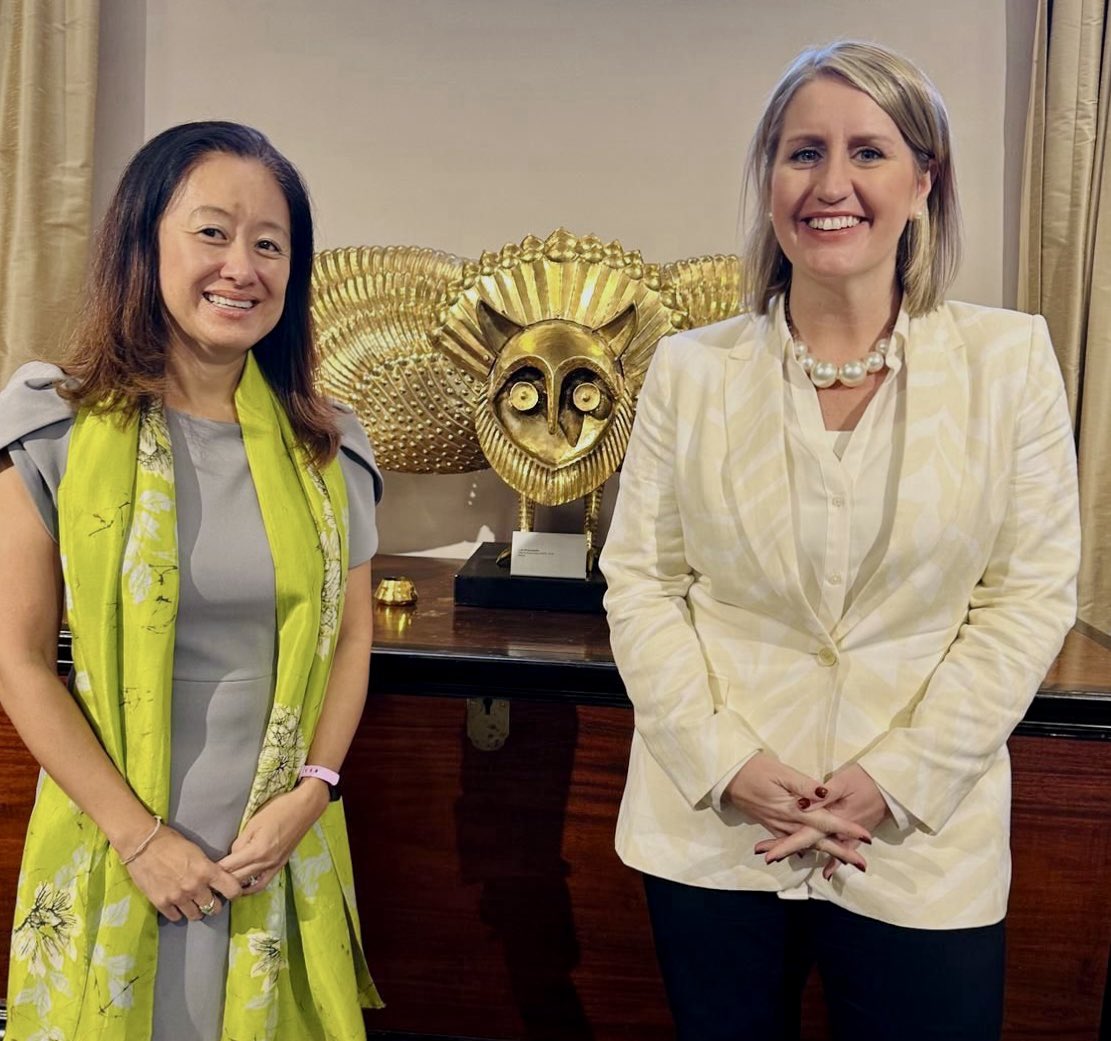
Sri Lanka will be secured if India is secured – Gopal Baglay

The Indian High Commissioner to Sri Lanka Gopal Baglay says that India has never responded to a crisis or supported a country in crisis with the swiftness and strength that it did during the unprecedented crisis in Sri Lanka.

Joining the “At Hydepark” current affairs programme on Ada Derana 24, the outgoing Indian diplomat in Colombo also discussed the vision for the advancement in bilateral relations between Sri Lanka and India, with the anticipated economic growth of India.

“India played the role bilaterally, as well as internationally to support Sri Lanka. The leadership of India is very clear and committed to a strong India – Sri Lanka relationship”, said the Indian Diplomat.

In response to a question regarding the India’s concerns on the visit of Chinese vessels to Colombo, Gopal Baglay pointed out that both India and Sri Lanka are located in the Indian Ocean, adding that assuring the freedom of navigation is a shared responsibility of India and Sri Lanka. He further expressed that the maritime challenges which arise must be addressed together.

“There can be prosperity and peace, when there is security and stability. Ensuring the security of the region in which we both are situated is a shared responsibility. In that sense I would say that the security of India and the region is mutual and indivisible”.

Commenting on the matter, Baglay also stressed that the security of Sri Lanka would be secured if India is secured. “When India is secured Sri Lanka is secured, and when Sri Lanka is secured, India is secured”, he added.

Expressing his views on the India’s vision of positioning itself in future, High Commissioner Baglay pointed out that India is currently the fifth largest economy of the world, highlighting that soon it will be within the top three.

“India is the most populated country and the largest democracy of the world. In 2047, India aims to achieve an economy of USD 30 trillion.”

The Indian envoy assured that Sri Lanka will be a key beneficiary of its prosperity as India’s leadership is committed to a stronger bond with Sri Lanka.

“We would like the region to grow together, because it is our fundamental belief that prosperity of the region is in the best interest of India. What is good for Sri Lanka is good for India.”

“We consider the world is our family and in that family, neighbourhood is the first”, he mentioned.

The growing role of mercenaries in warfare By P.K.Balachandran

With volunteers from Sri Lanka and Nepal joining the Russian or Ukrainian armies for money, the use of foreign mercenaries in war has again come under the international spotlight.

Earlier, the Russian Wagner Group was under the spotlight, for its role in the Ukraine war and wars in Africa, the way it rebelled against President Vladimir Putin and finally gave in to him.

Defence writers tend to dwell on standing armies of nation-states, neglecting the mercenaries, though the use of mercenaries is both widespread and has been a major feature in military history.

In his 2019 paper Mercenaries and War: Understanding Private Armies Today, Dr.Sean McFate of the US National Defence University (NDU) defines a mercenary as an armed civilian paid to do military operations or impart military training in a foreign conflict zone. A mercenary is not a member of a regular national armed force but is an auxiliary.

Sri Lankans who had joined the Ukrainian Foreign Legion (UFL) are mercenaries. While the UFL as such is an official body, the participation of Sri Lankans in it in the absence of a bilateral treaty between Ukraine and Sri Lanka, makes it a private affair. Like the Sri Lankans in UFL, the Nepalese joining the war on the Russian side are also mercenaries.

Companies which supply mercenaries are profit-maximizing entities. They are structured as businesses, and some of the large private military corporations have even been traded on Wall Street and the London Stock Exchange, such as DynCorp International and Armor Group, McFate points out.

Mercenary groups may be big or small. According to the Indian magazine Outlook, there are five major mercenary groups in the world, the Wagner group, Olive group, Academi, G4S Security, and Erinys.

The Carnegie Endowment for International Peace says that the Wagner Group is a vehicle the Kremlin uses to recruit, train, and deploy mercenaries, either to fight wars or to provide security and training to friendly regimes abroad. Controlled by Yevgeny Prigozhin, the Wagner Group has been used in Africa and Ukraine.

The Olive group has protected oil firms from suicide bombers and other attackers in Iraq since 2003. It recruits mainly from members of UK’s Special Air Service (SAS) at high wages. Started by Harry Legge-Burke, the Olive Group is a member of the International Peace Operations Association.

Formerly known as Blackwater, Academi was found in 1996 by an ex-US Navy man. Blackwater is most known for its involvement in the killing of 17 Iraqi citizens in the Nisour Square massacre in Baghdad. The group boasts an army of 20,000 men and a base in North Carolina to boot.

G4S is the biggest private military group in the world, with around 620,000 employees. It boasts of operations in over 120 countries providing routine support to airport security, night-time patrolling, and so on. It does not involve heavy combat.

Erinys is a UK firm in operation since the beginning of the Iraq War. One of the primary tasks of the firm is to guard the oil pipelines and energy assets in over 280 countries but mainly in post-war Iraq. In its fair share of controversy, Erinys was accused of torturing prisoners in custody. The group also maintains a presence in Africa, Outlook says.

Robert Lawless, writing in the website of the Lieber Institute West Point in March 2022 says that as many as 200 Russian irregular fighters (mercenaries) were killed in combat in February 2022. Another report asserts that more than 40,000 Syrians were registered to join the Russian side in the conflict in 2022.

“Russia reportedly is relying on irregular forces in part as a matter of operational necessity. According to US intelligence officials, Russia faces a significant shortfall in military personnel, exacerbated by perceived operational failures,” Robert Lawless says.

Huge Role in History

The taboo against mercenaries is only a few hundred years old, McFate says. Earlier, mercenary work was considered honourable and was thought to be equivalent to regular soldiering.

“The word mercenary comes from the Latin merces (wages or pay) and is no different than the solde or pay due to fighters, from which the word “soldier” is derived. For much of the past, mercenaries and soldiers were synonymous,” McFate points out.

He further says that much of military history is about mercenaries. The reason is simple: Renting a force is cheaper than owning it. A standing army means regular payment and perhaps even paying life-long pension and giving living quarters and other facilities. “Why invest in your own expensive standing army when you could just rent one?” McFate wonders.

Military history bristles with mercenary involvements. When Alexander the Great invaded Asia in 334 BC, his army included 5,000 foreign mercenaries, and the Persian army he faced contained 10,000 Greeks. Rome used mercenaries throughout its 1,000-year rule. In 18 th.Century India, James Skinner, a Eurasian freelancer, raised the Skinner’s Horse, a cavalry regiment which fought for any ruler who could pay.

The Portuguese, the Dutch and the British in Ceylon used mercenaries recruited both locally and from India. They were called Lascarines. The Lascarines were ad hoc fighters recruited for particular campaigns and were discharged upon the conclusion of the campaigns. The Dutch East India Company in Ceylon (VOC) used the Regiment de Meuron, a body of Swiss mercenaries, to fight their wars against the British and Lankan kings. After the British took over from the Dutch, they found it more convenient to use the Regiment de Meuron than requisitioning troops from India.

As Lankan historians, W.I.Siriweera and Sanath de Silva point out in Warfare in Sri Lanka, the Sinhalese kings also recruited mercenaries both locally and from India. While the locals were paid in land, the foreigners were paid wages.

Recent Use

Recent years have seen major mercenary activity in Yemen, Nigeria, Ukraine, Syria, and Iraq, McFate says. Many of these for-profit warriors outclass local militaries, and a few can even stand up to America’s most elite forces, as the battle in Syria shows,” he points out.

“Kurdistan is a haven for soldiers of fortune looking for work with the Kurdish militia, oil companies defending their oil fields, or those who want terrorists dead. The capital of Kurdistan, Irbil, has become an unofficial marketplace of mercenary services.”

“The United Arab Emirates secretly dispatched hundreds of special forces mercenaries to fight the Iranian-backed Houthis in Yemen. Hailing from Latin American countries like Colombia, Panama, El Salvador, and Chile, they were all tough veterans of the drug wars, bringing new tactics and toughness to Middle East conflicts. The Emirates hired 1,800 of them, paying two to four times their old salaries,” McFate says.

African mercenaries are also fighting in Yemen for Saudi Arabia. They come from Sudan, Chad, and Eritrea.

Rewards

McFate says that Syria rewards mercenaries who seize territory from terrorists with oil and mining rights. Russian company Evro Polis employed the Wagner Group to capture oil fields from the Islamic State (IS) in central Syria. Ukrainian oligarchs also hired mercenaries. Billionaire Igor Kolomoisky employed private warriors to capture the headquarters of oil company UkrTransNafta in order to protect his financial assets, according to McFate.

Nigeria hired mercenaries to tackle the deadly Boko Haram. The mercenaries arrived with special forces and Mi-24 Hind helicopter gunships and drove out the Boko Haram in a few weeks. The Nigerian military could not achieve this task in 6 years!

Even terrorists hire mercenaries. Malhama Tactical is based in Uzbekistan. It works only for Jihadi groups. McFate warns that Jihadis may hire mercenary special forces for precision terrorist attacks.

Humanitarian groups and Non-Governmental Organizations (NGOs) such as CARE, Save the Children, CARITAS, and World Vision are increasingly turning to the private sector security companies to protect their people, property, and interests in conflict zones, McFate says. Large military companies like Aegis Defense Services and Triple Canopy advertise their services to NGOs.

Posted in Uncategorized

SLFP to vote against VAT Bill tomorrow

The Sri Lanka Freedom Party (SLFP) announces that it will vote against the Value-Added Tax (Amendment) Bill, which is scheduled to be debated in the Parliament tomorrow (Dec. 11).

Issuing a statement, Publicity Secretary of the SLFP Thisara Gunasinghe highlighted that the party’s stance is to oppose the bill in the parliament tomorrow.

Posted in Uncategorized

30,000 desert security forces since 2021: COPF reveals

Around 30,000 have deserted tri forces since 2021, the Committee on Public Finance (COPF) revealed yesterday.

This was revealed when they took up the supplementary estimate for Rs 16.5 billion which is to be used to settle outstanding payments for suppliers of food to the forces.

The security forces officers who participated in the COPF meeting informed that one member of the security forces needs food which can give them 3400 kilo calories per day. They had informed COPF that it is difficult to purchase food to provide necessary nutrition for security forces. COPF Chief Harsha de Silva stressed the need to ensure that the funds are utilized effectively.

COPF also approved a Salary increase for the Chairman of the Bribery Commission. However, Dr. De Silva said the salary paid to the Bribery Commission Chairman should be similar to that of appeal court judges.

In addition COPF requested Customs to come up with a procedure where it could release 263 un- cleared vehicles with minimum loss to the government.

Posted in Uncategorized

RW sets elections calendar while awaiting IMF’s 2nd tranche and Budget conclusion this week

The Ranil Wickremesinghe Government, while preparing for the announcement by the International Monetary Fund (IMF) on Tuesday (12) on the disbursement of the second tranche under the Extended Fund Facility (EFF) and concluding the 2024 Budget proceedings on Wednesday (13) with the third reading vote in Parliament, is now moving in line with the agenda for the national-level elections next year.

It is no secret that much of Sri Lanka’s economic recovery plan currently hinges on the IMF and its sentiments on Sri Lanka’s economic reforms.

It is in such a backdrop that Foreign Affairs Minister Ali Sabry noted last week that the disbursement of the second tranche on Tuesday would indicate international acknowledgment of Sri Lanka’s positive economic trajectory. According to Sabry, the strategic reduction in debt payments and interest rates would position Sri Lanka to gain a substantial economic advantage of $ 17 billion.

The Official Creditor Committee (OCC) on Sri Lanka and China have already agreed in principle to the initial framework on restructuring Sri Lanka’s debt.

Meanwhile, in another confidence boost for the Sri Lankan Government, an official from the Asian Development Bank (ADB) was quoted as telling Reuters on Tuesday (5) that Sri Lanka would get about $ 600 million, on a staggered basis, from the ADB after the IMF released the second tranche of a $ 2.9 billion bailout for the country.

Alongside the IMF programme, the ADB is likely to provide total budget support of $ 2 billion over the next four years, ADB Sri Lanka Resident Mission Country Director Takafumi Kadono had said.

“I would say $ 500 million to $ 600 million budget support is what is planned (for 2024) but, again, it is subject to attainment, satisfying the policy actions, so it’s not free money,” Kadono had said in an interview with Reuters.

Meanwhile, the ADB last week approved a $ 200 million concessional loan to Sri Lanka, stating that the loan had been approved to help stabilise Sri Lanka’s finance sector.

Given the ongoing economic developments, First Capital has stated that it expected bond yields to drop between 10-12% by June 2024 to pre-crisis levels with the build-up of investor confidence due to the successful debt restructuring completion, State-Owned Enterprise (SOE) reform, and receiving the second tranche of the IMF programme.

Despite the developments in the country’s overall development, the economic strain on the masses is expected to continue till the end of the first quarter of 2024. One of the key burdens on the people will be the increase in the Value Added Tax (VAT) percentage on goods and services from January 2024.

It is this reason that resulted in Committee on Public Finance (COPF) Chairman Dr. Harsha de Silva informing Parliament on Wednesday (6) that the committee had approved the increase of VAT to 18% subject to amendments. De Silva had stated that the COPF had recommended waiving the VAT for infant foods, medical equipment, and fertilisers.

State Finance Minister Ranjith Siyambalapitiya in response had told Parliament on Thursday (7) that the Government was prepared to reassess the inclusion of 97 of the 138 items in the list of goods that would see an increase in VAT.

Polls calendar

President Wickremesinghe, meanwhile, has clearly laid out the election map for next year.

During the Budget speech, the President noted that next year would see the Presidential and General Elections, followed by Provincial Council and Local Government Elections the following year.

The statement caused much confusion in political circles, with everyone trying to figure out whether it would be a Presidential or a General Election that the country would face first. However, Wickremesinghe last week stated that the Presidential Election would be held first, followed by the General Election.

It is learnt that the President had discussed the holding of elections with several of his confidantes and while some had opined that a General Election held first under Wickremesinghe’s presidency could give the edge to the United National Party (UNP), the current economic and political state in the country could also result in no party being able to obtain a majority at such a poll. Besides, it was also noted that the Janatha Vimukthi Peramuna (JVP)-led National People’s Power (NPP) could benefit from the current situation in the country at a General Election.

It was also discussed that in the event the outcome of a General Election brought about a hung parliament or a parliament with a considerable number of NPP members, it would definitely reduce Wickremesinghe’s days as President. Therefore, it was finally decided that holding a Presidential Election was the way to go.

Back to CBK

Former President Chandrika Bandaranaike Kumaratunga (CBK) had always figured prominently during decisive periods in the country’s political landscape. It was CBK who played a key role in defeating the then Mahinda Rajapaksa (MR) Government in 2015 by presenting then General Secretary of the Sri Lanka Freedom Party (SLFP) Maithripala Sirisena as the common presidential candidate by mustering the support of the then main Opposition UNP and other Opposition political parties.

CBK once again played an active political role during the 52-day constitutional crisis during former President Sirisena’s tenure in 2018 where MR was ousted from the premiership by reinstating then Prime Minister Wickremesinghe in the post.

However, it is now learnt that CBK is back in action once again, playing a role in the formation of a broad political alliance. It is also learnt that senior SLFPers as well as a group of Sri Lanka Podujana Peramuna (SLPP) dissidents have been in touch with her, discussing the latest political developments and preparing to face them.

Common candidate

One of the key topics discussed in the political circles, including the parties looking at forming political alliances, has been on the candidate to field at the next Presidential Election.

With rumours that President Wickremesinghe might not contest at the Presidential Election, the focus of many political parties is on identifying candidates or a common candidate to field at the polls. Several Opposition politicians have already hinted at the formation of a broad political alliance aimed at elections.

Proroguing House

However, amidst the ongoing political drama, President Wickremesinghe is considering proroguing Parliament after the conclusion of the 2024 Budget proceedings until January 2024, when the House is scheduled to meet next.

In the event Parliament is prorogued, the President will yet again receive the opportunity to ceremoniously open the new session of Parliament. In terms of the provisions stipulated in Paragraph (2) of Article 33 of the Constitution, the President is empowered to make a statement of Government policy.

The prorogation will also result in the lapse of pending business in Parliament as well as the parliamentary committees like the Committee on Public Enterprises (COPE), COPF, and Committee on Public Accounts (COPA).

COPE undecided on Chair

Meanwhile, the ongoing controversy surrounding COPE and its Chair continues with the members of the committee yet to reach a consensus regarding the removal of its Chairman, SLPP MP Prof. Ranjith Bandara.

The Samagi Jana Balawegaya (SJB) has claimed that other members of the Opposition in the COPE have not been able to reach a consensus on the action to be taken with regard to the committee Chair.

However, a senior Government source noted that any issue pertaining to parliamentary committees, especially COPE, would be resolved in the event Parliament was prorogued since all committees would have to be freshly constituted once the House was reconvened.

SJB MP Nalin Bandara had said the COPE members would have to make a decision on the Chairman soon and that Speaker of Parliament Mahinda Yapa Abeywardena would have to convene a COPE meeting since it was not possible to postpone it continuously.

When asked about the speculation about Parliament being prorogued to convene the new committee meetings, Bandara had said that the SJB had not discussed the matter thus far but added that he believed the ruling SLPP would not allow President Wickremesinghe to do so.

Sacking more ministers

Meanwhile, President Wickremesinghe, it is learnt, is looking at sacking several State ministers prior to the impending Cabinet reshuffle next month.

It is learnt that the President had been keeping a close watch on parliamentary proceedings during the 2024 Budget debate and has looked into the attendance of Cabinet and State ministers during the Budget debates, especially during the second reading vote.

Wickremesinghe had identified several State ministers who have kept silent in Parliament while also staying away from the House during most part of the Budget debate and the voting times. Therefore, he will once again be monitoring the third reading vote on Wednesday (13) to see which Government members, especially Cabinet and State ministers, will be in the House for the third and final vote on the Budget.

Wickremesinghe, it seems, has already decided on whom he will remove from State ministerial portfolios. Therefore, new State ministerial appointments are likely to be made along with the Cabinet reshuffle.

The President is also looking at making new appointments to the Cabinet. However, several of his advisors have cautioned Wickremesinghe that expanding the number of members in the Cabinet will not bode well with the general public, especially when they will face a fresh round of price hikes in January due to the VAT increase. Wickremesinghe has however pointed out that there are already two vacancies in the Cabinet that can be filled.

Nevertheless, it will not be an easy task for Wickremesinghe to decide on the new entrants to the Cabinet with the ruling SLPP’s name list of 10 MPs and several MPs from the Opposition – SJB and SLFP – in the waiting list.

It is learnt that the President is looking at appointing around two members to the Cabinet while the rest are to be offered State ministerial portfolios.

SJB alliance in Jan.

Come 2024, the focus of all main political parties will be on preparing for Presidential and General Elections.

The main Opposition SJB is also in the process of forming a new political alliance that is to be launched early next year. According to Party General Secretary Ranjith Madduma Bandara, the proposed new alliance will be ceremonially launched along with 20 other like-minded parties in January to target the upcoming elections.

Madduma Bandara has further noted that several people’s organisations are also among the groups to support the new alliance. Accordingly, agreements are to be signed with all these parties and organisations.

Sajith’s pledge

Meanwhile, Opposition and SJB Leader Sajith Premadasa made a pledge in Parliament last week, where he vowed to act against the individuals who had been named by the Supreme Court as being responsible for the economic crisis faced by the country.

Premadasa had noted that despite claims by certain political party leaders on initiating legal action against those who had engaged in fraud and corruption once they came to power, it was the SJB that had already taken those responsible for bankrupting the country before court by taking necessary legal action while being in the Opposition.

Premadasa had told a meeting in Minuwangoda that the SJB was in the best position to act against those responsible for the economic crisis since the party did not have any deals with them. The Opposition Leader had requested the public not be fooled by the theatrics of certain politicians who displayed files on alleged corruption.

Meanwhile, the Chairman of the Parliamentary Select Committee (PSC) investigating the country’s economic bankruptcy and the factors that led to it, SLPP MP Sagara Kariyawasam, has said that the PSC will not, in any way, relate the recent Supreme Court ruling with regard to economic bankruptcy to its proceedings.

Kariyawasam had told the media: “There is no need for us to relate that ruling to our proceedings. That was issued based on affidavits submitted by the petitioners. What we do as the PSC is totally different and we don’t have to consider the Supreme Court ruling in any way.”

On 14 November, the Supreme Court ruled that former President Gotabaya Rajapaksa, former Prime Minister MR, former Finance Minister Basil Rajapaksa, and several others were responsible for the economic crisis.

Premadasa had also called on the Foreign Minister to formulate a mechanism to recover the ill-gotten wealth hidden overseas by politicians and racketeers. He had stated that the Supreme Court had named and determined the Rajapaksas and others as the persons responsible for the country’s bankruptcy and had urged the Minister to work as per that court ruling, and bring back the swindled money and assets.

Sacked Suresh to RW

While the Opposition and SJB Leader vowed action against those responsible for the economic crisis and worked on forming a political alliance, SJB MP Vadivel Suresh, who was recently sacked by the SJB from positions held by him in the party, openly joined forces with President Wickremesinghe.

Suresh was appointed as a Senior Advisor to President Wickremesinghe and will be responsible for reporting on the full integration of Hill Country Tamils into Sri Lankan society. Suresh was appointed as a Presidential Advisor after he voted in favour of the 2024 Budget during the vote on the second reading.

SLPP slams Sajith

Meanwhile, the showdown between Premadasa and SLPP MP Mahindananda Aluthgamage in Parliament on Wednesday (6) during the debate on the Cultural Affairs Ministry, which was held by Premadasa during the previous Yahapalana Government, became one of the highlights of the week.

The argument between the two politicians had heated up when Aluthgamage had said an audit report had revealed that billions of rupees had been misused during Premadasa’s tenure as Minister of Housing and Cultural Affairs.

“A sum of Rs. 10 billion has been misused from the Central Cultural Fund while State funds have been used to pay salaries for the 10 security officers attached to the salon owned by the Opposition Leader’s wife. The Minister of Cultural Affairs should make a statement on this matter,” Aluthgamage had said.

He had further claimed that Premadasa had released Rs. 1.6 million to repair Sirikotha during his tenure as Minister.

Opposition Leader Premadasa, responding to Aluthgamage’s claim, had alleged that millions had been used from the Central Cultural Fund in 2011 for a cycle race and for the swearing-in ceremony of the then President (MR). “I will resign from my post if the allegations against me are proved,” Premadasa had said.

Aluthgamage had then made his way to the well of the House, calling on Premadasa to resign.

Meanwhile, Minister of Cultural Affairs Vidura Wickramanayaka had revealed that certain amounts had been spent from the Central Cultural Fund without proper approval of its Board of Management. The cross-talk had continued from time to time during the committee stage debate, with Aluthgamage making allegations and SJB MPs saying Premadasa had been cleared of all charges.

Sajith hits back

Premadasa, however, claimed that the internal audit report prepared by a Chief Internal Auditor of the State Engineering Corporation (SEC), one N.V.T. Dhammika, that was tabled in the House, was aimed at slinging mud at him and his wife. The Opposition Leader further claimed that he had evidence to prove that the audit report presented to the House was aimed at discrediting him.

According to Premadasa, the individual in question, N.V.T. Dhammika, had been appointed as an executive member of a trade union affiliated to the SLPP on 3 February 2020. He had further noted that the SLPP had in writing informed the SEC on 18 February 2020 to appoint the individual as acting internal auditor of the institution.

Therefore, Premadasa had observed that the alleged audit report had been prepared by persons affiliated to the SLPP with the intention of slinging mud.

New Ex-Co for SLPP

Meanwhile, in its preparation for the impending national elections next year, the ruling SLPP will hold its second party convention on Friday (15).

There has been much talk about the possible change in the SLPP leadership, with MR tipped to take a backseat while making way for SLPP National Organiser Basil Rajapaksa to play a larger leadership role in the party. However, it is learnt that there will be no change in the SLPP leadership at this week’s convention.

There will also be no changes made to the SLPP’s office bearers. However, changes are expected to be made to the membership of the SLPP’s Executive Committee. It is learnt that Basil has proposed the formation of a strong Executive Committee in order to prepare the party to face the impending polls.

SLPP candidate

Meanwhile, SLPP MP Namal Rajapaksa spoke last week about the party’s candidate at the next Presidential Election. He had noted that several people from various sectors had expressed interest in contesting the Presidential Election under the SLPP.

Namal had told the media that the SLPP was ready to face the Presidential Election if it was held next year. “There have been several requests. Businessmen, politicians, and even presidents have expressed interest in contesting under the SLPP,” he had said.

UNP’s 1%

SLPP MP S.B. Dissanayake meanwhile claimed that the SLPP no longer enjoyed a voter base of 6.9 million recorded at the 2019 Presidential Election. He has said that the party’s vote base had now halved.

Dissanayake noted that the SLPP had faced a great setback in the past few years and was now in the process of restructuring and rebuilding the party. “The other political parties in the country like the SJB, SLFP, and the NPP are also facing a decline in their voter base,” he said.

Dissanayake further claimed that President Wickremesinghe’s UNP and the SLFP consisted only of around 1% of the voter base in the country. “Even if the UNP joins forces with the SJB, SLFP, and NPP, it will still only have a 1% voter base,” he added.

SLPP dissidents’ alliance

Meanwhile, yet another political alliance is being finalised by the SLPP dissidents’ group headed by MPs Anura Priyadarshana Yapa and Nimal Lanza. Like the SJB alliance, the Yapa-Lanza alliance is also expected to take off in January next year.

It is learnt that talks are ongoing with its expected affiliates and that a symbol has been selected. It is also learnt that among groups that would be joining this alliance are 37 trade unions affiliated to the SLPP, with the latest to join being its graduates’ union that played a key role in former President Gotabaya Rajapaksa’s election campaign.

Yapa had also chaired the first meeting of electoral coordinators recently.

Roshan’s move

Meanwhile, former Sports Minister Roshan Ranasinghe has also made a political move by taking over a political party.

Ranasinghe has reportedly taken over the political party – Ruhunu Janatha Party – that was owned by businessman Ajantha de Soyza. It is also learnt that Ranasinghe had taken over this party a few months earlier with the plan of building a fresh political alliance under the theme of anti-corruption.

The talk in the political circles is that Ranasinghe will get around 12 MPs who also focus on anti-corruption to join the party.

It is in such a backdrop that Ranasinghe had told Parliament he had not been allocated time to speak in Parliament at the Committee Stage Debate of the Sports Ministry and requested the Speaker to mediate to allocate time for him to speak.

He had requested the Speaker to provide him time to speak at the Committee Stage Debate of the Sports Ministry, claiming that it was against parliamentary democracy to prevent him from speaking. “I wonder why I am not given time to speak in Parliament. It may be because I speak of corruption at Sri Lanka Cricket (SLC),” he had said.

Speaker Abeywardena had said he would look into the matter and provide him time to speak.

SLC targets Roshan

SLC meanwhile announced last week that it had formally filed a complaint with the Commission to Investigate Allegations of Bribery or Corruption (CIABOC) against Ranasinghe over the alleged misuse of funds provided by SLC.

Issuing a statement, SLC had said the funds had been provided to the National Sports Fund for the development of various other sports in Sri Lanka. The decision to file this complaint stems from the concern that Ranasinghe has not appropriately disclosed the utilisation of funds allocated by SLC for the intended purposes.

This move comes in the wake of a discernible disparity between the information disclosed to the media by Ranasinghe and the response received by the SLC under a Right to Information (RTI) application, outlining the specifics of the expenditures made, SLC had said.

Emphasising on the importance of maintaining the integrity of financial transactions and ensuring that funds are utilised for their designated purposes, the SLC had said that the formal complaint filed with the Bribery Commission underscored the SLC’s dedication to upholding the highest standards of governance and ethics within the realm of sports administration.

Harin loses cool

Amidst the continuing SLC saga, newly-appointed Sports Minister Harin Fernando had lost his cool during a live TV interview recently and had threatened to walk out after objecting to the manner in which the presenter had posed questions.

Fernando had reportedly accused the presenter of posing some of the questions like a thug. The Minister had told the host that he had agreed to the relevant interview to make clear his plans for cricket in Sri Lanka.

An exchange of words had taken place when the presenter had reportedly accused the Minister of making contradictory remarks with regard to the International Cricket Council (ICC). Fernando had objected to the statement made by the presenter of the private television station and engaged in a heated exchange.

The Minister had at one point threatened to leave, telling the presenter that he was not prepared to give the responses the presenter wanted.

Internal clashes

Meanwhile, the UNP is continuing to experience several internal clashes among senior members of the party.

Recent news reports quoting UNP General Secretary Palitha Range Bandara have stated that the party has unanimously decided at a recent meeting that Party Leader, President Wickremesinghe will be the UNP’s candidate at the next Presidential Election. However, it has now been revealed that the party has not taken such a decision although a meeting of party seniors had been held at the Party Headquarters, Sirikotha.

During this meeting, party seniors Vajira Abeywardena and Ravi Karunanayake had engaged in a heated exchange of words. The discussion at the meeting had been mainly focused on party reorganisation work. The clash between Abeywardena and Karunanayake had taken place during a discussion on the reorganisation work related to the Colombo District.

During the argument, Abeywardena had accused Karunanayake of not being loyal to the party leadership. This statement had angered Karunanayake and he had claimed that the party had been destroyed by the many deals being done by the likes of Abeywardena. Karunanayake had further claimed that some individuals in the party were more interested in their personal agendas and making deals than ensuring the party’s victory.

However, when the media had inquired from the party General Secretary the following day about the decisions reached at the party seniors’ meeting, Range Bandara had responded that it had been decided that Wickremesinghe would be the party’s presidential candidate.

EC vacancy

The appointment to fill the existing vacancy at the Election Commission (EC) has now become a talking point among members of the Opposition amidst talk on the conundrum faced by the Constitutional Council over the delay in appointing the 10th member to the council.

SLPP dissident MP Prof. G.L. Peiris last week questioned whether the Government was not appointing a suitable person for the current vacancy in the Election Commission as part of an effort to avoid holding the Presidential and Parliamentary Elections next year.

He had said that the Election Commission was the most important among the commissions and that its role had special importance as it had now been announced that the Presidential and Parliamentary Elections would be held next year.

“What is the situation now? There should be five members in the Election Commission, including its Chairman, but there are only four at present. There has been a vacancy for a long time. The Government does not fill it intentionally.”

Posted in Uncategorized

Complete picture of Sri Lankans fighting for Ukraine unknown

As Russia’s war in Ukraine intensifies, the Sri Lankan Embassy in Türkiye is requesting those who have joined the Ukraine defence force’s international legion to submit their names to the embassy as soon as possible.

“The Embassy of Sri Lanka in Türkiye is aware that three Sri Lankans have died on the Ukrainian war front. One of them is Mr. Ranishka Hewage. The embassy is awaiting official confirmation from the Ukrainian authorities regarding all three Sri Lankans. It is also understood that until their remains are recovered by the Ukrainian military, it is the practice of Ukrainian defence authorities to consider such persons as missing in action,” the embassy said. The Embassy of Sri Lanka, based in Ankara, is accredited to Ukraine.

Ambassador Hasanthi Dissanayake told the Sunday Times that because the embassy does not have details of Sri Lankans registered as soldiers in Ukraine, it is difficult to obtain any updates on their status.
“Only Ranish was registered with the embassy as a military professional. Therefore, we were able to coordinate with the Ukrainian authorities,” said Ms. Dissanayake.

Andrew Ranish Hewage, 43, an ex-Sri Lankan army commando, was first deployed in Kharkiv in July 2022. Experienced in the Sri Lanka Light Infantry and commando regiments, Ranish was popular as ‘Captain Dentist’ on the Ukrainian battlefield, being the commanding officer of the First Special Force of the International Legion for the Defence of Ukraine.

A Russian artillery attack on December 4 killed him and two fellow Sri Lankan native Ukrainian soldiers who were with him. Another injured Sri Lankan currently being treated has confirmed Capt. Ranish’s death.

“His mother and sister are currently in Ukraine. We are coordinating with them as well,” Ms. Dissanayake said.

International Volunteers of Ukraine said Capt. Ranish died on the battlefield in Bakhmut, and the organisation is building a memorial.

“We have gathered information about a handful of soldiers. But (Sri) Lankan ex-soldiers are joining the battlefield by enlisting privately and being recruited directly. We do not even have a list of their names,” she said.

According to international reports, legally retired military personnel with battlefield experience are lured with attractive remuneration of over Rs 1 million a month.

Posted in Uncategorized

Sri Lanka ruling party MP contradicts poll to claim his party is overtaking president’s

The ruling Sri Lanka Podujana Peramuna (SLPP) is rising from the ashes albeit at a slower than anticipated pace, while President Ranil Wickremesinghe’s United National Party (UNP) still commands only 1-2 percent of the vote, an SLPP legislator said.

MP S B Dissanayake, who is not a member of the cabinet of ministers headed by President Wickremesinghe, told reporters on Thursday December 07 that support for any major political party of the island nation is on a downward trend while the SLPP alone is gaining ground.

An independent poll by the Institute for Health Policy (IHP) however shows that this is decidedly not the case. Polling data for October showed that the leftist National People’s Power (NPP) had enjoyed support from 40 percent of likely voters, having dipped 2 percent from September, while the main opposition the Samagi Jana Balawegaya (SJB) stood at 26 percent, increasing four percent from 22 percent in September. President Ranil Wickremesinghe’s UNP’s support decreased marginally to 11 percent in October from September’s 13 percent. The SLPP also saw a decrease to 5 percent from the previous month’s 8 percent.

“You can’t gamble with elections. The election must be held. We always say electrons must be held. The presidential election must be held next year. There is no alternative,” said Dissanayake.

“Parliamentary elections can be called if needed. But that’s not how it is with the presidential election. Nominations for that will have to be called by September, October next year,” he added.

Asked by a reporter if the SLPP is ready for elections, Dissanayake acknowledged that support for his party had eroded, to nothing.

“We crashed to zero. We were turned to ashes. But we will rise from those ashes. We’re not where we thought we were. The 6.9 million [votes received at the 2019 presidential election] no longer applies. We’re at about half of that. But we’re rising, like this,” he said, gesturing upwards.

“As other major parties go in the opposite direction, we’re rising slowly. But the UNP is not. It’s still on the ground, and still at 1 to 2 percent,” he claimed.

“The SLFP is there too. Those who left us are the same. Even together they cannot form 1 percent. But we’re climbing,” he said.

Posted in Uncategorized

HRW accuses Sri Lanka of ignoring EU GSP+ requirements

Human Rights Watch (HRW) has accused Sri Lanka of ignoring the European Union’s (EU) GSP Plus requirements.

Issuing a statement today, HRW said that the Sri Lankan authorities had detained nine ethnic Tamils under the country’s abusive counterterrorism law for commemorating those who died in the 1983-2009 civil war, Human Rights Watch said today.

The Sri Lankan Government has repeatedly assured international allies, trading partners, and the United Nations that it would replace the Prevention of Terrorism Act (PTA), which has long been used to arbitrarily detain and torture minority community members and civil society activists. The government should immediately release all those arbitrarily detained under the PTA and place a moratorium on its use until it can be repealed.

“The Sri Lankan authorities’ use of a counterterrorism law against Tamils commemorating those who died in the civil war is cruelly abusive and further marginalizes a community that already faces persistent government discrimination,” said Meenakshi Ganguly, Deputy Asia director at Human Rights Watch. “President Ranil Wickremesinghe speaks of ‘reconciliation,’ but his government’s actions only serve to deepen ethnic divisions.”

The authorities arrested those newly detained under the PTA between November 25 and 27 in Batticaloa, in the Eastern Province, and confiscated decorations and loudspeakers from a commemoration vigil. Since the civil war between the government and the Liberation Tigers of Tamil Eelam (LTTE) ended in 2009 with the separatist armed group’s complete defeat, successive administrations have prevented Tamils from publicly memorializing the war dead.

On December 2, police in Mullaitivu district, in the Northern Province, reportedly shut down an event at a Hindu temple to commemorate the Sri Lankan army’s 1984 massacre of Tamil villagers in Othiyamalai. Preventing ethnic and religious minorities from conducting ceremonies to commemorate the dead violates the rights to freedom of religion, belief, expression, and association, Human Rights Watch said.

Soon after taking office in July 2022, President Wickremesinghe ended a short-lived moratorium on the use of the PTA. A previous administration, in which Wickremesinghe was prime minister, had pledged in 2017 to repeal the law when it rejoined a European Union trading program called the Generalized Scheme of Preferences (GSP+). The GSP+ grants tariff-free access for Sri Lankan exports conditioned on compliance with international human rights conventions. Sri Lankan authorities have repeatedly renewed the pledge but never carried it out.

Many of Sri Lanka’s international partners, including the United States, European Union, and United Kingdom, as well as the United Nations Office of the High Commissioner for Human Rights, criticized the recent PTA detentions.

The administration has also used the PTA to restrict criticism of government management of the economy and other policies. In August 2022, three student activists were detained under the law for protesting the government’s handling of the economic crisis. Other activists say that they fear being arrested under the PTA for speaking out and that the government is constraining civil society organizations’ access to funding, particularly donations from abroad, under the guise of “countering terrorist financing.”

The International Monetary Fund (IMF), which is providing Sri Lanka with a US$3 billion loan, reported in September that civil society’s “oversight and monitoring” of government actions is “restricted … by broad application of counter-terrorism rules.”

In a November report on Sri Lanka’s compliance with its human rights obligations under the GSP+ trading arrangement, the EU found that “the treatment of minorities remains a concern in particular as efforts towards reconciliation are slow, and the 1979 Prevention of Terrorism Act (PTA) continues to be applied including after the protest movements in 2022, causing fear among the population and suffocating dissent. Substantial reform or repeal of the PTA in line with human rights standards remains a priority, just as Sri Lanka’s need to re-commit to reconciliation and accountability.” Despite Sri Lanka’s failure to comply with its six-year-old pledge to reform the PTA, the EU continues to extend GSP+ benefits to the country.

On September 15, the government published the latest version of its proposed replacement counterterrorism legislation. It then withdrew the bill for further revisions after widespread domestic and international criticism that it reproduced many of the abusive provisions of the current law while creating new speech-related offenses that could be used to suppress dissent.

The government recently proposed another law, the Online Safety Bill, that could also be used to restrict freedom of expression by creating a commission, appointed by the president, which would decide whether online statements are false or prohibited. The commission could order the removal of online statements and participate in police investigations and prosecutions of those accused of posting them.

“The Sri Lankan government’s latest misuse of the PTA should be a strong reminder to the EU that its GSP+ requirements are being ignored,” Ganguly said. “The European Union and EU governments need to make their displeasure with this turn of events known.”

Three Sri Lankans Ex Army serving in Ukrainian military killed in Russian attack

Three Sri Lankans who were serving in the Ukraine military have been killed in a Russian attack.

Reports from Ukraine, and Russia note that the attack took place on Tuesday (5).

A Telegram channel operation by Russian military personnel revealed this morning that Sri Lankan mercenary Andrew Ranish Hewage with the call sign Dentist from Sri Lanka was killed in a Russian Attack.

It also added that two more Sri Lankan mercenaries that were fight for Ukrainian regime died beside Ranish Hewage.

According to the Telegram channel, the three Sri Lankan mercs were killed in an Russian attack when they attempted to evacuate dead and wounded Ukrainian soldiers.

A comment on a YouTube video said that Andrew Ranish Hewage was killed in Bakhmut, a city in Ukraine.

The comment was made from a YouTube account that goes by the name Lahiru Kavinda.

Translation of the comment:

“Dentist, you breathed your last on my shoulder. You are a hero. I brought you as far as I can. I did everything possible. You made a name, and the name resounds in Ukraine. You deserve an honorable end.”

Who is this ‘Captain Dentist’?

An inquiry from the Sri Lankan Defence Ministry revealed that Andrew Ranish Hewage famous as Captain Dentist in Ukraine was once a member of the Sri Lanka Light Infantry of the Sri Lanka Army.

He had legally left the Sri Lanka Army on the 30th of September 2012, as a lieutenant, and also left the entire military service officially.

Later, he moved to the UAE for employment, and in 2022 decided to join the International Legion for the Defence of Ukraine, where he played an active role.

On February 27, 2022, just two days after the Russian invasion of Ukraine, Ukrainian President Volodymyr Zelensky called for “friends of Ukraine” to volunteer for the Ukrainian Territorial Defense forces, and thus was established the International Legion for the Defence of Ukraine.

According to international media reports, Andrew Ranish Hewage was serving as a Commanding officer on the front lines of the Ukraine – Russia war.

It is also reported that Captain Andrew Ranish Hewage was given a promotion by the Ukrainian President for his bravery in the battlefield.

Unfortunately, details of the two other Sri Lankans killed along with Andrew Ranish Hewage in the Russian attack, were not available.

(NewsFirst)

Sajith wears a Palestinian scarf to parliament as a mark of solidarity for peace

Sri Lankan Opposition Leader Sajith Premadasa attended Thursday’s (7) parliament session wearing the keffiyeh, a black and white scarf, a symbol of Palestinian identity and history, as a mark of solidarity to attain peace in the Middle East and world-wide.

Speaking on the country’s Foreign Policy, the opposition leader said that a foreign policy forms the basic fulcrum of governance.

“A strong, innovative, vibrant, thought-providing, result-oriented foreign policy is of great benefit to our own nation state,” he added in his comments.

He went on to note that Sri Lanka’s track record in terms of abiding by agreements is dismal, adding that abiding by agreements, and credibility is critical for a foreign policy.

“We have been a signatory to protect human rights, civic rights, political rights, economic, social, cultural and religious rights. Unfortunately, in the domestic jurisdiction, the government has embarked on a so-called Online Safety Bill, and an Anti-Terrorism Bill, which destroy the very essence of democracy, freedom of speech, freedom of thought, freedom of affiliation to political parties, expressing one’s vision and wishes,” he said.

He said the Sri Lankan Foreign Policy must walk the talk.

Posted in Uncategorized