Sri Lanka: World Bank Approves $150 Million to Strengthen Financial Sector

The World Bank’s Board of Executive Directors approved $150 million in financing for Sri Lanka to strengthen the resilience of the financial sector on Friday (10).

“Sri Lanka’s economic crisis highlights the need for strong safety nets to support the financial sector. Stable and reliable banking sector is essential for the economy, businesses and individuals, small businesses and poor households,” said Faris Hadad-Zervos, World Bank Country Director for Maldives, Nepal, and Sri Lanka.

“Strengthening the Deposit Insurance Scheme will help protect the savings of smaller depositors, including women and people living in rural areas. It will also sustain the confidence in Sri Lanka’s financial system, a critical part of building the country back better,” he added.

The Financial Sector Safety Net Project is designed to boost the financial and institutional capacity of the Sri Lanka Deposit Insurance Scheme (SLDIS), which is managed by the Central Bank of Sri Lanka.

The financing will help boost reserves of SLDIS which could be used towards the payout to insured depositors of banks and licensed finance companies.

In parallel, the project will support institutional strengthening of the SLDIS in line with international good practices for effective deposit insurance schemes.

“Strengthening the financial sector safety net is crucial for maintaining financial stability during a macro-debt crisis,” said Alexander Pankov, Lead Financial Sector Specialist and the Task Team Leader for the project.

“A robust deposit insurance system, along with enhanced supervision and resolution frameworks, will safeguard public confidence in the financial system and protect people’s savings,” he added.

The SLDIS was established in 2010 and has conducted several payouts for failed licensed finance companies in recent years.

Currently, the SLDIS guarantees the deposits of households and enterprises up to LKR 1,100,000, which covers more than 90 percent of deposit accounts in Sri Lanka.

The legal framework for deposit insurance in Sri Lanka was upgraded earlier this year through the approval by Parliament of Banking Special Provisions Act.

SLDIS should now be strengthened institutionally and financially for it to be able to effectively fulfill its legal mandate of protecting the financial sector stability.

River for Jaffna project to supply water to Sri Lanka’s north

The Sri Lankan government is in discussions with various bodies to establish water supply to the island’s north through the ‘River for Jaffna’ policy, which was proposed by an engineer decades ago.

“There is an acute water shortage in the north. To mitigate this dangerous situation, we are in discussions on how to implement the ‘River for Jaffna’ project which was proposed by professor Arumugam,” Prime Minister Dinesh Gunawardena said in parliament on Wednesday.

Gunawardena said that the government is in discussions with engineers, relevant specialist institutions and international bodies on how to implement the policy, and resolve the water supply and irrigation obstacles in the region.

Gunawardena pointed out that desalination was costly and would incur heavy prices for consumers.

In 1954, Engineer Arumugam, former deputy director of the Irrigation Department, proposed a River for
Jaffna for the benefit of the Jaffna peninsula water resources and environment.

Over the years, the irrigation department, Mahaweli Authority, various local and foreign consultants, and international agencies have contributed to and improved the proposal.

Postponement of LG polls a ‘deathblow’ to democracy – Mahinda Deshapriya

Chairman of the Delimitation Committee Mahinda Deshapriya has alleged that continuing the tenures of the current local government bodies without holding the polls dealt a ‘deathblow’ to the country’s democracy.

Speaking to the media in this regard, the former Chairman of the Elections Commission revealed that the Delimitation Committee has had no influence on the decision to postpone the Local Government (LG) elections.

Commenting further, Deshapriya also highlighted that it is impossible to hold the Presidential Election either before, or after the time allocated for such activities as per the Constitution of Sri Lanka.

Accordingly, he said, “The Presidential Election cannot be held soon. Neither can it be delayed. It must be held between the 17th of September and 17th of October, 2024”.

Posted in Uncategorized

Sri Lanka, Argentina top list of most vulnerable economies – Reuters

Sri Lanka and Argentina remain very vulnerable amid a worsening in global financial conditions while China has suffered a sharp deterioration in financial resilience since pre-COVID times, a think-tank study found on Wednesday.

The resilience indicator, published by the Washington-based Center for Global Development, assesses which countries would be most economically and financially affected if an external shock were to materialise. It is based on data published by the International Monetary Fund, the World Bank and governments.

China was found to be “most weakened country” across a sample of 37 countries, having ranked among the top 10 most resilient emerging economies in 2019 and dropping to 18th place in 2023.

Emerging markets were now more vulnerable than in 2019 on an overall basis, economist Liliana Rojas-Suarez wrote in the report.

“The scars of the 2020-2022 shocks that started with the COVID pandemic and the subsequent multiple shocks, such as Russia’s war on Ukraine and the U.S. Fed’s increases in interest rates, are deep and have weakened emerging markets’ economic and financial conditions,” Rojas-Suarez wrote.

A severe shortage of dollars tipped Sri Lanka into its worst financial crisis since independence from Britain in 1948 last year, triggering its first foreign debt default in May 2022.

Argentina is in recession for the sixth time in a decade, with triple-digit inflation and foreign net reserves in the red.

The study also showed that debt sustainability has declined over the last four years across emerging market economies.

“In 2019, only Tunisia, Pakistan, Argentina, and Sri Lanka had ratios of external financing needs above 100%. Now, 12 of the 37 countries we examined, or about one third, are in that position,” Rojas-Suarez said, adding these countries have very large and unsustainable large public debt ratios.

The study calculated external financing needs by measuring short-term external debt plus current account deficits as a proportion of international reserves.

Bolivia, Egypt, Turkey and El Salvador are also on the list of vulnerable countries, while the study shows that Indonesia, Peru and Bulgaria are the most resilient countries in the group.

Complaint to Human Rights Commission against arrest of Tamil students

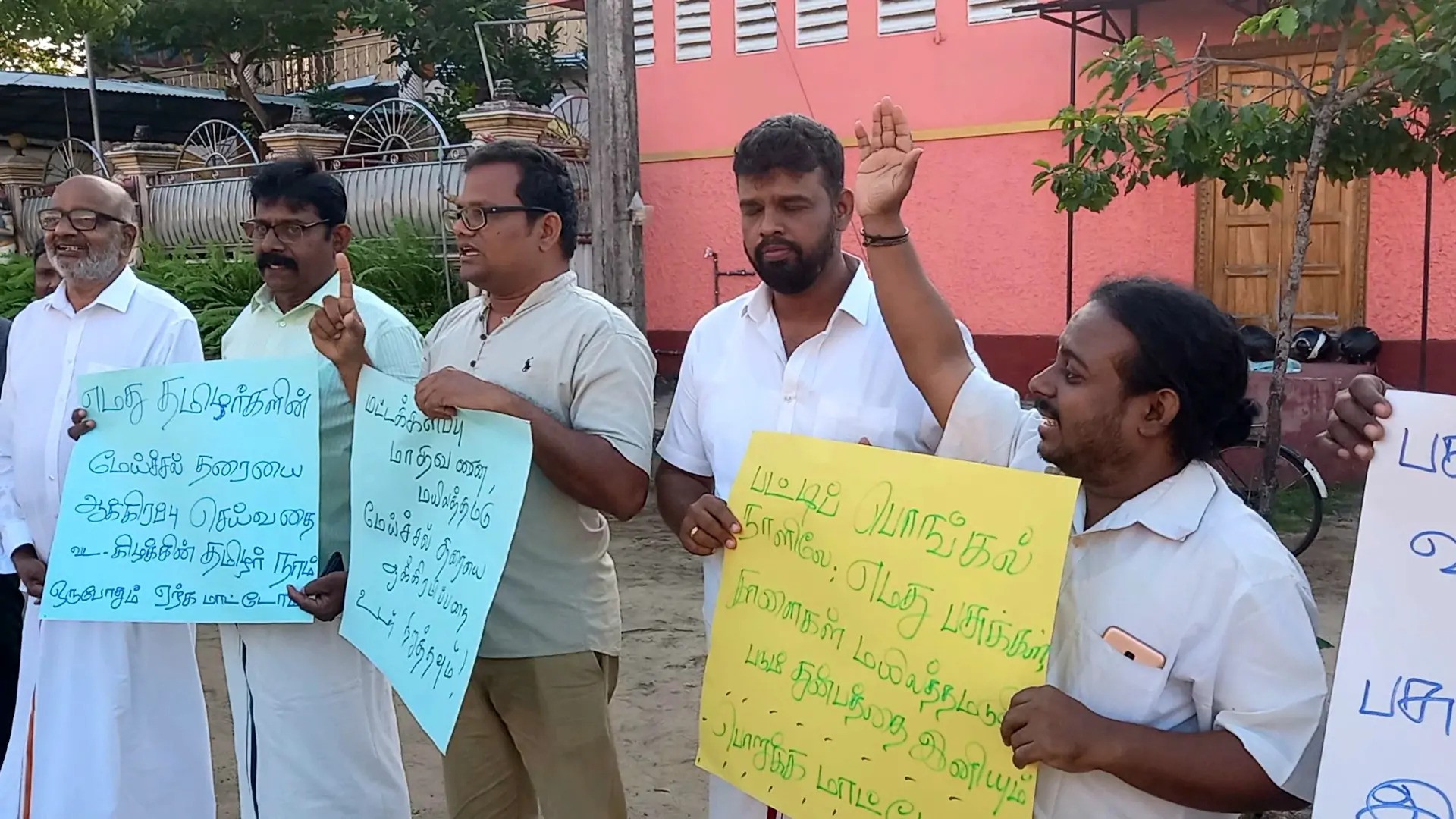
A complaint has been lodged with the Human Rights Commission against the arrest of six university students returning from a protest by Tamil dairy farmers at Mailattamadu.

Students of the Eastern University lodged the complaint with the HRC’s Batticaloa office on 06 November.

Speaking to the media thereafter, student leader K. Robinson said they strongly condemned the arrests.

Students of Jaffna and Eastern universities extended support to the dairy farmers on an indefinite protest to demand the return of their pastures taken over by Sinhalese for Chena cultivation.

On November 05, students were returning from attending that protest, when police stopped their bus at Sandiveli in Jaffna and took them into custody for not having student identity cards in their person.

Produced before courts, they were enlarged on sureties of Rs. 100,000 each.

Jaffna university student leader Alagarasa Vijayakumar said police action would make them more determined and stronger.

It is alleged that Sinhalese have captured 2,500 acres of pastures for Chena cultivation, denying feed for cattle owned by Tamils.

Posted in Uncategorized

Sri Lanka’s NPP may reach out to other MPs to form government: AKD

Sri Lanka’s leftist National People’s Power (NPP) may have to reach out to individual MPs of other parties in the event the NPP is victorious in a parliamentary election but is unable to secure 113 seats, party leader Anura Kumara Dissanayake said.

Speaking to a group of Sri Lankan expats living in the United States, Dissanayake said if the election result indicates that the voters have attempted to form an NPP government as opposed to relegating it to its traditional role of “watcher” or security guard of parliament, the party would be obligated to honour that verdict.

“If the voters have attempted to give us power and not to relegate us to the role of a watcher but we were somehow unable to get 113 seats, we think we may have to go into an agreement, not with the other parties, but with some elected MPs,” said Dissanayake.

“If the people’s wish is to form a government, we have no right to disregard that. They have tried to give us a government but were unable to give us 113. To fulfill that we have to come up with a strategy,” he said.

The NPP leader, who also leads the Marxist-Leninist Janatha Vimukthi Peramuna (JVP), the party that effectively controls the NPP “collective”, said, however, that there is little chance of an election before the presidential election that’s due in October 2024.

According to Dissanayake, it is not in President Ranil Wickremesinghe’s interest to call a parliamentary election before the presidential election as doing so would negatively impact the latter’s chances at a presidential poll. Even a local government election would reflect voter sentiment that would prove a challenge, he said.

The ruling Sri Lanka Podujana Peramuna (SLPP) on the other hand, said Dissanayake, is in a predicament. An early parliamentary poll would prove disastrous to the Rajapaksa-led party, so they would have to throw their weight behind President Wickremesinghe at the presidential poll, which would also spell a shift of power to Wickremesinghe’s associates and confidantes in his United National Party (UNP).

The only way for an early parliamentary poll would be for the president to dissolve parliament, which he is unlikely to do, with the upcoming budget also unlikely to be defeated, the JVP leader said.

Dissanayake currently leads at least one opinion poll on presidential election voting intent.

Posted in Uncategorized

Sri Lanka: US hopeful of a Presidential Poll next year?

Julie Chung, the US Ambassador to Sri Lanka, believes presidential elections will be held in the island nation next year.

She said that timely elections are important to any democracy, and that is why there will be a presidential election next year.

She said that the US is also hopeful that, as per the constitution Local Government Elections, Parliamentary Election, and Provincial Council Elections will also take place accordingly.

“All those things give the people a voice, to be able to voice their opinion through the ballot box and to be able to choose their leadership.,” she told News 1st.

“We hope that the elections stay on schedule next year and onwards, and we are looking forward to seeing that free and fair election, and that culture of free and fair elections that’s been in Sri Lanka for decades continue,” she added.

Posted in Uncategorized

Historic US boost for Sri Lanka’s shipping hub status in South Asia

The United States yesterday signified its biggest boost for Sri Lanka’s hub status for shipping in the Indian ocean with its International Development Finance Corporation (DFC) committing a 20 year financing worth $ 553 million to upcoming Colombo West International Terminal (CWIT) by a joint venture involving Indian giant Adani, Sri Lanka’s top blue chip John Keells Holdings and the Sri Lanka Ports Authority.

Given the historic significance and importance of the support from a regional and Sri Lanka’s perspective, US Ambassador Julie Chung, Indian High Commissioner Gopal Bagley, Sri Lanka’s Foreign Affairs Minister Ali Sabry and President’s Chief of Staff and National Security Advisor Sagala Ratnayake witnessed the agreement signing yesterday in Colombo between the parties.

Analysts told the Daily FT that given the 20 year tenor, the financing for the entirety of the debt component of CWIT is favourable. It also comes at a time when Sri Lanka remains a default-Sovereign and low grade credit rating. The CWIT costs $ 750 million and the balance is funded by equity.

DFC said its commitment of over half a billion US Dollars to support the development of a deep-water shipping container terminal in the Port of Colombo, will provide critical infrastructure for the South Asian region.

The new terminal reflects DFC’s commitment to financing high-quality infrastructure that supports its partner’s development needs, invests in local communities, and is respectful of local financial conditions. The investment further demonstrates the US enduring commitment to Sri Lanka’s economic growth and its regional economic integration, including with India.

When commissioned, CWIT will be the largest and deepest container terminal in Sri Lanka. With a quay length of 1,400 m and an alongside-depth of 20 m, CWIT will be equipped to handle ultra large container vessels with capacities of 24,000 TEUs. The new terminal’s annual cargo handling capacity is likely to exceed 3.2 million TEUs. Last year the Colombo Port handled nearly 8 million TEUs.

DFC, the US government’s development finance institution, partners with the private sector to finance solutions to the most critical challenges facing the developing world. It invests across sectors, including energy, healthcare, infrastructure, agriculture and small business and financial services.

DFC CEO Scott Nathan said, “DFC works to drive private-sector investments that advance development and economic growth while strengthening the strategic positions of our partners. That’s what we’re delivering with this infrastructure investment in the Port of Colombo.”

“Sri Lanka is one of the world’s key transit hubs, with half of all container ships transiting through its waters. DFC’s commitment of $ 553 million in private-sector loans for the West Container Terminal will expand its shipping capacity, creating greater prosperity for Sri Lanka, without adding to sovereign debt, while at the same time strengthening the position of our allies across the region,” Nathan added.

US Ambassador to Sri Lanka Julie Chung said, “The $ 553 million investment by DFC for the long-term development of the Port of Colombo’s West Container Terminal will facilitate private-sector-led growth in Sri Lanka and attract crucial foreign exchange inflows during its economic recovery. This financing is symbolic of the US long-standing commitment to the development and well-being of the people of Sri Lanka. Sri Lanka regaining its economic footing will further our shared vision for a free and prosperous Indo-Pacific.”

The US sentiments were in apparent response to China whose state-owned entities manage and majority own the biggest and most modern terminal (CICT) in the Colombo Port and the Hambantota International Port in deep-south of Sri Lanka.

Adani Ports and SEZ Ltd, is India’s largest port operator whilst JKH already operates Sri Lanka’s first ever private sector owned and managed terminal South Asia Gateway Terminal Ltd.

This is the first time that the US Government, through one of its agencies, is funding an Adani project, which is a ringing endorsement of the group, Adani said adding, “It shows their confidence in the group’s ability to invest and to create a world class container facility in Colombo Port.”

Adani Ports and Special Economic Zone CEO Karan Adani said, “We welcome the association of the US International Development Finance Corporation (DFC), the US government’s development finance institution, in funding the Adani project, and we see this as a reaffirmation by the international community of our vision, our capabilities and our governance.”

”As one of the world’s largest port developers and operators, APSEZ brings to this project not only our proven world-class expertise but also our deep experience in infrastructure creation. When completed, Colombo West International Terminal project will transform the socio-economic landscape, not just in Colombo but across the Island, through thousands of direct and indirect new employment opportunities and by massively boosting Sri Lanka’s trade and commerce ecosystem.”

JKH Chairperson Krishan Balendra said, “DFC’s investment is an endorsement of the potential of the West Terminal project and a boost for investor confidence as Sri Lanka’s economy recovers”.

The Port of Colombo is the largest and busiest transhipment port in the Indian Ocean. It has been operating at more than 90% utilisation since 2021, signalling its need for additional capacity. The new terminal will cater to growing economies in the Bay of Bengal, taking advantage of Sri Lanka’s prime position on major shipping routes and its proximity to these expanding markets.

The Adani group said it is expanding its global footprint through strategic investments in emerging markets. Adani Ports has positioned itself as the market leader in the transport logistics and energy utility portfolio businesses, focusing on large scale infrastructure development in India with operations and management practices benchmarked to global standards. Through its continued commitment to creating stellar and sustainable assets, the group is playing a vital role in building a better future for India and the world.

Posted in Uncategorized

Ministry accelerates signing MOU with Adani Group for wind power plant in Mannar: Charitha Herath

According to reports, the Power and Energy Ministry is expediting the signing of documents for a Memorandum of Understandings (MOUs) with India’s Adani Group to establish a new wind power plant in the Mannar basin with a capacity of 250 MW, Sri Lanka Podujana Peramuna (SLPP) MP Prof. Charitha Herath said.

Addressing the media, he said the Ministry is ready to complete the signing of all agreements before November 25.

According to the 2009 Electricity Act, a bit of a process should be followed for local generation of electricity by any private company. But this process was not followed for projects conducted between two governments (government to government – G to G).

MP Herath said the current government is trying to sign all agreements while putting India’s Adani Group into the act to pretend that the project is run between Sri Lanka and India.

He said the groups, including the Ceylon Electricity Board (CEB) chairman and General Managers, are in a hurry to complete all agreements before passing the new Electricity Act. These people are trying to give this project an unsolicited proposal.

After completing the project, the responsible groups are trying to sell one unit of wind power-generated electricity for Rs. 46, and these people are trying to sign this agreement for 30 years.

Meanwhile, fixing three new transformers at the Nadukuda Grid Substation was attached to the said project.

The agreement signing process has been boosted these days, other than those mentioned in the agreements.

It has been estimated to sell one unit of electricity, which is currently being generating from Pooneryn Wind-Solar Hybrid Energy Park, at Rs.46. A total of 234 MW of electricity is generated from the Pooneryn wind-solar power plant.

The agreements on all other electricity generation projects were signed for twenty years, but the projects under India’s Adani Group were signed for thirty years.

The officials at the Power and Energy Ministry and the CEB were requested to make a note that they were forced to make this agreement with any of the higher officials, such as ministers, because there would be a definitive investigation over this issue by the next incoming government, Prof. Herath claimed.

US makes half a billion-dollar investment in Colombo port development

The U.S. International Development Finance Corporation (DFC) today announced it has committed more than half a billion dollars to support the development of a deepwater shipping container terminal in the Port of Colombo, Sri Lanka, that will provide critical infrastructure for the South Asian region.

Issuing a statement, the US embassy in Colombo said the new terminal reflects DFC’s commitment to financing high-quality infrastructure that supports its partner’s development needs, invests in local communities, and is respectful of local financial conditions. The investment further demonstrates the United States’ enduring commitment to Sri Lanka’s economic growth and its regional economic integration, including with India.

DFC Chief Executive Officer (CEO) Scott Nathan traveled to Sri Lanka to launch $553 million in financing to Colombo West International Terminal Private Limited to support the development of the deepwater West Container Terminal located within the Port of Colombo. Foreign Minister Ali Sabry, Chief of Staff to the President and National Security Advisor (NSA) Sagala Ratnayaka and U.S. Ambassador to Sri Lanka Julie Chung joined CEO Nathan for the ceremonial launch of the new terminal.

“DFC works to drive private-sector investments that advance development and economic growth while strengthening the strategic positions of our partners. That’s what we’re delivering with this infrastructure investment in the Port of Colombo,” said DFC CEO Scott Nathan. “Sri Lanka is one of the world’s key transit hubs, with half of all container ships transiting through its waters. DFC’s commitment of $553 million in private-sector loans for the West Container Terminal will expand its shipping capacity, creating greater prosperity for Sri Lanka – without adding to sovereign debt – while at the same time strengthening the position of our allies across the region.”

U.S. Ambassador to Sri Lanka Julie Chung said, “The $553 million investment by DFC for the long-term development of the Port of Colombo’s West Container Terminal will facilitate private- sector-led growth in Sri Lanka and attract crucial foreign exchange inflows during its economic recovery. This financing is symbolic of the United States’ long-standing commitment to the development and well-being of the people of Sri Lanka. Sri Lanka regaining its economic footing will further our shared vision for a free and prosperous Indo-Pacific.”

This investment models how DFC operates, supporting projects that are strategic, economically sound, and led by the private sector. DFC is working with world-class sponsors John Keells Holdings and Adani Ports & Special Economic Zones Limited (APSEZ). These companies’ local experience and high-quality standards will help support local jobs and make this project a long-term, sustained success for the Indo-Pacific.

The Port of Colombo is the largest and busiest transshipment port in the Indian Ocean. It has been operating at more than 90 percent utilization since 2021, signaling its need for additional capacity. The new terminal will cater to growing economies in the Bay of Bengal, taking advantage of Sri Lanka’s prime position on major shipping routes and its proximity to these expanding markets.