Money found at President’s House: Police yet to record a statement from Gota despite a court order

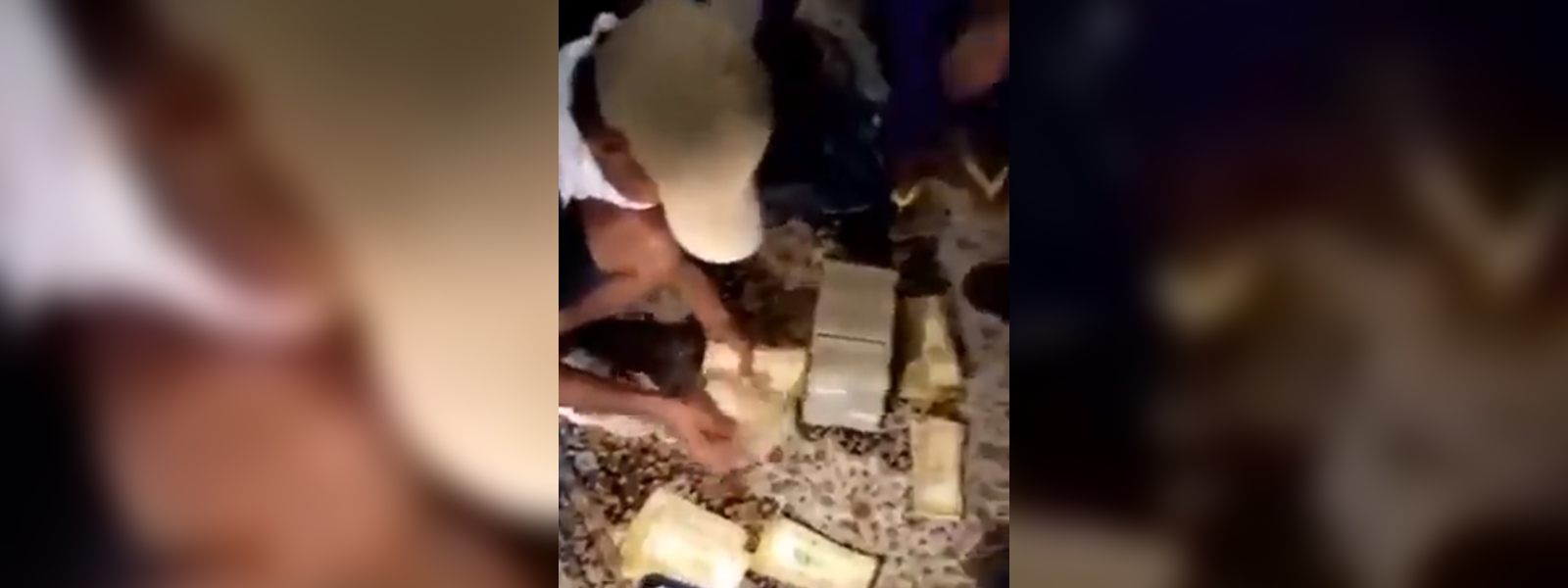
It was transpired before Colombo Fort Magistrate’s Court that despite a Court order, police have so far failed to record a statement from former President Gotabaya Rajapaksa regarding ongoing investigations into the sum of Rs. 17.8 million recovered by protesters inside the President’s House on 9th July.

The Court was informed that IGP’s decision to handover the probe to the Criminal Investigations Department (CID) from Special Investigation Unit (SIU) had led to delay the ongoing investigations into the incident.

Meanwhile, Colombo Fort Magistrate Thilina Gamage issued an order directing the IGP to show cause as to why investigations pertaining to the recovery of money inside the President’s House were handed over to the CID from SIU.

This information was revealed when a case filed against Convener of Inter-University Students’ Federation (IUSF) Wasantha Mudalige, Fr. Jeewantha Peiris and 71 others for forcibly entering the President’s House on the 9th of July was taken up for inquiry before Colombo Fort Magistrate’s Court.

Meanwhile, the Magistrate issued an order directing the National Authority for the Protection of Victims of Crimes to conduct an inquiry into an alleged incident where SIU Director SSP Wickremasinghe had been threatened by Senior DIG Tennakoon.

President’s Counsel Rienzie Arsekularatne with Maithri Gunaratne PC appeared for the suspects in the case.

Government goes for China again to enhance Colombo port

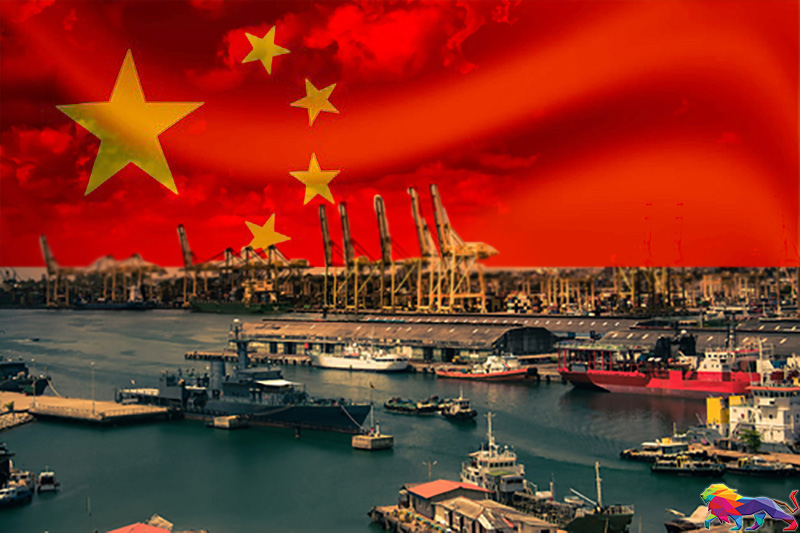
Sri Lanka is all set to roll out the first phase of the proposed Colombo South Port development project as a Public-Private-Partnership (PPP) with an investment of $ 150 million.

“Based on the recommendations of the Cabinet Appointed Negotiation Committee, the Government has decided to implement the Colombo International Container Terminals (CICT) proposal evaluated by a Cabinet Appointed Negotiation Committee,” Cabinet Co-Spokesman and Minister Bandula Gunawardena said at the post-Cabinet meeting media briefing yesterday.

As per the evaluation by a Cabinet Appointed Negotiation Committee, Battenberg and Bloemendhal service delivery areas belonging to Colombo South Port were identified as areas that can be developed under PPP.

“Based on the recommendations of the Cabinet Appointed Negotiation Committee, the PPP project will be developed between the China Merchant Port Company (CMPC), Colombo International Container Terminals Company (CICT) and Sri Lanka Ports Authority (SLPA),” Gunawardena added.

With the Government looking at transforming the Colombo Port into a service supply hub in South Asia, the proposal to this effect submitted by the Ports, Shipping and Aviation Minister Nimal Siripala de Silva was approved Cabinet of Ministers at its meeting on Monday.

The Port of Colombo is the largest commercial port in Sri Lanka as well as a key hub port in the South Asian region. One of the primary strategic objectives of the Port Authority’s National Port Master Plan is to turn Colombo Port into a service supply hub.

The Colombo West Container Terminal is being developed by India’s Adani Group in joint venture with John Keells Holdings which also operates the South Asia Gateway Terminal with several other partners.

Posted in Uncategorized

China’s Exim Bank offers Sri Lanka debt moratorium – Reuters

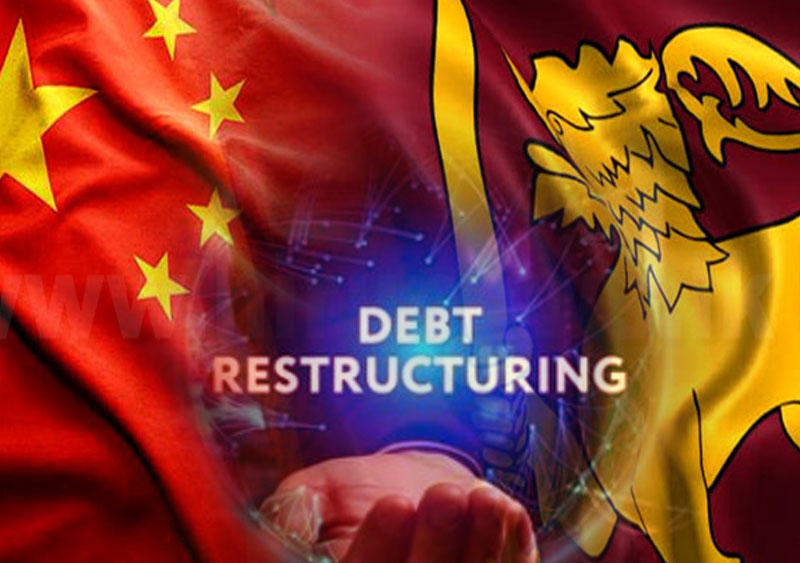
The Export-Import Bank of China has offered Sri Lanka a two-year moratorium on its debt and said it will support the country’s efforts to secure a $2.9 billion loan from the International Monetary Fund, according to a letter reviewed by Reuters.

India wrote to the IMF earlier this month, saying it would commit to supporting Sri Lanka with financing and debt relief, but the island nation also needs the backing of China in order to reach a final agreement with the global lender.

China’s Jan. 19 letter, sent to the finance ministry, however, may not be enough for Sri Lanka to immediately gain the IMF’s approval for the critical loan, a Sri Lankan source with knowledge of the matter said.

Regional rivals China and India are the biggest bilateral lenders to Sri Lanka, a country of 22 million people that is facing its worst economic crisis in seven decades.

According to the letter, the Export-Import Bank of China said it was going to provide “an extension on the debt service due in 2022 and 2023 as an immediate contingency measure” based on Sri Lanka’s request.

At the end of 2020, China EXIM bank had loaned Sri Lanka $2.83 billion which is 3.5% of the island’s debt, according to an IMF report released in March last year.

“…you will not have to repay the principal and interest due of the bank’s loans during the above-mentioned period,” the letter said.

“Meanwhile, we would like to expedite the negotiation process with your side regarding medium and long-term debt treatment in this window period.”

Sri Lanka owed Chinese lenders $7.4 billion, or nearly a fifth of its public external debt, by the end of last year, calculations by the China Africa Research Initiative showed.

“The bank will support Sri Lanka in your application for the IMF Extended Fund Facility (EFF) to help relieve the liquidity strain,” the letter said.

The Sri Lankan source, who asked not to be identified because of the sensitivity of the confidential discussions, said the island nation had hoped for a clear assurance from Beijing on the lines of what India provided to the IMF.

“China was expected to do more,” the source said, “This is much less than what is required and expected of them.”

Sri Lanka’s foreign and finance ministries and China’s foreign ministry did not immediately respond to questions from Reuters.

Sri Lanka’s central bank chief P. Nandalal Weerasinghe said on Tuesday that the country hoped for assurances from China and Japan, another major bilateral lender, soon and complete debt restructuring in six months.

Posted in Uncategorized

How a Chinese company destroyed a Sri Lankan fishing community

According to an article published by Daily Mirror, in 2020 alone, Sri Lanka has exported about 326 tons of sea urchins with China being the biggest buyer.[i] Going back as far as 2016, a sea leech hatchery was established by a Chinese joint venture company ‘Gui Lan (Pvt) Ltd’ centered on the northern peninsula to facilitate the export of these species to China. The company has been registered as a private limited liability company with a registered address in Negombo with two Chinese and a Sri Lankan being named as directors in April 2016. Welcoming Chinese investment in the country, in June 2022, the Sri Lankan cabinet approved a proposal for a large-scale commercial sea leech and sea cucumber farming project spanning 5,000 acres in the districts of Jaffna, Mannar, Kilinochchi and Batticaloa in the Northern and Eastern Provinces. The government also plans to set up an export village in an area of 100 acres.

As per online resources, the approximate price range for Sri Lankan Sea Cucumber is between US$ 30.39 and US$ 54.69 per kilogram or between US$ 13.78 and US$ 24.81 per pound (lb) in 2022. In 2017, a kilo of sea cucumber was priced at US$21.64 and in 2019 the price went up to $30.39 per kilo.[ii] According to a January 2020 Hindustan Times report, a kilo of sea cucumbers can fetch about Rs 50,000 and some fishermen could even earn Rs. 2 lakh in a single day. [iii] This highly priced delicacy is helping Sri Lanka bring in the much needed foreign currency to combat the ongoing economic crisis in the country.

While the Sri Lankan government is busy counting the money, the local fishermen communities have been suffering. It has come to light that the Gui Lan joint venture has failed to secure a permit from National Aquaculture Development Authority of Sri Lanka (NAQDA) for its new nursery in Kowtharimunai in Pooneryin. This new nursery is located only a few kilometers away from its Ariyalai hatchery in Jaffna. According to the chief of Pasaiyoor Fishermen Federation P. Mathan, the establishment of this new nursery has led to acres of sea lands being fenced off for sea cucumber harvesting, shutting out the traditional fishermen who harvest prawns for a living. While the company continued its operations at Ariyalai, the Fisheries department in 2017 filed a legal action against it for failing to produce a permit from NAQDA. The case was then transferred to Jaffna Magistrate’s court where it was ordered to release the baby sea cucumbers to the nearby waterways. Pooneryin Divisional secretary S.C. Krishnendran said he came to know about the company’s Kowtharimunai extension only through media reports and that no such permit applications were submitted to the local fishermen body seeking its consent.

The laid-back attitude of the authorities resulted in no proper action has been taken yet. About 3,200 small-scale fishing families have been seriously affected by the creation of sea leech farms, losing their livelihoods during an ongoing economic crisis in the country. A group of fishermen has also started a hunger strike near the Kiranchi fishing harbor because the roads leading to their boats for fishing activities has been blocked due to the permission of a group of fishermen to set up sea leech cultivation boxes. The fishermen point out that if out of 100 fishermen even just 10 set up a sea leech farm, the livelihood of the remaining 90 who catch shrimp, prawns and other fishes is put at stake. Out of the 17,000 fishing families living in the Northern Province, less than 1000 have been selected to work in these farms, leaving the remaining 16,000 Dhiwara families at risk of losing their livelihood and falling into the streets. This has led to continuous protests demanding the closure of the illegal sea leech farms in Punagari, Kirawan and Ilavankuda areas.

The effect of these farms on the marine diversity and ecology has been grave. The lights aimed at the sea urchin production farms across the lagoon are switched on in the evening which affect the movement of fish and prawn towards the shore. These organisms live near the coast or move towards the sea depending on the salinity of the waters. Chinese companies like Gui Lan have constructed several sea cucumber farms with electric fences along the sea shore, restricting the movement of other aquatic species towards the coast during monsoon season. This malevolent practice could pose a serious threat to the long-term sustainability of the region. Sea cucumbers help detoxify contaminants in the soil and other environments, help in nutrient cycling and redistribution of sediments. Moreover, they help other species such as corals to live, making them ideal for bioremediation.

Sea cucumbers (Holothuroidea) and sea urchin (Echinoidea) along with starfish are invertebrates that belong to a larger animal group called Echinoderms. These spiny-skinned spineless creatures live on the seabed and can be easily found in oceans around the world. Sea cucumbers have a long, barrel shaped body with soft, leathery skin while sea urchins are on the rounder side with spikes to protect it from the predators. Both of these echinoderms are consumed around the globe as food as well as medicine.

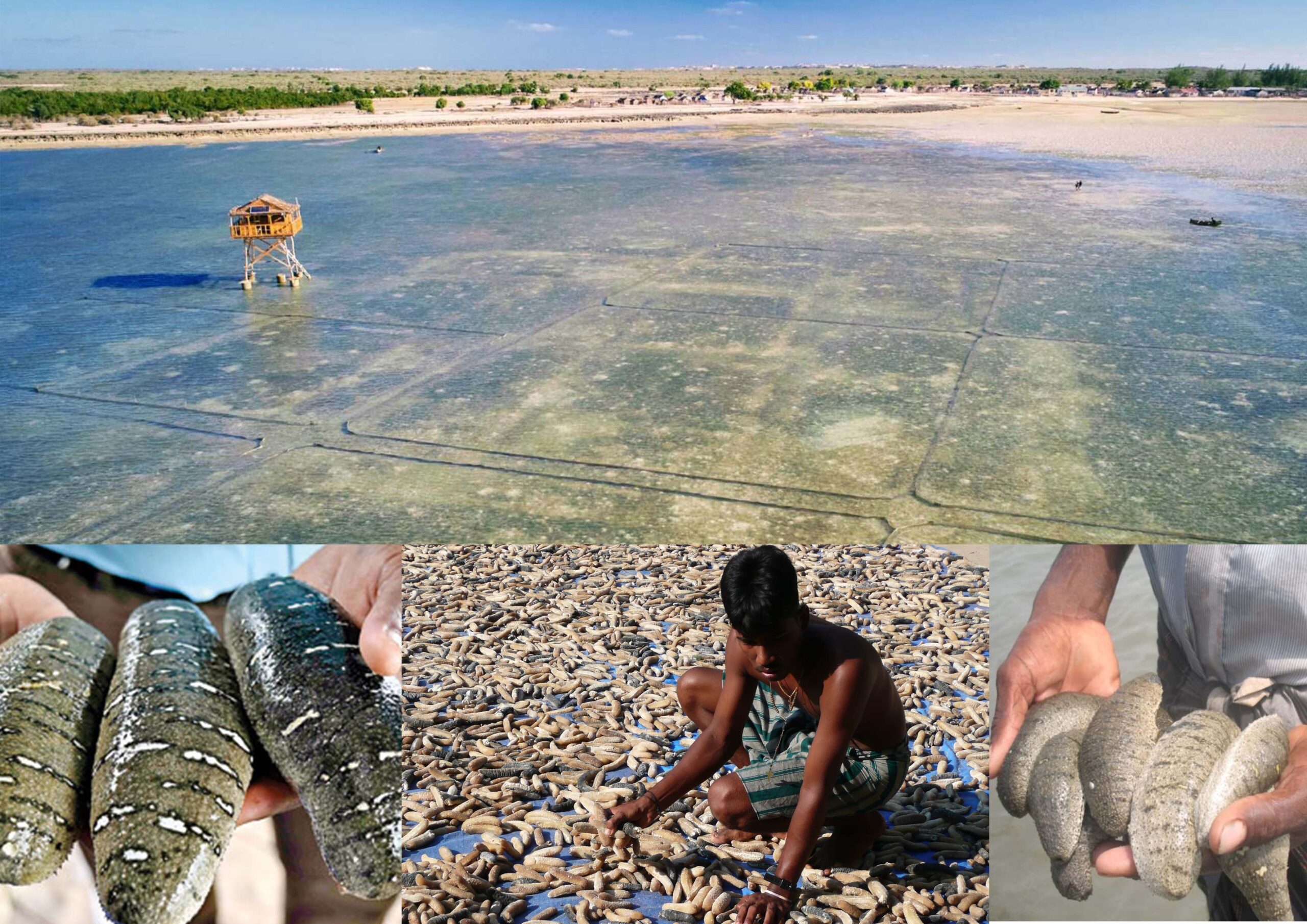
Sea cucumber, which is known as Muhudu Pipinna in Sri Lanka, is found along its Northwestern and Eastern coasts. Traditionally, these creatures have been harvested using wooden vallam and siraku valai, a passive type of fishing gear which is set up in night and harvested the following morning. This method has been popular in shallow waters and near shore areas. Another traditional method is patti valai, which is used to harvest fish and prawn using square-shaped nets. In addition, sea cucumbers are easily picked up by divers, who dive from traditional oru, a type of canoe or even motorized boats.

However, these methods are now disappearing due to the proliferation of large sea cucumber farms. The Ministry of Fisheries leases out sea land plots ranging between one to ten acres on the seashore. The largest fish breeding sites are located near shallow coastal lands due to favorable marine environment including sunlight and sea plants. While all these factors make Sri Lanka a suitable place for sea cucumber farming, large scale production could prove to be catastrophic. These areas are usually surrounded by thick electric fences keeping in line with the pen culture method. About 4000 sea cucumbers can be bred at one time in one acre of area. In a sea cucumber hatchery, the baby animals are nursed up to four months before they are sold to commercial farms run by locals. These babies then take at least ten months to mature and ready for export.

Considered a delicacy in China, sea cucumbers are often served during banquets and dinners. In addition, sea cucumbers are used in traditional Chinese medicine (TCM) to cure impotence, joint pain etc., enhance sports performance and is known to have anti-fatigue effects. All these factors have made sea cucumbers one of the most expensive seafood item that already has a huge market available for business. The demand of sea cucumber has been on the rise which has led to construction of massive farms along the Lankan coastline. Reportedly, the sea cucumber farm established by Chinese companies have led to loss of livelihood of close to 15000 Sri Lankan fishermen families. Reports of protests from these families state that the traditional fishing grounds and marine diversity are being destroyed and are leading to poverty and unemployment.

If the Sri Lankan government wants to tackle the problem and work to improve the living condition of the fishing community, then it can be achieved only through right technology and clean investments from local entrepreneurs. Handing over the coastline to Chinese domination will only bring disaster to the humans as well as the environment.

[i] Majueran, Maya, “Chinese Investment in Sea Cucumber Farm in Sri Lanka also a Threat to Indian Security?”, Daily Mirror, 20.10.2022 https://www.dailymirror.lk/news-features/Chinese-Investment-in-Sea-Cucumber-Farm-in-Sri-Lanka-also-a-Threat-to-Indian-Security/131-247136

[ii] “Sri Lanka Sea Cucumber Prices”, https://www.selinawamucii.com/insights/prices/sri-lanka/sea-cucumber/

[iii] Chatterjee, Badri,”219 sea cucumbers worth Rs1.17 crore seized in largest seizure in Lakshadweep”, Hindustan Times, 15.01.2020 https://www.hindustantimes.com/mumbai-news/219-sea-cucumbers-worth-rs1-17-crore-seized-in-largest-seizure-in-lakshadweep/story-O20FnMsd3bSd4HE6HMbYPK.html

Posted in Uncategorized

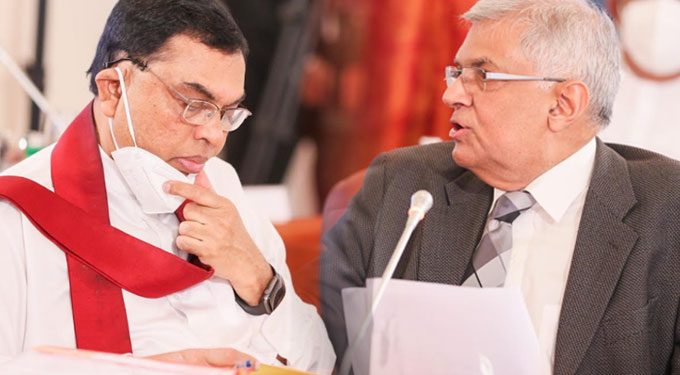
Basil says he is not part of the Government

Sri Lanka Podujana Peramuna (SLPP) founder Basil Rajapaksa says he is not part of the Government.

Rajapaksa said this in response to questions raised from him during a visit to Kandy today.

The former Minister was asked about moves by the Government to postpone the Local Government (LG) elections.

“You will need to ask the Government that. I am not in the Government,” he said.

There have been allegations that Basil Rajapaksa is working with President Ranil Wickremesinghe in the Government.

The SLPP is part of the Government with a number of SLPP members in the Cabinet.

Basil Rajapaksa said the SLPP kicked off its campaign today for the LG polls.

He said the party will contest in all the districts as the SLPP in some areas and with other political parties in other areas.

Rajapaksa said the public will decide the future of the SLPP at the polls.

Posted in Uncategorized

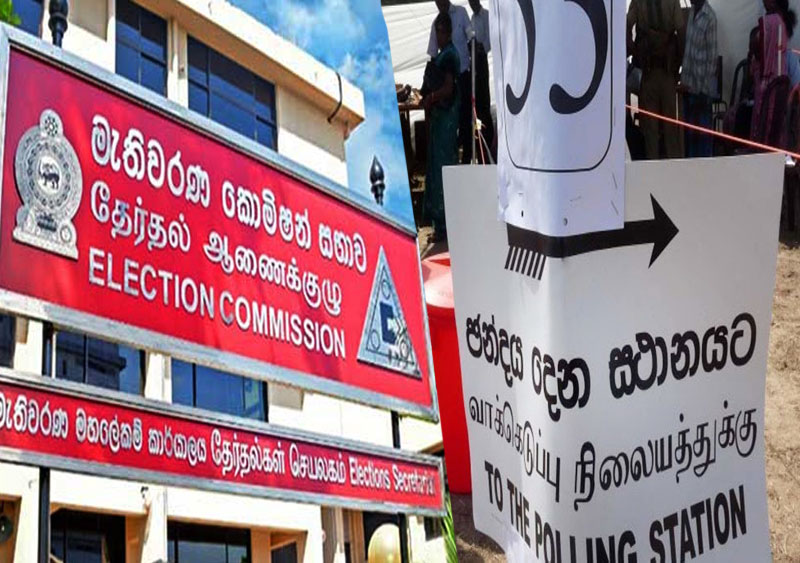
EC, political parties reach agreement on expenditure for election campaign

The Election Commission and around 85 political parties yesterday reached an agreement on the maximum amount which could be spent by individual candidates and parties at the local government election.

SLFP General Secretary Dayasiri Jayasekera said the agreement was to spend Rs. 15 per voter, of which the party can spend 60 percent of it per candidate.

“Total amount which could be spent will be computed by multiplying Rs. 15 by the total number of registered voters out of which 60 percent can be spent by the respective parties,” MP Jayasekera said.

UNP General Secretary Palitha Range Bandara also confirmed this and said all parties agreed on it.

Also the Chairman of Election Commission Nimal Punchihewa has told the political party representatives that the local government election will be held on March 9, 2023.

However CWC General Secretary Jeewan Thondaman said he had informed the Commissioner of Elections the election should not be held at this moment. “Time is not right to spend billions for the local polls. I am for elections but I am of the opinion that local government polls should not be held now,” he said.

Posted in Uncategorized

The ill-fated UK-Ceylon Defense Agreement of 1947 By P.K.Balachandran

The United Kingdom had decided to grant independence to Ceylon as part of the de-colonizing process following the end of World War II. But there was a condition attached it: independent Ceylon should allow the UK to retain its naval and air bases at Trincomalee and Katunayake respectively through a UK-Ceylon Defense Agreement.

The UK needed the bases to meet the emerging threat to its Empire from the USSR and also Communist China which was then looming in the horizon. As for Ceylon, it needed a British military presence to meet a perceived threat of an “invasion” from an independent India that was keen to play a dominant role in Asia.

But despite the shared strategic interest in the defense of the island, there were serious differences over the terms and conditions of the proposed Defense Agreement. The issues were: who will bear the cost of maintaining and staffing the bases; where will the money come from; under whose control will the bases be; and for how long will the arrangement last.

The UK and Ceylon did not see eye-to-eye on these. Both pleaded inability to bear the cost singly. Ceylon was poor and the UK had been devastated by the war. While Ceylon wanted to have overall control over the bases and the use to which they would be put, the UK wanted the bases to serve its geo-political interests in South East Asia as a whole, an objective that Ceylon did not share. Ceylon looked at the British military presence principally as a shield against a perceived “Indian invasion”, but the British ridiculed such an expectation and wanted the bases for resisting Soviet (and later Communist Chinese) inroads into South East Asia. Thus, geopolitical interests clashed.

However, because the dispute threatened to delay Ceylon’s independence, both sides felt a need to wrap up the pact by making the terms and conditions “vague” leaving the blanks to be filled later. It was also decided to state that the bases will be held by the British “in the mutual interest” of the two parties, thus assuring Ceylon that if it did not see a “mutual interest”, it could terminate the agreement. The Defense Agreement was signed in 1947 and Ceylon got independence in 1948.

In the years that followed, the geopolitical situation, across the world, got worse from the British point of view. Communist China had emerged in 1949 and the Korean war had begun in 1950. In this context, the UK began to press for filling-in the blanks in the 1947 Defense Agreement as per its interests. Initially, Ceylon was agreeable because the Soviets had irked it by vetoing its entry into the UN on the grounds that with British bases in it, Ceylon was not an “independent” country.

But during the talks, issues of funding and control came up. By this time, an additional factor had emerged – the Ceylon government was facing opposition from nationalist and Marxist forces due to burgeoning economic problems. This made it difficult to give any significant concessions to British military interests.

The story of the hard-nosed negotiations and the final derogation of the Agreement by the SWRD Bandaranaike government in 1957 is told in detail by Robert Barnes of York St.John University, UK, in his 2022 publication entitled: In the Mutual Interest’: The Making and Breaking of the United Kingdom-Ceylon Defence Agreement, 1947–1957 (Taylor and Francis).

In the first instance, Prime Minister D.S. Senanayake proposed that Ceylon purchase the land on which the bases were built and then lease them out to Britain. Britain agreed, but on the condition that it would be able to keep the bases as long as it required. However, the then Foreign Secretary, Sir Kanthiah Vaithianathan, subsequently told the British that the Ceylonese people would not allow precious land to be alienated to meet the needs of the British military. But Senanayake was more amenable. Due to the denial of citizenship to the people of Indian origin, he feared an Indian military intervention.

However, given the parlous state of Ceylon’s economy, Senanayake expected the UK to bear the cost of the bases. But the British rejected it and threatened to downsize the Trincomalee naval base. A worried Senanayake cited a threat to Ceylon due to the Korean war, and sought extensive assistance to Ceylon’s armed forces. But British Prime Minister Clement Atlee told him that Ceylon should first agree to purchase the land on which the bases stood and then make the land and all the facilities available to UK for as long as it was deemed necessary by the British military.

Subsequently, the British decided to give some financial assistance to Ceylon to defend itself. But it insisted that Ceylon buys the land on which the bases stood and that the proceeds would enable the UK to meet the cost of equipping and training the Ceylonese military. Senanayake agreed, but demanded the supply of two destroyers, one frigate, twelve minesweepers, and six seaward defense boats; equipment for one army battalion and two anti-aircraft regiments; and two regular and one auxiliary fighter squadrons. But the British rejected this and demanded BP 800,000 for the land on which the bases stood. In return, they said, they would give, free of charge, equipment worth BP 800,000. But this was not acceptable to Ceylon.

Ceylon then turned to the USA, which also wanted bases in Ceylon. But the US withdrew when Ceylon and Communist China signed the Rice-Rubber barter deal defying a US ban on sale of strategic material to China.

Talks on the UK-Ceylon Defense Agreement continued, but made no progress though Senanayake’s successors, Dudley Senanayake and Sir John Kotelawala, were both rightwing and pro-West. Meanwhile, the nationalist opposition to the stationing of the British military grew, which made Kotelawala say that Ceylon would not join any power bloc. Ceylon also refused to join the US-led South East Asia Treaty Organization (SEATO).

1956 was a watershed in the history of the Defense Pact talks. The leftist-nationalist SWRD Bandaranaike had come to power proposing full independence for Ceylon (not just a Dominion as Ceylon was at that time) and a non-aligned foreign policy. Meanwhile, the UK’s military misadventure over the Suez Canal had weakened its global stature. The mood in the UK was to shed some of its bases overseas. While Trincomalee was considered dispensable, Britain wanted the Katunayake air base and the telecommunications facilities on the island.

Bandaranaike proposed that the bases be held jointly with Ceylon having formal control. The UK wanted Ceylon to give concrete guarantees on which facilities the British could use and for how long. It also demanded a ‘fair price’ for any of the facilities that Britain was willing to hand over. But Bandaranaike forced the issue by publicly claiming that he had secured Ceylon’s absolute right to the bases and the withdrawal of 90% of the British forces. Britain was constrained to agree to shed formal control over the bases, though it still wanted the Royal Air Force to retain overflying and staging rights indefinitely.

It was finally agreed that the transfer of control of Trincomalee and Katunayake would take place in late 1957 and that the British withdrawal would be completed within five years. It was also agreed that Ceylon would pay £1.65 million over five annual payments during the withdrawal period.

The exchange of letters finally took place on June 7, 1957, “superseding rather than abrogating” the 1947 Defense Agreement, as Barnes put it. The transfer of control of the Trincomalee and Katunayake bases took place on 15 October and 1 November 1957 respectively.


Posted in Uncategorized

The newly formed TNA to seek meeting with Indian PM

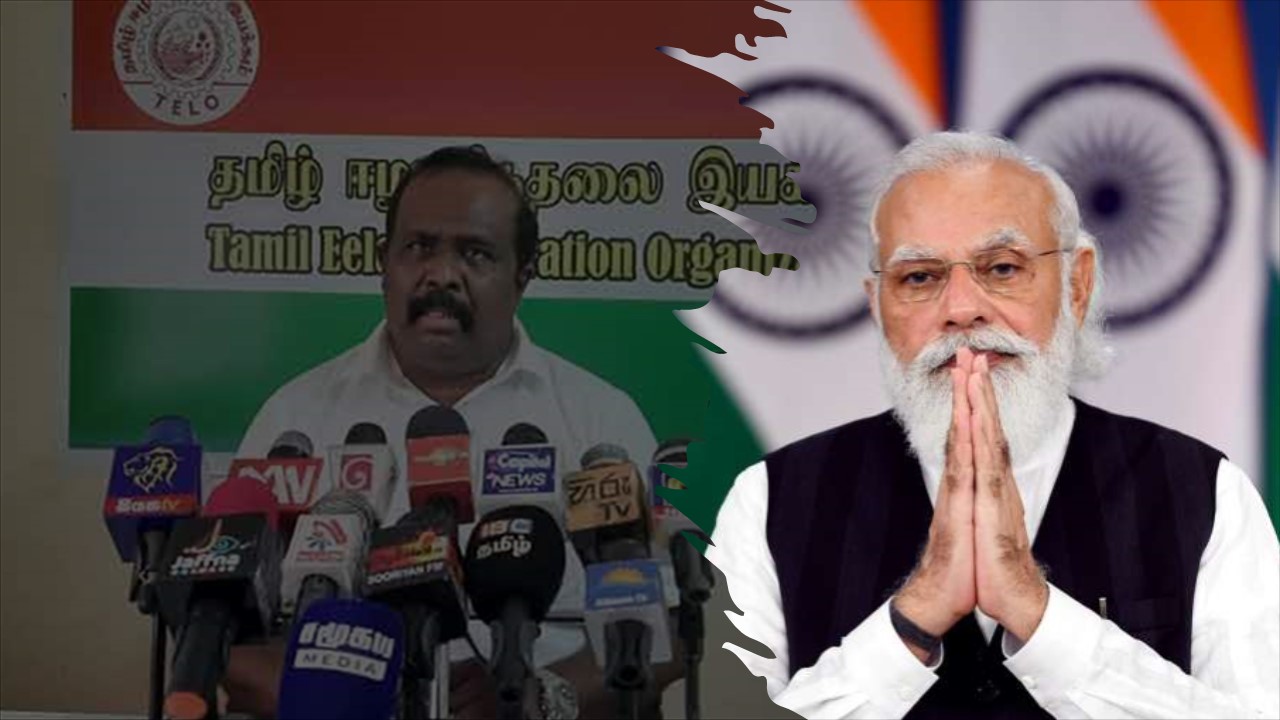
The newly formed Democratic Tamil National Alliance (DTNA), representing the two breakaway parties of the Tamil National Alliance (TNA) – the Tamil Eelam Liberation Organisation (TELO) and the People’s Liberation Organisation of Tamil Eelam (PLOTE) – would take necessary moves to meet Indian Prime Minister Narendra Modi post the Local Government polls, to hold discussions with regard to a suitable political solution and the implementation of 13th Amendment to the Constitution in Sri Lanka.

TELO Leader MP Selvam Adaikkalanathan told The Daily Morning yesterday (22) that his party would take necessary steps to obtain an appointment to meet PM Modi with regard to the above via Indian High Commissioner to Sri Lanka Gopal Baglay after the LG polls.

“Everyone is just talking about the implementation of the 13th Amendment. But if this is to happen, it is important to meet PM Modi and urge for it. Officials arriving from India would just highlight it, but it is important to actually implement it.”
He noted that his party would also highlight to PM Modi its long-term suggestion to have an Indian mediator in the ethnic talks.

Meanwhile, Indian Minister of External Affairs Dr. S. Jaishankar last Friday (20) highlighted the need for the full implementation of the 13th Amendment and early conduct of the Provincial Council elections.

The DTNA was formed in Jaffna last week with the representation of TELO, PLOTE,EPRLF, the Tamil National Party, and the Crusaders for Democracy (which comprises former Liberation Tigers of Tamil Eelam [LTTE] cadres).

Constitutional Council to meet next Wednesday

A meeting of the Constitutional Council will be held next Wednesday (25) at 9.30 am, Chief of Staff and Deputy General Secretary of the Parliament Kushani Rohanadeera said.

Meanwhile, President Ranil Wickremesinghe appointed the non-members of Parliament as members of the Constitutional Council based on the nominations submitted by the Speaker with the agreement of the Speaker, the Prime Minister and the Leader of the Opposition in Parliament.

Accordingly, Dr. Pratap Ramanujam, Dr. (Mrs) Dilkushi Anula Wijesundere, and Dr. (Mrs) Weligama Vidana Arachchige Dinesha Samararatne have been appointed.
Dr. Ramanujam has served as a Member of the Public Service Commission and has served as the Secretary to several Ministries for over a decade.

Dr. Wijesundere is a doctor by profession and Dr. Samararatne is a law academic and works as a Senior Lecturer of the University of Colombo.

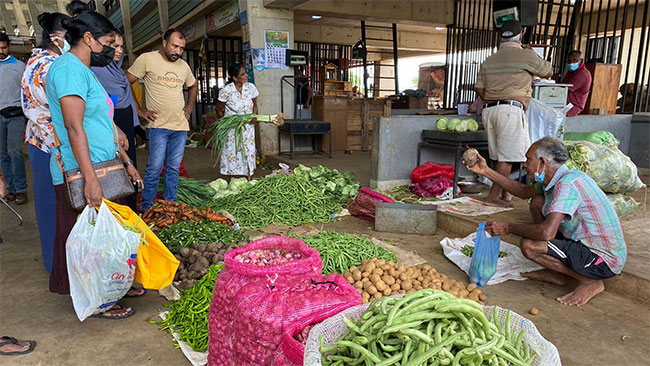
Food inflation still very high at 59.3% in December 2022

The Department of Census and Statistics said that on a monthly basis, the Year-on-Year inflation of the food group was at a mammoth 59.3% in December 2022, although it reduced from 69.8% in November 2022. The Year-on-Year inflation of the non-food group also remained high at 59.0% in December 2022 from 60.4% in November 2022.

The overall rate of inflation as measured by NCPI on a Year-on-Year basis is 59.2% in December 2022 compared to November’s 65.0%.

Posted in Uncategorized