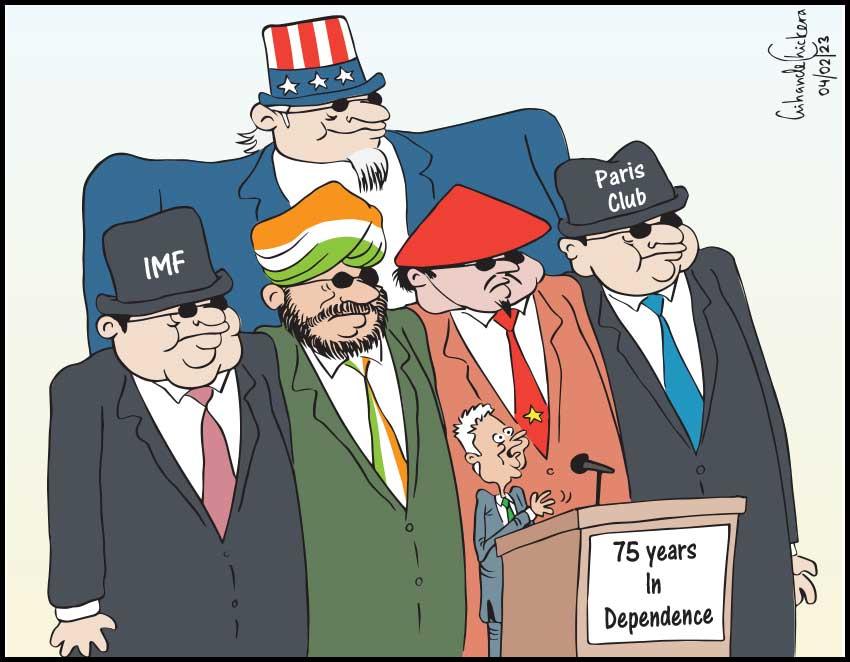
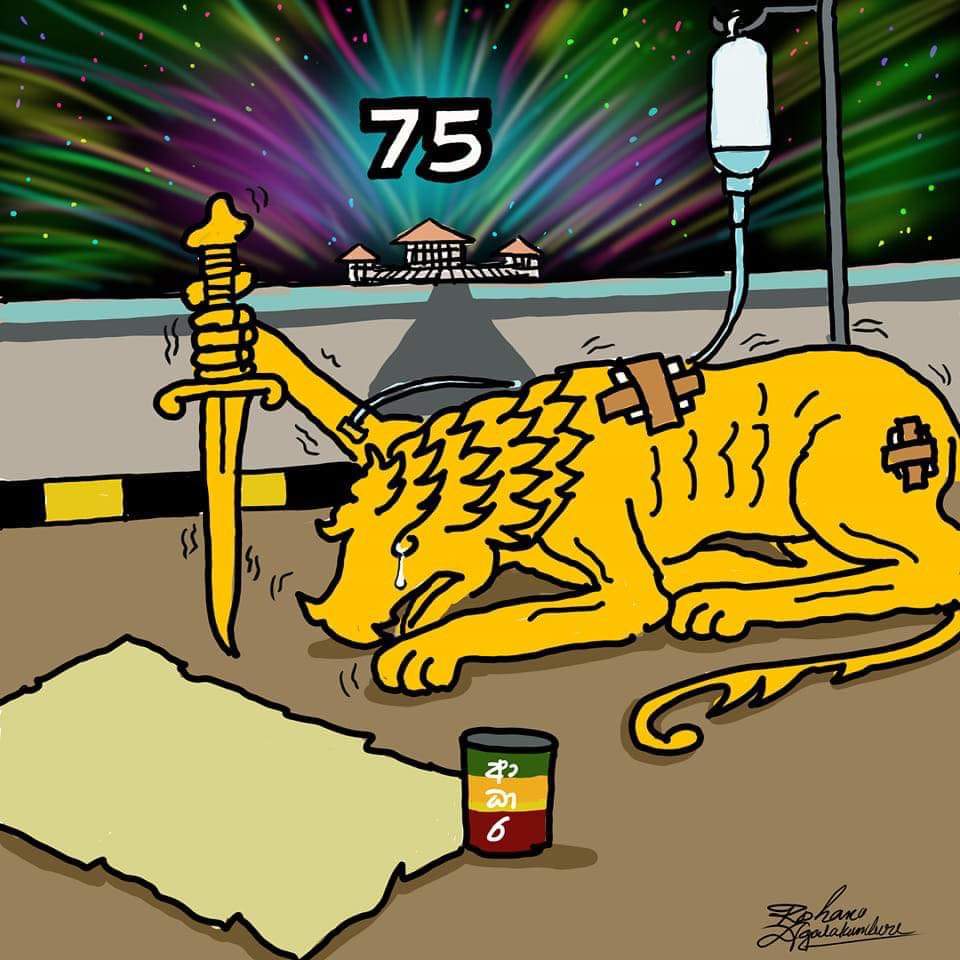
Jaishankar’s Colombo visit underscores Delhi’s role as the first responder in crises

Indian External Affairs Minister Dr.S.Jaishankar’s two-day visit to Sri Lanka that concluded on Friday, has underscored and re-affirmed India’s role as the first responder during crisis situations in Sri Lanka.

The visit, which included a meeting with President Ranil Wickremesinghe, raised hopes that India-Sri Lanka cooperation in a variety of economic sectors will increase. Jaishankar has offered further Indian investments and has appealed to the Sri Lankan authorities to create a business-friendly environment that will help attract Indian investments.

Jaishankar told a media briefing that the primary purpose of his visit was to express India’s solidarity with Sri Lanka during these difficult moments when the island nation is facing a deep financial crunch.

“As you all know, last year, India extended about US $ 4 billion in terms of credits and rollovers to help Sri Lanka get through an economic crisis. For us, it was an issue of ‘Neighborhood First’ and not leaving a partner to fend for themselves.”

“This year, in a developing situation that was beginning to cause concern, the same sentiment reasserted itself. We felt strongly that Sri Lanka’s creditors must take proactive steps to facilitate its recovery. India decided not to wait for others but to do what we believe is right. We extended financing assurances to the IMF to clear the way for Sri Lanka to move forward. Our expectation is that this will not only strengthen Sri Lanka’s position but ensure that all bilateral creditors are dealt with equally,” Jaishankar said.

The Indian External Affairs Minisiter stressed the importance of FDIs for the recovery of economies and said: “Sri Lanka’s pathway is one of a strong economic recovery propelled by greater investments. India will encourage greater investments in the Sri Lankan economy, especially in core areas like energy, tourism and infrastructure.”

Jaishankar then stated an important point – a flaw in the attitude of successive Sri Lankan governments’ FDI policies. He said: “We count on the Government of Sri Lanka to provide a more business-friendly environment to create a powerful pull factor. I am confident that the gravity of the situation is realized by policy-makers here.”

The Indian Minister laid out the areas in which Sri Lanka could count on Indian help. He particularly mentioned connectivity, energy and the development of Trincomalee as an energy hub.

“Energy security is today one of Sri Lanka’s most serious challenges. A search for solutions must necessarily encompass the larger region. Only then will Sri Lanka get the full benefit of scale. This country has enormous renewable energy potential that can become a sustainable source of revenue.”

“India is prepared to be a reliable partner on such initiatives. We have today agreed in-principle on a renewable energy framework that would take this cooperation forward,” Jaishankar said.

Recognizing the tourism is the life blood of the Sri Lankan economy, Jaishankar noted that Indian tourists are expressing their “positive sentiments for Sri Lanka in a very practical manner by coming here.” But more will come if connectivity is improved and if Indian tourists are able to make payments in Indian Rupees and the utilization of UPI would be most helpful in this regard, he added.

Indian Rupee payments will also boost Indo-Lankan trade, he said. “In a turbulent world, it is essential that India and Sri Lanka steady their trade. The use of rupee settlement for trade is obviously in our mutual interest,” Jaishankar said.

On political issues in Sri Lanka in which India has been historically interested, Jaishankar said that India has always supported both the political and economic stability of Sri Lanka. He said that he told President Wickremesinghe that the full implementation of the 13th amendment of the Sri Lankan constitution which devolves powers to the provinces will promote reconciliation and national stability. He also stressed the need for the early conduct of provincial elections. Durable efforts towards reconciliation are in the interests of all sections in Sri Lanka, he added.

Referring to the Indian Origin Tamils, he said that he spoke to the President about the need to pay “special attention” to the requirements of this community.

Jaishankar then sad that he had handed over to Wickremesinghe, Indian Prime Minister Narendra Modi’s invitation to visit India “at an early date to discuss how our partnership can facilitate Sri Lanka’s strong recovery.”

In conclusion, Jaishankar underlined that India is a “reliable neighbor, a trustworthy partner, one who is prepared to go the extra mile when Sri Lanka feels the need.”

“My presence here today is a statement about Prime Minister Modi’s commitment to Neighbourhood First. We will stand by Sri Lanka in this hour of need and are confident that Sri Lanka will overcome the challenges that it currently faces,” he said.

Lankan View

In his statement to the media, the Sri Lankan Foreign Minister Ali Sabry expressed “profound gratitude” to the Indian Prime Minister, External Affairs Minister and the Indian people for their “enormous support” when Sri Lanka was facing the most serious economic crisis in its history. He appreciated India’s official offer of financial assurances at a time when Colombo’s talks with the IMF for a relief package were at a crucial stage.

Sabry said that Sri Lanka is watching India’s growth with great interest as in its view, India’s growth is good for the region and Sri Lanka. He congratulated Prime Minister Modi and Jaishankar for giving an “intellectual impetus” to a new foreign policy.

The Lankan Foreign Minister announced Indian aid for “high impact” community development and housing projects in Anuradhapura, Kandy, Nuwara Eliya and Galle districts.

Jaishankar in the Maldives

Earlier, during a visit to the Maldives, Jaishankar signed agreements. MVR 100 million grant will be given for high-impact community development projects, under which a sports complex will be constructed in Gaafu Dhaalu Gadhdhoo. There is an agreement for assistance and cooperation between the Maldives National University and Cochin University in India. India also made a donation of two sea ambulances. He inaugurated the Indian-aided Hanimaadhoo Airport Development Project. The Hanimaadhoo Airport project will connect the world with the northern islands of the Maldives.

Jaishankar meets Mahinda before concluding visit

Indian External Affairs Minister Dr. S. Jaishankar had talks with former President Mahinda Rajapaksa before concluding his visit to Sri Lanka.

Rajapaksa tweeted saying he had a successful discussion with Jaishankar and that they discussed a range of issues of mutual interest.

“Also thanked the Indian govt. for it’s steadfast commitment in assisting Sri Lanka during its troubled times & the strong ties shared between Sri Lanka and India,” Rajapaksa tweeted.

During the visit to Sri Lanka, Minister Jaishankar held bilateral discussions with Minister of Foreign Affairs Ali Sabry on 19 January 2023 and was hosted to dinner by the Foreign Minister.

On behalf of President Ranil Wickremesinghe, the Government and the people of Sri Lanka, Minister Sabry conveyed gratitude to his Indian counterpart for the significant assistance extended by India to Sri Lanka in the past year, of USD 4 billion in credit lines as well as other in-kind assistance, when the country was going through its most serious economic crisis.

Minister Sabry also appreciated India’s announcement, as the first country to officially back Sri Lanka’s IMF-led debt restructuring programme by conveying financing assurances to the International Monetary Fund.

The Indian Minister reiterated that the primary purpose of his visit to Colombo was to express India’s solidarity with Sri Lanka in difficult times in line with the ‘Neighbourhood First’ policy of Prime Minister Modi. It was India’s intention to clear the way for Sri Lanka to move towards recovery and growth.

Bilateral discussions between the two Foreign Ministers and the respective delegations included Foreign Secretary Aruni Wijewardane and Indian High Commissioner Gopal Bagley and focused on several areas of possible further collaboration for mutual benefit. It was agreed that greater connectivity including through tourism would encourage enhanced people to people contact and economic activity.

Sustainable energy security was identified by both sides as one of the most urgent upcoming challenges, and agreement was arrived at in principle for the need for a framework for cooperation for renewable energy.

Foreign Minister Sabry noted that India was one of the fastest growing economies in the world. Sri Lanka recognizes that India’s growth would provide opportunities for Sri Lanka as India is Sri Lanka’s largest trade partner, the largest source of inward tourism and one of the largest investors.

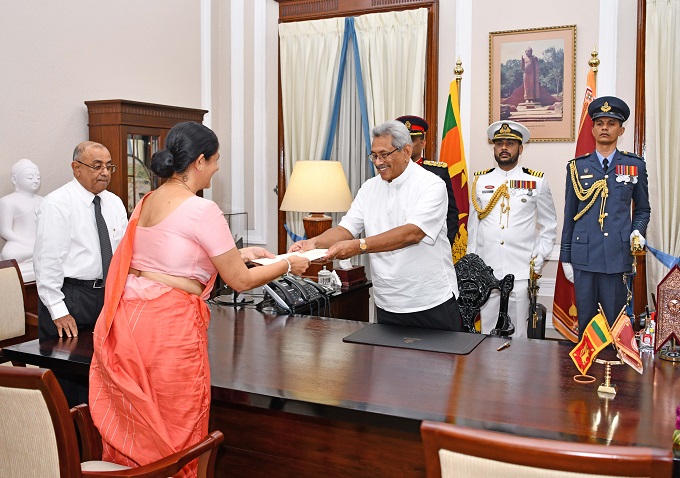
On the occasion of the visit, a number of important initiatives were concluded in the presence of President Wickremesinghe at the Presidential Secretariat.

This included the signing of an MOU on Indian Grant Assistance for implementation of High Impact Community Development Projects (HICDP) which focused on socio-economic development, infrastructure in education, health and community development sectors. Minister Jaishankar also participated in three virtual inauguration ceremonies to handover the Kandyan Dancing Academy under the Sri Dalada Maligawa Heritage Project, to handover 24 houses each in Anuradhapura and Badulla Districts under the Model Housing Village Project and to handover 300 houses under Phase-3 of the Indian Housing Project: 100 houses each in Kandy, Nuwara Eliya and Galle Districts.

Minister Jaishankar also handed over Prime Minister Narendra Modi’s invitation to President Ranil Wickremesinghe to visit India at an early date to discuss how India could further facilitate Sri Lanka’s strong recovery.

External Affairs Minister Dr. S. Jaishankar was accompanied by Joint Secretary (IOR) Puneet Agrawal, Director Sandeep Kumar Bayyappu and Deputy Secretary (Sri Lanka) Nidhi Choudhary and Deputy Secretary Raghoo Puri from the Ministry of External Affairs, India.

Posted in Uncategorized

Confidential letter on 1989 Matale disappearances made public

Four UN affiliate agencies have sent a confidential letter to president Ranil Wickremesinghe with regard to enforced disappearances in Matale during the JVP uprising in the late 1990s.

They called for action within two months, failure of which has now resulted in the letter dated November 08 last year being made public.

The letter was written by the United Nations Working Group on Enforced or Involuntary Disappearances, Working Group on Arbitrary Detention, Special Rapporteur on extrajudicial, summary or arbitrary executions and Special Rapporteur on the Promotion of Truth, Justice, Reparation and Guarantees of Non-Recurrence.

They drew attention to “alleged enforced disappearances, arbitrary detentions, torture, and extra-judicial killings, reportedly committed by government security forces between May 1989 and January 1990, in the Matale District, in the context of the Janatha Vimukthi Peramuna uprising.”

“The allegations received also refer to a complete lack of accountability and judicial action against the state authorities identified as the main perpetrators of the violations committed.”

In the published version, individual names were redacted but this was about the area where the future defence secretary and president Gotabaya Rajapaksa led the military.

Lieutenant colonel Rajapaksa was the coordinating officer of Matale in the period in question, during which more than 700 persons had reportedly gone missing.

Relaunch investigations – Rights activist

Meanwhile, head of an association of families of the disappeared, Britto Fernando, has demanded the government restart the probe into the Matale mass grave, based on a detailed report compiled by Journalists for Democracy – Sri Lanka and ITJPSL.

That report too, has highlighted Gotabaya Rajapaksa’s role and military coordinator in the area in 1989.

Posted in Uncategorized

Accepting cash deposits for upcoming LG election ends

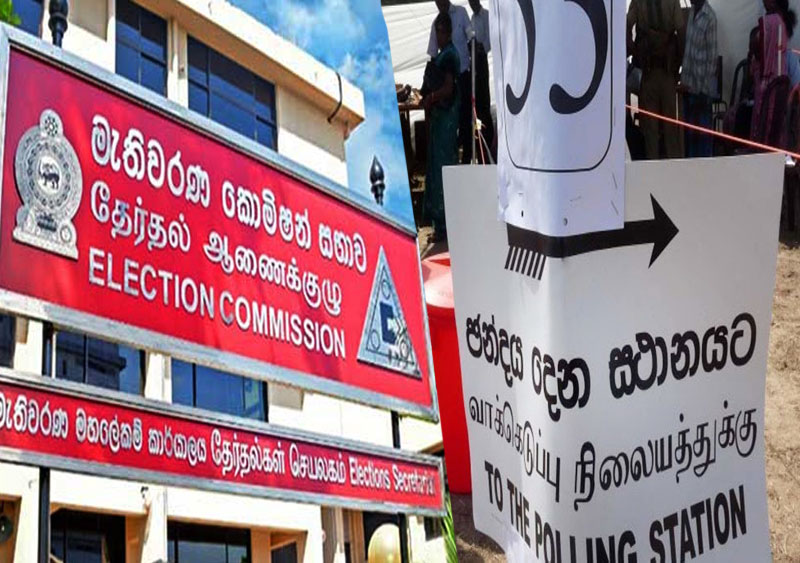
Accepting cash deposits for the upcoming Local Government (LG) election ends at 12.00 p.m. today (Jan. 20).

Several political parties and independent groups had placed their cash deposits for the LG election as of yesterday (Jan. 19), since the process began on January 18.

Meanwhile, 10 political parties handed over the nominations for the upcoming LG election yesterday. Accepting nominations will end at 12.00 noon on Saturday (Jan. 21).

National People’s Power (NPP) has handed over their nominations for Matale, Puttlam, Anuradhapura, Polonnaruwa, Badulla, Monaragala and Ratnapura districts so far.

In addition, ‘Nidahas Janatha Sandhanaya’ (People’s Freedom Alliance), United National Freedom Front, Tamil Makkal Viduthalai Pulikal, Jana Setha Peramuna, Sri Lanka Muslim Congress and United Socialist Party and several other parties have handed over the nominations for a number of LG institutions, said the Election Commission.

Meanwhile, the election monitoring organizations emphasize that nearly 15 complaints in relation to the upcoming LG election have been received so far since the day accepting cash deposits for the LG election commenced.

Executive Director of the People’s Action for Free & Fair Elections (PAFFREL) Rohana Hettiarachchi stated that a considerable number of complaints regarding the misuse of public property have been received to date.

Furthermore, he points out that passing the Regulation of Election Expenditure Bill can affect the upcoming LG election despite remarks of political representatives stating otherwise.

The Regulation of Election Expenditure Bill was passed in Parliament yesterday, by a majority of 61 votes, with a total of 97 votes in its favour, and 36 against.

MP Anura Kumara Dissanayake, who spoke to the media after the vote, claimed that the government is trying to delay the election by passing the relevant bill.

However, Minister Prasanna Ranatunga stated that the government has no intention postpone the election through this bill.

State Minister Chamara Sampath Dasanayake said that the comments made by the political groups in the opposition against the Regulation of Election Expenditure Bill are baseless.

Posted in Uncategorized

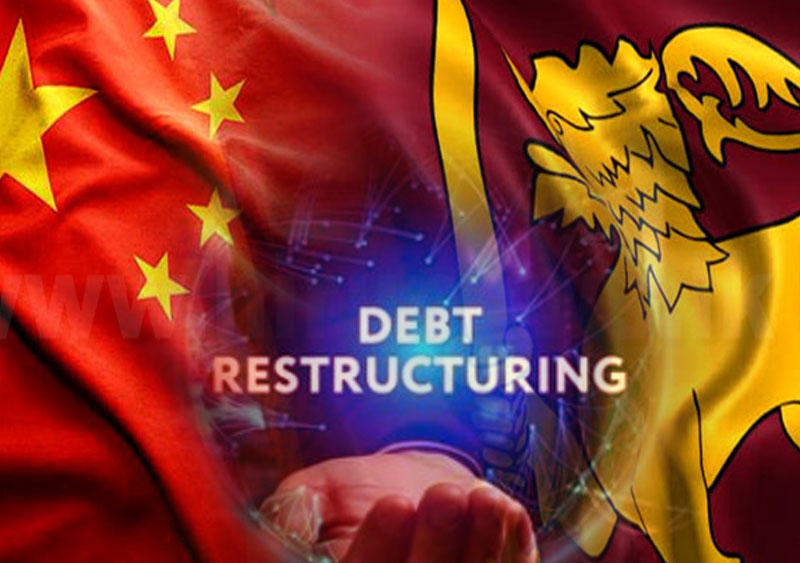
Jaishankar arrives in Colombo to discuss Lankan debt restructuring and pending projects

India’s foreign minister arrived in Colombo on Thursday following his country’s backing of Sri Lanka for a $2.9 billion International Monetary Fund (IMF) loan, leaving China as the island’s last remaining major creditor which has yet to agree to the debt restructuring plan.

Jaishankar, who came from a visit to the Maldives was received at the airport by the Sri Lankan State Minister for Foreign Affairs Tharaka Balasuriya. Jaishankar is on a two-day visit, newsin.asia adds.

India has told global lender IMF that it strongly supports Sri Lanka’s debt restructuring plan, with Colombo owing around $1 billion to its nearest neighbour.

But Sri Lanka requires the backing of both China and India – its biggest bilateral lenders – to reach a final agreement with the IMF on the loan that is essential to help the country of nearly 22 million people emerge from its worst financial crisis in seven decades.

During his two-day visit, his third to Sri Lanka since 2021, minister Subrahmanyam Jaishankar will look to strengthen India’s ties with its debt-ridden neighbour and sign several key deals.

The two countries are also expected to sign a Memorandum of Understanding for a renewable power project covering three islands in Sri Lanka’s north during Jaishankar’s visit, two sources at Sri Lanka’s power and energy ministry said.

The project stoked controversy last year as it was initially awarded to a Chinese company before India stepped in to secure them.

Jaishankar will meet Sri Lanka’s president on Friday morning, his office confirmed. He will also hold discussions with Sri Lanka’s prime minister and foreign minister, according to a statement from India’s foreign ministry.

Sri Lanka owed Chinese lenders $7.4 billion – nearly a fifth of its public external debt – by the end of last year, according to calculations by the China Africa Research Initiative. China is Sri Lanka’s largest bilateral lender.

New Delhi separately provided Sri Lanka with about $4 billion in rapid assistance between January and July last year, including credit lines, a currency swap arrangement and deferred import payments.

The two Asian giants, which have jostled for influence over Sri Lanka for decades, are also the island nation’s biggest trading partners, accounting for about $5 billion each in bilateral trade in 2021.

“China’s assurances are the only thing that is pending,” said Sanjeewa Fernando head of research at CT CLSA Securities.

“We were expecting India to give financing assurances and now that they have there is no value in China delaying giving assurances. We expect that China will also give assurances soon. China delaying here will not get them any benefits from the international community.”

Japan is Sri Lanka’s third significant bilateral lender but is part of the Paris Club creditor nations and has expressed support for Colombo in its debt restructuring plan.

The United States welcomed India’s support for Sri Lanka for the prospective IMF loan.

“The U.S. stands ready to assist Sri Lanka to unlock IMF assistance when all creditors agree to fair and equitable treatment,” Julie Chung, the U.S. ambassador to Sri Lanka, said in a tweet on Thursday.

Source: Reuters

Posted in Uncategorized

SC ban on accepting nominations in Kalmunai extended

The Supreme Court today (19) further extended the interim order preventing the acceptance of nominations for the Kalmunai Municipal Council for the Local Government Election.

Accordingly, the Supreme Court informed that the interim order will remain in place until a verdict is issued over the relevant.

The order was issued by justices Vijith Malalgoda, Yasantha Kodagoda, and Mahinda Samayawardena.

Two fundamental rights petitions were filed by two are residents claiming that they belong to the Sainthamaruthu Urban Council yet was listed as the Kalmunai Municipal Council in the latest Gazette notification..

Accordingly, the Supreme Court issued an interim order on the 17th of January, preventing the acceptance of nominations for the Kalmunai Municipal Council.

During the first hearing, the Supreme Court ordered notices to be issued to the Chairman and members of the National Election Commission, who have been cited as respondents, to be present in Court today.

Posted in Uncategorized

CNN Travel lists Jaffna amongst 18 most underrated places in Asia

Jaffna has been listed in CNN Travel’s ‘18 of Asia’s most underrated places’, amongst several other scenic locations within the continent.

While acknowledging the island’s breathtaking southern coast and the abundance of hills and estates in its central area, the heart of Sri Lanka’s Northern Province was hailed by CNN Travel for its culture, food and architecture.

“Jaffna is the primary home of the country’s Tamil-speaking population and still has gimmers of its Indian and Dutch colonial past, resulting in a fascinating, complex culture”, the article read.

Meanwhile, Ipoh, Malaysia; Isaan, Thailand; Leshan, China; Skardu, Pakistan; Nikko, Japan; Dalat, Vietnam; Davao, Philippines; Meghalaya, India; Pulau Ubin, Singapore; Samosir Island, Indonesia; Pakse, Laos; Bangladesh; Tengchong, China; Gogunsan Islands, South Korea; Lan Ha Bay, Vietnam; Kenting, Taiwan; and Banteay Chhmar, Cambodia were listed as the other 17 most underrated locations in Asia.

Posted in Uncategorized

Regulation of Election Expenditure Bill passed in parliament

The Regulation of Election Expenditure Bill with amendments was passed in Parliament today with a majority of 61 votes.

When the Division was taken at the Third Reading, 97 Members of Parliament voted in favor of the Bill while 36 MPs voted against the Bill.

Parliamentarians of many political parties, including the Samagi Jana Balawegaya and the National People’s Power, voted against the bill.

Minister of Justice, Prisons Affairs and Constitutional Reforms Dr. Wijeyadasa Rajapakshe presented the bill for the Second Reading debate.

The Regulation of Election Expenditure Bill which discloses the parties providing money for election campaigns, is expected to bring about accountability and responsibility in campaign spending.

The leaders of several political parties of the opposition expressed their objection in the Committee on Parliamentary Affairs regarding the debating of this bill when an election has been declared.

The leaders of the opposition parties requested to include a clause that the bill will not affect the upcoming Local Government elections if the bill is debated, but the government did not agree to that.

President Ranil Wickremesinghe earlier said the Bill will have no adverse effect on the process underway for the conduct of the Local Government Election.

Mano Ganesan demands written assurance from Prez on plantation Tamils

The Tamil Progressive Alliance (TPA) yesterday (18) noted that unless there is written assurance from President Ranil Wickremesinghe on their basic demand that he should nominate a special committee to look into the issues of hill-country Tamils, the TPA would not show keen interest in attending the upcoming all-‽party conference.

Speaking to The Morning, TPA Leader and Samagi Jana Balawegaya (SJB) Opposition MP Mano Ganesan said yesterday that the TPA had continuously reminded President Wickremesinghe of the need to separately address the socio-political issues of the hill-country Tamils.

“The Government’s discussion with North and East Tamil parties should continue. We support it, provided that those Tamil parties participate. But this cannot be the entire agenda. There are two more entities that need to be handled separately, namely, the hill-country Tamil community and the Muslim community,” he added. He further said that the TPA had informed in writing to President Wickremesinghe on various occasions in regard to the aspirations of the hill country Tamils.

When commenting on President Wickremesinghe’s recent promise made in Jaffna to fully implement the 13th Amendment to the Constitution on the devolution of power to the Provinces within the next two years period, he said: “The 13th Amendment to the Constitution should be the starting point in resolving the ethnic issue.”

Meanwhile, Ganesan noted earlier that President Wickremesinghe should appoint three separate high powered committees to examine the proposals of the North and East Tamil community, the Muslim community, and the hill country Tamil community, where common positions reached through these committees should be taken up at the upcoming all party conferences that are scheduled for this year (2023), and thereafter be adopted as constitutional amendments.

Ganesan also proposed the establishment of a constitutionally mandated non-territorial community council for the hill-country Tamil community, as deliberated under the previous all party conference established by former President and incumbent Government MP Mahinda Rajapaksa, with a mandate on dealing with select affairs of the community that is living in a geographically concentrated basis in Nuwara Eliya and in a dispersed manner in other parts of the country.

“Once an agreement is arrived at by these high powered committees from the proposals presented by the three communities, constitutional amendments could be adopted. This would be a way forward for the all party conferences. We will not agree to be sidelined in this process,” he added. He pointed out that talks on the national ethnic issue are not restricted to any particular area, but that it is an islandwide issue.

Meanwhile, on 13 December, 2022, President Wickremesinghe stated that he intends to hold discussions with Opposition and SJB Leader Sajith Premadasa at the all-party conference in January, 2023, with regard to the devolution of powers and the 13th Amendment to the Constitution based on seven previous and related commission reports and the report on constitutional reforms submitted by the committee led by President’s Counsel Romesh De Silva.

No Resolution To The Tamil Issue, No System Change By Vishwamithra

“When we are motivated by goals that have deep meaning, by dreams that need completion, by pure love that needs expressing, then we truly live.” ~ Greg Anderson

Illankai Tamil Arasu Kachchi (ITAK) was founded in late 1949 by a group of three Ceylon Tamil parliamentarians, SJV Chelvanayakam, C Vanniasingam and Senator EMV Naganathan. They had withdrawn from GG Ponnambalam’s All Ceylon Tamil Congress (ACTC) over the latter’s decision to enter the United National Party (UNP) government of DS Senanayake. ITAK was commonly called or known as the Federal Party (FP) in English. However, Ceylon being a multi-racial and multi-cultural polity and the ITAK being branded as a the Federal Party, that branding by itself may have contributed largely to the negation of this extraordinary governing concept of ‘Federalism’ by Sinhalese Buddhists, the majority voter-bloc in the country.

Federalism is a combined or compound mode of government that combines a general government with regional governments in a single political system, dividing the powers between the two. Federalism in the modern era was first adopted in the unions of states during the Old Swiss Confederacy. Furthermore, Federalism in most of the countries that have adopted as a mode of government, also have to grapple with issues related to varied cultures, religions and ethnic groups. United States of America, India, Canada and Switzerland are examples that have adopted Federalism as their governing methods. All these countries have not been invaded by a foreign power since the adoption of Federalism.

The relations between the central government, the ‘Union’, as it’s called in India, and the States are not blurry as one would expect. For instance, India’s federal system is so defined as per the three ‘lists’ over the subjects of which, power or authority is to be exercised by the respective institutions, Union, State or Concurrent, as defined in the Indian Constitution. This ‘list’ system must have played a very critical and heavy role in the adoption of the 13th Amendment to our own Constitution. Annexure ‘C’ to the 13th Amendment contained such a list of subjects but unfortunately for our Tamil brethren and more dishearteningly for Sri Lanka, Sinhala-chauvinists in the then JRJ-government of the 1980s did not allow the full implementation of Annexure C’.

Transfer of full powers over the Land and Police policies was a clear ‘no-no’ for these chauvinists in particular and when exploited by the Opposition politicians, to the majority of Sinhalese population in general. Adoption of the 13th amendment and implementation of the Provincial Government system suffered further by the escalation of the armed conflict between the security forces of the Central government and the militant Tamil forces led by Prabhakaran and the Liberation Tigers of Tamil Elam (LTTE) organization.

India at no time wanted this escalation; on the one hand, because it increased the pressure they themselves faced from the Tamil Nadu State government and on the other, a weak Central government in her closest neighbor would not represent a palatable element in their future development as an up-and-coming world power. Everything that could go wrong went wrong afterwards for Sri Lanka.

It is utterly futile to labor the fact that Ceylon, especially her majority Sinhalese Buddhists, has been suffering from a severe ‘minority complex’ all along her history. What our anti-Federalism elements have not realized, or have deliberately ignored, is that before the invasion by the Portuguese in 1505, Ceylon too was ruled on a quasi-Federal system. Ancient Ceylon was divided into three major provinces, Ruhunu (South), Pihiti (what is known today as the Northern, North western and East) and Maya (Western and largely Central provinces). It was King Dutugamunu (our Ultra-chauvinists’ hero) who founded the first central rule covering the whole Island. Yet in 993, when Raja Raja Chola sent a large Chola army which conquered the Anuradhapura Kingdom, in the north, and added it to the sovereignty of the Chola Empire, Ceylon once again became a country with so many kingdoms whose respective powers were limited to the terrain that each kingdom-chief reined. The whole island was subsequently conquered and incorporated as a province of the vast Chola Empire during the reign of his son Rajendra Chola.

Ceylon as one single polity was conquered and ruled by the British after 1815, thus the sovereign Ceylon became a subject of the British Monarch. An unsophisticated type of federalism that Ceylon used to be ruled under various kings and chieftains vanished and the Soulbury Constitution was introduced as our main source of power, law and what followed wherefrom.

What armed the chauvinists on both sides of the aisle, Sinhalese and Tamils, is this concept of ‘sovereignty’. Sinhalese on the one hand never wanted to grant federalist type of powers to Tamils because they mistakenly thought (they are still of that opinion) the sovereignty of the nation would be compromised. Politicians went to town with this concept of sovereignty and what ensued was a 27-year war which claimed some of our youth who would have had a much different life if things were viewed by our leaders through a more farsighted lens.

We are now in the twenty first century. The country has travelled a long seventy five years after it was declared independent. For the first time in those 75 years, we are facing a crisis of unprecedented proportions. The economy has collapsed; the politicians are corrupt beyond redemption and the people are as desperate as never before.

If only Federalism was marketed as a positive mode of government, a mode that decentralized broad powers of the ‘Center’ to a given number of provinces whilst retaining the same powers as the ‘Union’ government of India such as defense, armed forces, foreign affairs, war and peace, citizenship, extradition, railways, shipping and navigation, airways, banking including income tax, customs and export duties, duties of excise, taxes etc., there would not have been suspicion and tension between the two major ethnic groups in the country. Well, it was not to be.

What the current crop of politicians failed to do was to enunciate the ‘decentralization’ aspect of ‘Federalism’ amongst their peers in the provinces. India would not have sustained her democratic way of government and democratic way of life if powers were centralized in the center. With such a vast variation amongst her peoples, a power that solely emanated from the center would have easily contributed to a total collapse of India’s democracy.

Please have look at the following spreadsheets:

Current Provincial and District CompositionProposed Provincial and District Composition

The 1st spreadsheet gives the current district and provincial distribution and their respective vital statistics as to land area, population density etc.

The 2nd Spreadsheet illustrates the proposed provincial divisions and the district assigned to each province. In both sheets the most salient statistic is the population density and the land area. Instead of arbitrary divisions by the British, I attempt to strike a balance between the population density and the cultural and ethnic complexion of each province and also availability of industry, schools, irrigation facilities etc. with a view to maintaining a more cohesive composition of the province. Provinces have come down from 9 to 6. Uva, Sabaragamuwa and Wayamba have been done away with as provinces. Badulla of Uva has been assigned to Central Province while Moneragala to Southern Province. From Sabaragamuwa Province, Ratnapura has been grouped with Central and Kegalle to Western Province. Entire North Western Province has been amalgamated with North Central Province.

What I have presented is not a fully complete proposal. However, I wish that this would encourage discussion and exchange of better input from all parties concerned in order arrive at a more acceptable ‘System Change’ through a sincere commitment to the principles of a) Sovereignty of the nation, b) Viability of the Proposal, c) Sustenance of Democracy and above all d) Extension of equality to all ethnic, religious and cultural segments of the land and her people.

Such changes would provide for inter district, inter provincial and intra provincial migration of the population, making such migration based solely on any reason. Institution of strong and durable architecture to the Union Constitution and Provincial Constitution shall further buttress the process of change. Albert Einstein defined insanity thus: “Insanity is doing the same thing over and over and expecting different results.” We are engaged in this madness. However, that madness is not accidental; it’s deliberate; in order to keep oneself in power, one resorts to all sorts of insanities. Cosmetic changes and superficial remedies are such insanities our leaders have been committing ever since Independence. It’s time we sought another path.

After enduring the whirlwinds of Aragalaya, if Sri Lanka were to learn from her shameful errors, must think anew. They must honestly and deliberately think outside the clichéd box. One might argue that after having been driven to the brink of total economic collapse, how can she think of a Federal System of Government? The answer is simple: it is the very fact that the country was driven to the edge because we have been stagnating in a system that has not served the purpose of its people.

Nevertheless, one unseen yet critical element of this proposal is leadership. Do we have the leadership to implement a new policy? Do we have, as one people, one country and sovereign nation have the guts and stomach to retain those guts to envision and put into action a totally fresh set of proposals whose only vested interest is the wellbeing of the masses?

*The writer can be contacted at vishwamithra1984@gmail.com

Posted in Uncategorized