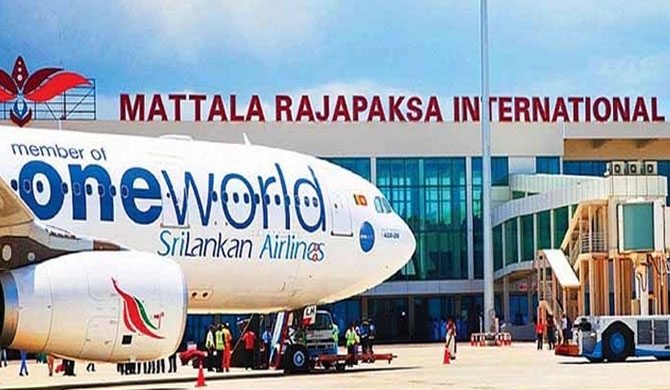
Srilankan Airlines warns of imminent bond payment default

Srilankan Airlines has warned about its capability to make a coupon payment on a Singapore-listed bond, citing the deterioration in Sri Lanka’s economy.

The payment relates to a $175 million bond with a 7% coupon listed in Singapore, according to a filing with the Singapore stock exchange. The bonds term is to complete in 2024.

The carrier missed a coupon payment due on 25 June, but still has a 30-day grace period. The bonds are backed by the Srilankan government, which holds 99.52% of the carrier.

“The economic situation in Sri Lanka has directly impacted the ongoing operations of the Company,” says Srilankan.

“In light of the current circumstances, the board considers it necessary to make use of the 30-day grace period to further determine the position of the company, both in respect of the upcoming coupon payment and its debt obligations more generally.”

The carrier adds that Sri Lanka’s economic conditions have deteriorated rapidly owing to a “very low level” of foreign exchange reserves, the coronavirus pandemic, and Russia’s invasion of Ukraine. As such, Sri Lanka is “seeking urgent financial assistance from the International Monetary Fund.”

“The board intends to establish a transparent process for discussions and communications with all bondholders, and to pursue an active dialogue with bondholders as soon as it is in a position to do so,” says Srilankan.

“The board will continue to keep bondholders informed as matters develop.”

In May, ratings agency Fitch affirmed its ratings for Srilankan bonds at ‘C’. It noted that Sri Lanka’s government has imposed a debt repayment moratorium, thus triggering “the commencement of a default-like process for [Srilankan].”

Cirium fleets data indicates that Srilankan has 22 in-service aircraft, comprising 11 Airbus A330s and 10 A320 family aircraft. All of its aircraft are leased. Lessors with exposure to the airline are AerCap, Air Lease Corporation, Aircastle, Avolon, Carlyle Aviation Partners, and one unconfirmed lessors.

World Bank to redesign 17 ongoing projects in Sri Lanka

The World Bank would extend further support after reaching an agreement with the International Monetary Fund, the World Bank’s Country Director for Sri Lanka Faris Hadad-Zervos says.

There are 17 ongoing World Bank-funded projects in Sri Lanka, he said adding that the projects will be redesigned to provide financial assistance to face the current crisis.

For similar articles, join our Telegram channel for the latest updates. – click here

This was mentioned at a discussion between World Bank representatives and President Gotabaya Rajapaksa at the President’s House in Colombo, today (June 29).

Explaining the current situation in the country, the President pointed out the need to provide the World Bank loan assistance to banks and financial institutions.

President Rajapaksa requested the representatives to take necessary measures to issue such financial assistance at low interest rates to the people engaged in agriculture, livestock, small and medium scale enterprises and businesses.

The World Bank representatives said they have already decided to allocate funds for domestic gas and fertilizer supplies.

Tax increases, the removal of diesel and kerosene subsidies will have a severe impact on many sectors including fisheries.

The government is also concerned about other groups at risk, the President said adding that these issues would have to be considered in reaching an agreement with the International Monetary Fund.

World Bank Country Manager for Sri Lanka Chiyo Kanda, Senior Operations Officer Asela Dissanayake, Practice Manager Gabi George Afram, Lead Private Sector Specialist Peter Mousley, Lead Financial Sector Specialist Miquel Dijkman, Senior Economist Kishan Abeygunawardana and Secretary to the President Gamini Senarath, Principal Advisor to President Mr. Lalith Weeratunga, Chief of Staff to the President Anura Dissanayake, Secretary to the Finance Ministry K.M.M. Siriwardena, Director of the External Resources Department Himali Bogodagedara and Vice President of the Sri Lanka Medical Association Dr. Surantha Perera, also attended this discussion.

Posted in Uncategorized

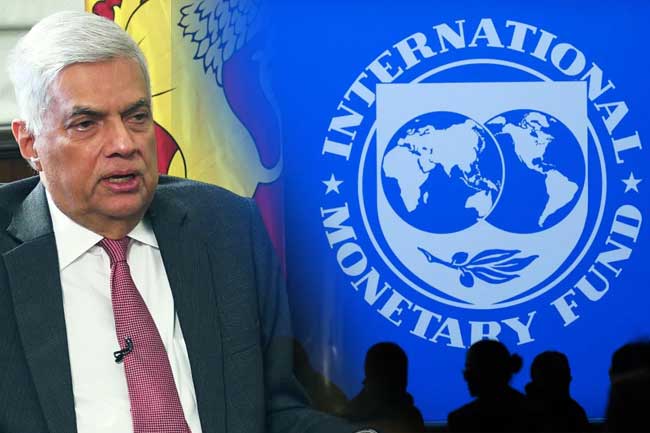
IMF-Sri Lanka bailout talks end without a deal – CNBC

The International Monetary Fund has ended talks with Sri Lanka, failing to conclude a deal for a bailout package for the near-bankrupt nation after 10 days.

Nevertheless, in a statement released around noon Sri Lanka time on Thursday, the IMF promised to keep up the talks, which began on June 20. “The discussions will continue virtually with a view to reaching a staff-level agreement on the extended fund facility or EFF arrangement,” it said.

The EFF was established to assist countries with “serious payment imbalances,” according to the IMF. In addition, it provides support for policies “needed to correct structural imbalances over an extended period.”

Sri Lanka, an island nation of 22 million people, is facing its worst financial crisis since independence in 1948, which has left it struggling to pay for fuel and forced it to default on some foreign debt.

Left with just enough fuel for about a week and fresh shipments at least two weeks away, Sri Lanka has imposed restrictions on supplies, limiting them for use for public services like trains and buses and those relating to the health sector, Reuters reported. The ban is scheduled to last two weeks.

Noting that public debt is assessed as unsustainable, the IMF said executive board approval of a package would require “adequate financing assurances from Sri Lanka’s creditors that debt sustainability will be restored.”

“In this context, discussions focused on designing a comprehensive economic program to correct the macroeconomic imbalances, restore public debt sustainability, and realize Sri Lanka’s growth potential,” the press release said.

‘Fragile state’

The lack of a bailout package defied the expectations of an expert CNBC spoke to earlier in the day.

Georgetown University professor Shanta Devarajan said Sri Lanka was close to reaching an agreement with the IMF.

″[Sri Lanka is] very close to reaching what is called a staff level agreement [with] the Fund [on] the set of policies and programs that Sri Lanka would undertake in order to bring down the fiscal deficit and make the fiscal debt sustainable,” Devarajan told CNBC’s “Squawk Box Asia” on Thursday.

He traced the genesis of the current problem to tax cuts three years ago. “We are in this mess at the moment…because in November 2019, the government cut taxes substantially. The value added tax rate went from 15% to 8%,” Devarajan said.

He added that the country is on the verge of becoming a “fragile state.”

“It has all the characteristics [of a fragile state] at the moment. It’s not just the protests in the streets, but … the queues for fuel,” he said, adding that there are now confrontations with the army and the police in various places.

“People have been killed; there have been some shootouts. So this is a very dangerous situation to be in,” Devarajan said.

Sri Lanka has closed schools in urban areas and officials have urged the country’s residents to work from home.

Posted in Uncategorized

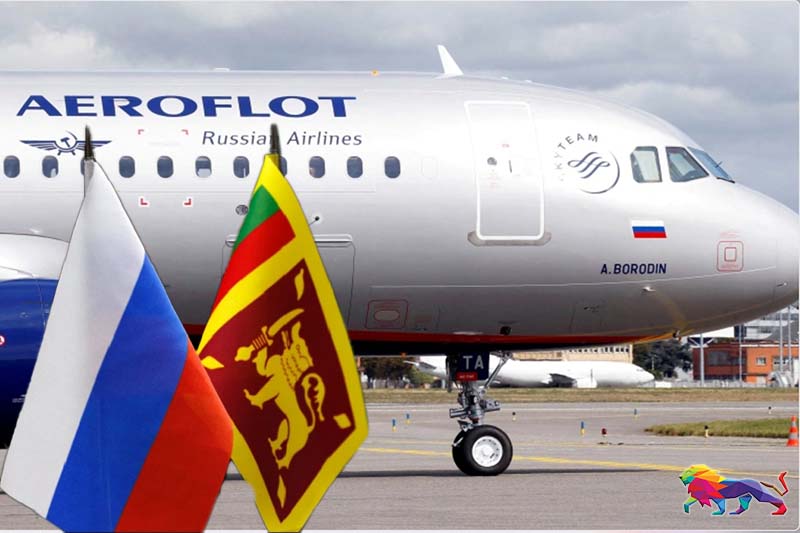
NEWS Fuel from Russia? Prez reaches out to Putin

President Gotabaya Rajapaksa has spoken to his Russian counterpart Vladimir Putin over the phone to secure fuel supplies to Colombo from Moscow, says Sri Lanka Podujana Peramuna (SLPP) Parliamentarian Mahindananda Aluthgamage, adding that the President is also expected to visit United Arab Emirates (UAE), to discuss fuel supply to Sri Lanka.

Meanwhile, discussions are underway with India through the Indian High Commission in Colombo for procuring fuel for the country before the 10th of July, MP Aluthgamage added.

At present, the government is reaching out to other nations to procure fuel due to the lack of foreign exchange to purchase the much needed commodity.

Minister of Power and Energy Kanchana Wijesekara and Minister of Environment Naseer Ahamed arecurrently in Qatar to procure fuel and to brief Qatari officials on the ongoing crisis situation in the country.

They called on Saad Sherida Al-Kaabi, Qatar’s Minister of State for Energy Affairs and the President and CEO of Qatar Energy, to discuss the supply of petroleum products, liquefied petroleum gas (LPG) and liquefied natural gas (LNG) to Sri Lanka to overcome the energy crisis with the assistance of the country’s state-owned petroleum company Qatar Energy and The Qatar Development Fund.

Minister Wijesekara also met with the Deputy Director-General of the Qatar Fund for Development for a discussion on a possible credit line facility for petroleum and gas supply to Sri Lanka.

He also held a discussion with Sheikh Mohammed bin Hamad bin Qassim Al-Abdullah Al-Thani, Qatar’s Minister of Commerce and Industry with regard to investment opportunities in power, energy and other sectors.

Posted in Uncategorized

US Ambassador meets President

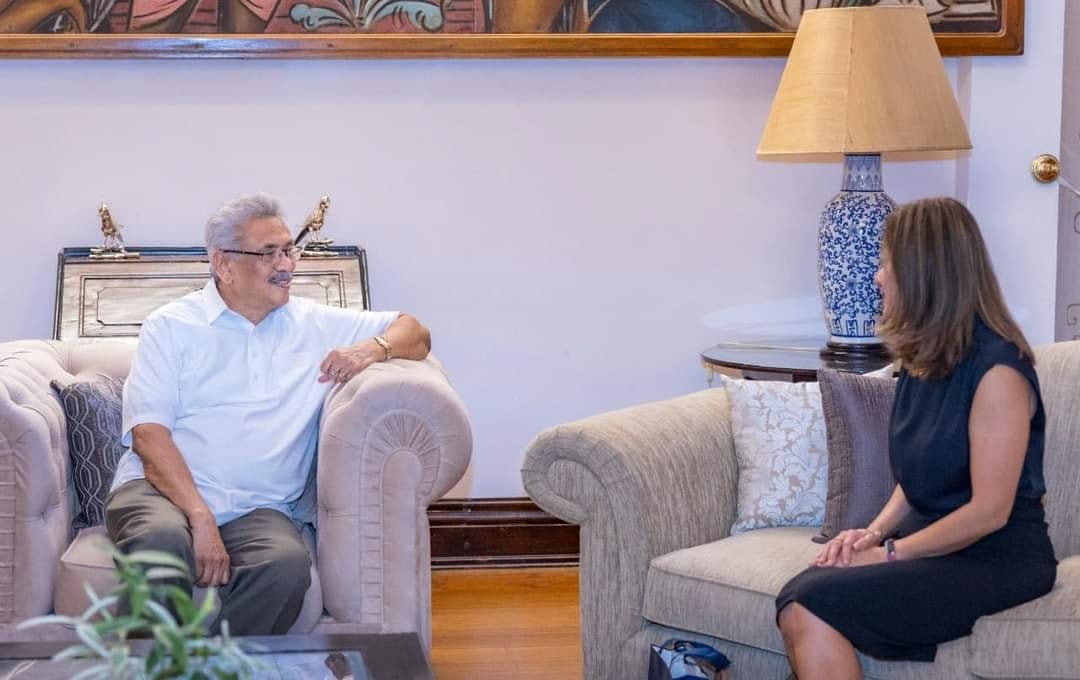
President Gotabaya Rajapaksa met with the USA Ambassador in Sri Lanka Julie J. Ching today (30) and thanked the US for the valuable support shown during these difficult times.

Further, the Ambassador assured the Government of the USA’s continuous support in stabilizing the economy with the recent developments with the International Monetary Fund (IMF).

US Ambassador to Sri Lanka Julie Chung told President Gotabaya Rajapaksa that the US will support Sri Lanka in finding a solution to the economic crisis.

A high-level diplomatic delegation from the United States stated that the US supports the strengthening of the relationship with the International Monetary Fund.

US President Joe Biden has also taken steps to provide humanitarian assistance on several occasions.

Posted in Uncategorized

Sri Lanka’s gazetted 22nd amendment bill is a diluted version of itself: CPA

Sri Lanka’s newly gazetted 22nd amendment to the constitution bill does not curtail the powers of the president nor introduce checks and balances in any meaningful manner, contrary to the demands of the people of Sri Lanka, the Centre for Policy Alternatives (CPA) said.

In the absence of any genuine attempt to address the inherent problems of governance, this attempt at reform will only worsen the existing political and economic crisis and destroy whatever little remaining faith citizens might have in constitutional governance, the organisation said in a statement issued on Thursday June 30.

“CPA has carefully considered the contents of the Bill and notes that the Bill does not revert the Constitution to the structure of government that prevailed under the Nineteenth Amendment (2015-19). The Minister of Justice had proposed two previous versions of this Bill (one as a Private Member’s Bill). The present gazetted Bill represents a significant weakening of the previous limited proposals by the Minister of Justice and leaves intact the unchecked powers of the Executive President,” the statement said.

Justice Minister Wijeyadasa Rajapakshe had previously claimed that the amendment, as drafted by him, will largely be a restoration of the 19th amendment which will see some of the powers conferred on the president by the controversial 20th amendment will be repealed.

The 19th amendment to the constitution, enacted during the Yahapalana government of former President Maithripala Sirisena and then Prime Minister Ranil Wickremesinghe saw some of the executive powers of the president curtailed and parliament significantly strengthened. That amendment was rolled back by President Gotabaya Rajapaksa’s Sri Lanka Podujana Peramuna (SLPP) government after its 20th amendment to the constitution was passed in parliament, conferring the office of the president with even more sweeping powers.

Sri Lanka’s prevailing economic crisis which has precipitated a political crisis has brought to the fore the need to speedily introduce constitutional reforms, and Minister Rajapakshe’s 21st amendment (referred to in the bill as the 22nd amendment) promised to be a restoration of the more progressive provisions of the 19th.

However, the CPA, a public policy research and advocacy think tank, said the final version of the 21st (or 22nd) amendment bill that was approved by the cabinet of ministers on Monday June 27 was a watered-down version of the original.

For example, the organisation said, the proposed Constitutional Council has been significantly diluted from what prevailed under the 19th amendment.

“The proposed composition of the Council favours the government and enables the government to control or influence 7 of the 10 members. Thus, it is CPA’s view that the Council is merely an expanded version of the Parliamentary Council that exists under the Twentieth Amendment. The original intent behind the creation of the Constitutional Council under the Seventeenth Amendment, which was to de-politicise governance, involved two methods: one was to ensure a majority representation in the Council for non-politicians, and the other was to remove government dominance over the political members. The composition of the Council proposed in the Bill achieves none of those objectives and in turn, undermines the independence of the institutions to which appointments are made through the Council,” it said.

Whilst some effort has been made to curtail the president’s powers in relation to the appointment and removal of the cabinet of ministers, the CPA said, these have all been rendered ineffective by the transitional provisions that make them applicable only from the next parliament. The president will also be able to appoint all secretaries to ministries at his own discretion, which the CPA said again protects the executive power concentrated in the office of the president.

Minister Rajapakshe, for his part, has called for wide support for his version of a 21st amendment to the constitution after the Supreme Court determined that the provisions of a competing draft by the main opposition required a referendum. The main opposition Samagi Jana Balavegaya (SJB)’s 21st amendment concentrated heavily on abolishing Sri Lanka’s all-powerful executive presidency and, according to a determination by the Supreme Court, many of its provisions require a two thirds majority in parliament along with a people’s referendum.

“We have included everything that can be passed without a referendum,” Rajapakshe told parliament on June 21, defending his version of the amendment.

The amendment bill gazetted over a week later, on Thursday June 30. The document can be found at this link.

In its statement, the CPA said that though Sri Lanka’s worsening economic crisis was the result of due to the failures of successive governments, the present holder of the executive presidency exacerbated the issue as a result of arrogating more power to himself through the 20th amendment to the constitution and “fatally undermined even the weak checks and balances and the separation of powers implemented by the 19th amendment“.

“The only appropriate institutional reform response to this unprecedented disaster through constitutional reform is the complete abolition of the executive presidential system and the return to a full parliamentary constitutional
democracy,” the CPA said.

The rhetoric used to usher in the 20th amendment in 2020 that called for unilateralist and centralised executive decision-making for economic development is directly linked to the present crisis and such a model must be unequivocally rejected, the organisation further said.

“Considering the multiple challenges confronting Sri Lanka, Sri Lanka’s economic recovery cannot and must not be yet again based on a heavy executive decision-making governance model. For these reasons, it is clear from the perspective of both constitutional principle and constitutional design that the Bill is not in any sense a meaningful
contribution to the necessary institutional reform that must be part of Sri Lanka’s economic recovery,” it said.

Attorney-at-Law Luwie Ganeshathasan expressed similar sentiments.

“This 22A is no change from what we have right now, it is just dressed up to look like something new. I am not even sure why we are wasting our time and money debating this in Parliament. If this is the best “reform” this Parliament can deliver, they might as well go home,” he tweeted Thursday morning.


Posted in Uncategorized

China speaks to Dhammika on promoting Chinese projects

China had talks with Investment Promotion Minister Dhammika Perera today on promoting Chinese projects in Sri Lanka.

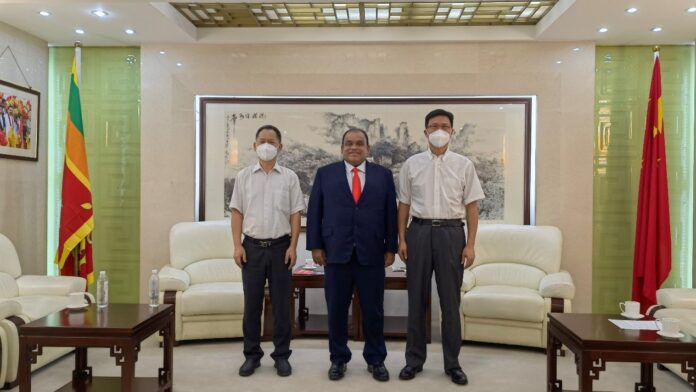
Ambassador Qi Zhenhong met with Perera and exchanged views on enhancing economic and trade cooperation, promoting Chinese invested projects in Sri Lanka as well as other topics of mutual interests, the Chinese Embassy in Colombo said.

A gazette notice was issued this week bringing a number of institutions, including some Chinese funded projects under Investment Promotion Minister Dhammika Perera.

The gazette notice issued by President Gotabaya Rajapaksa brought the Board of Investment of Sri Lanka, Colombo Port City Economic Commission, Projects related to Colombo Port City, Department of Immigration and Emigration, Colombo Lotus Tower Management Company (Pvt.) Limited, Techno Park Development Company (Pvt.) Limited and Information Technology Parks under the Minister of Investment Promotion Dhammika Perera.

The new Minister has been tasked with promoting foreign direct investment and private sector investments in Sri Lanka.

Other duties entrusted to the new Minister includes formulation of policies, strategies, programmes and projects to enhance regional trade and investment cooperation, promotion, regulation and monitoring of economic development zones.

He has also been given the task to develop the Colombo Port City Special Economic Zone as an international business and services hub with specialized infrastructure and other facilities aimed at national interest and economic advancement.

Dhammika Perera also has the responsibility of establishing the Colombo Lotus Tower as a business model and promoting it as a tourist centre.

The business tycoon took oaths recently as a Member of Parliament replacing Basil Rajapaksa as a National List MP.

Posted in Uncategorized

26 train services cancelled as railway guards unable to report to work due to lack of fuel

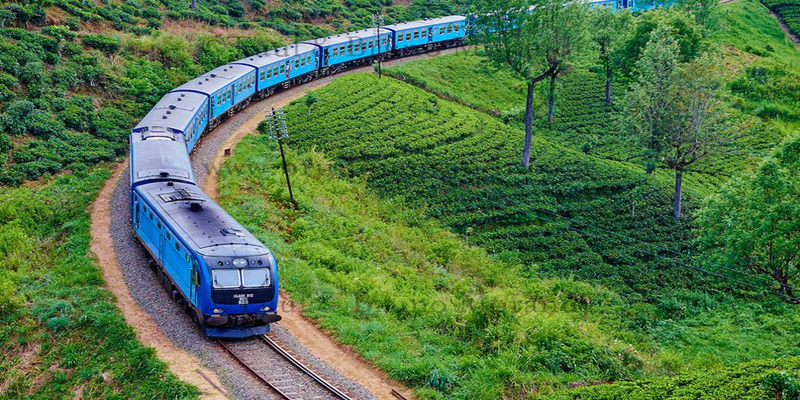
A total of 26 train services including office and intercity trains which were scheduled to operate yesterday were cancelled following difficulties faced by the Station Masters (SMs) and junior staff in reporting for work due to the prevailing fuel crisis, the Sri Lanka Railways Station Masters’ Union (SLRSMU) said.

Accordingly, two train services between Colombo Fort-Wadduwa, Colombo Fort-Veyangoda, Colombo Fort-Ambepussa, Colombo Fort -Chilaw, Colombo Fort -Madampe, passenger and mail transport trains operated between Colombo Fort and Avissawella, and six train services between Colombo Fort-Panadura, Colombo Fort-Rambukkana were cancelled.

Meanwhile, intercity express trains scheduled to leave for Batticaloa and Kankesanthurai (KKS) from Colombo Fort were also cancelled.

The collapse of the railway service has begun now. However, the station masters and the junior staff are trying to overcome the situation as much as possible to make the service work.

The majority of the railway staff do not have official quarters. The lack of fuel can lead to problems in them reporting to work in the future. Therefore, delays in the operation of trains, inability to issue tickets, failure to deliver or delayed delivery to passengers’ needs may affect the railway transport service.

However, neither the department nor the government has taken steps to introduce a successful method of providing quick fuel to railway employees, which is the main mode of transport at this time.

The union emphasized that train cancellations in the future are more likely if this matter is not addressed promptly.

Would not get support from Security council: UK

Britain on Monday said that, while Sri Lanka is a human rights priority country for the Foreign, Commonwealth and Development Office, its assessment was that a referral to the International Criminal Court (ICC) against those responsible for alleged human rights violations in Sri Lanka would not have the required support from members of the UN Security Council.

Vicky Ford, Parliamentary Under-Secretary (Foreign, Commonwealth and Development Office) was responding to a question raised in the British parliament by Labour MP Stephen Morgan, who asked whether her Department is taking steps to ensure that those responsible for human rights violations against the Tamil community in Sri Lanka are brought to justice in the International Criminal Court.

“It would not advance the cause of accountability for an ICC referral to fail to win Security Council support or to be vetoed,” Parliamentary Under-Secretary Vicky Ford stated in a written answer.

She further stated –

We, alongside our partners in the Core Group on Sri Lanka, have led international efforts over many years to promote accountability, reconciliation and human rights in Sri Lanka. On 23 March 2021 the UN Human Rights Council (UNHRC) adopted resolution 46/1, which provides a continued framework for international engagement on human rights. It calls on the government of Sri Lanka to make progress on human rights and stresses the importance of a comprehensive accountability process for all violations and abuses committed in Sri Lanka. The Minister of State for South Asia, Lord (Tariq) Ahmad of Wimbledon, visited Sri Lanka in January 2022. He travelled to the North and East as well as Colombo and met a range of civil society groups, including Tamil representatives, to discuss human rights. The Minister also urged the Government of Sri Lanka to take steps to deliver justice and accountability.

Crisis-hit Sri Lanka cabinet okays US grant after rejecting $480 mln MCC deal in 2020

Sri Lanka Cabinet has given green light to a proposal submitted by the Prime Minister to obtain a grant from the United States of America, nearly two years after President Gotabaya Rajapaksa rejected a $480 million from the U.S.-based Millennium Challenge Corporation (MCC).

The $57 million comes through two agreements signed between the Governments of Sri Lanka and U.S. to supply funds to strengthen the cooperation for democratic good governance and social integrity’ and to create a sustainable and covered economic development’

The proposal by the Premier Ranil Wickramasinghe suggested signing a new agreement for implementation of a new programme for financing 57 million US dollars by the United States Agency for International Development (USAID).

The project has been named as ‘The Programme for a Democratic, Prosperous Sri Lanka with the Ability to Survive Amidst Disasters’ until the year 2026, paying the preliminary attention on the fields of productive democratic governance, growth based on a secure market and strengthening the resources required to sustain pressure and stress.

President Rajapaksa in November 2021 said that his government will never sign the MCC agreement proposed by the U.S soon after the then Secretary of State Mike Pompeo’s visit. However, the U.S. cancelled the MCC offer to Sri Lanka one month after Rajapaksa’s statement.

Posted in Uncategorized