GL slams UNHRC report, but friendly countries say Lanka missed opportunity to brief members

The ‘interactive dialogue’ on Sri Lanka at the Human Rights Council in Geneva will end on Monday and the focus will then shift to its sessions in September when a new resolution is likely.

Monday’s continuation for less than an hour is the result of the Council making provision for an urgent debate on the Russian invasion of Ukraine.

UN Human Rights High Commissioner Michele Bachelet, who commented on her report on Sri Lanka that was released earlier, said “the past year has seen further obstruction and setbacks to accountability. Victims and their families continue to be denied truth and justice.”

The session on Sri Lanka was delayed and resultantly shortened. It was the because of the Council conducting an urgent debate on the situation in Ukraine.

Foreign Minister, G.L. Peiris, made a scathing attack saying that

the “so called evidence gathering mechanism” is deeply flawed procedure and unacceptable. He said that the Report on Sri Lanka is “intolerably intrusive character, impinging as it does no core functions and responsibilities of organs of Sri Lankan state, overwhelmingly mandated by the people at successive elections.”

In making those highly critical remarks, Foreign Minister Peiris has overlooked the fact that the Human Rights High Commissioner is only carrying out a mandate given to her by the Human Rights Council.

Diplomats from countries friendly with Sri Lanka said that the opportunity could have been better used to brief member, observer countries and NGOs who are drivers of the action against Sri Lanka. “This approach will make it difficult to help Sri Lanka. For instance, the EU countries awaited a briefing on amendments to the Prevention of Terrorism Act (PTA) with the future of GSP plus hanging in the balance,” said one diplomat.

A statement on behalf of the core group was made by Rita French, United Kingdom’s Global Ambassador for Human Rights and Deputy Permanent Representative to the United Nations. She expressed concern that surveillance and intimidation of civil society members and journalists continues.

The core group is made up of Canada, Germany, North Montenegro, Malawi, Montenegro, United Kingdom, and the United States.

India tells Lanka: Address “legitimate aspirations of Tamils”

India’s Permanent Representative to the United Nations in Geneva this week called on Sri Lanka to address the “legitimate aspirations of the Tamil community” in Sri Lanka.

The envoy, Indra Mani Pandey, did not elaborate what they were, except to say they included carrying forward the process of reconciliation and implementing the 13th Amendment to the Constitution.

“India believes it is in Sri Lanka’s own interest that the expectations of Tamils in Sri Lanka for equality, justice, peace and dignity, within a united Sri Lanka are fulfilled,” Mr. Pandey added.

The Indian delegation supported the UN High Commissioner’s report saying; “The report raises important concerns on promoting, reconciliation, accountability, and human rights in Sri Lanka”. India also called for early Provincial Council elections in Sri Lanka.

Posted in Uncategorized

Rajapaksa Govt drops to 10% approval rating in Verité poll

The government of Sri Lankan President Gotabaya Rajapaksa has a meagre 10% approval rating little over 2 years into his term, according to a poll by Verité Research.

The Colombo based think-tank recently launched a Gallup style “Mood of the Nation” poll in Sri Lanka to assess approval, satisfaction and confidence in relation to the government, the country and the economy.

Gallup is the most reputed polling organisation in the world. It runs a regular “Mood of the Nation” poll in the United States. Accordingly, Verité Research has adapted that same poll and scoring methodology to follow the pulse of the people in Sri Lanka.

The poll is based on an island wide nationally representative sample of responses from 1,021 Sri Lankan adults, conducted in January 2022. The sample and methodology were designed to ensure a maximum error margin of under 3% at a 95% confidence interval. The polling partner was Vanguard Survey (Pvt) Ltd.

Government approval rating | 10%

To the question, “Do you approve or disapprove of the way the current government is working?” only 10% said they approve.

Sri Lanka satisfaction | 6%

To the question, “In general, are you satisfied or dissatisfied with the way things are going in Sri Lanka?” only 6% said they were satisfied.

Economic confidence | negative (-) 82.96

Multiple choice questions on the condition and trajectory of the economy are used to generate an economic confidence score. The score can range from negative (-) 100 to positive (+) 100. A score above zero means more people see the economic conditions positively rather than negatively.

If everyone thinks the economy is in either excellent or good conditions, and everyone also thinks it is getting better the score will be positive (+) 100. If everyone thinks that the economy is in a poor condition, and everyone also thinks it is getting worse, the score will be a negative (-) 100.

The score is a negative (-) 83 because the average of those who thought the economy was in a poor condition, and those who thought it was getting worse, was 83%.

Posted in Uncategorized

Take necessary steps to address Tamil aspirations, India urges Sri Lanka

India on Friday called upon Sri Lanka to take “necessary steps” to address the “legitimate aspirations” of the Tamil community, while reiterating its earlier stance that it is in Sri Lanka’s “own interest that the expectations of Tamils in Sri Lanka for equality, justice, peace and dignity, within a united Sri Lanka, are fulfilled”.

Delivering a statement in the interactive dialogue segment on the U.N. Human Rights chief’s latest report on Sri Lanka, Ambassador Indramani Pandey, Permanent Representative of India told the Human Rights Council in Geneva that, “As its friend and immediate neighbour, India has consistently called upon Sri Lanka to fulfil its commitments on addressing the issues related to protecting the interest of Tamils in Sri Lanka.” While making a similar intervention last year, India abstained from voting on the resolution on Sri Lanka. There is no resolution or vote on Sri Lanka this year.

Calling for continued engagement by the Government of Sri Lanka with the international community, India on Friday noted that High Commissioner Michelle Bachelet’s recent report raises “important concerns” on promoting, reconciliation, accountability and human rights in Sri Lanka.

The written report, among other observations, highlighted “setbacks to accountability for past human rights violations and the recognition of victims’ rights”, and the failure of transitional justice mechanisms to win the confidence of victims affected by the civil war that ended in 2009.

In her statement to the Council on Friday, Ms. Bachelet said, “Regrettably, the past year has also seen further obstruction and setbacks to accountability. Victims and their families continue to be denied truth and justice.”

“Two years after the expression of commitments to pursue an “inclusive, domestically designed and executed reconciliation and accountability process” before this Council, the Government has still not produced a credible roadmap on transitional justice towards accountability and reconciliation,” the High Commissioner noted, adding that “as long as impunity prevails, Sri Lanka will not achieve genuine reconciliation and sustainable peace”.

Tamil concerns

India’s statement in response focussed on long-pending concerns of Tamils and the need for power devolution. “We call upon Sri Lanka to take the necessary steps to address the legitimate aspirations of the Tamil community, including by carrying forward the process of reconciliation and the implementation of the 13th Amendment to the Constitution of Sri Lanka, to ensure that the fundamental freedoms and human rights of all its citizens are fully protected,” Ambassador Pandey said. India would “continue to urge” the Sri Lankan Government for the early conduct of elections to the Provincial Councils in keeping with its commitment to devolution of power, he said.

What is the 13th Amendment to the Sri Lankan Constitution, and why is it contentious?

The five-year terms of all nine Provincial Councils in Sri Lanka expired in 2018 and 2019. There is no official word on provincial polls from the Government, which is cash-strapped and growing increasingly unpopular in the wake of an unprecedented economic crisis, reflecting in fuel shortage and prolonged power cuts.

Thrust on 13 A and provincial polls

India’s emphasis on the 13th Amendment, which followed the Indo-Lanka Accord of 1987 and assured a measure of devolution, comes weeks after senior Tamil parliamentarians wrote to Prime Minister Narendra Modi, seeking his intervention in securing a durable political solution for Sri Lanka’s historic Tamil question.

Significantly, the signatories to the letter pointed to limits of the 13th Amendment, especially within a Unitary Constitution, and underscored their commitment to a political solution that goes beyond the Amendment, and is based on a federal structure that recognises Tamils’ “right to self-determination”.

No more Chinese loans?

The Government of China is seriously considering refraining from granting any more loans to Sri Lanka, informed sources revealed.

A high level group of Chinese Government officials, who are currently in Colombo, had reportedly conveyed this decision to a few top officials in the Government.

It is stated that Beijing had decided to abstain from granting loans or aid to Colombo due to two reasons. One of the main issues is said to be the problems that had cropped up in connection with the construction of the third phase of the Central Highway.

The second reason is the controversial Chinese fertiliser vessel that had been sent back from Colombo after its arrival here. It is reported that China had granted loans to Sri Lanka amounting to US$ 16 billion.

Posted in Uncategorized

Tamil Political Parties in Sri Lanka Jointly Call for Referendum for Permanent Political Solution to the Ethnic Conflict

Five main Tamil political parties from Sri Lanka have jointly wrote a letter to UN High Commissioner for Human Rights Michelle Bachelet calling for “Referendum as the only way to bring permanent political solution to the ethnic conflict, thereby stopping mass atrocities against the Tamil people.”

“We would like to point out that repeated mass killings of Tamils amounting to genocide is due to lack of permanent political solution to the protracted ethic conflict in Sri Lanka. We strongly feel that an internationally conducted and monitored referendum is the only way to bring permanent political solution to the ethnic conflict, thereby stopping mass atrocities against the Tamil people.” said the letter.

The letter appreciated High Commissioner’s Report to the UN Human Rights Council on Jan 12, 2021 referring to accountability as:
“Member states have a number of options to advance criminal accountability and provide measures of redress for victims. In addition to taking steps towards the referral of the situation in Sri Lanka to the International Criminal Court….”

In addition to calling for Referendum, the letter also appealed the High Commissioner to:
“take decisive steps to stop government sponsored Sinhala – Buddhist settlements in Tamil areas, to stop demarcation of divisional boundaries to incorporate Sinhala – Buddhist areas into Tamil districts and to reduce the overwhelming Sri Lankan military presence in Tamil areas even after the war ended over twelve years ago.”

The letter also highlighted the continued abuses faced by the Tamil people as:
* Suffering Tamil women continue to face numerous challenges in their life since the war ended. International Truth and Justice Project (ITJP) in February 2017 handed over details to UN of Sri Lankan Military run “Rape Camps”, where Tamil women are being held as “sex slaves”.
* According to UK Foreign and Commonwealth Office report in April 2013, there are over 90 thousand Tamil war widows in the North and East of Sri Lanka.
* Thousands of Tamils had disappeared, including babies and children. UN Working Group on Enforced Disappearances stated in 2020 that the second highest number of enforced disappearance cases in the world is from Sri Lanka. Families of the disappeared who seek their loved ones are harassed, threatened and intimidated by the Terrorist Investigation Department (TID), Criminal Investigation Department (CID) and other Government intelligence agencies. Peaceful protests of these families face numerous challenges.

This letter was written ahead of UN Human Rights Council Session currently taking place in Geneva. High Commissioner will table a report on Sri Lanka during this Session.

** BELOW, PLEASE FIND THE FULL LETTER:

February 25, 2022

Honourable Michelle Bachelet
UN High Commissioner for Human Rights
Geneva

Dear Madam High Commissioner!

As you are preparing to deliver a written update to the UN Human Rights Council about Sri Lanka, we, from the Tamil political parties in Sri Lanka wish to bring to your kind attention our assessment of the situation of Tamils since the adoption of UN Resolution 46/1 in March 2021.

We also want to express our appreciation for your below report on Sri Lanka on Jan 12, 2021 referring accountability as:

“Member states have a number of options to advance criminal accountability and provide measures of redress for victims. In addition to taking steps towards the referral of the situation in Sri Lanka to the International Criminal Court, Member States can actively pursue investigation and prosecution of international crimes committed by all parties in Sri Lanka before their own national courts, including under the principles of extraterritorial or universal jurisdiction. The High Commissioner encourages Member States to work with OHCHR, victims and their representatives to promote such avenues for accountability, including through opening investigations into possible international crimes, and to support a dedicated capacity to advance these efforts. Member States can also apply targeted sanctions, such as asset freezes and travel bans against State officials and other actors credibly alleged to have committed or be responsible for grave human rights violations or abuses, as well as support initiatives that provide practical benefits to victims and their families.” https://undocs.org/A/HRC/46/20

We also would like to bring to your kind attention an open letter from 20 former high-level UN officials on February 18, 2021. The signatories included all four former UN High Commissioners for Human Rights – four former high officials of the UN, nine former Special Rapporteurs who had visited and written reports on Sri Lanka, and, all three members of the Secretary-General’s Panel of Experts on Sri Lanka.

As the signatories noted, “The recently released report on Sri Lanka by UN High Commissioner for Human Rights underlines, yet again, the country’s lack of progress on justice and accountability. Based largely on an analysis of emerging trends, it makes a compelling case for decisive international action to ensure justice and accountability for mass human rights violations and atrocities in Sri Lanka as a central element of the search for sustained
reconciliation and the prevention of the recurrence of rights abuses and conflict.” They concluded, “Given the continued reluctance of the Sri Lankan Government to meaningfully uphold the human rights of all, only decisive, international action to ensure justice and accountability can interrupt Sri Lanka’s periodic cycles of violence. https://chrgi.org/wp-content/uploads/2021/02/Sowing-the-Seeds-of-Conflict.pdf

During the last six months, there was continued impunity for violations committed during the war that ended in 2009 and the government ignored repeated UN Human Rights Council Resolutions calling for justice and accountability. As such, justice stalled and impunity prevailed. Tamil victim groups, Human rights defenders, Civil society leaders, Journalists and others were increasingly intimidated and harassed by Sri Lankan authorities. Increased use of Covid-19 restrictions and counter-terror laws by the Sri Lankan law enforcement authorities restrict the space for peaceful protests while discrimination against and marginalization of the Tamil people continues.

Under the guise of “development projects,” government – driven Sinhalese – Buddhist colonization (settlements) is growing in traditional Tamil areas with the intent to change the demography, disturb the contiguity of the North East Tamil speaking areas and deny Tamil people access to their lands. Several government departments, including the Mahaweli Authority, Archaeological Department, Forest Department, and Wildlife Department are deployed in this initiative. This encroachment is facilitated by the overwhelming presence of the Sri Lankan military which is comprised almost exclusively of Sinhala – Buddhist persons. The present ethnocratic government is bent on disturbing the demography of the North and East areas and plant Sinhala settlements within predominantly Tamil speaking areas.

We also wish to bring to your attention that Sri Lankan government is also engaged in a program of demarcation of divisional boundaries to incorporate Sinhala – Buddhist into Tamil districts, thereby increasing the Sinhala – Buddhist population in the Tamil areas.

Suffering Tamil women continue to face numerous challenges in their life since the war ended. International Truth and Justice Project (ITJP) in February 2017 handed over details to UN of Sri Lankan Military run “Rape Camps”, where Tamil women are being held as “sex slaves”. Also, according to UK Foreign and Commonwealth Office report in April 2013, there are over 90 thousand Tamil war widows in the North and East of Sri Lanka. Thousands of Tamils had disappeared, including babies and children. UN Working Group on Enforced Disappearances stated in 2020 that the second highest number of enforced disappearance cases in the world is from Sri Lanka. Families of the disappeared who seek their loved ones are harassed, threatened and intimidated by the Terrorist Investigation Department (TID), Criminal Investigation Department (CID) and other Government intelligence agencies. Peaceful protests of these families face numerous challenges.

Despite numerous appeals and Resolutions by the UN Human Rights Council, Sri Lanka continues to use draconian Prevention of Terrorism Act (PTA). While numerous Tamil political prisoners are imprisoned for years without charge or trial or convicted after unfair trials, not a single member of the Sri Lankan security forces was arrested or charged for committing atrocity crimes against Tamils. It is pertinent to mention that members of the security forces have been released from their convictions or charges of crimes by the current Government.

We would like to point out that repeated mass killings of Tamils amounting to genocide is due to lack of permanent political solution to the protracted ethic conflict in Sri Lanka. We strongly feel that an internationally conducted and monitored referendum is the only way to bring permanent political solution to the ethnic conflict, thereby stopping mass atrocities against the Tamil people.

We appeal to you to take decisive steps to stop government sponsored Sinhala – Buddhist settlements in Tamil areas, to stop demarcation of divisional boundaries to incorporate Sinhala – Buddhist areas into Tamil districts and to reduce the overwhelming Sri Lankan military presence in Tamil areas even after the war ended over twelve years ago. We also appeal to you to strongly consider calling for a referendum to prevent further atrocity crimes against Tamil people.

We submit these facts for your kind attention, consideration and necessary action and to support your commitment and untiring efforts to ensure justice to the Tamil people of Sri Lanka.

Thanking you, Sincerely

1) Hon. Justice C.V. Wigneswaran, MP Member of Parliament, Jaffna District.
Leader – Tamil Makkal Kootani (TMK) / Tamil Makkal Thesiya Kootani (TMTK)
No. 232, Temple Road, Nallur, Jaffna, Sri Lanka.
Tel: +94 21 221 4295 – Email: cvwoffice18@gmail.com

2) Hon. Selvam Adaikalanathan, MP Member of Parliament, Vanni District.
President – Tamil Eelam Liberation Organization (TELO) (TNA)
St. Sebastian Road, Mannar, Sri Lanka.
Tel: + 94 23 222 2100 – Email: selvamtelo@yahoo.com

3) Hon. Dharmalingam Sithadthan, MP Member of Parliament, Jaffna District.
Leader – Peoples Liberation Organization of Tamil Eelam (PLOTE) (TNA)
Kantharodai, Chunnakam, Jaffna, Sri Lanka.
Tel: +94 11 258 6289 – Email: sithadthan@gmail.com

4) Mr. Kandiah Premachandran, Former Member of Parliament, Jaffna District
President – Eelam People’s Revolutionary Liberation Front (EPRLF) (TMTK)
Kattappiriai, Irupaalai, Jaffna, Sri Lanka.
Email: akpchandran@gmail.com

5) Mr. Nallathamby Srikantha, Former member of Parliament, Jaffna District
Leader – Tamil National Party (TNP) (TMTK)
138A. Pointpedro Road, Aanaipanthi, Jaffna, Sri Lanka.
Email: nsrikanthampsl@gmail.com

Posted in Uncategorized

Time Tamils looked beyond UNHRC, PTA By N Sathiya Moorthy

Now that the draft of High Commissioner Michelle Bachelet’s mandatory bi-annual report to the UNHRC council is doing the rounds, the Sri Lankan Tamil (SLT) polity should be wondering as to what she meant by describing the government-proposed amendments to the dreaded Prevention of Terrorism Act (PTA) as an ‘important initial step’. Even otherwise, High Commissioner Bachelet’s report this time does not bark, leave alone bite, possibly indicative of an easy time for the government through the fixe weeks of council discussions and a possible new resolution and vote.

“…we have very serious issues… the militarization, the ethno-religious nationalism, the continued lack of accountability. And you couple that with a pattern of surveillance and harassment of those who try to speak out — civil society organizations, human rights defenders, journalists — and it is a recipe for further human rights violations,” high commissioner’s spokeswoman, Ravina Shamdasani, said. At the same time, she also said that the government had shown some willingness to initiate reforms, but there little to address past human rights violations or redress the harm done to victims. At least, she was not as specific and sharp as the high commissioner’s report was expected to be.

However, High Commissioner Bachelet has said enough in one sentence to provoke the government enough, but without giving any real hope to the victims, which now includes not only the SLT community and their ‘war victims’, but being expanded to include every other allegation of human rights violations in the country. As her office should have anticipated, Foreign Secretary Adm Jayanth Colombage (retd), has promptly declared that the government would not allow the high commissioner’s office to set up an evidence-gathering mechanism in the country. “It is against the UN mandate,’ he asserted, adding that the government could not allow one even otherwise as a domestic mechanism for the purpose was now taking shape.

Dramatic but to no end

All of it should now make the SLT community and polity thinking – as to the uselessness of their current call for international support on multiple fronts, all pertaining to their core ethnic concerns. Already, the TNA has launched a signature campaign for the wholesale withdrawal of the PTA, including the amendments, and party and allied Tamil MPs staged a surprise protest outside the President’s Secretariat, seeking an appointment with incumbent Gotabaya Rajapaksa. Again, to no avail.

It is thus time for the Tamil polity to sit back, look back and then decide the future course. For instance, they need to address the simple question, if the wholesale rescinding of PTA alone would suffice, or they instead needed iron-clad, enforceable guarantees that multiple arms of the Sri Lankan State would not be used to harass them illegally, as has been the case all along.

With the likes of Justice C V Wigneswaran and President’s Counsel M A Sumanthiran among them, the Tamil polity should actually be thinking about such instrumentalities. They can independently assess if they still wanted the PTA to stay or go, as nations across the world are under compulsion to have one of their own, given the existing circumstances and emerging apprehensions. The SLT may get little help and support from the international community for the wholesale deletion of PTA, precisely for this reason – and the latter would be couching their reservations in such pious terms, nothing more.

Delayed, welcome initiative

Then, there is the Sumanthiran initiative to bring together all Opposition parties to take on the government on the economic front. As a concept, it is a delayed yet welcome initiative. As a tactic, the choice of TNA, and through the TNA, Sumanthiran, a post-war Tamil politician, makes sense. Not for the latter reason, but because the TNA as the second largest party in the Opposition after the SJB alone is capable of bringing the party and its estranged and diminished UNP together, to the same table. Of course, the JVP too participated in the first round of what could be described as the all-Opposition talks.

Even those non-Sinhala parties of the Muslim and the Upcountry Tamil stocks have no real political issues viz the TNA, for them to turn down an invitation for such a conclave. Needless to say, they have produced a document for the government to consider – which it would do only in breach, as always. This has been the bane of the nation whichever party is in power.

But then, the TNA too has to realise that despite being around in national politics and international interactions for decades, the Tamil polity does not have a comprehensive idea about regional, national and international economy – which is the real driving force in all three segments. Maybe, a bunch of economists from outside, or an economic council to advise chief minister Wigneswaran when he held the post in the Tamil Northern Province could have turned out things better for the people and the party, the TNA at the time.

It does not stop there. Through the four-plus years of a friendly and eternally-dependent Government of National Unity (GNU), the TNA and the anti-TNA sections of the Tamil polity wasted all time and opportunity to reach out to the Sinhala South, to the last village. Barring a low-profile meeting that TNA boss R Sampanthan had with the Buddhist prelates in Kandy, nothing came of what was otherwise seen as a TNA/Tamil out-reach to the majority community.

Cataclysmic changes

Third and equally important, the TNA and the rest of the Tamil polity may have to look at a future without their past haunting them and the rest of the nation and the rest of the world. It is a reality that they cannot escape from, as a new generation of Tamils born away from the horrors of war won’t be able to relate to the past as their present generation does.

This could mean, new ideas, new concepts and new ideologies may prosper without anyone knowing and acknowledging. The chances are that the present generation is often caught napping at such cataclysmic changes to their beliefs and politics, on the one hand and the passage of time taking with it the tall leaders from their midst, one after another.

Deciding factor

Unlike the Sinhala parties the SLT, Muslim and the Upcountry Tamil polity to a lesser extent has not allowed fresh grass to grow under the foot of the present generation. That’s how the socio-political changes that they are going to face in the next five or ten years is going to be catastrophic to their current faith in the eternity of their past ideology.

They all need only to look around the neighbourhood and elsewhere in the democratic world to know how a new generation throws up a disturbing ideology and methodology, which overshadows the status quo and demolishes the same, oftentimes effortlessly. The JVP, the LTTE and the rest of the Tamil youth militancy from the past are products of such a demographic dynamic that their own older generation did not comprehend enough and in time.

Maybe, it is thus time for the TNA, for instance, to take the initiative not only for bringing together all of the SLT polity, but also attempt to form a forum of all minority interests. There had been occasions in the past decade-plus when Tamil-speaking parliamentarians cutting across ethnic and political divides added up to 50, if not more, in a House of 225. That is saying a lot.

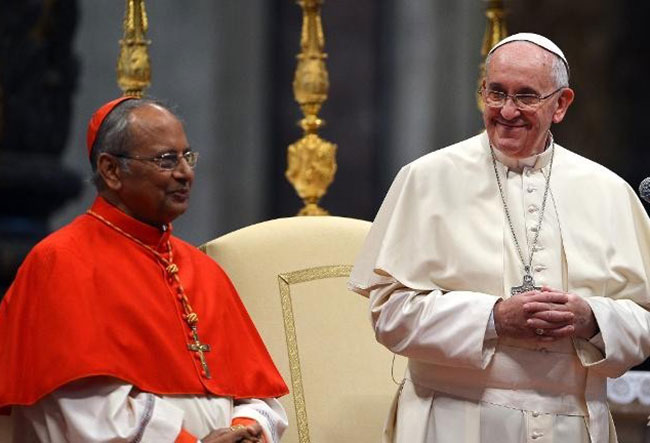
Include the Catholics under Colombo Archbishop Malcolm Cardinal Ranjith now, and you will have over 30 per cent of the nation’s voters. In a good election for the presidency, it translates as the ‘deciding factor’, provided they all stick together, or most of them stick together. And in a good parliament election again, they will decide who will be prime minister.

In turn, they can tell the government to have the kind of Constitution and laws and enforcement that the nation deserves and their own constituencies demand. The PTA would then be passe. Why UNHRC, the government and Parliament nearer home could then be made to act!

What Made Me Take Part In The Demonstration By Tamil MPs Opposite The President’s Office

C.V. Wigneswaran

The question for this month posed in English to me, is as follows;

Question – At your age and with your background what made you take part in the demonstration by Tamil MPs recently opposite the President’s Office at Galle Face?

Response- The urgency of our request! I organized an International Virtual Conference on Land Grabbing some time ago with International Experts taking part, apart from our own Senior Parliamentarian Hon’ Mr. Sambanthan and others.

A significant statement was made by an International Expert from Israel by name Professor Yiftachel who participated in the Conference. He is a highly cited Israeli Scholar in geography and urban studies. He formulated over two decades ago the theory of ethnocratic regimes. He did research into the nature of land grabbing taking place against Tamils and Muslims in Sri Lanka by the successive majority Sinhala Governments and came to the conclusion that Sri Lanka too like Israel is an ethnocratic regime.

This reference to Sri Lanka as an ethnocratic regime is very significant. The successive Sri Lankan Governments in recent times have all been ethnocratic in their nature and attitude towards the Tamils especially, and against the Muslims in recent times.

An ethnocracy is a type of political structure in which the state apparatus is controlled by a dominant ethnic group to further its interests, power and resources. From the time of Independence the Sinhalese leaders have been plotting and planning against the Tamils to drive them out of the regions they had occupied in Sinhala majority areas during British times and to then take control of areas within the traditional homelands of the Tamils.

There is now sufficient evidence to show the Tamils occupied these traditional homelands for more than 3000 years continuously. In fact the original inhabitants of this Country were Tamils. The original Tamil inhabitants swelled up subsequently with the coming of the Pandyas, Pallavas, Cholas, Cheras and the Arya Chakrawarthy group, all leaving behind Tamil speaking people to add up to the numbers of the original Tamils who occupied the areas now identified as Northern, Eastern and parts of Western, North Central and North Western Provinces. If you look at the old title deeds of many a Sinhala family of those who lived along the coast from Colombo to Puttalam they would be found to be in the Tamil language. When I visited Munneswaram Temple during my childhood, the area was full of Hindu Tamils. Now hardly any noticeable Hindu Tamils live there.

Sri Lankan state-sponsored colonization schemes were the successive Sinhala majority governments’ program of settling mostly persons from the South in the North and the East and elsewhere. Within predominantly Tamil speaking areas, persons from outside the said Provinces were brought and settled. This is taking place since the 1950s. According to International Law principles people of the area of settlement should be given first preference. Not only that. They should reflect the racial demography of the area.

Since irrigation settlements occurred under direct state sponsorship, most of those who were settled in the North and East were ethnic Sinhalese . It was no doubt a deliberate attempt of the Sinhalese-dominated state to marginalize the Tamils further by decreasing their numbers in their own areas. This no doubt was one of the reasons if not perhaps the most immediate cause of inter-communal violence in the early days.

Shortly after independence, the government of Ceylon started a program to settle Sinhalese in the jungles of the Trincomalee District. The forests were cleared and water tanks restored. As a consequence of these schemes the Sinhalese population of the Trincomalee District which was quite low rose to 33% in 1981.In the 1980s the government extended the colonization schemes into the Dry Zone area of the Northern Province, drawing up plans to settle up to 30,000 Sinhalese in the area. Colonization schemes also took place in the areas of Ampara and Batticaloa districts. The Sinhalese population rose in the combined Batticaloa and Amparai Districts to numbers far in excess of the natural projected growth.

The notion of the “traditional Tamil homeland” became a potent component of popular Tamil political agitations while the Sinhalese nationalist groups viewed the resettlement schemes in these areas as “reclamation and recreation in the present of the glorious Sinhalese Buddhist past”. But the Sinhalese were wrongly advised by their Politicians and others about their past.

Tamils were the original inhabitants of this Island. When Buddhism was introduced there were no Sinhalese. It were the Tamils who were converted to Buddhism. All the Buddhist remains now found in the North and East going back to 2000 years are the remnants from the time of the Tamil Buddhists. (Demala Baudhayo as Professor Sunil Ariaratne refers to them). Sinhala language came into being in the 6th and 7th centuries AD. There were no Sinhala speaking people before that. Their first grammar book Sidath Sangaraya came out in the 13th century AD.

The Mahawansa was a fiction written in the Pali language. Atta Katha also was written in Pali though some Sinhalese try to make out that it was written in Sinhalese. In recent times there is an insidious habit among the Sinhalese to translate ancient Tamil names used in the areas in the North East, into Sinhalese and claim those translated names were the original Sinhala names used in Sinhala areas of yore which predated Tamils’ occupation!

Coming back to the Colonisation schemes of the successive Governments the first colonisation scheme was in the Gal Oya Valley in the Batticaloa District in 1952. Tens of thousands of Sinhalese peasants from the Kegalle and Kandy districts were given fertile land in the upstream end of Gal Oya. Gal Oya became later the site of the first major anti-Tamil riot in 1956.

The next colonisation scheme was around the Kanthalai tank where peasants from outside of the Trincomalee District were settled in the then Tamil dominant village of Kanthalai, 39 km south-west of the Trincomalee town. Almost all the settlers were Sinhalese. When I was a child Kantalai was a Tamil speaking area.

Another colonisation scheme was set up at the areas surrounding the Kantalai Tank, 25 km south of Trincomalee town. 65% of settlers were Sinhalese and the rest were Muslims.

A scheme was started at Pathavik Kulam 65 km North-East of Anuradhapura town. The scheme lay in Trincomalee District but was administered by the Sinhalese majority Anuradhapura District. Land Development Department employees from this scheme took part in the 1958 anti-Tamil riots.

In 1961 a colonisation scheme was started at Muthali Kulam, 24 km west of the Trincomalee town. There too Sinhalese were settled.

In the 1980s, funded by aid received from the European Community, a Sinhala colonisation scheme was started at Periya Vilankulam (Mahadiulwewa) tank, 30 km North-West of Trincomalee town.

This colonisation scheme was extended into the Northern Province with the introduction of the Manal Aru (Weli Oya) scheme, which covered the districts of Mullaitivu, Trincomalee, Vavuniya and Anuradhapura. Sinhalese were settled in lands that were formerly populated by ethnic Tamils, given land, money to build homes and security provided by the Special Task Force. Although the scheme covered four districts, administration was handled by the Anuradhapura district, which constituted a Sinhalese majority demography. The Weli Oya scheme aroused much anger amongst the Tamils.[19] This anger boiled over into violence when the Liberation Tigers of Tamil Eelam attacked the Kent and Dollar Farm settlements at Weli Oya.

When the Indian Peace Keeping Forces were withdrawn in 1990, Tamil homes in the suburbs of Trincomalee were occupied by Sinhalese settlers. Tens of thousands of Sinhalese were reported to have been brought in by the advancing government forces and made to occupy local villages and lands, denying resettlement to its original inhabitants who had earlier fled to the jungles due to the murder of Tamil civilians at the hands of the Army.

After May 2009 several settlement programmes were initiated by the government that extended towards the Northern Province. In the Vavuniya district 3000 acres in Madukulam were cleared for a village, while work of a settlement is underway in Othiyamalai Kaadu. A settlement is being created in Rampaveddi bordering a minor tank area and new settlement of approximately 2500 ethnic Sinhala families (about 6000 people) from the South have been settled in the village of Kokkachaankulam and the Hindu temple in the village was demolished and replaced with a Buddhist Stupa. Tamils in Barathypuram in the Kilinochchi District were evicted and a Muslim settlement is being created in the area due to the large economic opportunities provided by an apparels’ factory built there.

Several new settlements are also being built in Mullaitivu District while the Manal Aru (Weli Oya) settlement is being expanded as well. Several fishing colonies are being built in the Mannar district and Muslim settlements have been built in lands previously owned by Tamils that fled to India during the war.

‘Navatkuli Housing Project’ is being built in Navatkuli, Jaffna District to house 135 Sinhalese families, including 54 families who had, in 2010, attempted to set up temporary residences at the Jaffna Railway Station with funding from Buddhist Organizations and Political parties.

Tamils are being ethnically cleansed in the Jaffna peninsula and Mullativu districts, and this was being supplemented with the construction of Buddhist stupas and Sinhalisation of names of streets and places. Over 400 Sinhala families were reported to have been settled in Nelukkulam in Mullativu district recently .The Tamil populace had been reduced to a fourth, based on Government figures. Tamil locals also complained of the State waging an accelerated campaign of Sinhala Buddhist colonisation by destroying historic Hindu shrines in the East.

Another incident of State colonization before the Final Eelam War was reported by Muslim residents of the Pulmoddai village in the Trincomalee District who claimed that several acres of their traditional land had been annexed by the Government for settlements from South on the pretext of industrial development.

The settlements are made easy to the Government due to the large presence of its Military who hold 65000 acres of State Land apart from the private lands held.

Now to answer your question. My age and background need not be barriers when the Traditional Homelands of the Tamils of this Country are being misappropriated under several guises through several Government Departments like the Mahaweli Authority, Forest Department, Wild Life Department and the Archaeology Department. The recent One Country One Law project seems to be a deliberate attempt to erase our identity and individuality. The chances are the Government is trying to bring in a new Constitution sans Federalism, sans Thirteenth amendment, sans Indian intervention through the Indo Sri Lankan Agreement and restrict unit of Local Authority to Districts instead of Provinces under a centralized Unitary constitution.

Why do you expect me to think of my background, age and the inconvenience of sitting on the roadside at the Galle Face, when the entire Sri Lankan Tamil population are facing slow extinction at the hands of the Sri Lankan Government?

Posted in Uncategorized

GL attends bilateral meetings on the sidelines of UNHRC sessions

Minister of Foreign Affairs Prof. G.L. Peiris and the Sri Lanka delegation had high level bilateral meetings on 28 February with the United Kingdom, the Commonwealth Secretariat, the Organisation of Islamic Cooperation (OIC) and the World Intellectual Property Organisation (WIPO) on the side lines of the High-Level Segment of the 49th session of the Human Rights Council which commenced 28 February.

During his meeting with Minister of State of the United Kingdom for South and Central Asia, UN and the Commonwealth Lord Tariq Ahmed, the Minister of Foreign Affairs discussed bilateral cooperation and progress achieved by Sri Lanka in advancing reconciliation as well as the Government’s comprehensive efforts at fostering unity and harmony. The Minister emphasised the need for understanding and recognition of Sri Lanka’s efforts.

At the Meeting with Secretary General of the Commonwealth Baroness Patricia Scotland, the Minister discussed avenues of furthering Sri Lanka’s cooperation with the Commonwealth including on the economic front, tourism and opportunities for youth such as vocational training. The Commonwealth Secretary General commended Sri Lanka’s lead role on the Blue Economy and requested enhanced engagement in this area.The Minister and the delegation also had a constructive meeting with Permanent Observer of the Organisation of Islamic Cooperation in Geneva Ambassador Nassima Baghli, where Sri Lanka’s longstanding friendly relations with members of the OIC, the multi-ethnic and multi-religious nature of the Sri Lankan society, the significant contribution from its Muslim community and matters relating to advancing their interests, were discussed.

The Minister also had a productive meeting with Director General of WIPO Daren Tang and exchanged ideas on further advancing technical cooperation in intellectual property in the areas of policy development, digitisation, geographical indications and empowerment of youth in the use of IP for research and development.

The Minister was accompanied by Minister of Justice Ali Sabry, State Minister of Production, Supply and Regulation of Pharmaceuticals Channa Jayasumana, Secretary to the Ministry of Foreign Affairs Admiral Prof. Jayanath Colombage, Additional Solicitor General Nerin Pulle and Permanent Representative of Sri Lanka to the UN in Geneva C.A. Chandraprema.

Basil plans to meet IMF/WB officials before the Spring Meetings

Finance Minister Basil Rajapaksa is scheduled to leave for the United States in the second week of April to commence the Balance of Payments (BoP) discussions with top officials of the International Monetary Fund (IMF), World Bank (WB) and US Treasury officials, as exclusively reported by Ceylon FT on 23 February.

A top Finance Ministry official told Ceylon FT, the Lankan delegation is scheduled to leave on 10 or 11 April for this high-level meeting before the Spring Meetings of the WB Group and the IMF scheduled for 22 to 24 April in Washington DC.

Sources revealed, the Sri Lankan Ambassador to Washington Mahinda Samarasinghe is making the necessary arrangements to fix the dates and times for the said meetings. However, independent economic commentators say that there are number of issues that need to be addressed before embarking on any BoP support programme with the IMF. They emphasise the urgent need to understand the parameters within which the existing unmanageable External Debt Stock could be restructured.

According to the IMF Debt Sustainability Analysts (DSA), SL’s Debt dynamics are in a very critical stage. Therefore, it cannot seek IMF support without introducing a viable Debt Restructuring mechanism.

Based on the recently concluded Article IV Consultation team of DSA, SL has a high risk of debt distress, with debt burden indicators well above the relevant thresholds in the baseline and all the stress scenarios. Accordingly, international tenders should be called for internationally recognised consultants/managers to implement this Debt Restructuring programme.

Thus, the world’s leading debt restructuring specialists, Rothschild and Co and Lazard Ltd have already focused their attention on SL.

According to sources familiar with the subject, they have recently met government officials and discussed potential plans to help the nation raise funds, including asset sales and securitised debt facilities.

Thereafter, the Debt Restructuring programme would take the course of implementation with the technical assistance of the IMF, usually a timeline of about six months before its actual implementation based on a binding agreement with the IMF for the BoP assistance programme. Accordingly, the Government would have to focus on ‘bridging finance options’ to meet the dollar demand during this transit period.

SL is eligible for IMF support under the four-year Extended Fund Facility (EFF), possibly about US$ 2 billion at an interest rate of less than 2 per cent.

An IMF programme would assist in Debt Restructuring under the Paris Club and secure new facilities from the World Bank and enable re-entry into global capital markets.

There is a reasonable probability of achieving debt sustainability, removing import controls without facing a costly restructuring of commercial loans, economists said.

Foreign Minister Peiris meets UN High Commissioner for Human Rights

Sri Lanka’s Minister of Foreign Affairs Professor G.L. Peiris today held wide ranging discussions with the United Nations High Commissioner for Human Rights, Michelle Bachelet at her office in the Palaise des Nations in Geneva.

He was accompanied by Minister of Justice, Ali Sabry, State Minister of Production, Supply and Regulation of Pharmaceuticals, Prof. Channa Jayasumana and Secretary to the Ministry of Foreign Affairs, Admiral Jayanath Colombage.

Foreign Minister Prof. Peiris is leading the Sri Lanka Delegation to the 49th Session of the UN Human Rights Council in Geneva.

During the visit, the Foreign Minister is slated to address the High Level Segment of the 49th Session of the Council and thereafter speak at the Interactive Dialogue on Sri Lanka.

The Foreign Minister is also scheduled to have meetings with other dignitaries during his visit, the Ministry of Foreign Affairs said.

Prof. G.L. Peiris had met with the delegations of Pakistan, Palestine, South Africa, Saudi Arabia and Egypt on March 01, 2022.

He held talks with the Foreign Minister of Palestine, Rizad Al Maliki, Federal Minister for Human Rights of Pakistan, Shireen M Mazari, Minister of International Relations of South Africa, Dr. Naledi Pandor and the Vice Minister of Foreign Affairs, Human Rights and Humanitarian Affairs of Egypt, Khaled El Bakry.