India reaffirms support for Sri Lanka to overcome economic and other challenges

India’s External Affairs Minister Dr S. Jaishankar held a virtual meeting with Finance Minister of Sri Lanka Basil Rajapaksa on January 15, 2022, where both sides exchanged New Year greetings and conveyed wishes on the festival of Pongal celebrated both in India and Sri Lanka.

Furthermore, to help Sri Lanka overcome its economic challenges, India under the SAARC currency swap arrangement has made an extension of USD 400 million to Sri Lanka and provided a deferral of ACU (Asian Clearing Union) settlement of USD 515.2 million by two months, said the Ministry of External Affairs in a statement.

The two Ministers also reviewed the progress in extending the Indian credit facility of USD 1 billion for importing food, essential items and medicine and USD 500 million for importing fuel from India.

Jaishankar also brought up the issue of Indian fishermen detained in Sri Lanka. He urged the Government of Sri Lanka to ensure the early release of the detained fishermen on humanitarian considerations.

Jaishankar, during the meet, said, that India will continue to extend a helping hand to Sri Lanka amid these tough times of the COVID-19 pandemic.

“Dr Jaishankar conveyed that India has always stood with Sri Lanka, and will continue to support Sri Lanka in all possible ways for overcoming the economic and other challenges posed by COVID-19 pandemic. As close friends and maritime neighbours, both India and Sri Lanka stand to gain from closer economic interlinkages.”, said the statement.

Notably, this meet is followed by Rajapaksa’s visit to India last month.

The Ministry in the statement also said, “Mr Rajapaksa recalled India’s longstanding cooperation with Sri Lanka and deeply appreciated the gestures of support. He welcomed Indian investments in Sri Lanka in a number of important spheres including ports, infrastructure, energy, renewable energy, power and manufacturing and assured that a conducive environment will be provided to encourage such investments. In this context, both Ministers noted that the recent steps taken by the Government of Sri Lanka for jointly modernizing Trincomalee Oil Tank Farms will boost the confidence of investors, apart from enhancing Sri Lanka’s energy security.”

As per the statement by MEA, the two Ministers agreed to remain in close touch for guiding mutually beneficial bilateral economic cooperation towards long-term economic partnership for shared progress and prosperity.

Posted in Uncategorized

Canada warns nationals in Sri Lanka of economic crisis-led food, med shortages

Canada on Friday (14) warned its nationals visiting and living in Sri Lanka of a looming economic crisis that could lead to shortages in food, medicine and fuel and also contribute to deterioration in the security environment.

The Canadian government in its travel advisory issued via its official Twitter account also warned of possible poor delivery of public services including healthcare due to the economic crisis.

Sri Lanka is facing an unprecedented economic crisis due to heavy debt and bad policies in the past. The island nation, which thrived under British colonial rulers before independence in 1948, is grappling with food shortages due to insufficient dollars for imports and lower harvest in its farmlands due to the government’s controversial change in its fertilizer policy.

Though the government has assured no shortages, already the 80 billion US dollar economy is seeing queues for kerosene, cooking gas, rice, milk powder, sugar, and wheat flour among many other commodities.

Prices of many essential goods have skyrocketed in the last six months with inflation hitting record highs and double digits, resulting in a negative rate of returns for risk-free investments.

The Canadian government advised its citizens to take measures due to limited access to resources which “could also contribute to a deterioration in the security environment”.

“Keep supplies of food, water and fuel on hand in case of lengthy disruptions. Long line-ups may be experienced at grocery stores, gas stations, and pharmacies. Monitor local media for information related to food and fuel shortages.” it said.

Canada is the first country to issue a travel advisory on Sri Lanka’s over economic instability and its possible impact on its travellers.

The President Gotabaya Rajapaksa-led ruling Sri Lanka Podujana Peremuna (SLPP) coalition is facing a twin crisis of dent and forex. It has to pay around 6.9 billion US dollars in foreign loans this year while it’s forex reserves were at just 3.1 billion US dollars by end December.

The government shrugged off possible sovereign debt default concerns and requests to seek International Monetary Fund (IMF) assistance. The government has also claimed that it has already been restructuring debts.

German Submarine Hunter ‘Bayern’ in Colombo

Bayern, a Brandenburg-class frigate of the German Navy reached the Colombo Harbour on Saturday (15).

The Commander of the Frigate and the Crew were warmly welcomed in Colombo by the German Ambassador to Sri Lanka and the Sri Lanka Navy.

F217 “Bayern”, was commissioned on 15th June 1996 for the German Navy.

236 soldiers work on board a Type 123 frigate. As on any other naval ship, sea watches lasting several hours ensure 24-hour operation on board.

Since their commissioning, the four ships of the F123 class have primarily been used for submarine hunting.

They can use both their bow sonar and two Sea Lynx on-board helicopters. These extend the ships’ anti-submarine range with their diving sonar and their torpedoes. With this focus capability, the Brandenburg-class warships ideally complement the 124-class frigates, whose main task is long-range air defense.

The four Brandenburg-class frigates have powerful radar systems for sea and airspace surveillance and fire control for use with weapons.

Sonar, systems for electronic warfare as well as telecommunications and data transmission systems complete the equipment. The well-equipped radio room in particular allows the Brandenburg class to also take on management tasks.

Dimensions:
139.0 m length (over all)
16.7m wide
6.3m draft
4,900 t displacement

Drive:
Type CODOG (combined diesel engine or gas turbine drive)
2 x gas turbine
2 x diesel engines
Total output: 38,000 kW (51,700 hp)
2 propellers
Speed: more than 29 knots

Sensors:
1 × SMART-S multifunction radar
1 × airspace surveillance radar LW 08, range: more than 260 km
2 x fire control radar STIR 180
1 × bow sonar DSQS-23BZ
1 x video and infrared target tracking MSP 600
1 x EK system FL 1800 S (electronic reconnaissance/electronic combat)
2 × navigational radar

Weapons:
1 x main gun 76 mm compact, range: more than 18 km
2 x 27mm MLG auto cannons naval light gun
4 x 12.7mm heavy machine guns
2 x launchers for anti-ship missiles RGM-84 Harpoon, range more than 220 km
1 x VLS Mk41 vertical launch system for NSSM and ESSM anti-aircraft missiles, range: more than 50 km (ESSM)
2 x RIM-116 RAM short-range anti-aircraft launchers Rolling Airframe Missile
2 x torpedo tube set for lightweight torpedo Mk46
4 x MASS decoy launcher

Crew and Others:
Regular crew: 214 soldiers
Additional personnel (for on-board helicopters): 18 soldiers
2 x dinghy model Boomeranger
2 x Sea Lynx Mk88A onboard helicopters (onboard for mission only)

Financial crisis: Sri Lanka printed Rs. 1.4 trillion last year: CBSL

The Central Bank of Sri Lanka (CBSL) printed Rs. 1,400 billion (1.4 trillion) last year, the bank’s Economic Research Department Director Anil Perera told the media on Friday (15).

Speaking at the same forum, CBSL Governor Ajith Nivard Cabraal admitted that Sri Lanka had not printed such a large amount of rupees before.

However, he argued that if Sri Lanka had not printed the amount, the country may have faced more pressure due to the economic climate.

This was as island-wide inflation calculated by the National Consumer Price Index (NCPI) shot up to 11.1% in November 2021. The NCPI also hit double digits for the first time since it was introduced in 2014.

Opposition politicians and economists have criticised the State for excessive money printing over the last two years.

Batticaloa: The Tamils grazing lands continue to be looted by Sinhalese

Farmers have expressed concern that Sinhala families from other districts are re-occupying and cultivating the Mayiladuthurai and Madhavanai grazing areas in the Batticaloa district.

Sumanthiran, President’s Counsel and Member of Parliament on behalf of the Batticaloa District Parliamentarians, had filed a case in the Colombo Supreme Court last year alleging that Sinhala people from other areas had encroached on and cultivated hundreds of acres of land in the Madhavanai grazing area in Mayiladuthurai.

In this case, the cultivators in the area had agreed to leave. The farmers say that the area has been accepted as a grazing area by the lawyers appearing on behalf of the Sinhalese people (occupiers) in the court and the land is being reclaimed and cultivated again.

The farmers state that despite government support being brought to the attention of parliamentarians, no action has been taken so far.

Posted in Uncategorized

World leaders wish for Thai Pongal

Tamils around the world are celebrated the Thai Pongal festival yesterday (14). World leaders and political leaders send their wishes to the Tamils.

Here are some of the messages:

Posted in Uncategorized

Sri Lanka is flirting with default

Gotabaya Rajapaksa’s government is reluctant to go to the IMF.

Almost three years since terrorists blew up hotels along Colombo’s lovely beaches and two years since covid-19 shut down international travel, tourists have begun returning to Sri Lanka, providing sorely needed foreign exchange. The country’s stockmarket has been bounding along, up by more than 80% in 2021, trailing only commodity-rich Mongolia among global bourses. Corporate profits have been strong, too. gdp growth last year was somewhere between 3.5% (by private estimates) and 5% (by the government’s). This suggests a thriving economy. Yet alarm bells are clanging.

Encouraging though the renewed tourist arrivals may be, they are still barely a fifth of the pre-pandemic peak. Exports grew strongly in the fourth quarter of 2021 but are still too meagre to prevent a looming financial crisis. Years of heavy foreign debt and current-account deficits have taken a toll. Foreign reserves have collapsed (see chart). Supplies of oil, cooking gas, milk, wheat and medicine are running short. A rapidly depreciating currency has helped the country’s exporters, including clothing manufacturers and tea growers. But it has made servicing foreign-denominated debt more costly and has stoked inflation, which jumped during 2021 to 12% and appears to be accelerating.

The numbers are sobering. Interest obligations on government debt in 2021 amounted to 72% of total revenues, while public-sector salaries and pensions came to 80%. Multiple downgrades have in effect locked it out of the international private-credit market. On January 12th s&p, a credit-rating agency, downgraded Sri Lanka’s debt further, citing “increasingly likely default scenarios without unforeseen significant positive developments”.

So Sri Lanka finds itself looking down the barrel of a gun. On January 18th $500m in foreign-currency-denominated debt will come due. Another $5.4bn in principal and interest will need to be paid by the end of the year. Similar payments are required for years to come. That has provoked a series of complex financial manoeuvres. In January the central bank disclosed that it had sold off half the country’s $382m of gold reserves. Rumours abound that the rest has been liquidated too. One obligation—an oil bill of $251m owed to Iran—was paid in tea. The government has also taken a series of heavy-handed actions to preserve foreign currency. It has banned the import of cars. It briefly tried to ban foreign chemical fertiliser in the name of going organic, until crashing agricultural yields forced it to change its mind.

Other measures include a currency swap with China, nominally expanding the central bank’s foreign-currency reserves from $1.6bn to $3.1bn. It is unclear whether the money can be used for anything except Chinese goods. A similarly complex deal has been announced with India, along with—perhaps not coincidentally—the resolution of a long-running dispute over India’s stake in a Sri Lankan oil-storage facility. State assets, including prime property, have been put up for sale. No one has so far been keen to buy them.

A bigger problem is that Sri Lanka’s increasingly desperate deals do not address the real reason for its current travails. After Gotabaya Rajapaksa was elected president in 2019, he abandoned the fiscal and monetary-policy conditions imposed by the imf three years earlier after another financial upheaval. Taxes were cut and interest rates pushed down. The approach was not without merit. It may have softened the harsh consequences of the post-covid global economy and reawakened the animal spirits of businesses that are now reflected by the soaring stockmarket. But it has proved to be unaffordable. Deficit financing on this scale is unfeasible.

Were the imf to arrange a restructuring of the country’s finances, interest rates and taxes would probably rise, government spending decline, and bondholders would have to take losses. In exchange there would be stability and new funds. But Mr Rajapaksa’s government has vocally opposed imf intervention, calling it an infringement of sovereignty. Still, some kind of restructuring seems inevitable, either under the oversight of a multilateral agency or with a more comprehensive government plan that has yet to be presented. The alternative is default—and the risk of higher inflation, fewer imported goods and an end to the current recovery.

Posted in Uncategorized

Britain says Sri Lanka needs good governance and equal rights for all

Kumar Sangakkara, a sportsperson both our countries greatly admire, spoke passionately about ‘different ethnicities and religions who celebrate their diversity by uniting for a common cause’. Naturally, he was talking about cricket, but I like it as a metaphor for the ties between your country and mine. We hold in our hands the enormous potential to unite – in all our diversity – to create a more secure and prosperous future.

As the UK’s Minister of State for South and Central Asia, United Nations and the Commonwealth I’m visiting Sri Lanka this week to discuss our shared interests and to explore future opportunities. I look forward to meeting people from all communities in Colombo, Jaffna and Trincomalee.

The UK has a renewed focus on the importance of the Indo Pacific region to global trade and investment, and our mutual security. The UK is building a network of economic partnerships and will look to work with Sri Lanka on these issues. I am also keen to support those in Sri Lanka striving for good governance and for strengthening human rights for all citizens.

The UK and Sri Lanka, with our wide range of shared interests, are long-standing partners in the Commonwealth, and share many international concerns. One of these is climate change. In November 2021, the UK hosted the UN Climate Change Conference in Glasgow, COP26, bringing together delegates, along with youth and indigenous leaders, civil society groups and business, across the world. This was a huge moment for the world to take stock of climate commitments and ensure that we deliver the collective action to maintain the target of limiting temperature rises to 1.5°C and finalise the outstanding elements of the Paris Agreement, as set out in the new ‘Glasgow Climate Pact’.

Following COP26, the UK will continue working closely with Sri Lanka to help realise its transition to a greener and sustainable economy. This means working together to deliver the action needed to support Sri Lanka’s recent climate, COP26 and Nationally Determined Contribution (NDC) commitments. We will support Sri Lanka’s climate adaption and decarbonisation efforts through initiatives like the UK’s ‘Climate Action for Resilience Asia Programme’ and the UN’s ‘No New Coal Compact’ and facilitate green finance and investment opportunities. We will continue to offer support through the Blue Planet Fund and Commonwealth Litter Programme to reduce marine litter, increase and strengthen marine protected areas, and develop seafood and aquaculture industry sustainably. We will also continue to work with Sri Lanka to support their pioneering work on mangrove restoration and nitrogen management to boost environmental protection.

The recovery from Covid has presented many economic challenges. The UK, a long-term partner with Sri Lanka, is keen to support Sri Lanka in its goals to develop new infrastructure, develop the financial services sector and expand trade and investment links, through our honest, reliable, and transparent approach to providing infrastructure finance and support for the green transition. This includes Sri Lankan Government priority projects with significant social benefits, including the transition towards cleaner and more sustainable energy generation. With the right market conditions and open supply chains, there will be potential for financing from the City of London and UK Export Finance.

Dealing with issues of the past is essential to lasting peace, and building an inclusive future. The Geneva process provides an essential framework for all those supporting Sri Lanka’s progress on peace, accountability, reconciliation, and social cohesion following the civil war. The UK supports the promotion of human rights in Sri Lanka, for all groups of people. As Desmond Tutu, the inspiring human rights activist once said: “True peace must be anchored in justice and an unwavering commitment to universal rights for all humans, regardless of ethnicity, religion, gender, national origin or any other identify attribute.”

We strive to combine our words and deeds on the international stage, with practical support for reconciliation and peace building on the ground. One example of this is our support to Sri Lanka becoming mine risk free by 2025, and helping those displaced to resettle and build resilient livelihoods. We have seen encouraging results: the clearance of more than 1.7 million square metres of mine-contaminated land – benefitting more than 120,000 Sri Lankan citizens and, we hope, saved lives.

Like Kumar Sangakkara’s diverse vision for the Lions team, the UK also seeks to play a positive role supporting freedom of religion or belief and the strengthening the rights and opportunities for women and girls. We have supported partners in the country to tackle violence and online abuse, especially where the risks are heightened due to COVID-19 lockdowns. We also support civil society to tackle hate speech and extremism, promoting dialogue and understanding across faiths and strengthening the monitoring and reporting of crime. I look forward to meeting those seeking to make progress on these important issues to share ideas and learn from each other experiences.

As a born and bred Brit, muslim by faith and proud of his Asian heritage, I am acutely conscious of the depth and breadth of historical and cultural ties between our two countries, and the rich network of friends and families. I have often heard of people fondly referring to the British Council and their valuable links in arts, culture, education and the English language, teaching programmes, and improving access to knowledge through its libraries in Colombo, Kandy, and Jaffna. The British Council can also help Sri Lankan students access a UK education through courses hosted in both the UK and Sri Lanka.

I am so proud that the UK has and will continue to offer a world-class education. Four of the world’s top universities are in the UK: Oxford, Cambridge, Imperial, and UCL. The British Council can help Sri Lankan students to access a UK education through courses hosted both in the UK and Sri Lanka, with more flexibility than ever before with our learning from the pandemic.

I encourage the best students from across Sri Lanka to apply for our prestigious Chevening Scholarship to study for a Masters qualification in the UK. Details can be found on their website @Chevening.org. The Chevening Alumni network is a group of formidable talent, with business, academic and world leaders in its number.

Of course, the sporting ties between the UK and Sri Lanka are our shared passion. I followed the England and Sri Lanka cricket match in Galle closely last year, and the Queen’s Baton toured Sri Lanka just two week ago. I’m really excited that Birmingham will host the Commonwealth Games later this year, a city that is home to over 190 nationalities speaking more than 200 languages, making the West Midlands one of the most diverse regions in the UK. So we expect Birmingham 2022 to be a ‘home Games’ for every nation competing, including Sri Lanka! This sporting occasion epitomises the resilience and spirit of our two nations as we explore new ways of delivering on our mutual prosperity, security, and shared values as Commonwealth members.

It is my firm belief that if we celebrate our diversity by uniting for these common causes, we can make sure that every one of us has a chance to play their part. I look forward to my visit to Sri Lanka and in celebrating the ties between our two countries, bound together by our people to people links.

UN paints bleak picture for Sri Lanka this year

The United Nations (UN) expects Sri Lanka to face numerous challenges this year, mainly as a result of the coronavirus.

According to a UN report, Sri Lanka’s major challenges are food shortages, dwindling foreign reserves and sovereign debt risks.

The 2022 World Economic Situation and Prospects (WESP) report, produced by the UN Department of Economic and Social Affairs (DESA), cites a cocktail of problems that are slowing down the economy globally, namely new waves of COVID-19 infections, persistent labour market and lingering supply-chain challenges, and rising inflationary pressures.

On Sri Lanka, the report says GDP growth is projected at 2.6 per cent in 2022. Its major challenges include food shortages, dwindling foreign reserves and sovereign debt risks.

“The Central Banks of Pakistan and Sri Lanka increased interest rates in the second half of 2021 amid rising inflation and widening current account deficits. Central banks need to assess the magnitude and timing of policy changes to support an inclusive recovery and maintain financial and price stability,” the report said.

The report said that South Asia faces major downside risks that can strengthen headwinds in achieving the 2030 Agenda.

Relatively slow vaccination progress leaves the region vulnerable to new variants and recurrent outbreaks. Financial constraints and an inadequate global vaccine supply continue to drag down full recovery in some countries.

As of early December 2021, Bangladesh, Nepal and Pakistan had less than 26 per cent of their populations fully vaccinated. By contrast, the fully vaccinated population is above 64 per cent in Bhutan, Maldives and Sri Lanka. In India, a deadly wave of infection with the Delta variant stole 240,000 lives between April and June and disrupted economic recovery. The report said that similar episodes could take place in the near term.

Posted in Uncategorized

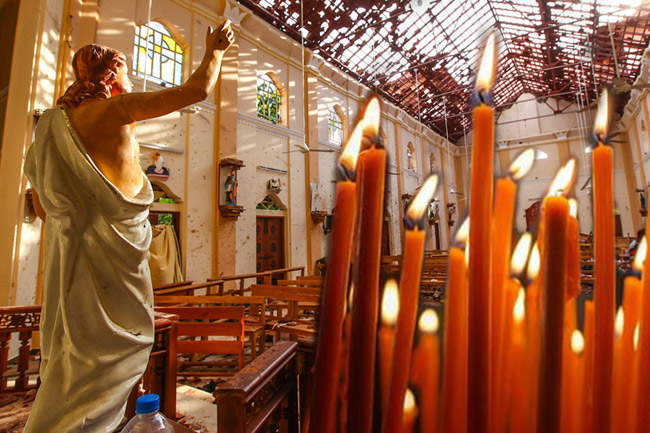
1,000 Days since Easter Attacks: Cardinal says attacks a conspiracy for political gains

The Head of Sri Lanka’s Catholic Church, His Eminence Malcolm Cardinal Ranjith, the Archbishop of Colombo claimed that certain political leaders, who were well aware of the 2019 Terror Attacks, used it for their political advantage.

He reiterated that the 2019 April 21st Attacks or the Easter Attacks was a conspiracy.

“The 2019 April Attacks may be over. But, today we can see that those in powerful places are attempting to put the entire blame on Muslim Extremists and cover up the truth. However, the truth is now coming out,” he told a gathering while marking 1000 days since the heinous attacks took place.

He said many tried to cover up the truth and they failed to do so.

“God Almighty has started to expose those who are responsible for this. The Parliamentary Select Committee in its findings said that Intelligence that only a few people were privy to, was not shared with relevant parties. The Parliamentary Select Committee on State Intelligence has highlighted serious concerns over this,” he said.

“The Parliamentary Select Committee has also called for further investigations to determine if action was NOT taken on the intel received that claimed that persons with vested interests were attempting to incite fear, uncertainty, and turmoil in the country targeting the elections that were to be held later that year (2019),” he further quoted a report in his address.

His Eminence said it is now even more clear that persons with vested interests had ulterior objectives that they concealed the fact they were aware of the intel and did nothing to save the lives, and also prevented those from taking action to prevent the attacks well.

“Such events will lead to a call for a change in government to control acts of terror by inciting fear among the people. This report suggests that the attacks were used to win votes at the election,” he further added.