SL averts immediate default; calls to engage with IMF get louder

As Sri Lanka avoided an immediate debt default, averting a massive crisis, the country’s policymakers should now make use of the breathing space provided by the Indian credit lines to the tune of US $ 1.9 billion to engage with its creditors, preferably equipped with an International Monetary Fund (IMF) programme, to chart a durable and a sustainable path for foreign debt management, according to economists.

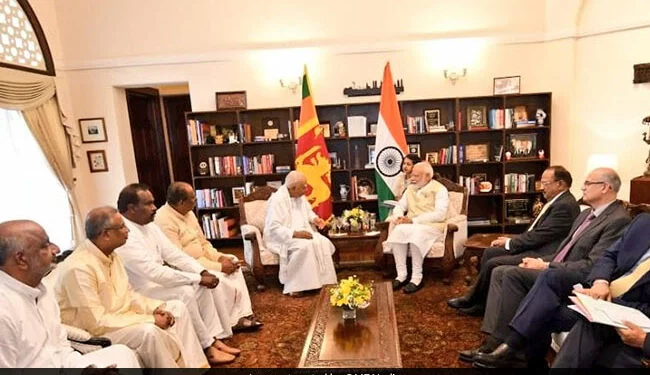
India last week confirmed a US $ 400 million swap line, under the SAARC currency swap arrangement and a deferral of A.C.U. settlement of US $ 515.2 million by two months, which would temporarily stop the country’s foreign reserves bleeding.

During the weekend, India announced the extension of further financial support with two bilateral funding lines—US $ 1.0 billion assigned for importation of food, essential items and medicines and US $ 500 million for importing fuel from India.

But all is not well with Sri Lanka’s external sector. Sri Lanka approximately has a US $ 1.6 billion monthly import bill and US $ 6.1 billion worth of foreign obligations to be settled during the remainder of 2022, including a billion dollar sovereign bond maturing in July.

As the path for the tourism industry that has a US $ 4.5 billion potential is still uncertain, with the direction of the pandemic, Sri Lankan policymakers will have to work harder to deal with the country’s external debt, which has bunched up till 2025.

Hence, the economists, who have long been advocating Sri Lankan policymakers since the onset of the pandemic to seek debt restructuring, have doubled down their efforts, as the Indian credit lines and debt deferment provide Sri Lanka a delayed opportunity to engage with its lenders to negotiate a durable and a less painful path for foreign debt and broader economic reforms.

“Now SL has 2 months of breathing time & must settle to hard econ(omic) reforms + honouring its promises to India to realise full gains; Should realise India can’t fully bailout SL; time to use space for negotiating with IMF for a permanent solution; Kudos to SL’s man in Delhi, @MilindaMoragoda,” said former Central Bank Deputy Governor Dr. W.A. Wijewardena on Twitter, applauding Sri Lankan High Commissioner in India Milinda Moragoda, who brokered the deal.

As Sri Lanka avoided an immediate debt default, averting a massive crisis, the country’s policymakers should now make use of the breathing space provided by the Indian credit lines to the tune of US $ 1.9 billion to engage with its creditors.

Posted in Uncategorized

International debt expert says SL ISB default not feasible

Calls for the Government of Sri Lanka to default on its International Sovereign Bond (ISB) repayments coming up tomorrow and to speak to the bond holders to restructure payment are not feasible as such a move would require the restructuring of all private and bilateral debt, stated Prof. Lee C. Buchheit of the University of Edinburgh Law School, at the Sri Lanka Economic Outlook 2022 organised by Nextgensl and Friedrich Naumann Foundation, last Thursday.

Buchheit during his stellar legal career of 43 years at Cleary Gottlieb Steen & Hamilton LLP worked on more than two dozen sovereign debt restructurings. He led the legal teams advising Greece in the 2012 restructuring of government bonds totalling more than € 206 billion (the largest sovereign debt workout in history) and also advised the Republic of Iraq in the 2004-08 restructuring of $ 140 billion of debt accumulated by the Saddam regime.

According to him, if Sri Lanka were to embark on a debt restructuring process, it would be a much broader gauged process involving both private and bilateral creditors.

“I don’t think there will be a renegotiation of a particular bond, all creditors both commercial and bilateral view each other with suspicion. If one went to the holders of the January 2022 ISBs or the July 2022 ISBs and said ‘you are the problem, let’s restructure your liability’, they will say ‘this pain must be shared with our fellow creditors, both bond holders and bilateral partners’,” stated Buchheit.

Explaining further, he stated that in his experience, any effort to negotiate with private creditors to restructure liabilities over a short-term period would not be successful and the holders of said liabilities will require that the pain be shared in an equitable fashion with all private and bilateral creditors, and that such a debt restructuring process will take around a year or even longer.

He further claimed that restructuring of private debt will be extremely complicated during this decade, more than ever before, due to the diversity of private creditors and debt instruments. According to Buchheit, there is no mechanism within the field of sovereign debt restructuring to co-ordinate such a diverse range of creditors and such a process will inherently be messy. Furthermore, another issue affecting the restructuring of private debt is the presence of secured debt arrangements where the sovereign borrowers have either directly or structurally provided collateral to the loans. Loans that benefit from collateral will be extremely difficult to restructure as the creditor will be reluctant to give up the benefit of his collateral.

Buchheit further noted that there will be greater temptation among commercial creditors to decline in participation in sovereign debt restructuring in part because of how the Argentine saga ended. Argentina defaulted in 2001; the crisis that was triggered didn’t actually end until 2016, 15 years later. The few creditors that declined participating in the Argentine debt restructuring process wound up getting very significant pay-outs, which has left a memory in the market which may tempt a number of investors to walk that path in a future sovereign debt crisis in a particular country, Buchheit stated.

According to Buchheit, the position Sri Lanka is in right now is not unique and many countries have been in the same position. Sri Lanka has lost access to its capital markets and is therefore pursuing a policy of looking at its bilateral partners to provide funding to help it get over what it hopes is merely a difficult period. According to him, in his experience, politicians in this situation hope that the inflows from bilateral and multilateral parties will be sufficient to tide the country over during the period the country institutes a homegrown fiscal adjustment.

“Sometimes that works but often it doesn’t work; fiscal adjustment programmes are inherently distasteful. Whether they are homegrown or recommended by the IMF, they will involve a degree of pain. It will require, for example, the stripping of subsidies which may have become embedded in the economy. Homegrown adjustment programmes of that kind often become casualties of the political process. Politicians simply do not have the stamina to push them through to their eventual success. It is often the case that those local politicians find the intervention of someone like the IMF quite helpful. Because they can say ‘we, your elected leaders, are not the authors of your misery’.”

Commenting on the Government of Sri Lanka’s insistence on pursuing a homegrown debt restructuring process without IMF intervention, Buchheit stated: “Is there a plausible set of fiscal adjustments that you could implement in a reasonable time period – the next two or three years – which would return the country to voluntary private capital market access. If there is such a set of policies and if you believe that you have the stamina to push them through then perhaps it makes sense to try to bridge this difficult period through borrowings from your bilateral partners.”

Buchheit made a grim prediction for 2022 where he believed that it’s likely that we would see a large number of sovereign default crises globally. According to him, globally, debt stocks, both government and private, were already at all-time high levels prior to the pandemic and have increased significantly since then to fund Covid-19 amelioration purposes and in developed countries, it has also funded economic stimulus measures and social safety net improvements.

“Despite the colossal size of the debt stock, we have not had a contagious sovereign debt crisis of the kind we saw in the 1980s and early 1990s during the so-called global debt crisis. There are several reasons for this; undoubtedly the most important relates to the extraordinarily accommodating monetary policies of the large central banks. This has had two aspects; first, interest rates have been brought down to zero or near zero, and in Europe below zero. That has meant that borrowers, including emerging market borrowers, could borrow at interest rates that are historically low levels. It has also meant that investors seeking a remunerative yield on their fixed income investment and not finding it in traditional debt issuances by governments of developed countries have been forced to look further and further afield in order to earn a remunerative yield. That undoubtedly has benefitted emerging market borrowers. The second aspect of the monetary policies is quantitative easing which involves central banks going into the market and buying debt instruments issued by their own government, and in some cases, from corporate issuers as well. The central banks quite literally print the money used to purchase these debt instruments and the balance sheets of central banks like the Federal Reserve of the US and the European Central Banks are now astonishingly large.”

Furthermore, the Group of 20 (G20) countries announced the Debt Service Suspension Initiative (DSSI) allowing 73 of the poorest countries in the world to defer their bilateral debt service payments starting from May 2020; this, according to Buchheit, undoubtedly helped 46 of the 73 eligible countries who availed themselves of the DSSI, to avoid defaulting during the pandemic period. However, this initiative wasn’t available to Sri Lanka.

In addition, the IMF allocation of special drawing rights to member countries, proportionate to their share in the fund, also assisted many countries, including Sri Lanka, survive during the pandemic period.

Owing to the above factors, the number of sovereign default crises during the pandemic period was largely limited; the most prominent during the period are Argentina, Ecuador, and Belize.

However, according to Buchheit, the concern is that this honeymoon period might run out in 2022 due to the emergence of inflation in developed countries which will put pressure on their central banks to rein in their accommodative monetary policies. This is currently occurring with the Federal Reserve announcing that it will tail off its quantitative easing measures by the end of the first quarter of 2022. Moreover, they are now planning to increase their interest rates by two to three times.

Furthermore, the DSSI expired at the end of 2021 and was not renewed. That means the countries that deferred their bilateral debt payments under the initiative will have to consider whether they will implement full-scale debt restructuring.

All Saints’ Church Parish Council express displeasure over probe

The All Saints’ Church Parish Council has expressed displeasure over the investigations into the discovery of a grenade inside the church premises.

Issuing a statement, the All Saints’ Church Parish Council questioned the decision by the Police to arrest suspects even before viewing CCTV footage.

It also questioned the decision by the Police to later view only CCTV footage recorded after 3pm the day the grenade was found and not footage recorded earlier in the day.

The All Saints’ Church Parish Council also strongly condemned the “cowardly and irrational” acts of those who placed the grenade inside the church last week.

The All Saints’ Church Parish Council assists in the Church’s apostolic work and sanctification in the field of charity, social relations and all other aspects.

Inspector General of Police (IGP) C. D. Wickramaratne had kast week defended the ongoing investigations into the discovery of the grenade at All Saints’ Church in Borella.

The IGP said that the investigations are still at the initial stages and that statements have been recorded from a number of people.

He said that the Borella Police had launched initial investigations and later the Colombo Crimes Division (CCD) took over the probe.

Dayasiri asks Namal aspiring to higher office to learn from his father

Having declared in Hambantota over the weekend that SLFP wouldn’t give up its ongoing political campaign under any circumstances, SLFP General Secretary Dayasiri Jayasekera told The Island yesterday (16) the revamping of the party was on track amidst ongoing disputes with the SLPP. Lawmaker Jayasekera emphasized their drive wouldn’t be reversed regardless of the consequences.

State Minister Jayasekera pointed out that former President and the SLPP leader Maithripala Sirisena, in his address to the Hambantota District convention at the Anugakolapalessa town hall stated that the SLFP wouldn’t keep quiet in spite of SLPP’s pressure. The former President, senior SLFPer cabinet minister Mahinda Amaraweera and State Minister Dayasiri Jayasekera declared in unison their determination to face the SLPP challenge.

Minister Amaraweera told the Hambantota convention that they had a right to take up issues both at cabinet level and directly with the people. The Minister said that no one could interfere with that right.

MP Jayasekera said that they were in serious conflict with the SLPP, the main constituent of the ruling coalition over the latter’s handling of political issues as well as a range of other developments such as fertilizer and debt servicing crises.

The SLFP parliamentary group comprises 14 members, including one National List MP Dr. Suren Raghavan. Altogether, the SLPP led government parliamentary group consists of 145 members. Of them, 117 have been elected on the SLPP ticket and appointed on its National List.

Kurunegala District lawmaker said as he pointed out at the Hambantota convention that Minister Namal Rajapaksa should realize the SLPP couldn’t achieve future political targets without the SLFP’s backing. Pointing out that recently Minister Namal Rajapaksa aspiring to be the next leader asked the SLFP to leave the government, State Minister Jayasekera emphasized that Premier Mahinda Rajapaksa never said so. The former President and incumbent Premier addressed internal issues tactfully.

Former Minister Jayasekesa said that the SLPP leadership quite conveniently had forgotten their candidate Gotabaya Rajapaksa couldn’t have obtained 6.9 mn votes at the last presidential election without the SLFP’s backing. “They had about five mn votes. The remaining 1.9 were SLFPers,” MP Jayasekera said, adding that the ruling coalition couldn’t have secured as many as 145 seats if the SLFP didn’t contest on the SLPP ticket.

The SLFP General Secretary said that the party held conventions in most of the district. We’ll be having conventions in Moneragala, Colombo, Gampaha, Batticaloa, Ampara, Trincomalee, Vavuniya, Jaffna and Polonnaruwa in the coming months.”

Lawmaker Jayasekera said that the SLPP couldn’t expect the SLFP to simply toe the line. Minister Namal Rajapaksa aspiring to be future PM and President shouldn’t repeat fellow members’ ludicrous response to constituents taking a stand contrary to that of the SLPP on a particular issue. State Minister said that the SLFP unhesitatingly backed Ministers Vasudeva Nanayakkara, Wimal Weeawansa and Udaya Gammanpila on the Yugadanavi issue as there was general consensus regarding the manipulation of cabinet procedures in authorizing the agreement. “We’ll not back down,” MP Jayasekera said.

Responding to another query, lawmaker Jayasekera said that the government would have done a lot better if the top leadership ensured proper dialogue among constituents. Unfortunately, there hadn’t been a proper mechanism to discuss contentious matters though the SLPP repeatedly claimed issues could have been dealt at cabinet level or at the parliamentary group.

The SLPP’s strategies resulted in the rapid deterioration of the government. The State Minister pointed out how the government (SLPP) put off Local Government polls scheduled for March 2022 to the following year without consulting other political parties. Had the SLPP followed basic principles in a coalition government, the government wouldn’t have been in crisis today, the MP said.

Power Crisis: ‘If CEB needs fuel they must pay in USD’

The Ceylon Electricity Board (CEB) must provide US dollars to the Ceylon Petroleum Corporation, if it needs fuel continuously, Minister of Energy Udaya Gammanpila said adding that if the CEB provides the dollars, the Ministry of Energy is prepared to import and supply the required stocks of fuel for power generation.

“Amidst the prevailing dollar crisis in the country, the CPC goes through serious difficulties to earn USD $400 million every month, to ensure the adequate supply of fuel stocks required for transportation and other industries,” Minister Gammanpila noted.

According to Minister Gammanpila, the Ministry of Energy has informed the CEB three months ago that if they require fuel for power generation, they should inform in advance.

“However, the CEB informed us on the 11th of January that they require Diesel from the 13th of January. We do not possess additional stocks of Diesel to supply on such short notice,” Minister Gammanpila pointed out.

He emphasized that the Ceylon Petroleum Corporation is ready to import and supply fuel if the Ceylon Electricity Board provides the necessary dollars, adding that the CEB can also directly import fuel by themselves.

At the same time, Minister of Power Gamini Lokuge says that a discussion will be held with the Ceylon Petroleum Corporation to obtain fuel until the 22nd of this month.

“The CPC has provided 3000 Metric Tonnes of fuel for the power generation at the Kelanitissa Power Plant. It is sufficient to ensure an uninterrupted supply of power until Tuesday (Jan. 18),” Minister Lokuge noted.

According to the Minister, the CPC is informed of the amount of fuel required annually.

“Due to the concessions granted to the consumers during the COVID-19 pandemic, the CEB is yet to receive arrears payments worth around Rs. 44 billion,” Minister Gamini Lokuge pointed out.

Posted in Uncategorized

Colombo Port City: A new Dubai or a Chinese enclave?

Officials say the city being built in the sand will rival other financial centres such as Dubai, Singapore or Hong Kong

“An economic game changer” is how officials describe Colombo Port City, a shiny metropolis soaring out of the water along the Sri Lankan capital’s seafront.

Next to Colombo’s leafy business district, the huge expanse of sand reclaimed from the sea is being transformed into a high-tech city which will host an offshore international financial centre, residential areas and a marina – prompting comparisons with Dubai, Monaco or Hong Kong.

“This reclaimed land gives Sri Lanka a chance to redraw the map and to build a city of world class proportions and functionality – and compete with Dubai or Singapore,” Saliya Wickramasuriya, a member of the Colombo Port City Economic Commission, told the BBC.

But critics question how much of an economic game changer it will really be for Sri Lanka.

For a start, in order to reclaim the 665 acres (2.6 sq km) of new land, the country needed the China Harbour Engineering Company (CHEC) to invest $1.4bn. In return, the firm has been given 43% of it on a 99-year lease.

After several years of dredging, construction activity is gaining momentum and the new city is taking shape.

Huge cranes supervised by Chinese engineers are moving concrete slabs, while earth movers fill trucks with tonnes of sand. A river passing through the reclaimed land has already been dredged, allowing access for small boats and yachts.

Officials estimate it will take about 25 years to complete the project, the first of its kind in South Asia.

Sri Lanka says the land under its control and the area given to the Chinese will be leased to multinational firms, banks and other companies. The government may also charge a levy on their revenue.

About 80,000 people are expected to live in the new city, which will offer tax holidays for those who invest and do business there. All transactions in the special economic zone, including salaries, will be in US dollars.

The Port City project was officially unveiled during Chinese President Xi Jinping’s visit to Colombo in 2014, a year after he launched his Belt and Road Initiative – an ambitious plan to build road, rail and maritime infrastructure links across Asia and Europe to boost trade.

Sri Lanka turned to China for financial help to rebuild after a long war with Tamil separatists ended in 2009. Western nations had raised concerns over human rights abuses.

At the time of the Xi Jinping visit, Mahinda Rajapaksa was Sri Lanka’s president but he lost elections later that year, with concern over Chinese loans – in particular for a vast port in the south at Hambantota – one of the issues on voters’ minds.

Eight years later, and Mr Rajapaksa is now back in power, as prime minister, with his younger brother Gotabaya as president.

But Hambantota port is no longer in Sri Lanka’s hand. Under the last government in 2017, Sri Lanka handed it over to Chinese control after struggling to pay off the debt to Chinese firms, with some of the money earned reportedly being used to pay off other debts.

So perhaps it is not surprising that not everyone in Sri Lanka shares the enthusiasm Port City officials have for the project.

Concerns over the scheme are numerous, and include the environmental impact of a project of this size.

Others fear the benefits of such a development will not benefit the country as much as supporters suggest it will.

“One potential negative around the Port City is the fact there are very significant tax holidays that are built into its law. There’s a possibility of up to 40 years’ worth of tax holidays for some investors,” Deshal de Mel, an economist with Verite’ Research, said.

“Having this large tax concession does not enhance Sri Lanka’s overall revenue proposition.”

The tax regime has triggered other worries. The US has warned that the relaxed business environment could become a haven for money launderers.

Mohamed Ali Sabry, Sri Lanka’s justice minister, disagrees.

“There’s no way that can happen because the normal criminal law applies here. We have our money laundering act and we have our financial intelligence unit. So, with all those things there is no way that somebody can get out of it,” he told the BBC.

With China increasingly assertive on the global stage, there are also concerns over its long-term strategic ambitions.

The growing Chinese footprint in Sri Lanka is a worry for India in what has traditionally been seen as its back yard.

The Port City aims to lure away multinational firms and investors already based in India, which could dent investments and job opportunities there.

But some say Sri Lanka also has much to fear from Colombo Port City.

In 2020, Laos avoided bankruptcy only by selling part of its energy grid to China to help fund a railway linking the two countries.

As with Hambantota, could Colombo Port City end up becoming a Chinese outpost in the long run?

“At the moment the way this government has agreed to the Chinese, China has taken over as much as everything in the Port City, the whole thing,” opposition MP Rajitha Senaratne told the BBC.

“One day, actually Sri Lanka won’t have any say in this project.”

Chinese academic Zhou Bo disagrees, saying the aim is for both countries to benefit.

“China’s Belt and Road Initiative is not a charity. We also want to be mutually beneficial. That means we also want our investments to have economic returns,” Mr Zhou, a former People’s Liberation Army senior colonel who’s now with Tsinghua University in Beijing, told the BBC.

“China has no intention to trap any country into debt.”

Sri Lankan officials take the same line.

“The entire area is under Sri Lankan sovereign control. The right to patrol, police, immigration and other national security duties lie with the Sri Lankan government,” said Saliya Wickramasuriya, of the Port City Economic Commission.

But Sri Lanka, currently going through an unprecedented economic crisis, has limited options.

The Covid pandemic has devastated its lucrative tourism sector and dented overseas employment, sending foreign exchange reserves plummeting.

The country’s external debts have surged to more than $45bn and it owes around $8bn to China alone.

Amid appeals for financial help, Sri Lanka last week asked visiting Chinese foreign minister, Wang Yi to restructure its debt repayment to Beijing.

But with repeated downgrades by international ratings agencies, Colombo’s chances of going to international investors for further loans appear slim.

Only China has long-term ambitions – and deep pockets.

But there could be strings attached – some believe a city like Hong Kong in Sri Lanka would help China tighten its grip in this part of Asia in the years ahead.

Posted in Uncategorized

India hands over 1000 houses to Lankan Tamil plantation workers

The High Commissioner of India, Gopal Baglay, the Sri Lankan Minister of Youth and Sports, Minister of Development Co-ordination and Monitoring and State Minister of Digital Technology and Enterprise Development, Namal Rajapaksa, and the Minister of State for Estate Housing and Community Infrastructure jointly Jeevan Thondaman handed over house keys to more than 1000 beneficiaries from plantation areas of Sri Lanka at a public event in Kotagala on January 15.

Members of Parliament S.B Dissanayake and M. Rameshwaran and other dignitaries took part in the well-attended event.

Speaking on the occasion, High Commissioner conveyed Pongal greetings in Tamil. He stressed that India will stand with Sri Lanka and continue to work for the development of Indian origin Tamil community. He noted that the community was an organic link between India and Sri Lanka and underlined that the Festival of Pongal represented shared civilizational ties between the two countries.

The handed over houses were built under the third phase of the Indian Housing Project. 4000 houses are being constructed with grant assistance from the Government of India in plantation areas, spread across seven districts of Sri Lanka, under this phase for the estate workers in Sri Lanka. Around 3000 houses have already been handed over to beneficiaries till date and handing over of close to 750 houses is being scheduled under this phase. The remaining houses are at various stages of implementation.

Indian Housing Project is a flagship development assistance program in Sri Lanka which is being carried out in different phases. 46,000 houses were built/repaired in the Northern and Eastern Provinces of Sri Lanka in the first two phases. Another 10,000 houses shall be constructed in the plantation areas in the next phase. This would take the Government of India’s overall commitment under the project to 60,000 houses.

The dignitaries took part in a traditional ‘Maatu Pongal’ ceremony prior to the handing over event, which was attended by thousands and featured cultural performances.

Celebration of Pongal in Sri Lanka attests to the abiding cultural linkages between the people of India and Sri Lanka as well as the shared heritage. Development assistance is a key pillar of bilateral relations between the two countries. At a total quantum of around USD 3.5 billion, development assistance from India cuts across sectors spanning from infrastructure development to all aspects of daily human lives such as education, health, livelihood, among others. Estate workers from plantation areas have been at the centre of such assistance and several projects implemented through grant assistance by the Government of India including the 150-bed hospital in Dickoya, multi-purpose hall in Saraswathy Central College in Pussellawa etc reinforce India’s ongoing focus on the region under the ‘Neighbourhood First’ policy.

Posted in Uncategorized

Discrimination and harassment haunt Sri Lanka’s Muslims

Apart from looking after her toddler, Maram Khalifa’s days consist mostly of trying to find ways to bring her husband home. Hejaaz Hizbullah, a prominent Sri Lankan civil rights lawyer, has been in prison for about 20 months, under anti-terrorism charges.

Prosecutors accuse him of hate speech and causing communal disharmony.

They allege that Mr Hizbullah gave a speech to young Muslim boys inciting them against the Christian community.

Mr Hizbullah, who is from the minority Muslim community, spent more than a year in prison before the charges were levelled in April 2021, and he has remained in prison since. His trial is due to begin later this month. His wife firmly rejects the charges.

“He was outspoken, very active in defending Muslim rights and minority rights in general,” she told the BBC. The charges against her husband were “a message to anyone who wants to speak about against racism, against discrimination”, she said.

Mr Hizbullah was first arrested in connection with the devastating 2019 Easter Sunday suicide bombings, carried out by local Islamists. More than 260 people were killed when high-end hotels and churches were targeted.

Initially, he was accused of having links with one of the bombers. His lawyers say the prosecution later dropped those allegations after they pointed out that he had only appeared in two civil cases involving property disputes for the father of the attacker, a well-known spice trader.

Amnesty International last year called Mr Hizbullah, a vocal critic of the government, a “prisoner of conscience”.

Activists say that the arrest of Mr Hizbullah is part of ongoing harassment of the minority community in recent years. Ethnic fault lines run deep in Sri Lanka, where Muslims constitute less than 10% of the country’s 22 million people, who are predominantly Sinhalese Buddhists.

Muslims were allies of the government during the nearly three-decade war against the Tamil Tiger rebels, who were fighting for a separate homeland for the other minority Tamil community.

But Muslim leaders say the attitude of a section of the majority Sinhalese towards them changed after the war ended with the defeat of the Tamil Tigers in May 2009.

Rights groups point out that there had been anti-Muslim riots, targeting houses and businesses, by the ethnic Sinhalese mob even before the Easter Sunday attacks took place.

The Easter Sunday bombings were a watershed moment. Weeks after the attacks, Muslim properties and mosques were vandalised by Sinhalese mobs and hate speech became virulent on social media. The Muslim community was demonised and there were calls by Sinhalese hardliners to boycott Muslim shops.

The current president, Gotabaya Rajapaksa, who as defence secretary led the war efforts against the Tamil rebels, came to power in November 2019 with a strong backing from Sinhala Buddhist nationalists. He campaigned on a platform of national security.

With his elder brother Mahinda Rajapaksa winning parliamentary elections a year later, the Rajapaksas firmly tightened their grip on power.

“For the government it is a trump card that they keep using to keep the vote base – saying that there is a threat to the country from Islamic extremists,” Hilmy Ahamed, from the Muslim Council of Sri Lanka, told the BBC.

If China restructures debt, others will follow: S. R. Attygalle

The Government of Sri Lanka is optimistic of succeeding in its plan to restructure its debt with bilateral and multilateral lenders if its current attempts to restructure the debt with the Chinese Government materialises, the Treasury told The Sunday Morning Business.

Speaking to The Sunday Morning Business, Treasury Secretary S. R. Attygalle stated that if the Government of China were to extend its support to Sri Lanka, and given the existing supporting ally, the Government of India, other lenders would also be willing to help Sri Lanka restructure its debt repayment.

“India has supported us, and similarly the Cabinet requested China to restructure the debt. We will see how it goes; when these two Governments do so, certain others will also follow,” Attygalle said.

United National Party (UNP) Leader and former Prime Minister Ranil Wickremesinghe, in an interview held last week for international news agency WION, opined that Sri Lanka would not be restructuring its debt with the Chinese Government.

“If China restructures its debt, it will also have to do so for a large number of countries on the Belt and Road Initiative, so I don’t think there will be restructuring on the debt, because you can’t restructure the debt of one country and not on the others,” Wickremesinghe highlighted.

Meanwhile, responding to this claim by Wickremesinghe and others in opposition, Attygalle said that there could be different forms of restructuring debt; for example, one could be given the option of not settling payments now but doing so after two years and so on.

“If the lender is willing to give, then what is the problem? It’s his money and he is saying to pay later. These are bilateral loans with China and if the lender is willing to postpone, there is no problem,” Attygalle stressed.

On 9 January, President Gotabaya Rajapaksa put forward this request at a meeting held with Chinese Foreign Minister Wang Yi.

“The President pointed out that it would be a great relief to the country if attention could be paid to restructuring debt repayments as a solution to the economic crisis that has arisen in the face of the Covid-19 pandemic,” the President’s Office said.

The statement also said China was asked to provide “concessional” terms for its exports to Sri Lanka, which amounted to around $ 3.5 billion last year, without providing further details.

Further, Rajapaksa also offered to permit Chinese tourists to return to Sri Lanka provided they adhered to strict Covid regulations.

Subsequent to this announcement, Central Bank of Sri Lanka (CBSL) Governor Ajith Nivard Cabraal on 12 January stated that the Sri Lankan Government was presently in negotiations with China to obtain a loan to cushion the effect of the existing debt repayments to China.

According to Cabraal, the Government’s strategy is to restructure the country’s debt structure in a manner that does not inflict pain on investors who kept faith in the country. Cabraal noted that the Government would implement its debt restructuring process while considering the interests of investors.

China is Sri Lanka’s fourth biggest lender, behind international financial markets, the Asian Development Bank (ADB), and Japan. According to official data, China has lent Sri Lanka over $ 5 billion (£ 3.7 billion) in the last decade for projects including roads, an airport, and ports.

Sri Lanka has also received billions of dollars of soft loans from China but the island nation has been engulfed in a foreign exchange crisis, which some analysts opine have pushed it to the verge of default.

Posted in Uncategorized

Sri Lanka seeks up to US$3.5 b loan from Japan

Sri Lanka’s debt-ridden government is now negotiating a fresh financial relief package from Japan amounting to between $2billion and $3.5 billion similar to Indian assistance of US$ 900 million granted to Sri Lanka recently, with the aim of overcoming the current economic crisis.

The exact amount of the planned swap of the loan into dollars is yet to be finalised as it depends on the outcome of the ongoing negotiations, a senior official who wished to remain anonymous told the Business Times.

Japan has historically been a major source of development aid for Sri Lanka, providing the country not just with financial but also technical assistance.

The Japanese loan will further deepen the bilateral relationship between the two states, which has been amicable under the present government, he said.

He added that for Sri Lanka the loan offers the opportunity to restructure its financial liabilities on more favourable terms.

The loan from Japan may be from a Japanese agency or institution and it will be issued in Japanese yen and carry an interest rate of just 0.05 per cent, informed sources said.

The Finance Ministry will also enter into foreign financing agreements with foreign development partners including Japan and lending agencies to support the public investment programme this year.

Sri Lanka anticipates more financial commitment considering the urgent needs of the country to support the budgetary activities, he pointed out.

Sri Lanka faces one of its worst economic crises, with foreign reserves which stood at around $3.1 billion, enough for a few months of imports.

It also has foreign debt obligations over $6 billion this year, including repayment of bonds worth $500 million in January 18 and $1 billion in July.

The cash strapped government is to pursue further loans from other multilateral lending agencies (such as the World Bank) and other bilateral agencies, particularly those in India and China.

For the development support it will seek access to financial assistance from multilateral lending agencies and foreign governments.

The Finance Ministry has requested Japan to restructure (Sri Lanka’s) debts and access to preferential credit for imports of essential goods, as the island nation struggles in its worst economic crisis,

Under the Indian line of credit, Sri Lanka is to purchase 500 mini buses for commuter transport services and 750 jeeps for the Police Department.