No decision to grant Northern energy project to India – minister

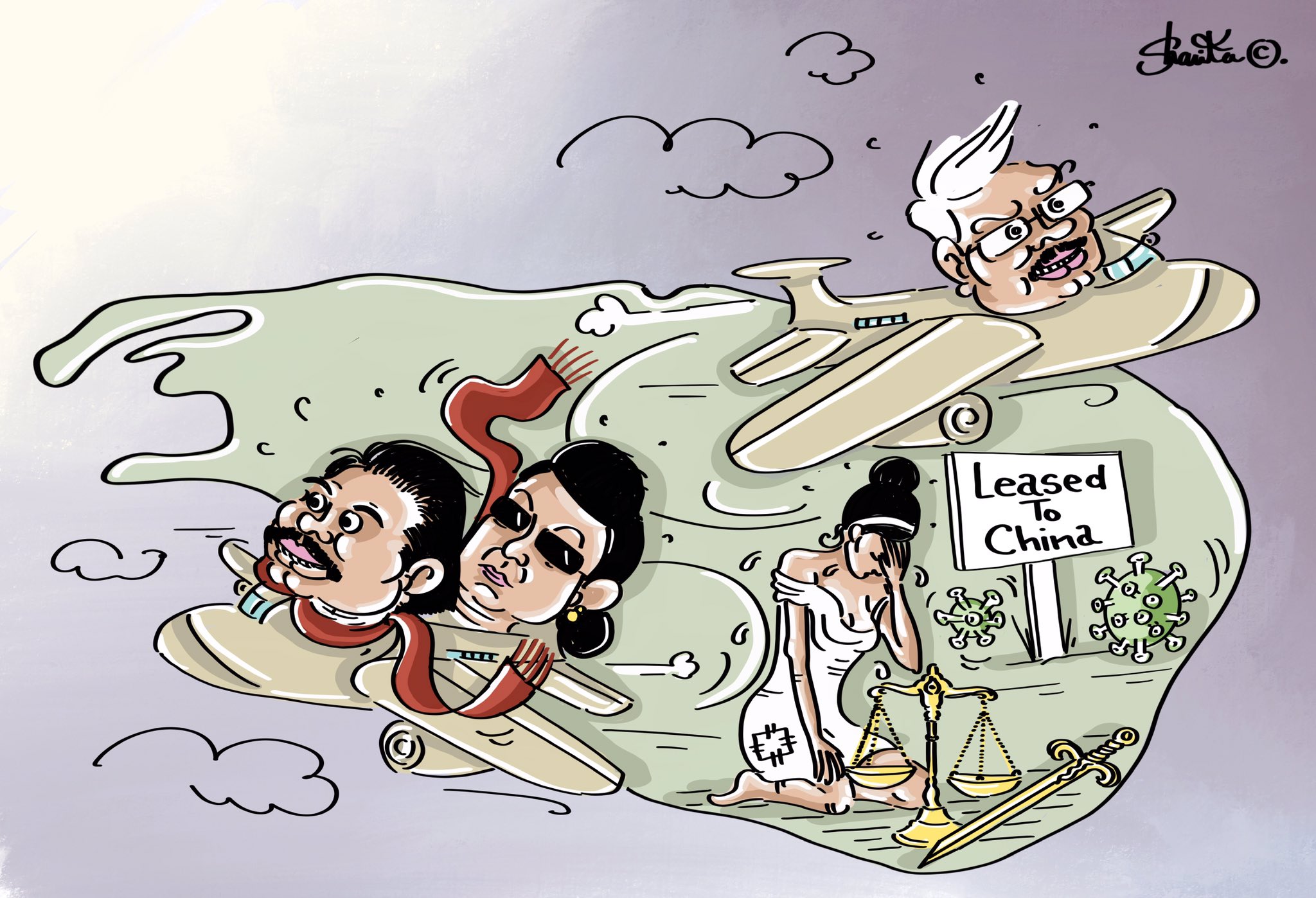
No decision has been taken to grant the Northern energy project to an Indian company, Co-cabinet spokesman – minister Ramesh Pathirana stated.

He was responding to a query raised at the Cabinet briefing this morning (07), asking whether the project was granted to the Adani Group of India.

Earlier, Opposition MP – Patali Champika Ranawaka had alleged that the government is planning to hand over three northern islands of the country to India’s Adani Group to construct a 500MW Wind and Solar energy plant.

Meanwhile, the the Chinese embassy in Sri Lanka had tweeted last week that the Sino Soar Hybrid Technology, being suspended to build Hybrid Energy system in 3 northern islands due to ‘security concern’ from a third party, has inked a contract with Maldivian gov’t on 29 Nov to establish solar power plants at 12 islands in the Maldives.

Champika

Posted in Uncategorized

China – SL signs aid agreement to refurbish SC

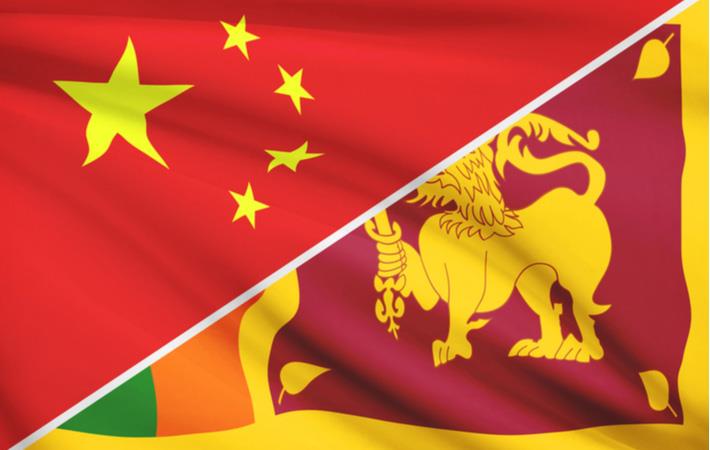
China and Sri Lanka today (07) have signed an aid agreement about Rs. 8 billion on comprehensive refurbishment of the Supreme Courts Complex.

The SC Complex, built in 1989 with China Aid, has been playing a central role in the island’s judiciary for more than 32 years.

The signing event was presided by the Chinese ambassador in Sri Lanka – Qi Zhenhong and the minister of Justice – Ali Sabry.

Posted in Uncategorized

SJB continues parliament boycott citing security concerns

Sri Lanka’s main opposition faction, the Samagi Jana Balavegaya continues to boycott Parliament citing security concerns.

Recently, the SJB decided to refrain from attending Parliament Sessions until assurance is given with regard to the security of opposition MPs.

The decision came after it was alleged that ruling party MPs had made threats, following a dispute that arose between MP Manusha Nanayakkara and the ruling faction.

Opposition Leader Sajith Premadasa dismissed the Speaker’s move to appoint committees over the matter, noting that the need of the hour is to take strict action against the ruling faction for intimidation.

He called on the speaker to use his powers to ensure the rights of the MPs.

Pakistan Defence Minister must apologize to Sri Lanka – Public Security Minister

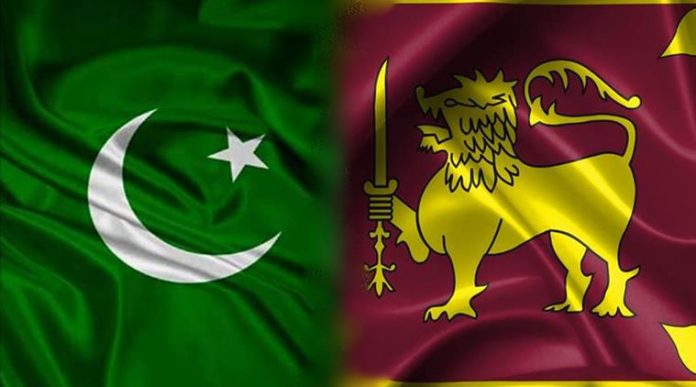
Sri Lanka’s Public Security Minister Rear Admiral (Retd) Dr. Sarath Weerasekara has condemned the comments made by Pakistan’s Minister of Defence Pervez Khattak on the murder of Priyantha Kumara.

Pakistan’s Defence Minister dismissed the seriousness of the killing of a Sri Lankan by a lynch mob.

He said it was “youthful exuberance” of youth and that it happens all the time.

Rear Admiral (Retd) Dr. Sarath Weerasekara said the Pakistan Minister of Defence must apologize to the people of Sri Lanka for those remarks.

Posted in Uncategorized

The IMF is the hated physio that Sri Lanka desperately needs By Ashan Rodriguez

Sri Lanka has just been knocked by a tuk-tuk, hit by a bus, and is being dragged along the road. The country is dangerously low on foreign reserves, struggling to pay creditors, facing import restrictions leading to shortages, and seen overnight price hikes on essentials. Though exacerbated by COVID, the underlying conditions for the crisis have been in the making for years. The Government of Sri Lanka (GOSL) may dislike the International Monetary Fund’s (IMF) programs, but if Sri Lanka is to ever pull itself out of its current quagmire it needs the IMF.

Central Bank Governor Nivard Cabraal and MP Vasudeva Nanayakkara vehemently oppose the program because of the conditions the IMF imposes on the country. “Even if we die, we will not seek assistance from the IMF,” Vasudeva told Parliament in November. Instead of dismissing IMF assistance, Vasudeva and other officials should view it as physical therapy that will enable Sri Lanka to start walking on its own two feet again.

Sri Lanka’s situation is dire. The country, unfortunately, checks all boxes on the IMF’s list of why crises may occur. Inappropriate fiscal and monetary policies? Check. An exchange rate fixed at an inappropriate level? Check. A weak financial system? Check. Political instability and/or weak institutions? Check. A natural disaster or an external shock? Check, we have that too, with COVID still prevalent. Bingo!

The IMF states that crises usually result in sharp slowdowns in growth, higher unemployment, lower incomes, and greater uncertainty in countries that can lead to deep recessions. These outcomes are inevitable unless Sri Lanka has someone to help exercise it back to health.

So why does the Government shun the IMF? Resorting instead to taking two Panadols, sleeping and hoping to magically walk again painlessly in the morning, without ever addressing the underlying issues. One reason is the short-term no conditions attached loans Sri Lanka receives to plaster over its wounds: loans from India; China; an IMF distribution of pandemic assistance; and, a currency swap with Bangladesh—considered one of the UN’s Least Developed Countries but now coming to Sri Lanka’s rescue.

As the lender of last resort, the IMF will provide Sri Lanka with financial support to restore economic stability, while ensuring it does not fall into a debt spiral. The IMF will design a loan program, aimed at fixing structural issues, in collaboration with the Government. And just as a physio rehabilitates with painful exercises, the IMF program conditions will get Sri Lanka walking again, even if the exercises will be painful in the short-term.

Tax revenues will need to be increased to improve the fiscal position and operational capacity of GOSL. A painful exercise going against public sentiment, but easier to stomach when conditionality also improves accountability. The 2016 IMF program included having the ministry update its tax administration system; publish tax expenditure statements as part of the budget; and increasing tax collection by simplifying the tax code, auditing dodgers, and broadening the tax base. Sri Lanka ranks among Somalia, Yemen, Bangladesh, and Ethiopia in the top 10 least tax-collecting countries. Currently, Sri Lanka’s tax revenue is 9.5% of GDP, down from ~20% in the 1990s, while studies estimate that 13% is needed for a state to effectively carryout its duties.

The next painful exercises will be improved public financial management and governance and accountability of state-owned enterprises. The Ceylon Electricity Board and SriLankan Airlines are among the State’s loss-making entities that are not commercially viable. This leads to GOSL constantly bailing them out while increasing its exposure to the foreign loan market.

Just as Vasudeva fears, the IMF will also ask for a devaluation of the rupee as part of its rehab program, which could lead to an increase in prices over time. The MP, however, discounts the upsides of devaluation: It improves export competitiveness, narrows the trade deficit, and can reduce the cost of some interest payments. As Sri Lanka’s international reserves rapidly declined from $ 8 billion to $ 2 billion since 2020—the lowest level recorded ever—GOSL will need to stop propping up the rupee.

Yes, Cabraal and GOSL, IMF conditionality is difficult, and it certainly is a painful rehabilitation process. While encouraging fiscal discipline and structural adjustments is the primary tenet of the program, an IMF program is more than just money to shore up short-term crises. The IMF can provide a comprehensive assessment on Sri Lanka’s fiscal, monetary, and governance reforms. It can monitor its performance indicators. And a successful completion of the program will reduce Sri Lanka’s borrowing rates and attract creditors once again.

A condition-based program with the IMF, the hated physio, is crucial if Sri Lanka is to stand up on its own two feet again; delays in accepting this truth will only lead to exacerbating the crisis and prolonging the suffering.

(The writer is finishing up his Master’s program at the Harvard Kennedy School and previously worked at the IMF for four

years working on program

negotiations with developing countries.)

Posted in Uncategorized

‘By no stretch of imagination could you call this country a Sinhala or Sinhala Buddhist Country’ – Wigneswaran

Q Recently in Parliament the words “Tamil Homeland” and “Tamil National Leader Prabhakaran” were used and objected to by the Government Members who wanted those words to be expunged from the Hansard. The Chairman of that time Velukumar MP had promised to bring the matter to the notice of the Speaker. He did not make any decision on the objections raised. Do you not think this Country is a Sinhala Country and that a Terrorist Leader who killed so many innocents must not have his name mentioned as a National Hero?

Response: –

No. I do not think so.
Firstly, this Country is not a Sinhala Country. It is a Sinhala Majority Country. But in the North and East the majority of people are Tamil Speaking. Before 1833 when the British united the Country for administrative purposes there was a Jaffna Kingdom in the North and the Chiefs in the East who were Tamils paid tithes to the Kandyan King. As you know the last King of Kandy was a Tamil and signed the 1815 Agreement with the British in Tamil. So did some of the Kandyan Chiefs.

By no stretch of imagination could you call this Country a Sinhala or Sinhala Buddhist Country. It consists of areas which are majority Sinhala-speaking and majority Tamil-speaking. The original inhabitants of this Country 3000 years ago were Tamil speaking. There was no Sinhala language born then. Therefore no Sinhalese existed then. The Sinhala Language is a mixture of mainly Tamil and Pali. Some Sanskrit words went into Sinhala language through the Tamil Language.

The first grammar of the Sinhalese the “Sidath Sangarawa” was written in the 13th Century AD just eight centuries ago. If the Sinhala language had come into being 3000 years ago why did it take 1700 years for its grammar to be born?

The Sinhala people have been fed with wrong history based on Mahawansha. When Mahawansha was written there was no Sinhala Language born then. That is why it was written in Pali. The Attakatta too was written in Pali. There are no evidence of any Sinhala inscriptions before 5th Century AD. Mahawansha was written for the glorification of Buddhism as the Author Mahanama himself says at the end of every stanza.

“Sinhalese cannot refer to themselves as the Aryan Race. They were local Dravidians who adopted a new language in course of time around 1500 years ago. That the Sinhalese and the Tamils belong to a common origin is proved by DNA Tests conducted recently”

During the past 73 years the Sinhala politicians and the Sinhalese intelligentsia have resorted to the gimmick of giving a distorted picture of Sinhalese Language and Sinhala History.
Officially the Tamil names of places in the North and East of the Island were translated into Sinhala language during the second half of last Century only. For example Manal Aru which was for Centuries referred to as Manal Aru (in Tamil) was translated to Weli Oya (Manal-Weli-Sand / Aru- Oya-River), post-Independence. After sometime, since the translations were done, Buddhist priests and others have started referring to the Tamil areas and the Tamil place names in the North and East by the Sinhala translated names saying that the Original names of those places in the North East were in the Sinhala Language and that those Sinhala names were translated into Tamil after the Chola Conquest in the 10th Century AD. If the Sinhala language came into being in the 5th or 6th Century AD how could there have been Sinhala names of Tamil places 2000 years ago?
There is no evidence of any of those Sinhala names existing in the North and East prior to the translations of recent times. How they resorted to such deception, was, by connecting Buddhism to the Sinhalese and say wherever Buddhist remains exist those were originally occupied by Sinhalese.

This is an absolute falsehood. Prof. Sunil Ariyaratne has written a Book in Sinhalese a few years ago by the name of Demala Bauddhayo (Tamil Buddhists). He accepts that Tamils at a stage in our history were Buddhists. That was a time when the Sinhalese language had not come into existence. Hence there were no Sinhalese when the Demala Bauddhayo existed.
How the Sinhalese racial historians and scheming Buddhist priests manage to refer to the existence of Sinhalese prior to 5th and 6th Centuries AD is by referring to words in Pali which later got into Sinhala to make the Sinhalese Language. Those words were not Sinhala words but Pali words. Since in later times those words from Pali got into the new language to make the Sinhala Language, these historians refer to the existence of the Sinhala language then, by identifying the Pali words in inscriptions and other sources which were not Sinhala words but Pali words because they only later came into the Sinhalese Language.
Their argument that Sinhala language existed for over 3000 years is like saying I existed when my grandfather (who died long before I was born) existed because I came from my grandfather!

There is every plausibility to refer to Sri Lanka as a Tamil Hindu Country. The Saivaite Tamils were the original inhabitants of this Island. The Shivalingas at Naguleswaram at Keerimalai (North), Munneswaram in Chilaw (West), Koneswaram in Trincomalee (East) and Thondeswaram in Dondra (South) protected the Country from pre historic times. The Sinhalese descend from the original Tamil inhabitants who adopted a new language called Sinhala language around 5th or 6th Century AD. Their language is a mixture of Tamil, Pali and other dialects.
No proper historian now believes there was an Aryan invasion of the Country. The Westerners misunderstood our history. The word Aryan did not refer to a race. So the Sinhalese cannot refer to themselves as the Aryan Race.

“Tamils of the North and East do not call Prabhakaran a terrorist and an enemy. They call him their Saviour and National Leader. The truth is that. When the Sinhalese brought the Sinhala Only Act in 1956, it was an act of betrayal of the Tamils”

They were local Dravidians who adopted a new language in course of time around 1500 years ago. That the Sinhalese and the Tamils belong to a common origin is proved by DNA Tests conducted recently.
In Chennai today, a new language is in the offing. May be in 25 to 50 years it would be identified as Tamilish because the new language is a mixture of Tamil and English!
On the other hand, North and East of Sri Lanka is Tamil Homeland (for over 3000 years). This has been accepted by the Sri Lankan Government in the 1987 Indo Sri Lanka Accord. I need not explain at length about this matter.
Now to come to Tamil National Leader Prabhakaran.

If Prabhakaran was a Terrorist, so too Keppetipola Disawe who fought the British must be considered a Terrorist. But why are the Sinhalese building Roads in his name and naming Buildings in his name and calling him a Hero? It is the British who considered Keppetipola a Traitor and an enemy. The Sinhalese still call him a Hero and a leader among the Sinhalese.
Tamils of the North and East do not call Prabhakaran a terrorist and an enemy. They call him their Saviour and National Leader. The truth is that. When the Sinhalese brought the Sinhala Only Act in 1956, it was an act of betrayal of the Tamils. They foisted the Language of the majority of the Seven Provinces (Sinhala) on the majority of the Two Provinces (Tamils). The Sinhalese started the violence.

They ill-treated Tamil leaders in 1956 and threw them into the Beira Lake. The Sinhala Politicians unleashed violence on the Tamils in 1958 and got the Sinhalese to rape Tamil women, kill Tamils including infants and burn properties owned by the Tamils in Colombo and other areas in the Island. Sirimavo Bandaranaike sent her relative Colonel Udugama in 1961 to quell the “Uprising” in the North. When Tamils in the North and East demonstrated against the unreasonable ‘Sinhala Only Act’ and other discriminatory laws passed against the Tamils, their activities were referred to as an “Uprising”. The discriminatory law that broke the back of the Camel was the Higher Education Standardization scheme with regard to University Entrants. It was only after this, the Tamil youth took up to arms. Having taken up to arms, they kept the Sinhala Armed forces at bay for nearly 30 years. This is something the Tamils are proud about concerning their Youth.

Finally it was the participation of 22 other countries in favour of the Sri Lankan Army that brought an end to Prabhakaran and the LTTE. What is wrong in the Tamils calling Prabhakaran a Leader of the Tamil Nation? They are not calling him a Leader of the Sinhala South! How could Sinhala MPs ask for the expunging of Prabhakaran’s name from the Hansard?
In any event who decides whether a person is Terrorist or not? Any independent, international, professional Inquiring Panel would no doubt refer to the Sri Lankan Forces as Terrorists. They did not protect the Tamils as the Government claimed. They destroyed the Tamils, their properties and their cultural remains. It was they who burnt the Jaffna Library which was the best in South East Asia at that time with 95,000 Books including rare manuscripts.

Innocent Tamils were killed by Prabhakaran, the Sinhalese say as if they are so concerned about Tamils’ lives. Many a Sinhala Leader killed those Sinhalese whom they considered traitors and enemies during the JVP riots and during the War. If proper independent International inquiries are held the culprits would be known. Many of their killings were foisted on the LTTE and its Leader. While I do not condone any form of violence by anyone, picking out one person out of a Country full of political killers and picturing him as a terrorist leaving out the others, amuses me.

Just as killers like Keppetipola Disawe among the Sinhalese are now called Leaders and Heroes, those Tamils who fought the Sinhalese and their acolytes among the Tamils, could no doubt be called Heroes considering their ultimate purpose to free Tamils from Sinhala hegemony. Keppetipola wanted emancipation of his people. So did Prabhakaran. There was nothing wrong in remembering the martyrs and heroes among the Tamils on a suitable day. Tamils have fixed the week starting from November 21 and ending on 27th as Martyrs’ Week.

Justice C. V. Wigneswaran
Member of Parliament
Jaffna District

Foreign Remittance update: Notice to the public from Central Bank of Sri Lanka

The Governor of the Central Bank Ajith Nivard Cabraal has stated that under the Money Laundering Act if a person credits money to another account without any reason, the Central Bank will investigate the transaction.

He also added that the Central Bank will take steps to freeze such suspicious accounts.

“Remittances are one of the top foreign exchange earning sectors in Sri Lanka, which used to be about US$ 7 billion a year,” he said addressing a media briefing held at Central Bank.

However, Cabraal said that during the past month alone, there was a reduction of about US$300 million in remittances as money has been exchanged through various other means.

“We feel that the exchange rate which is around Rs. 200 is paid at around Rs. 240 in some places. Rs. 72 billion is required to distribute US$300 million. That is around Rs. 7200 crores to be distributed in the country. If so, where is all this money coming from? Most can be from drug trafficking,” he added.

Cabraal went on to say that under the Money Laundering Act, investigations will be conducted if any person is sending money to another person without any reason.

He also warned that the Central Bank has the authority to suspend such accounts.

Notice from the CBSL

The Central Bank of Sri Lanka (CBS) has received information that some Sri Lankans residing abroad send remittances to their dependents in Sri Lanka, knowingly or unknowingly, through various racketeers.

CBS is aware that there have been instances where certain brokers collect foreign currency from Sri Lankan employees in other countries and credit the accounts of their dependents in Sri Lankan rupees by way of cash or transfers through the financial system.

The public may not be aware that they are committing offences punishable in terms of law for the violation of the provisions of the Prevention of Money Laundering Act.

Further, available information indicate that these transactions could be linked to drug trafficking and other illegal activities.

Hence, the CBSL hereby informs all Sri Lankans residing abroad and their dependents not to be victims of such illegal activities, knowingly or unknowingly.

The CBSL emphasizes the need for all concerned parties not to become victims of illegal operators and to ensure that they remit their foreign remittances to Sri Lanka only through banks and through financial institutions which are supervised by the CBSL or other international banks and financial institutions

Posted in Uncategorized

SJB lodges complaint with CPU & IPU over alleged attempted assault of MP Manusha Nanayakkara

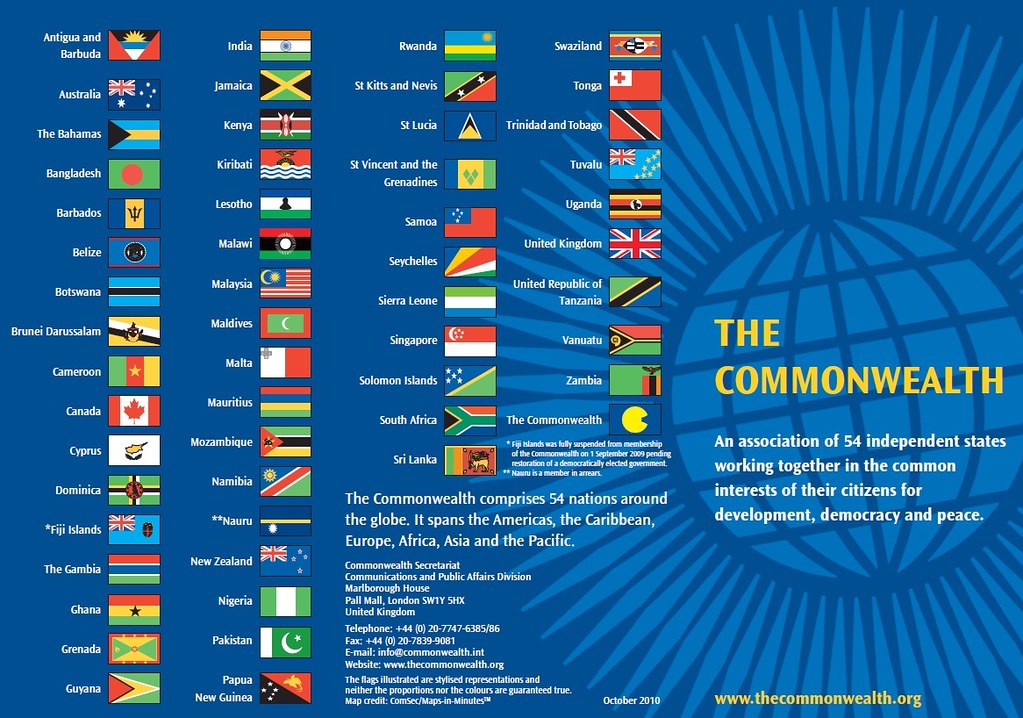
Samagi Jana Balawegaya (SJB) has lodged a formal complaint with the Inter Parliamentary Union (IPU) and Commonwealth Parliament Union (CPU) over the recent alleged attempted assault of MP Manusha Nanayakkara at the Parliamentary complex.

Chief Opposition Whip Lakshman Kiriella who had lodged a written complaint to CPU and IPU Secretary Generals has sought their intervention to prevent further undemocratic acts.

“I kindly call upon you as the secretary generals of IPU and CPU to intervene and to take all necessary measures required to prevent any further undemocratic actions by the government and to safeguard the parliamentary democracy of Sri Lanka,” Mr. Kiriella said in his letter.

Mr. Kiriella who had elaborated on the incidents which took place in Parliament had accused the Chief Government Whip Johnston Fernando and other government MPs of forcefully stopping the additional time that would have been given to MP Manusha Nanayakkara after the time of the debate was extended.

He said Mr. Nanayakkara approached the Speaker only to discuss with him the situation.

Mr. Kiriella in his letters accused State Minister Kanchana Wijesekera of verbally assaulting Mr. Nanayakkara.

He also accused several MPs including Mr. Wijesekera for trying to assault Mr. Nanayakkara at the lobby.

“ I firmly state that the attacks were provoked and were intended to be malicious. These are little more than mafia type actions by the government MPs.I further believe that the said actions of the government MPs were carried out with the intension of deterring the members of opposition from exercising their freedom of speech, inquiry and debate,” he further said in his letters to IPU and CPU leaders.

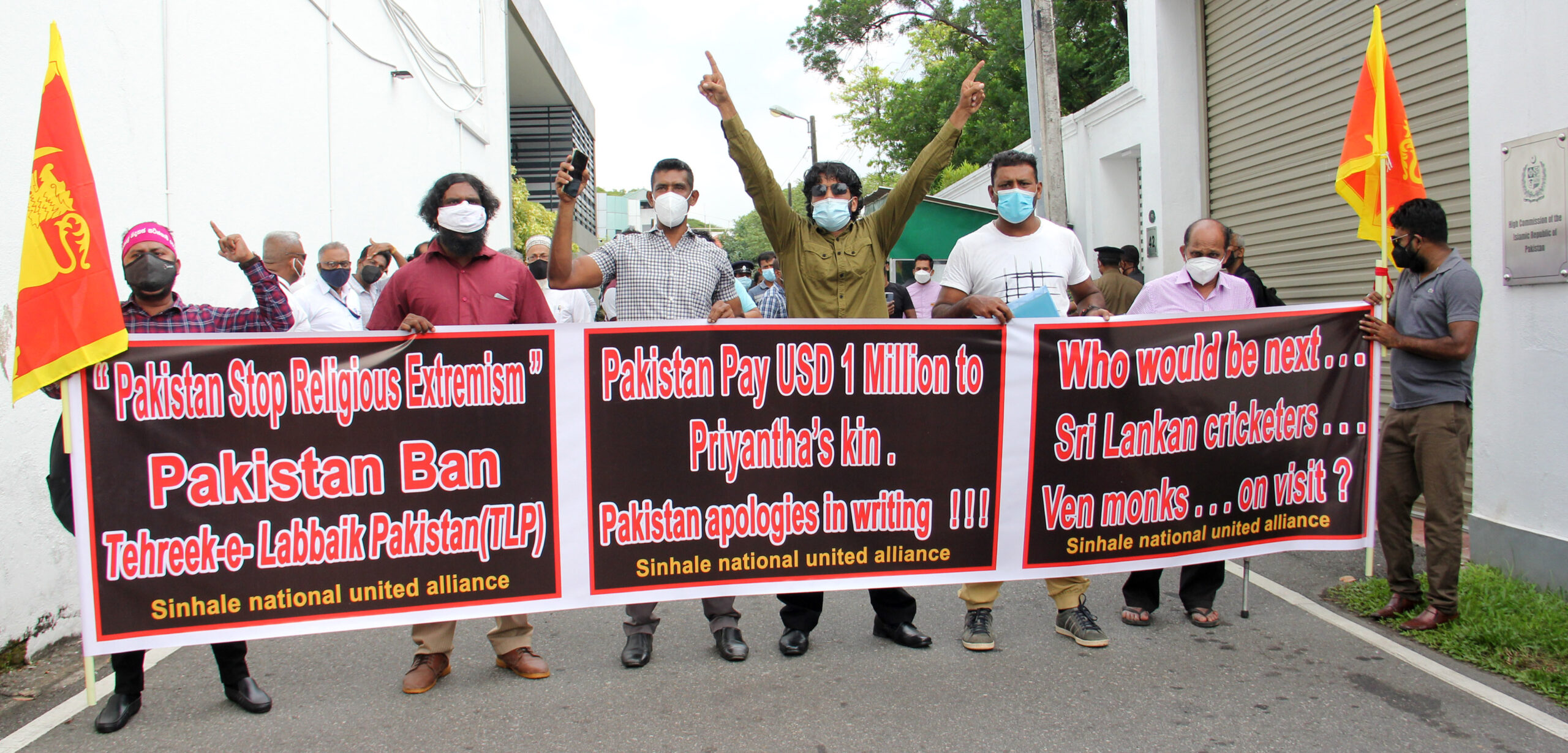
Demanding justice for Priyantha Demonstration outside the High Commission of Pakistan

At least ten associations staged a silent demonstration outside the High Commission of Pakistan today condemning the heinous attack on Nandasiri Priyantha Kumara in Sialkot, Pakistan and demanding justice for him. Multi-religious leaders were also present at the occasion.

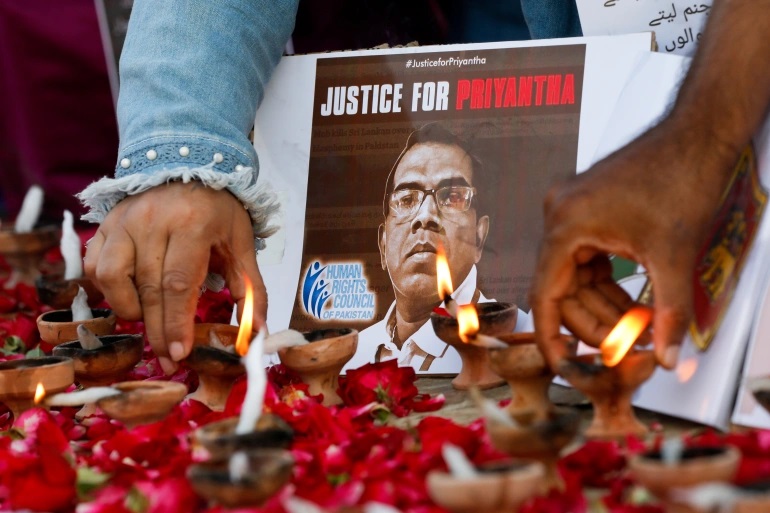
Lynched Sri Lankan man’s family seeks justice from Pakistan – ALJazeera

Pakistani police say they have arrested seven “prime actors” in the brutal mob lynching of a Sri Lankan factory manager over alleged “blasphemy”, as the man’s family say they are still struggling to make sense of the “inhumanity” of the killing while they make preparations for his funeral.

The body of Priyantha Kumara, 48, a general manager at a Pakistani textile factory in the eastern city of Sialkot, was due to arrive in the Sri Lankan capital Colombo on Monday afternoon, his elder brother Kamal Kumara told Al Jazeera.

“I have to tell the [the perpetrators]: please don’t do this, this kind of attack, don’t react inhumanly,” Kumara told Al Jazeera via telephone from Colombo.

“We are humans, no? We have to respect each other and each other’s religion.”

On Friday, the younger Kumara was accused of committing blasphemy against Islam at the factory he managed in Sialkot, a huge industrial centre located about 100km (62 miles) north of Pakistan’s second-largest city, Lahore.

Police say he was beaten with sticks, fists and kicks by a mob of dozens, before being dragged to the road outside the factory and set on fire. Social media footage of the attack showed dozens of young men chanting slogans associated with supporting Islam’s Prophet Muhammad, as some took selfies with the burning body.

Blasphemy is a sensitive subject in Pakistan, where certain forms of the crime, including insulting Prophet Muhammad, can carry a mandatory death sentence. Increasingly, blasphemy allegations have led to extrajudicial murders or mob lynchings, with at least 80 people killed in such attacks since 1990, according to an Al Jazeera tally.

The victim is survived by his wife and two children, aged nine and 14. Kumara’s family has asked the Sri Lankan government to request financial compensation from either the Pakistani government or Kumara’s employer for his immediate family.

“We believe that [Pakistani Prime Minister Imran Khan] will take serious action,” said Kamal Kumara. “I told [Sri Lankan officials to] please ask the Pakistani government to help his family, because he has a wife and two children who are alone, and they need to be educated.”

On Monday, a statement by the Pakistani police said they had arrested seven additional suspects, bringing the total number of those arrested for the attack to 131.

“These include those involved in planning the attack on the Sri Lankan manager, as well as those who tortured him and those who incited others,” said a statement.

Brutal killing shocks nation

Priyantha Kumara was the youngest of six siblings, and his mother has still not been told the details of how he was killed, his brother Kamal, 53, said. He said the family members have been tasked with keeping her away from social media and television news lest she sees footage of the attack.

“My mother is 80 years old, she is not well in health, and still we can’t explain to her what has happened,” he said. “She is crying continuously.

“We just told her there is some accident, we cannot say what has happened.”

Kamal Kumara and a second brother live in the Pakistani city of Faisalabad, about 175km (108 miles) southwest of Sialkot, where both also work in textile factories. Priyantha Kumara, a textile engineer, moved to Sialkot in 2010 to pursue work as an industrial engineer and later became a factory manager “because of better economic prospects”.

Kamal said all three Kumara brothers had never had any complaints while living in Pakistan.

“Many people are my friends, and other [Pakistanis], they have taken my number they are calling us and crying, they are saying that we [feel] shameful to talk to you, we are, all Pakistanis, with you,” he said.

The brutal killing has shocked Pakistan, with religious leaders, civil society and politicians across the spectrum condemning the murder. On Sunday, civil society groups held a small demonstration against the killing in the eastern city of Lahore.

‘Gone from this world’

On Friday, rights group Amnesty International called for an impartial inquiry into the killing.
“Authorities must immediately conduct an independent, impartial and prompt investigation and hold the perpetrators accountable,” Amnesty said in a statement.

“Today’s event underscores the urgency with which an environment that enables abuse and puts lives at risk must be rectified.”

Religious violence around the issue of blasphemy has risen in the South Asian country in recent years, with the rise of the far-right Tehreek-e-Labbaik Pakistan (TLP) religious group accompanied by an increase in violence against alleged “blasphemers”.

“[Priyantha] was not concerned [about this], because we are always focusing on our duty [and] at our company we are not having any religious discussions,” said Kamal. “We are respecting that they are religious, so we never got a bad impression, and we didn’t want them to have a bad impression from our side.”

A post-mortem examination of Priyantha Kumara’s body will be carried out by Sri Lankan authorities on Tuesday, with his funeral scheduled for Wednesday in his native Gampaha district, 20km (12.4 miles) northeast of Colombo.

His brothers, meanwhile, are debating whether they can return to Pakistan safely, and how to break the details of his death to their ailing mother, who suffers from diabetes and high blood pressure.

“We are struggling how to explain this thing to her,” said Kamal. “My brother is gone now, is gone from this world.”

Asad Hashim is Al Jazeera’s digital correspondent in Pakistan. He tweets @AsadHashim.