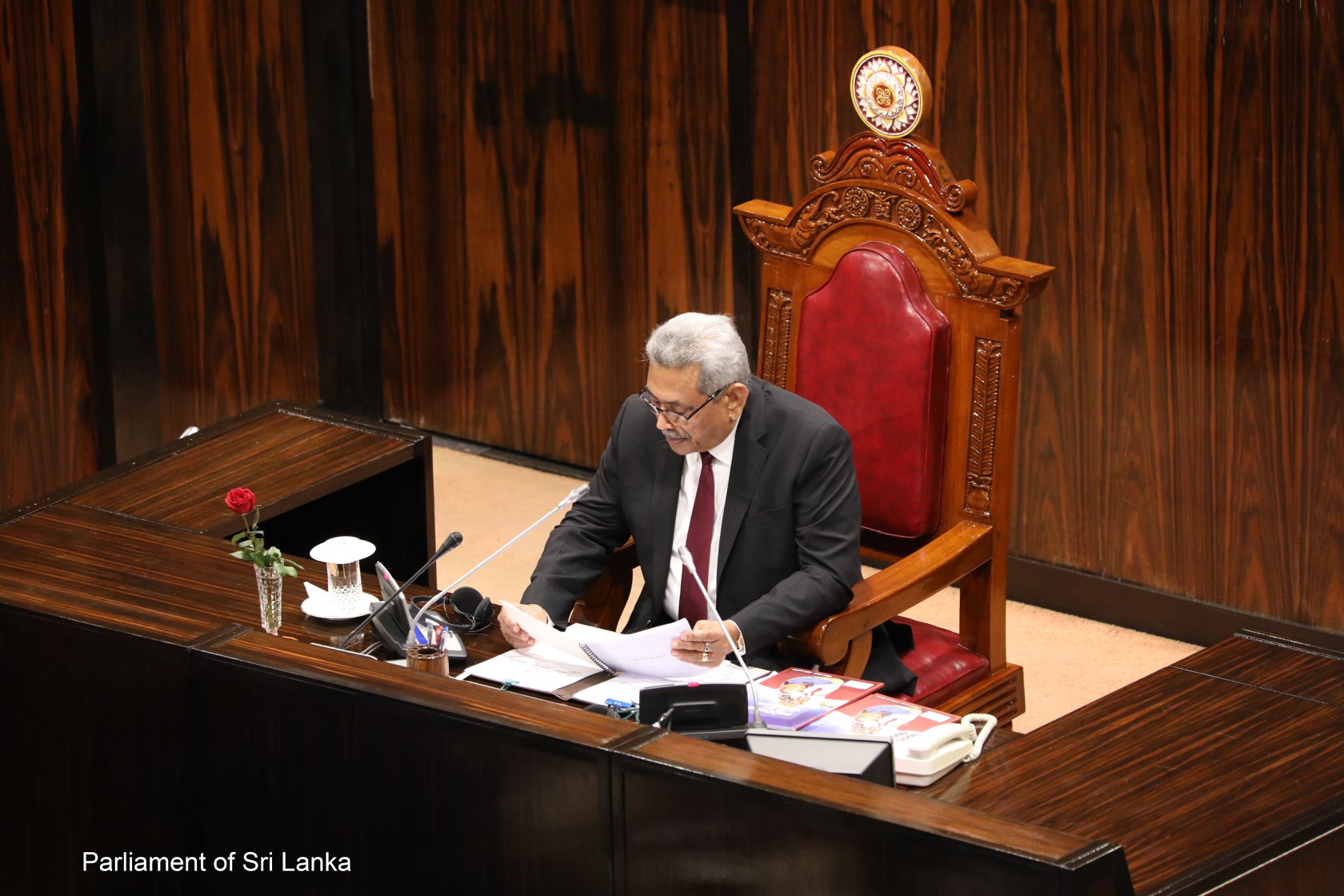
President Gotabaya Rajapaksa delivered a special address to the nation in a televised broadcast on Friday (June 25).
The full text of the President’s address to the nation is produced below:
The Most Venerable Maha Sangha, religious leaders of other faiths, Sri Lankan Brothers and Sisters, Friends and Dear Children,
Covid-19 global pandemic is the most serious challenge at this juncture not only for our country but also for each and every country irrespective of their development status. About 180 million people worldwide have contracted the virus while nearly 3.9 million people have died from it so far.
The developed countries, which initially suffered severely from coronavirus, have largely contained the risk of virus spread today since the majority of the population has been vaccinated. Although some vaccine-producing countries have easy access to the vaccine, there are others that have so far failed to secure any vaccine to their people.
I took special efforts in the recent past to bring down vaccines to Sri Lanka. I personally spoke to the Heads of State in countries like China and India. I also made requests by letters. I personally wrote letters to the Heads of State of Russia and other countries. We held discussions with vaccine-producing countries through our Foreign Ministry and through the Ambassadors and High Commissioners. Our officials coordinated with vaccine manufacturing companies.
All these efforts were made because I wanted to vaccinate all the people in our country.
As a result of these efforts, the country is now receiving a large number of vaccines that we need on a monthly basis. We only use the vaccines approved by the World Health Organisation (WHO).
So far, we have received 1,264,000 doses of AstraZeneca vaccine,
3.1 million Sinopharm vaccine doses, and 130,000 doses of Sputnik V vaccine.
Altogether, we have received a total of 4,494,000 vaccine doses.
At present, the vaccination drive is being carried out successfully in all provinces of the country.
In July, 4 million doses of Sinopharm vaccine and 2.5 million doses of Sinovac are expected to be received. Arrangements have also been made to obtain 2 million Sputnik V doses. In addition, 5 million doses of Sinopharm vaccine, 2.5 million doses of Sinovac and 2 million doses of Sputnik V are expected in August. By getting down 3 million more Sinopharm vaccine doses in September, we could vaccinate 13 million people by the end of September this year. Accordingly, we can vaccinate almost everyone over the age of 30 by that time.
This is a very satisfactory situation.
The people elected me as the President in November, 2019 with high expectations for the future of the country. I am committed to fulfilling those expectations, regardless of the seriousness of the obstacles. Similar to how we took on the responsibility to end the war against the LTTE terrorism which was considered an impossible task, I am committed to liberate the country from the difficulties it faces and bring prosperity to the people.
I always act according to a plan. When planning the future, we must not forget the past and should properly realise the present as well.
The main demand of the more than 6.9 million of people who voted for me in the 2019 Presidential Election was to stabilise the country by ensuring national security.
Back then, the people of this country were terrified of religious extremism. With the attacks on Easter Sunday, the people realised that the security apparatus of our country had been greatly weakened.
Our intelligence services were weakened due to many ill-advised decisions taken by the previous government. Our security forces were challenged and discredited internationally. Our places of worship were forcibly occupied. Archaeological sites were destroyed out in the open. The terrorism, which we ended in 2009, had re-emerged in a more dangerous form.
We have made great strides in ensuring national security once again. The most suitable officers were appointed to responsible positions. We have re-strengthened the morals of the security forces which had deteriorated owing to various harassments. The intelligence services that were weak at that time have been reorganised. We have reactivated the security plans that were abandoned during the previous government’s tenure.
We successfully contained the underworld which was becoming a major threat to the country. Although it is difficult to solve at once, the drug menace has been largely brought under control. We are implementing a programme to eradicate this menace completely.
We went through a period where making comments about our character, our culture and nationality was a cause for insult and ridicule. We have changed that. During this short period of time, we have created a peaceful environment in which members of all communities and people belonging to different religions can live with dignity without causing harm to others, while preserving their identities.
We have safeguarded the cultural and religious heritages such as the Muhudu Maha Vihara, Kuragala and Deegawapiya which were threatened in the past.
Today, the people of this country no longer have a reason to fear for the unity of the country. This government will not allow anyone to interfere in the internal affairs of our country.
My government has ensured national security.
One of our major challenges was to rebuild the economy which was in ruins. We came up with a sound plan for that purpose.
The people need to be aware of the key challenges we have faced over the past 1 and 1/2 years and how we have faced them.
When President Mahinda Rajapaksa handed over the country to a new government in 2015, we had a strong economy. The economic growth of 7% was only second to that of China in Asia. Foreign investments were flowing in, the rupee was stabilised, foreign reserves were strengthened, the debt burden was being eased and the whole country became a workplace and a rapid development was taking place.
During the previous government’s tenure from 2015 to 2019, there were no natural disasters in the country. There was no global crisis like Coronavirus at that time. However, simply because of the failure of the state administration, the economy of our country began to collapse without a just cause. By 2019, the country’s economic growth rate slowed down to 2.1%. The debts of the country had increased to Rs. 13,000 billion from Rs. 7,400 billion. The tax burden on the people had doubled. The rupee destabilised and the prices of commodities skyrocketed. Export earnings had declined and foreign reserves had depleted.
I acquired an economy that was in ruins. However, we understood that reality well and accepted that responsibility with a plan.
However, the global coronavirus pandemic, which unexpectedly devastated not only our country but also the entire world, created an environment in which those plans could not be implemented as we had expected.
Less than a month after I became the President, the Covid-19 pandemic broke out in China and began to spread around the world. At that time, no country possessed the required knowledge to provide medical facilities regarding this virus. Even the World Health Organisation was taken by surprise.
We set up a Presidential Task Force comprising of doctors, health professionals, competent administrators, and security forces chiefs to deal with any situation that may arise as soon as we learnt the risk of a pandemic.
Foreign students studying in Wuhan, China, where the virus broke out, became helpless and 34 students from our country were also among them. We took swift action before other countries and were one of the very first countries to send an airplane to China in accordance with health guidelines and safely bring back all 34 Sri Lankan students stranded in Wuhan. By quarantining them in an army camp in Diyatalawa and releasing them to their families, we set a good example to other countries of the social responsibility of a government.
When the first coronavirus cluster emerged in Sri Lanka, the country was put under a lockdown in time, various restrictions were imposed and the public was made aware of health and safety guidelines. The government intervened and treated all those who contracted the virus. All those who came in contact with them after they contracted the virus, were traced with the help of the intelligence services and quarantined. Accordingly, we were able to successfully control the first wave of the coronavirus. When other countries were severely affected by the coronavirus pandemic, no patient was reported from Sri Lanka for about three months.
No country can continue to function with its airports and ports closed for long. The helpless citizens stranded abroad should be brought back. Imports and exports have to be done at least under some sort of control. Due to this unavoidable global connectivity, no country has been able to completely prevent the re-entry of the coronavirus. By shutting down the country, the risk can be controlled only temporarily.
When the second wave of coronavirus emerged, a new variant of the virus began to spread rapidly. This was especially the case in the factories, fish and vegetable markets.
In order to successfully control the coronavirus, the people must responsibly support the strict social distancing laws imposed by the government. But you all know that despite the numerous advices to restrict travel in Sri Lanka and to be responsible in terms of health, some communities did not fully support it.
However, the second wave was also largely controlled by the beginning of this year.
Today, we are facing a third wave of coronavirus as a consequence of the people travelling in large groups in an improper manner during the Sinhala and Tamil New Year. A number of different strains of the virus have now entered into the country. The high transmissible nature of the new variants has created a more dangerous situation than ever before. The human resources and other facilities available to the health sector are inadequate to urgently deal with the situation when the virus spreads rapidly and the number of infected people increases alarmingly. Therefore, the government had to shut down the country again.
In the fight against such a pandemic, we, like many other countries in the world, have to shut down the country from time to time, but we must understand the consequences of that decision. Accordingly, various rules had to be put in place. The number of workers in factories and institutions had to be limited. However, this situation gravely affected our industries. In particular, the apparel industry which brought in about US $ 5 billion revenue to Sri Lanka suffered a heavy loss. Their orders were suspended. Many lost their jobs. Export earnings declined.
Due to the closure of industries in foreign countries, our migrant workers began to return. Many of them lost their jobs. Over 200,000 migrant workers who returned to Sri Lanka because of the pandemic have not yet been allowed to return to those countries. The remittances received by Sri Lanka decreased as a result of this.
When we formulated the Vistas of Prosperity and Splendour Policy Statement, we had high hopes for the tourism industry. We made plans to grow the tourism sector from an industry of US$ 4.5 billion to US$ 10 billion by 2025. But today, the tourism industry of the whole world is in crisis. Airports are closed and travel is restricted. As a result, our tourism industry which directly and indirectly helped more than three million people to generate their income has completely collapsed. Hundreds of thousands of direct and indirect jobs have been lost. Hundreds of thousands of self-employed people have lost their sources of income and those who were involved in that field are now facing difficulties.
Another key expectation in our development plan was the construction industry. We wanted to revive the collapsed construction industry. This sector has been hit hard by the occasional closure of the country. The construction companies are unable to bring in the workers as they require. It is not possible to obtain the raw material at the required time. Over the past one and half years, we have lost most of the expected local and foreign investments.
Due to all these factors, we did not receive the amount of foreign exchange we had originally planned. We have to manage foreign exchange more carefully in such a situation.
Small and medium enterprises are another important sector of our local economy. The coronavirus pandemic was a major issue for these businesses, which account for more than 50% of the GDP. Due to the continuous disruption of their business activities, these companies lost revenue and faced serious problems as they were unable to repay their loans or pay salaries. People had no money to spend. Those who obtained leases for vehicles could not pay the installments. Housing loan borrowers could not settle the loan installments. Those who borrowed money on a daily basis to conduct businesses were inconvenienced without customers.
The government took steps to give them extra time to pay off their debts to get them out of this situation. Accordingly, the government allocated over Rs. 400 billion to provide loan deferral facilities to small and medium enterprises.
After we came into power, the Opposition accused us of reducing government revenue due to tax cuts. But if we had not done so then the people would have been under even more pressure in the context of the COVID-19 pandemic. The previous government had imposed a heavy tax burden on the people. Direct and indirect taxation had doubled during the period of 2015-2019. As soon as we came into power the people were released from that pressure. Despite all these obstacles, we fulfilled our responsibility of supporting people to maintain their everyday life.
The government annually allocates budget funds to create a conducive environment that allows supporting the public finance environment. A total of Rs 560 billion is being spent and among those budgetary allocations Rs. 50 billion will be utilised for Samurdhi programme, Rs. 90 billion for provision of free medicines and Rs. 40 billion to enhance the welfare of disabled soldiers, Rs. 250 billion for the payment of pensions, Rs. 35 billion to provide fertilizer subsidies to farmers and the Treasury has allocated Rs.25 million to provide uniforms, textbooks and nutritious meals to the school children. Rs.70 billion have been annually allocated to provide various other reliefs including maintenance of loss making state institutions. The government has to bear a number of new expenditures to deal with the coronavirus crisis.
Every time the country is shut down due to COVID-19 risks, we spend around Rs. 30 billion in each round to provide an allowance of Rs. 5,000 for daily wage earners who lost their work due to Covid-19 situation. At present the government has borne this cost on a number of occasions. The government incurs a number of additional costs related to the health sector in relation to the coronavirus pandemic. The government has incurred additional costs to conduct PCR and antigen tests, to treat identified infected persons and to set up a number of new treatment centers.
In addition to the cost of quarantine centers maintained by the government, each family quarantined in their own homes were provided with a relief package worth Rs. 10,000 for two weeks.
Since the beginning of the coronavirus crisis the government has spent over Rs. 260 billion to provide relief to the people.
When the expenditure on support measures relating to the COVID-19 crisis is added to the planned subsidies, it is about half of the country’s total government revenue of 1,380 billion rupees last year.
Thus, despite the dire situation caused by the coronavirus pandemic, the government has never taken actions to reduce the salaries or allowances of more than 1.4 million public servants.
Even though our foreign exchange reserves declined, the government has not defaulted on loan installments that should be paid to foreign financial institutions. We had to pay a huge loan installment of about US $ 4 billion a year as a result of loans taken by various governments in the past. The Opposition socialized a view that the government would not be able to repay these loans. But we did not discredit the country and repaid all the loans on time.
Under these circumstances, it is the responsibility of the government to prevent the occurrence of a foreign exchange crisis. So as a government we had to take some harsh decisions. That is why we had to ban some non-essential imports, especially the importation of luxury goods. These are not the restrictions that we expect to maintain forever. We hope that intelligent people, who love the country, see the future and identify the needs of the time and will extend their help to us to overcome this crisis.
One of the weaknesses of our government was that our development works were not properly communicated to the people. In this context, the people witnessed only problems through media platforms. Only questionable events were discussed on social media. Therefore, no one talked about the benefits received to the country and the people from the development projects carried out by the government amidst the coronavirus crisis.
People should be aware of the development works done by the government even if it does not carry out propaganda activities to inflate personalities. Otherwise, the government’s opponents will have the opportunity to spread false information based on political agendas. As a result of this situation, truth is being overshadowed today by lies.
It was a great blessing during the coronavirus pandemic that we paid special attention to the importance of food security in the country while building a people-centric economy. We did not have to face such problems when countries that depended on imported food were in trouble.
Through our policies we have been able to revive the local agricultural sector.
We strengthened the paddy farmer by providing a guaranteed price for paddy. Fertilizers provided free of charge.
A good price was received for tea, coconut, rubber and cinnamon yields recently.
The ban on the import and re-export of agricultural products that can be grown in Sri Lanka created a good market for crops such as pepper and turmeric.
Our sugar factories are making a profit today because the importation of ethanol has been completely banned.
Many people who were not interested in the agricultural sector in the past, have now engaged in various agricultural projects, as a result of giving due respect to this sector.
We have initiated a massive programme to rehabilitate 14,000 tanks throughout the country to uplift the agricultural sector. Through this we have the opportunity to cultivate thousands of unutilized paddy fields and abandoned agricultural lands.
We have taken several important steps towards building a sustainable development policy that is resilient to environmental and climate change.
Another important step in this process is the decision to ban import of chemical fertilizers into the country.
There has been a debate in our country on this issue over decades. The use of chemical fertilizers introduced to this country about 45 years ago has become a major social threat to our country.
The widespread use of these chemicals has contaminated the soil and the water, and many experts believe that it has directly led to the increase in cancer and kidney diseases. The harm caused to human life by the use of chemical fertilizers must be identified and remedied.
Although there has been a great deal of discussion in society about the long-term damage it causes to the people’s lives, no government has ever had the ability to make a direct decision in this regard. 6.9 million people of this country approved the promise to move away from the use of chemical fertilizers and direct the country to the use of organic fertilizers. Therefore, I am committed to fulfilling that pledge stated in the National Policy Framework, “Vistas of Prosperity and Splendour”. It is the responsibility of the present generation to implement that policy for the benefit of our future generations.
Stopping the importation of chemical fertilizers into the country is not a hasty decision. Prior to the implementation of that decision, stocks of fertilizer required for the forthcoming season had been imported. Already 300,000 metric tons of fertilizer required for 1 and 1/2 million hectares of cultivated land has been distributed. At the same time, about 8,000 metric tons of organic fertilizer have been distributed.
The Government guarantees that all organic fertilizer required for farming will be provided for the forthcoming Maha Season.
With this policy decision, a large number of entrepreneurs and companies have come forward to produce organic fertilizer in the country.
I would like to remind you how the war, which has plagued us for nearly three decades due to changing policies from time to time, ended in a short period of two and a half years under a straightforward policy. We should not take back the step which was taken based on the constructive reasons that are beneficial to the country.
Now we need to gradually increase the use of organic fertilizers. Together as a nation, everyone must join hands for this.
Local, as well as foreign experts, pointed out to us that we, as a country can certainly expect long-term benefits from the use of organic fertilizers. Soil fertility increased productivity and higher income earning can be expected, among the benefits we have is the opening up of a larger market for agricultural products and a healthier population.
If humans’ external influences on the natural environment are stopped, the environment will soon be able to repair the damage done to it. At one point when the first wave of COVID-19 began, almost every country in the world was locked for weeks. At that time, the polluted air in those countries was almost automatically cleaned. This conveyed a very good message to the world. That is, if man does not harm the environment, the environment will be activated and humankind will be protected faster than expected.
There was an opinion that in order to compete in the world market, our tea had to be mixed with imported tea or other ingredients. But the government was adamant that the quality of our tea should be protected. As a result, factories were able to earn about 83 rupees more per kilo of tea than in 2019. By 2021, not only will these prices rise further, but tea production will also increase, generating foreign revenue of Rs. 81 billion for the tea industry in the first four months of 2021. This is an increase of 17 billion rupees than the first four months of last year. Compared to other countries in the world market, our Ceylon tea received the highest value of $ 4.82 per kilo in foreign exchange. This is a good example of how the results of the difficult, but correct, decisions we make can be successful.
Even those who are of the opinion that agriculture cannot be developed without chemical fertilizers will surely see the long-term economic benefits of this decision in the future. Today, there is a great demand around the world for the products produced utilizing organic fertilizers. When Sri Lanka is internationally recognized as a country that does not use chemical fertilizers, a huge market opens up for us. Farmers and entrepreneurs can expect a very good price for their produce from it. There is a huge demand for organic food in the world. This is a unique opportunity for the country. Therefore, the intelligent entrepreneurs should be prepared to reap the benefits of a prosperous future, rather than complaining about the current difficulties.
The housing development is another area that my government has paid special attention to.
Even after 72 years of independence, nearly 6 million families in the country still do not have a proper residence to live in. Many still live in semi-finished houses or in rental houses with fewer facilities. Many more live in shanties. Residents may not be able to further develop the house because they do not have a deed to their land. We will change this situation and create an environment where every family living in this country can have a suitable home to live in under the theme of a happy family.
Accordingly, we have resumed the rapid implementation of housing development projects that we had successfully carried out before 2014.
Over the next four years, we hope to construct 300,000 houses through projects implemented jointly by the government and the public and private sectors.
Meanwhile, 60,000 urban houses and 200,000 rural houses will be constructed. Our plan also includes 40,000 estate houses and rental houses.
More than 20,000 of these houses are under construction. Another 10,000 will be constructed before the end of this year.
Under the previous government, only 450 flat units were constructed for the benefit of low-income families. Nevertheless, at present, we are building around 7,000 flat units for low-income earners.
Construction works have commenced building 3,000 flat units for middle-income earners.
Under the ‘One house per one village’ programme, 14,000 rural houses are being constructed.
As another step towards eradicating poverty among the rural population, the programme to provide cultivable lands to landless families is progressing very successfully. So far more than 20,000 families have been given an acre plot of land.
A programme is also underway to issue legal deeds to more than 100,000 landless people who have traditionally settled for many years.
Providing access to safe drinking water for all is a very important promise made in the “Vistas of Prosperity and Splendour” policy statement. A number of large scale water supply projects such as the Kelaniya South Bank and Deduru Oya initiated by President Mahinda Rajapaksa had been hindered during the era of the previous government. As stated in our election manifesto, as soon as we came into power, our government invested Rs. 50 billion to restart these projects. Accordingly, we have been able to increase the safe drinking water coverage from 41% in 2019 to 52% by now. Our goal is to increase that figure to 79% by 2025. Under this, we hope to launch Alawwa – Polgahawela, Matugama Agalawatta, Wisal Matale, Anuradhapura North, Colombo East, Medirigiriya and Galle cluster water supply projects by 2021.
The total cost of this project is over 100 billion rupees.
Employment opportunities for unemployed graduates is one of the main demands made to us during the election campaign. Accordingly, as soon as the government was appointed, steps were taken to provide government employment to 65,000 graduates who were unemployed at that time. In addition, we have planned to employ 100,000 young people from underprivileged and financially challenged families under the Multi-Task Force Department. Under the first phase, 35,000 youths have been recruited and sent to government institutions island-wide for their training. Upon completion of the training, all these individuals will be attached to the primary grade posts in various government institutions. We will recruit others as well.
We also shared our thoughts about the education field during our election campaign.
Due attention was paid to education as promised. Although the schools were often closed due to COVID-19 in the past, we have made great strides in distance education and have continued to provide the educational facilities that children needed.
Tens of thousands of schools have been provided with fiber optics internet connections. More schools will be provided with this facility.
In addition to the existing 373 national schools, 1,000 schools will be elevated to national schools. These schools have already been identified and at least three schools in each Divisional Secretariat Division have been re-classified as National Schools and funds have been allocated to improve their physical facilities and standards.
The number of students admitted to universities annually has already been increased by 30%. Accordingly, in addition to the usual 20,000 admissions, additional 10,000 students were enrolled in the universities last year. No other year has seen such an increase in the number of students entering universities in one year since independence.
Moreover, we are all set to enroll 10,000 new students for technology-based degrees at open universities this year and to provide them with on-the-job education from the first year.
Last May, Gampaha Wickramarachchi University of Indigenous Medicine joined the National University System as the first Indigenous Medical University in Sri Lanka. The University of Vavuniya is scheduled to open in August as the second university to open this year.
The Siddha Medical Units of the Universities of Jaffna and the Eastern Provinces will be upgraded to University Faculties and the Sir Ponnambalam Ramanathan Faculty of Performing Arts will be established at the University of Jaffna to promote the performing arts.
In fulfillment of our promise made during the election campaign, all arrangements are in place to unite all the Teacher Colleges in Sri Lanka and establish a National Teacher Training University and mobilize all State Nursing Schools and bring them under one National Nursing University.
Cabinet approval has already been granted to build a National University of Plantation and Agriculture by amalgamating all existing research institutes related to the plantation industry and agriculture.
In addition, plans are being made to select 10 districts without higher education institutions and build City Universities.
A sophisticated programme is in motion to develop technology-based education in the country. We have taken steps to keep the entire university system online even during the COVID 19 pandemic.
We have allocated funds to build new faculties in every university to increase the number of students studying Science, Technology, Engineering and Mathematics (STEM) streams.
In this budget, we have approved an allowance of Rs. 5,000 for students studying in technical institutes.
Completion of the expressway system planned during the Mahinda Rajapaksa era is a vital investment for the future development of our country. Therefore, we have revived this programme which was slow during the previous administration. The Mirigama-Kurunegala section of the Central Expressway is currently under construction. It is expected to be completed in about three months. The Kadawatha-Mirigama section, which is about 15 km long, will be completed by the end of 2023. The Dambulla- Kurunegala section will also commence soon. An important section of the road to Kandy, from Pothuhera to Galagedara has now commenced and will be completed by 2023. Accordingly, people will have the opportunity to travel from Colombo to Kandy on the Central Expressway by 2024.
The construction of the expressway from the Kelani Bridge to Athurugiriya via Rajagiriya on concrete pillars and the expressway from the Kelani Bridge to the Port City has been commenced. They will conclude by 2023.
The new Kelani Bridge with six lanes and its affiliated junction is expected to open this year.
In addition, about 25,000 km of the 100,000 km road construction programme planned by the government is almost complete.
Five flyovers in Colombo and one in Kandy are being constructed as a solution to traffic congestion. In addition, the construction of nine multi-car park buildings has begun to cover highly populated cities.
We recently commenced the first phase of the Ruwanpura Expressway. This expressway will be completed by the end of 2023.
Everyone understands the need for infrastructure for the development of the country. In the recent past, our government was attentive to the development of all types of infrastructure, not just housing and roads.
Provisions have been made to restore 14,000 rural tanks and construct 10,000 bridges by 2021 and most of them have already commenced. More than 1,000 playgrounds are being built across the country. Rural hospitals are being renovated. Development work of 100 small and medium scale cities will be completed this year under the ‘Hundred Cities’ programme.
We have taken a policy decision to implement all urban beautification projects as green projects. Urban parks are planned in all major and suburban areas. The Muthurajawela Wetland, which caused a great deal of controversy recently due to unauthorized constructions and garbage disposal, has been taken over by the government and has been approved by the Cabinet to be conserved as a Ramsar Wetland.
Technology parks are being set up in Galle, Kurunegala, Nuwara Eliya, Kandy and Dambulla to help promote a technology-based society.
One of our foremost promises is that by 2030, 70% of Sri Lanka’s energy needs will be generated from renewable energy sources. We have taken a number of steps to implement this policy.
Under the “Power Plant for a Village” programme, work has commenced on the construction of 7,000 small rural solar power plants with a capacity of 100 kilowatts through local investors, which will add 750 megawatts to the national grid. The construction of the Mannar Wind Power Plant with a capacity of 100 MW and the Poonaryn Wind Power Plant with a capacity of 240 MW has already commenced. The 120 MW Uma Oya and 35 MW Broadlands Power Plant will be completed this year. The Moragolla Hydro Power Plant with a capacity of 31.5 MW will be completed in 2023. The first project to generate electricity from urban solid waste was launched at Kerawalapitiya. In addition, the construction work of the first natural gas power plant in the country with a capacity of 300 MW has commenced at Kerawalapitiya and 300 MW of capacity will be added to the power generation system by 2023. A capacity of 340 MW has already been added to the national grid through 30,000 rooftop solar panels.
Moreover, with the loan facility of Rs. 20,000 million signed with the Republic of India on June 16, steps will be taken to install solar panels on the roofs of government offices.
Under the “Deyata Eliya” project, over 100,000 impoverished families will be provided electricity free of charge.
Our Government has identified the strengthening of irrigation management systems and strategies as an urgent national need. Under this endeavor, we took action to empower the existing irrigation systems and to construct new irrigation systems. As one of the foremost steps, work on 10 selected irrigation projects has been expedited.
Accordingly, development work on the North Central Province Main Canal and the North-Western Province Main Canal has commenced with a view to meeting the drinking and irrigation water needs of the dry zone representing the North Western, North Central and Northern Provinces. Development work on the left bank canal of Minipe is nearing its completion.
Through the Kumbukkan Oya Reservoir Project, measures will be taken to provide drinking water to the people of the Monaragala District who are constantly affected by water shortages and to provide irrigation water for cultivation in the two seasons.
The drinking and irrigation water needs especially in the Mannar and Anuradhapura Districts and the Eastern Province are being met through the Lower Malwathu Oya and Mundeniyaru Irrigation Project.
The government spends a considerable amount of money annually on the importation of medicinal drugs. In order to minimize this cost, we have taken steps to increase local drug production through the State Pharmaceutical Corporation. Accordingly, the Corporation currently manufactures drugs in excess of its maximum production capacity. This year alone, the State Pharmaceutical Corporation will manufacture 65 drugs locally, including seven new drugs for the hospital system. Thirty six drugs out of these, are produced procuring raw materials locally. It has helped the country save a large sum of money spent on imports.
Preliminary procurement work has already been completed for the commencement of the construction of three pharmaceutical factories in the Millewa area in Horana as an anti-cancer, orthopedic and general pharmaceutical factory. The ultimate goal of all these projects is to meet the domestic drug demand within the country itself and thereby save a large amount of foreign exchange in the country.
In addition, several public-private partnerships affiliated to the State Pharmaceutical Corporation have already established pharmaceutical factories.
We now have the opportunity to attract local and foreign investors to the newly added 269 hectares of land to Sri Lanka, Colombo Port City. After the Port City Economic Commission Act was passed in Parliament, I appointed a Commission consisting of 100% Sri Lankans. The Cabinet and Parliamentary Finance Committee have already approved a $ 400 million commercial building with two towers as the first investment for the financial city we hope to build.
A few days ago we held an international conference on investment opportunities in Sri Lanka via Zoom. The enthusiasm shown by local and foreign investors sends a positive message about the potential for investments in our future development. If we can achieve success in terms of foreign investment which would be on par with the other rapidly developing countries in the region, it will be a great help to strengthen our country’s foreign reserves. The people of our country can expect many direct and indirect benefits through this. We hope to open up these investments to the general public in our country by giving them the opportunity to be listed on the Sri Lankan stock market.
We have always respected the rule of law in public administration. Public servants can perform their duties without fear. When I came to power I did not politicize any appointment. Appointments were made based on merit. That justice was done at the highest level in the appointment of judges to the Courts and in the appointment of the Attorney General.
We have been given another opportunity to correct past mistakes and move forward. We can only prosper if we work hard with a proper plan. When history is written, it will mention the hard times we are now in. But amidst those difficulties, it is up to us to decide whether we will succeed or not.
When I contested the Presidential election, many of my supporters asked me to take the leadership placing the country as their priority. They did not make personal requests from me. But after I came to power, some people were angry with the government for not fulfilling their personal demands. They are now criticizing the government. They are in an attempt to spread that the government is a failure, in order to discredit it. What I want is not to change my policies to please a few, but to implement the Vistas of Prosperity as I promised.
I am ready to lead you today as I did then. I will fulfill my responsibility without failure. I believe that the wise people who love the country and are ready to take responsibility for future generations will continue to support me and my government in achieving our goals.
I wish you all the best!