US & UK issue travel advisories to Sri Lanka

The United States of America and the United Kingdom issued travel advisories to Sri Lanka over the weekend.

United States of America:

The Centers for Disease Control and Prevention (CDC) has issued a Level 2 Travel Health Notice for Sri Lanka due to COVID-19, indicating a moderate level of COVID-19 in the country.

This advisory was issued on the 21st of April 2021.

United Kingdom:

Travel to Sri Lanka is subject to entry restrictions

Entry to Sri Lanka is subject to arrangements for quarantine and PCR testing.

This advisory was issued on the 26th of April 2021.

Posted in Uncategorized

Port City Bill: ASG presents amendments; petitioners see threat to sovereignty

After five days of exhaustive arguments, a five-judge Supreme Court bench on Friday evening concluded hearings into petitions challenging the constitutionality of the Port City Economic Commission Bill.

As lawyers for the petitioners argued that sections of the Bill violated the Constitution, the Attorney General insisted it had been drafted with the sole aim of advancing the country’s economy and was a reflection of government policy.

A total of 19 petitions had been filed challenging the Bill, with the petitioners urging the court to declare that it was in contravention of the law and it should be withdrawn, or rule that it should be passed by a two-thirds majority in Parliament and a referendum.

The court’s decision on the Bill will be conveyed to the Speaker in the coming days.

The bench comprised Chief Justice Jayantha Jayasuriya, Justices Buwaneka Aluwihare, Priyantha Jayawardena, Murdu Fernando and Janak De Silva.

Roland Perera, PC, appearing for United National Party (UNP) Chairman Vajira Abeywardena said the Bill would be harmful to the legislature, the judiciary and executive powers of the country.

The Bill should also be sent to the Provincial Councils for their approval since it contains subjects that come under the Provincial Councils List in terms of the relevant Act. Not doing so will be a fundamental violation of the Constitution, he contended.

The Bill paves the way for the creation of a federal state, argued Ikram Mohammed PC, appearing for Bar Association of Sri Lanka (BASL) President Saliya Pieris PC.

Certain laws that cover the rest of the country won’t apply to the Port City. This includes provisions under the Finance Act. Accordingly, the legislature will not have control over monetary transactions being conducted in this area. Provisions of the draft Bill curtail the powers of the legislature to control state finances, he submitted.

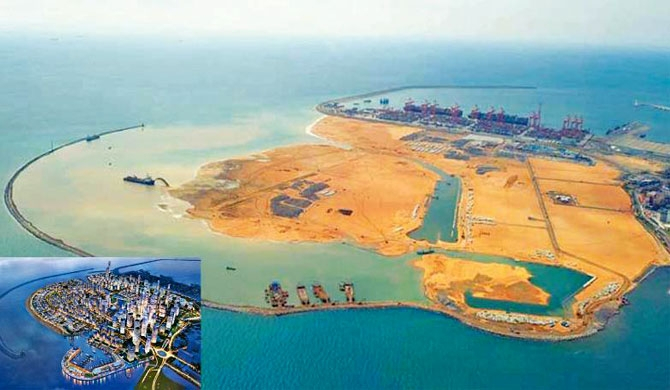
President’s Counsel Kanag-Isvaran PC, appearing for the Centre for Policy Alternatives and Transparency International, pointed out that the Port City is an artificially constructed island.

Recognising it as a separate entity outside the administrative control of Sri Lanka will be a death blow to the sovereignty and territorial integrity of the country, he stressed.

The Constitution’s Article 3 and 4 vest Parliament with powers to control public finance. However, Clause 40 of the proposed Bill violates these two articles of the Constitution, he said, warning that the Bill exempts regulatory oversight of offshore banking and other industries. This, in turn, could lead to money laundering and other fraudulent activities within the proposed Port City Special Economic Zone, Counsel Kanag-Isvaran contended.

The Bill confers the proposed Port City Commission powers to transfer, lease or sell land within the Port City. It also empowers the Commission to grant visas to foreigners coming to work in the Port City. Moreover, investors in the Port City are not liable to pay taxes, he explained.

The appointment of the Port City Commission violates the Constitution, submitted M.A. Sumanthiran PC, appearing for petitioner Gamini Viyangoda. He pointed out that the entire Commission is appointed by one person and there is no mention of the qualifications they must hold. Even foreigners can be appointed to the Commission, he noted. He also stressed that in its current form, the Port City will not bring benefits to the country.

The act of conferring the Port City with the Port City Commission is a blatant violation of the Constitution and the Bill paves the way for the creation of a separate state, insisted Wijedasa Rajapakshe PC, who appeared for Muruththettuwe Ananda Thera.

He noted that the Bill transfers presidential powers to an unknown Commission. Delegating presidential powers in this manner is a violation of the Constitution, he told the court, adding that workers in Port City will be paid in foreign currency and not Sri Lankan Rupees, and this is also a violation of the Constitution.

The Bill’s Clause 7 (1) Bill confers an arbitrary power on the President to appoint even non-citizens to the Commission, claimed Thisath Wijayagunawardane PC, representing Samagi Jana Balawegaya (SJB) General Secretary Ranjith Madduma Bandara. Thus, the Bill leaves room to run the Commission entirely or with a majority of foreigners, he pointed out.

If the Commission consists of all or a majority of foreigners, a body controlled by foreigners would be exercising extensive powers over a portion of the territory of Sri Lanka and over Sri Lankan citizens, and this would certainly affect the Sovereignty of Sri Lanka and its citizens, he said. He also noted that the arbitrary power vested in the President to appoint citizens of any country to the Commission interferes with the Sovereignty of the People and of the Republic.

He also noted that Clause 30 (1) empowers the Commission to be the sole authority in determining who may engage in business in, invest in, reside in, be employed in, or visit, the Colombo Port City. He submitted that as such a large concentration of power being vested in the Commission, Clause 30(1) is inconsistent with the Constitution.

Appearing for Presidential Secretary Dr P.B. Jayasundara, an intervenient petitioner, Romesh De Silva PC told court that COVID-19 had drastically impacted the economy with many Sri Lankan migrant workers returning to the country after losing their jobs. He claimed that such persons will be able to obtain jobs through the Port City project.

The Commission will consist of not less than five and not more than seven members. All of them will be appointed by the President. According to Articles 2 and 4 of the Constitution, the sovereignty of the people is exercised by the President. Foreigners can be appointed to any Commission in the country. Some Commissions can be composed entirely of foreign nationals, he said.

Additional Solicitor General (ASG) Farzana Jameel PC told court there was no need for the Government to refer the Bill to the Provincial Councils for approval as its contents refer to the country’s national economic policy.

She told court that the Presidential Secretariat had already submitted several amendments to the Bill to the Attorney General for consideration, and presented those amendments to court. Chief Justice Jayantha Jayasuriya ordered that these amendments also be handed over to the petitioners and intervenient petitioners for study.

The Bill does not give limitless powers to the Port City Commission, ASG Jameel insisted. The Commission, whose main purpose is to direct business activities at the Port City, is appointed by the President, who is answerable to Parliament. Any member of the public can go to court against his appointments to the Commission, she noted. As such, the Commission comes under the jurisdiction of the courts, she pointed out.

She argued that the land in which the Port City was built falls under the Crown Lands Ordinance of 1960 as it comes within the coastline of Sri Lanka. Under international law, everything along the coast belongs to the country. As such the Port City land belongs to the State, she stressed.

The petitioners are: The Bar Association of Sri Lanka (BASL), United National Party (UNP) Chairman Vajira Abeywardena and General Secretary Palitha Range Bandara, Samagi Jana Balawegaya (SJB) General Secretary Ranjith Madduma Bandara and MP Harshana Rajakaruna, Janatha Vimukthi Peramuna (JVP) Politburo member Wasantha Samarasinghe, BASL President Saliya Pieris and its Secretary Rajeeva Amarasuriya, Association of Information Technology Professionals (AITP) Chairman Kamal Renuka Perera, the Centre for Policy Alternatives, its Director Paikiasothy Saravanamuttu, Leslie Devendra, G.S. Shyamali, ‘Puravesi Balaya’ Convenor Gamini Viyangoda, Muruththettuwe Ananda Thera, Rajika Kodithuwakku, Dr Ajantha Perera, Bandula Chandrasekara, Transparency International, Nagananda Kodithuwakku and Raveena Gayen De Silva.

Meanwhile, Minister G.L Peiris, Presidential Secretary P.B. Jayasundara, Sri Lanka Podujana Peramuna (SLPP) General Secretary Sagara Kariyawasam, SLPP Lawyers Association, the Finance Ministry Secretary and the Cabinet Secretary were among 11 intervenient petitioners who made submissions in support of the Bill.


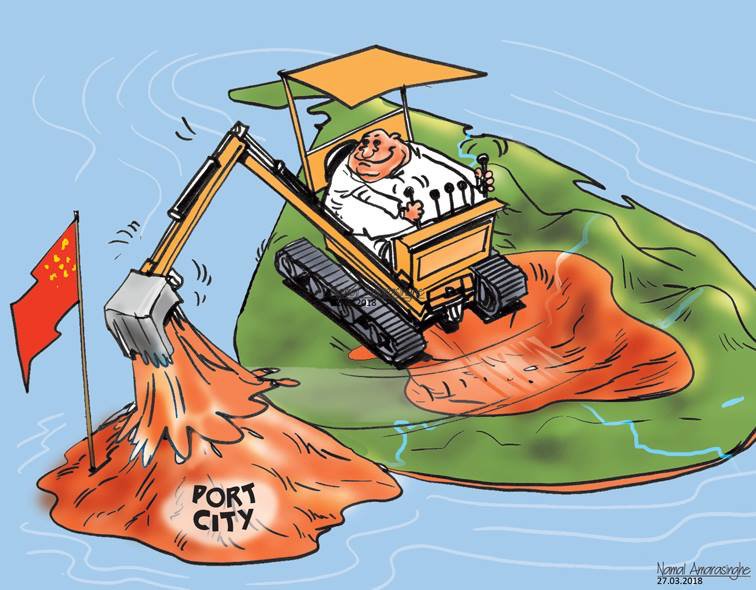
NPP questions ownership of Port City project

The National People’s Power has questioned how the government which failed to develop the country by using land and other existing resources, will succeed in developing the country through the Colombo Port City.

Speaking during a media briefing Tilvin Silva said the Port City project will lead to friendly ties with China, but affect ties with India and several other countries.

Tilvin Silva said India and the United States will take action against the creation of a Chinese stronghold, in close proximity to India.

He noted Sri Lanka depends on foreign loans adding that the government will not be able to function without loans from India and China.

Silva claimed therefore the government is selling state resources in order to obtain loans from India and China, and the Colombo Port City is such a project.

He said the government claims the Port City project will bring in foreign investments and job opportunities and develop the economy.

He urged the public to not be deceived by such claims adding that the government was making such claims to cover-up their mistakes.

Joining the media briefing NPP Parliamentarian Harini Amarasuriya said last week Members of Parliament received a SMS from the Chinese Embassy claiming the tour for MPs to visit the Colombo Port City was postponed, adding that MPs only found out about the tour as a result of the message.

MP Amarasuriya said it is the Chinese Embassy that is taking Parliamentarians to visit the project, situated in a location in the country, and questioned the country’s sovereignty and independence.

She also questioned the ownership of the Port City project.

MP Amarasuriya claimed the country’s leaders must be ashamed of the country’s current situation.

All schools in Trincomalee closed until further notice

All schools in Trincomalee have been closed until further notice.

Eastern Province Governor Anuradha Yahampath has instructed all schools in the Trincomalee Education Zone to close until further notice.

The decision was taken as a precaution to prevent school children from being infected with the virus.

On Friday Director General of Health Services Dr. Asela Gunawardena said that more young people have now been found to be infected with the coronavirus in Sri Lanka.

The health authorities also said that the virus is now airborne as opposed to only transmitting through contact.

Speaking at a special media briefing, Dr. Asela Gunawardena said that the new variant of the coronavirus has been found to be affecting young people and not just senior citizens.

Head of the Department of Immunology and Molecular Sciences of the Sri Jayawardenapura University, Professor Neelika Malavige said that a new variant of the coronavirus has entered Sri Lanka and tests are being carried out to identify the variant.

She said that the new variant is highly transmissible and that 5-6 people can be infected by just one person as opposed to one or two people from the earlier variant.

Professor Malavige said that droplets from the new variant stay airborne for an hour and people crossing that space can be infected so it is essential to wear face masks.

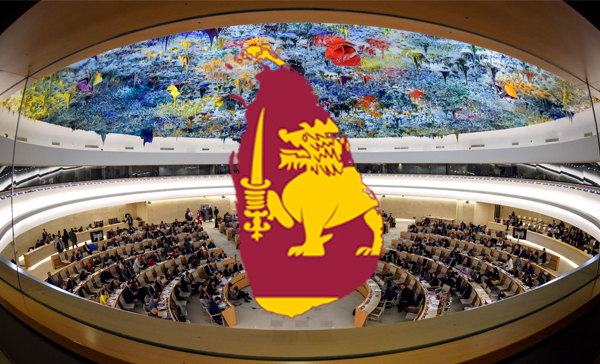
Govt. slams OHCHR process; ‘Unilateral activity’, says Keheliya

The Government of Sri Lanka (GoSL) is scheduled to make a formal response to the decision by the Office of the United Nations (UN) High Commissioner for Human Rights (OHCHR) to not have any GoSL representation in its dedicated investigative and monitoring team of international professionals based in Geneva, Switzerland, which is tasked with monitoring Sri Lanka’s human rights situation and implementing the UN Human Rights Council (UNHRC) Resolution against Sri Lanka.

The OHCHR recently stated that it is considering the swift implementation of the provisions of the fifth post-war Resolution on Sri Lanka. This is said to include the collection, preservation, and analysis of information in connection with alleged human rights abuses and violations during and after the war.

Accordingly, the OHCHR is assembling a team of dedicated Geneva-based international professionals to monitor Sri Lanka.

However, as mentioned by the UN OHCHR Spokesperson Elizabeth Throssell to The Sunday Morning when contacted in early April, the OHCHR has decided to omit any form of representation from the GoSL in this team.

Speaking to The Sunday Morning, Cabinet Spokesman Keheliya Rambukwella said however that this decision by the OHCHR to omit a representative of Sri Lanka in the said investigative team is still at the proposal stage, adding that the Government will present a formal response to this proposed decision shortly.

Further, citing the UN’s budgetary processes, the OHCHR had stated that this team will most likely be based in Geneva.

Questioning the efficacy of such an operation, Mass Media Minister Rambukwella said: “The practicality of its functions should be questioned. Many of the people named are alien to the culture and background of Sri Lanka. They will be working on documents and information given to them by a party who we have no faith in. This is a unilateral activity at best.”

However, UN HR Office in Geneva Spokesperson Marta Hurtado, told The Sunday Morning yesterday (24) that the OHCHR has been engaging with the GoSL in relation to the implementation of past Resolutions of the UNHRC, and hopes that this can continue in relation to the present Resolution.

Hurtado also revealed that the OHCHR would “request visits for this purpose in line with the regular procedures”.

When queried as to whether the team will be granted permission to visit Sri Lanka if they seek to do so, Minister Rambukwella said that this decision will be made once it goes through the respective governmental hierarchy and the Foreign Ministry, before settling on the course of action to be taken.

When questioned about the progress of evidence gathering, monitoring, and post-Resolution responsibilities, Hurtado said that the monitoring of the human rights situation in Sri Lanka is ongoing, and that there will now be a process to approve the budget accompanying the Resolution. Hurtado also mentioned that the OHCHR will keep the GoSL and all stakeholders informed about the process.

Accordingly, further information about the mandate and how to submit information will be made available once the new team becomes operational. Commenting further on the team, Hurtado said: “Once the new team is operational, it will review all available information and set the priorities for further work.”

Sri Lanka’s fifth post-war Resolution, seeking to promote reconciliation, accountability, and human rights, presented by the UN Core Group on Sri Lanka, was adopted at the 46th UNHRC Session in Geneva on 23 March this year.

The OHCHR is expected to present an oral update on the human rights situation in Sri Lanka to the UNHRC at its 48th Session, while a written update is due at the 49th Session, along with a comprehensive report at the 51st Session.

Posted in Uncategorized

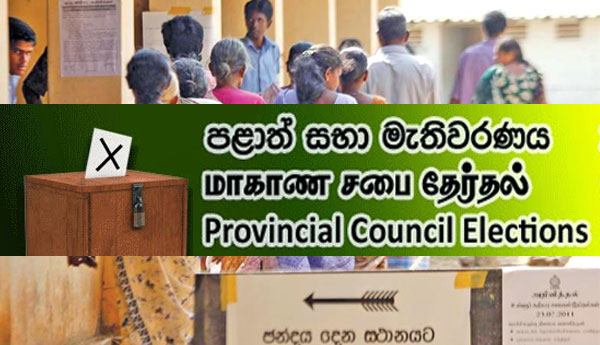
PM to give final decision on holding PC polls!

A final decision on holding of the provincial council elections will be taken at a meeting of party leaders which is to be held on May 4th under the chairmanship of the Prime Minister, government sources said.

The government has decided to steadfastly resolve two issues at the meeting.

They include the unresolved issue of the election system and whether 03 candidates can be fielded for each division.
If a final decision is taken on that day, the Provincial Council Elections Act will be amended in the next few weeks with the necessary delimitation work to commence soon.

The aim of the government is to hold provincial council elections before the end of this year.

Posted in Uncategorized

Sri Lanka’s new Coronavirus wave claims two foreigners, Covid-19 total tops 100,000

Two foreign nationals have died in a new Covid-19 wave in Sri Lanka with authorities warning of a more deadly variant of Coronavirus in the island which is triggering pneumonia and killing younger patients.

A 46-year old foreigner residing in Colombo 02 had died on April 24, the state information office said.

He was being treated at a private hospital in Colombo when diagnosed with Covid-19 and he was transferred to National Hospital Kandy. He developed Covid pneumonia and suffered respiratory and heart failure.

No underlying conditions were mentioned.

A 63-year old foreigner residing in Colombo 04 had died on April 23, while being at a treatment center in Colombo. He developed Covid pneumonia and suffered multiple organ failure. He had a chronic kidney condition.

A 46-year old male from Ratgama had died at Karapitiya Hospital on April 22. He had developed Covid pneumonia and a secondary bacterial infection. No underlying conditions were mentioned.

A 65 year old male from Kuliyapitiya had died on April 24 after being transferred to Homagama Base Hospital. He developed Covid pneumonia.

Sri Lanka has recorded 642 deaths so far.

On April 24, 880 new domestic Coronavirus cases were confirmed. The total with foreign returnees was 895 only slightly down from 969 a day earlier.

Public health inspectors were chasing new clusters and ordering home quarantine to battle the new outbreak. On Saturday Adikarigama in Kaluthara police area was isolated.

Health authorities say a possible new variant is spreading which is causing severe symptoms and deaths in young persons. A 18 year old and a 35 year old was reported to have died in hospital on Saturday.

Authorities have urged the public to stay at home and avoid travel especially for the next two weeks.

Sri Lanka running out of ICUs for COVID-19 as younger cases with severe symptoms surge

It is not clear how the new variant came to the island.

However Sri Lanka had relaxed institutional quarantine for some foreign returnees including vaccinated ones. However vaccinated persons were also getting infected in many countries though their symptoms are believed to be less severe.

The new wave was also putting pressure on the health system.

Meanwhile persons under treatment had risen to 5,793 from below 4000 at the beginning of the week.

Sri Lanka was running out of ICU facilities and hospital beds dedicated for Coronavirus patients.

Sri Lanka has two tier treatment framework with asymptomatic patients housed at secondary treatment centres.

Posted in Uncategorized

All State and private functions banned for two weeks

All State and private functions have been banned for two weeks, the President’s Office said today (Sunday).

The President’s Office said that all State events and functions have been suspended.

Meanwhile, all private events and functions scheduled for the next two weeks have been suspended using the quarantine laws.

The President’s Office said that the decision has been taken to contain the spread of the coronavirus.

Sri Lanka is currently facing the threat of the coronavirus third wave.

Health authorities said earlier that several coronavirus sub-clusters have been reported from across the country since the Sinhala and Tamil New Year.

Public Health Inspectors (PHI) Association Secretary M. Baalasooriya told Colombo Gazette that sub-clusters were initially reported from the Piliyandala, Maharagama, and Pamunuwa areas.

He said thereafter more infected people were reported across the country, including from Kurunegala, Narammala, Allawwa, Gampaha, Colombo, Puttalam, Trincomalee and Jaffna after the festive season.

Baalasooriya said sub-clusters have also been reported from the garment sector, with infected individuals having already been detected at a few factories.

Urgent talks between Basil, SLFP

Founder of the SLPP, Basil Rajapaksa, had reportedly held urgent talks with leaders of the SLFP on 21 April, as part of a well coordinated programme initiated by the SLPP to sort out internal political wrangling among its coalition members.

SLFP Leader MP Maithripala Sirisena, SLFP General Secretary State Minister Dayasiri Jayasekera, Ministers Nimal Siripala de Silva, Mahinda Amaraweera and Suren Raghavan attended this discussion with Rajapaksa.

During the discussion the SLFP members had highlighted the failure of SLPP top brass to accommodate SLFP activists at grassroots level, especially its LG members in the various development programmes being initiated at district level.

Rajapaksa had then urged SLFP Minister Mahinda Amraweera to submit proposals from his party on this and promised that he will look to accommodate SLFP members in future without any undue advantage to the SLPP.

Posted in Uncategorized

PC elections: Govt. caught between India and legal snags BY M.S.M Ayub

The impression the government had instilled in the minds of the people soon after the Sri Lanka Podujana Peramuna (SLPP) captured power that the provincial council system would be scrapped has by now vanished into thin air.

Barely a fortnight after assuming office as the President, Gotabaya Rajapaksa stated in India that it was through development and not through devolution that the problems faced by the Tamil people could be resolved. And he had assigned the subject of Provincial Councils to Rear Admiral Sarath Weerasekara who is dead set against the concept of devolution of power and provincial councils. And Weerasekara in turn had been expressing his antipathy towards the provincial council system.

However, now the government and the ruling SLPP is said to be discussing about holding of provincial council election which has delayed for over two years. The backpedalling is obviously due to the pressure exerted by India and the United Nations Human Rights Council (UNHRC). Indian leaders, though not interested in the merger of Northern and Eastern Provinces now, have been insisting on conferring more powers to the provincial councils.

It must be recalled that Indian External Affairs Minister Dr. S. Jaishanker arrived in Sri Lanka within 24 hours after Gotabaya Rajapaksa taking oaths as the President on November 18 with a personal message from Indian Prime Minister Narendra Modi and held talks with the new Sri Lankan President. Dr. Jaishankar had conveyed to President Rajapaksa “India’s expectation that the Sri Lankan government take forward the process of national reconciliation to arrive at a solution that meets the aspirations of the Tamil community for equality, justice, peace and dignity.”

On November 29, 2019, eleven days after assuming office, President Rajapaksa visited New Delhi. During the joint Press briefing with the new Sri Lankan leader, Modi also echoed the same sentiments with the same sentence. However, as if he wanted to allay doubts and stress what he specifically meant, he added that “it also includes the implementation of the 13th Amendment.”

On February 2, two days after the Cabinet decided to pull out from the Memorandum of Cooperation (MOC) signed in May 2019 with the Governments of India and Japan for the development of the Eastern Terminal of the Colombo Harbour, the Indian Deputy High Commissioner, Vinod. K. Jacob met two Tamil leaders from the Eastern Province, former Chief Minister and current MP, Sivanesathurai Chandrakanthan alias Pillayan, and former Deputy Minister Vinayagamurthi Muralitharan, alias Karuna Amman, and discussed the 13A. He had reiterated that meaningful devolution is the way forward for achieving the aspirations of the Tamil people and stressed full implementation of the 13th amendment.

At a time when Sri Lanka was desperately longing for India’s support last month as well, the latter used the devolution issue as a precondition. When Sri Lanka was facing a harsh resolution at the recent UNHRC session, India’s Permanent Representative to the UN Indra Mani Pande, while addressing the council on last February 25, insisted that aspirations of the Sri Lankan Tamils must be addressed “through the process of reconciliation and full implementation of the 13th Amendment to the Constitution of Sri Lanka.”

It is vivid that India has been using the Sri Lankan Tamil issue to advance its own interests. The issue is a lever for India to tame its southern neighbour when needed. Yet, these facts point that Sri Lanka would have to pay a heavy price if it resorted to abrogate the provincial council system arbitrarily, especially ignoring India.
Against this backdrop, India now wants provincial council elections held soon. India’s position in this regard had been asserted in a letter to AIADMK Rajaya Sabha member M.Thambi Durai recently by Dr. Jaishankar. The Indian External Affairs Minister in his letter had linked India’s stand in this regard to his country’s abstention from voting for the last month’s UNHRC resolution on Sri Lanka.

However, Sri Lanka is in a catch 22 situation in respect of conducting of provincial council elections due to a legal hiccup that has been created by an amendment to the Provincial Councils Election Act brought in by the last Yahapalana government. The Amendment introduced in September 2017 provides for conducting of elections for the provincial councils under the mixed electoral system of first-past-the-post system and the Proportional Representation (PR) system.

Yet, the mixed electoral system has run into controversy after it was experimented at the local government elections held on February 10, 2018, as many flaws in the new system were identified. In the wake of the LG elections even former President Mahinda Rajapaksa under whose leadership the SLPP swept the electorate had stated that the new system had to be changed again, as it had created a mess in many LG bodies.

There are strong grounds not only for the politicians but also for the people to reject the mixed electoral system in its present form, despite it having been experimented only at the last LG polls. It doubles the number of council members (from around 4,000 to 8,000 LG members) and it is the public coffers that have to maintain and facilitate them. Without a cut-off point for political parties to be eligible to represent the councils, many small parties won seats, creating an Opposition larger than the ruling party in many councils.

This muddled situation was further aggravated by the ridding of the bonus seat system that had earlier strengthened the winning parties to be above the collective strength of the Opposition parties. The mess resulted in unethical deals among political parties, although those settlements helped later for the smooth functioning of the councils. Besides, wards have to be demarcated within each provincial council area under the new system. Political parties are now divided over the system with one group preferring to revert to the old PR system and others wanting to stick to the new system, but with changes.

The second group is also in turn divided. During a recent discussion among the constituent parties of the ruling coalition, one group had proposed to field three candidates from each party for each ward which had been opposed by a section of the SLPP and smaller parties in the coalition. The proposal would definitely reintroduce the preferential voting system which would again lead to intra-party conflicts. There is no sign of any settlement to these controversies either.

Interestingly, no complaints were heard about the absence of elected provincial councils for the past three years even from the politicians representing the Northern and Eastern Provinces for which the devolution of power was originally meant. Nevertheless, the country has to maintain the system for two reasons – external pressure and Tamils would feel alienated if the system is done away with.