

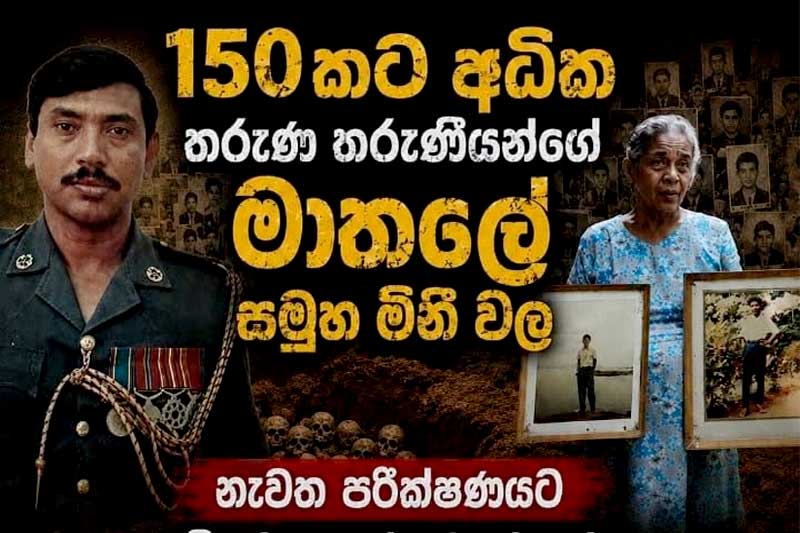
Relatives of forcibly disappeared persons have called for the reopening of investigations into the Matale mass grave, uncovered fourteen years ago.
A peaceful public protest has been scheduled for the morning of 16th July opposite the Matale District Secretariat, demanding an immediate, formal and independent reinvestigation into the mass grave, widely considered one of the most heinous human rights violations in the country’s history.
Organised by the People’s Voice for Justice and Fairness, the demonstration aims to seek justice for the young men and women abducted and brutally murdered during the 1988 to 1990 reign of terror, while demanding that those responsible be publicly exposed.
Chairman of the Families of the Disappeared, Brito Fernando, said they had petitioned the magistrate’s court to reopen the case involving the mass grave.
He said construction workers had accidentally uncovered the skeletal remains of around 154 people at the Matale Base Hospital in 2012.
Forensic and judicial investigations were subsequently conducted at the site.
In April 2014, the Matale Magistrate’s Court ordered the skeletal samples to be sent to Beta Analytic, a laboratory in Florida, for carbon-14 dating, with the samples dispatched in 2015.
The case file was closed without a final order, however, with the judge stating that the investigation could not proceed further but could be reopened, Fernando told UCA News.
Relatives have now requested the court to safely preserve the remains for DNA testing, in the hope of matching them with missing persons. The case is scheduled to be heard again on 16th July.
According to Fernando, the relatives claim that former President Gotabaya Rajapaksa was the military commander in the Matale area during the last phase of the twenty six year civil war that ended in 2009, when thousands had disappeared.
Rajapaksa also served as defence secretary later, when the skeletal samples were sent to the United States for analysis.
The authenticity of the samples has been questioned by relatives, who have also raised concerns about transparency in the investigation process and are demanding action against those they allege obstructed it.
Kandy based human rights activist Navarathna Bandara said the petition, filed by attorneys Himali Kularatne and Lakmal Suriyagoda, asks the court to reopen the case, order DNA testing of the remains, and direct the Government to launch a new investigation.
Sri Lanka has one of the world’s highest rates of enforced disappearances, with an estimated 60,000 to 100,000 unresolved cases since the 1970s.
About twenty mass graves have been discovered over several decades, with the most prominent sites located in Chemmani, Duraiappa Stadium in Jaffna, Mannar, Kokkuthoduvai in Mullaitivu, and Colombo Port.
These are linked to the security forces’ crackdown during the 1987 to 1989 uprising by the Janatha Vimukthi Peramuna, and to the civil war with the Liberation Tigers of Tamil Eelam between 1983 and 2009.