

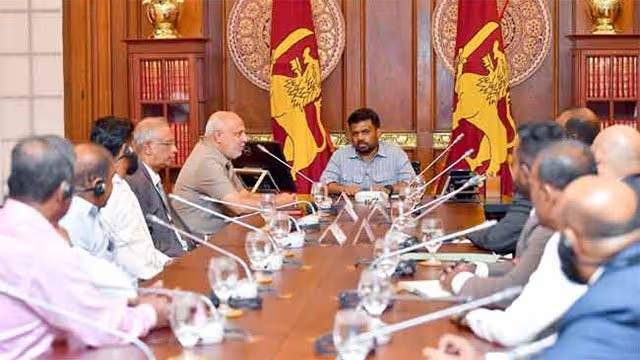
Representatives of an alliance formed by six Tamil and Muslim political parties met with President Anura Kumara Dissanayake at the Presidential Secretariat this morning (03).
During the meeting, the representatives drew the President’s attention to a number of issues of importance to Tamil-speaking communities and the public.
These included the introduction of a comprehensive new Constitution, the holding of the Provincial Council elections and the issues relating to conduct it, as well as concerns affecting the Northern and Eastern Provinces and the Malayagam (Hill Country Tamil) community.
Provincial Council elections
The Provincial Council elections featured prominently in the discussions.
President Dissanayake noted that a Parliamentary Selection Committee had been appointed to examine matters relating to the conduct of the elections and said he expected to engage with the Committee to discuss the issues that have arisen.
New Constitution
The proposal to introduce a new Constitution, as set out in the current Government’s election manifesto, was also discussed.
General Secretary of the Ilankai Tamil Arasu Kachchi (ITAK), M.A. Sumanthiran, observed that drafting a new Constitution was not a task that could be undertaken hastily.
He emphasised the importance of approaching the process as a broad national dialogue capable of addressing the concerns of the country’s diverse communities.
He said that the new Constitution should not be one introduced unilaterally by a single party, as was the case with the Constitutions of 1948, 1972 and 1978.
Commenting on the proposals, President Anura Kumara Dissanayake reaffirmed that it is the Government’s position that the Constitution should be reformed and that the Executive Presidency should be abolished. However, he stressed that, rather than pursuing a hastily drafted constitutional amendment, the priority at this stage is to build a new national consensus. The President emphasised the importance of initiating a broad and inclusive national dialogue to achieve that objective.
President Dissanayake said that the current Government has laid the foundation for building a country in which people act together as Sri Lankans, rather than pursuing the interests of their respective ethnic communities. He noted that the country had remained free of ethnic unrest during the Government’s tenure and reiterated that his vision is for a system of governance that is clearly accountable to Parliament.
Land rights for the Malayagam community
The meeting also discussed the Government’s proposal to grant estate workers and estate staff legal ownership of 10-perch plots of land for residential purposes as part of efforts to improve the living standards of the Malayagam community.
Commenting on the proposal, V. Radhakrishnan of the Tamil Progressive Alliance (TPA) said he was hopeful that the current Government would succeed in implementing a measure that previous governments had been unable to achieve due to opposition from plantation companies.
The President noted that landslides have been reported even in parts of the Central Highlands where there are no human settlements.
He stressed that solutions to these issues must ensure the long-term environmental sustainability of the Central Highlands, adding that a dedicated authority has already been established for this purpose.
He said that the Government expects to address the challenges faced by the Malayagam community as part of these broader initiatives.
President Anura Kumara Dissanayake further noted that plantation companies had entered into lease agreements with the State at different times to meet varying circumstances and that these agreements would need to be renewed before 2042.
In view of the forthcoming negotiations, he said the Government intends to include provisions in the new agreements to grant the Malayagam community legal ownership of residential land.
Housing projects
The meeting also discussed the housing projects being implemented for the Malayagam community with Indian assistance.
Commenting on the matter, Jeevan Thondaman of the Ceylon Workers’ Congress (CWC) pointed out that, although many families had received ownership of houses under these schemes, they continue to face practical difficulties in meeting the costs of essential services, including water and electricity.
Responding to these concerns, the President stated that proposals have already been made to develop a new programme jointly through the Thondaman Foundation and the Nevada Foundation to provide economic assistance to the community.
He said that the Government intends to allocate a higher level of funding for the Ministry of Plantation and Community Infrastructure in the 2027 Budget than was provided this year.
Land issues in the North and central highlands
President Dissanayake also reaffirmed the Government’s commitment to resolving land-related issues in the Northern Province and the Central Highlands. He stressed that it is the Government’s policy that land should rightfully belong to the people and noted that a number of positive measures, including the appointment of commissions, have already been taken to address these longstanding issues.
Housing for war-displaced and Cyclone Ditwah-affected families
President Anura Kumara Dissanayake also announced that funding would be allocated through the 2027 and 2028 Budgets for the construction of 13,000 houses in two phases, addressing the long-standing housing needs of people who lost their homes during the conflict.
The President further said that the Government is taking steps to provide permanent housing for families who lost their homes as a result of Cyclone Ditwah. He noted that work has already commenced on the construction of temporary shelters until the permanent houses are completed and that affected families will continue to receive a rental allowance during the interim period.
Electoral system and institutional concerns in the North and East
Members of the alliance also raised issues relating to the Provincial Council electoral system and the work of the Delimitation Commission.
They further drew the President’s attention to the difficulties faced by communities in the Northern and Eastern Provinces as a result of what they described as outdated policies followed by institutions such as the Department of Archaeology, the Department of Forest Conservation and the Mahaweli Authority.
President Dissanayake thanked the representatives for coming together as a united alliance to discuss the concerns of Tamil-speaking communities.
He also encouraged them to frame these issues within the broader context of the public interest and to focus on common national concerns in a manner that would avoid creating misunderstandings within society.
Attendees
The meeting was attended by representatives of the All Ceylon Makkal Congress (ACMC), including its Chairman M.S.S. Ameer Ali and Members of Parliament M.A.M. Tahir and N.P.M.M. Tahir; Ceylon Workers’ Congress (CWC), represented by Member of Parliament Jeevan Thondaman; Democratic Tamil National Alliance (DTNA), represented by TELO Leader Selvam Adaikalanathan,EPRLF Leader Suresh Premachandran and Murugesu Chandrakumar; Ilankai Tamil Arasu Kachchi (ITAK), represented by M.A. Sumanthiran and Member of Parliament Shanakiyan Rasamanickam; Sri Lanka Muslim Congress (SLMC), represented by Members of Parliament Rauff Hakeem and Nizam Kariapper; and Tamil Progressive Alliance (TPA), represented by V. Radhakrishnan and Bharat Arulsamy.