

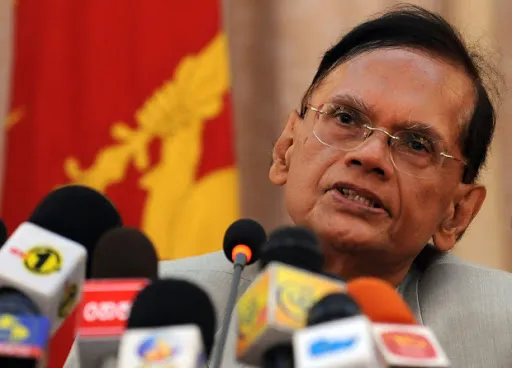
Sri Lanka’s Protection of the State from Terrorism Act (PSTA), published on the Ministry of Justice website in late December, would severely undermine democratic freedoms and expose the country to serious international and economic repercussions if enacted in its present form, former Minister of Foreign Affairs Prof. G.L. Peiris said yesterday.
Speaking at a press conference at the N.M. Perera Centre in Colombo, Prof. Peiris described the draft law as “one of the most dangerous pieces of legislation introduced in this country.” “It is the death knell of democratic freedoms and liberties,” he said.
He warned that the consequences would not be confined to domestic governance. Sri Lanka, he noted, is a signatory to numerous international conventions and treaties from which it derives significant economic benefits, including the European Union’s Generalised Scheme of Preferences Plus (GSP+).
“GSP+ is neither a gift nor an entitlement. It is granted temporarily, subject to the fulfilment of specific conditions,” he said, referring to the tariff- and duty-free access granted to Sri Lankan exports to the European market. He stressed that these benefits must not be jeopardized and called for drastic amendments to safeguard the economy.
While acknowledging that special legislation may be required in situations where ordinary law is insufficient, he argued that the fundamental flaw in the proposed legislation is the absence of a clear definition of terrorism.
“As this law now stands, there are 13 major categories of terrorist acts. But the term ‘terrorism’ itself is not defined with clarity. It is vague and open-ended,” he said. He further noted that the offences are framed so broadly that they place ordinary citizens at risk, carrying penalties of up to 20 years’ imprisonment.
Prof. Peiris also criticized provisions granting extensive powers to the armed forces, police and Coast Guard, including authority to enter homes, seize confidential documents and search individuals.
In addition, the proposed law empowers the Secretary to the Ministry of Defence to issue detention orders for up to one year. It also allows a person under investigation, who would ordinarily remain in judicial custody under court supervision, to be transferred to police custody.
Moreover, Prof. Peiris described provisions relating to proscription as “extremely dangerous.” Under the current draft, the President may, through a Gazette notification, declare any organisation illegal. Such an organisation would be barred from recruiting members, holding meetings or operating bank accounts, with the order remaining in force until rescinded by the President.
The legislation also allows the President to declare any location a prohibited place, barring entry and prohibiting photography or videography. Violations could result in up to three years’ imprisonment or a fine of Rs. 3 million.
Another controversial provision allows the Attorney General to defer prosecution for up to 20 years on condition that a suspect complies with specified requirements, including participation in a rehabilitation programme.
The proposed PSTA is intended to replace the PTA introduced in 1979, which was initially enacted as a temporary measure and made permanent in 1982, and has since been widely criticised as overly harsh. However, Prof. Peiris claimed the new draft is far more dangerous than the 1979 law.
“This is a colossal onslaught on democracy,” he said, urging the Government not to proceed with the legislation in its present form but to introduce fundamental modifications before presenting it to Parliament.
Former Minister Nimal Siripala de Silva, also addressing the press conference, said the PTA had been introduced at a time when terrorism posed a grave threat to the country. “Now we need a people-friendly law,” he said.
Meanwhile, Former Minister Anura Priyadarshana Yapa said the proposed Act appeared to curtail citizens’ freedoms rather than focus solely on combating terrorism.