

The seven agreements signed between Sri Lanka and India during Indian Prime Minister Narendra Modi’s recent visit to the country will be made public once the Indian Government grants its consent, Ceylon Today learns from highly placed government sources.
A clause within these agreements requires mutual consent from both countries before any third-party disclosure can be made, which has been cited as the reason for the current lack of transparency. As a result, even individuals who attempted to obtain these documents under the Right to Information (RTI) Act, No. 12 of 2016, have been denied access, a government spokesperson said.
Ceylon Today’s sister paper, Mawbima, also made an inquiry through the Right to Information Act to the Presidential Secretariat via the RTI Unit of the Sri Lanka Press Institute (SLPI), requesting copies of these agreements. However, the response received stated that the relevant agreements are not available at the Presidential Secretariat. The response, sent under the signature of Senior Additional Secretary to the President, G.G.S.C. Roshan, stated that the reason for this is that President Anura Kumara Dissanayake had not signed those agreements.
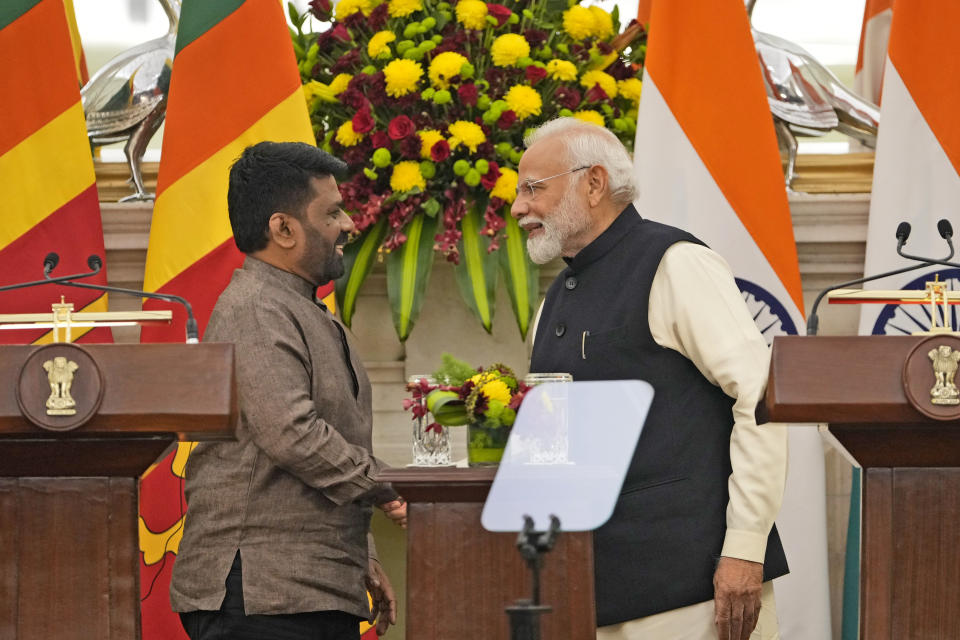
The exchange of the seven Memorandums of Understanding (MoUs) took place at the Presidential Secretariat on 5 April, in the presence of President Anura Kumara Dissanayake and Indian Prime Minister Narendra Modi. The MoUs cover a range of sectors including Energy, Digitalisation, Defence, Health, and Development Assistance.
According to a press release from the President’s Media Division (PMD), the agreements involve collaboration on establishing a high-voltage direct current (HVDC) electricity interconnection for power trade, exchanging grassroots-level digital solutions to support digital transformation, cooperation in developing Trincomalee as an energy hub, strengthening defence ties, and improving pharmaceutical and medical services. They also include joint efforts on a multi-sectoral development support initiative in the Eastern Province.
Sri Lankan signatories to these MoUs included Secretary to the Ministry of Power and Energy Prof. K.T.M. Udayanga Hemapala, Secretary to the Ministry of Digital Economy Varuna Sri Dhanapala, Defence Secretary (Retired) Air Vice Marshal H.S. Sampath Thuyacontha, and Health and Media Ministry Secretary Specialist Dr. Anil Jasinghe. Representing India were Foreign Secretary Vikram Misri, Indian High Commissioner to Sri Lanka Santosh Jha, and UAE Ambassador to Sri Lanka Khaled Nasser Al Ameri.
Following the signing, several political parties and civil society organisations called on the Government to make the contents of the agreements public. Criticism has emerged over the lack of Cabinet or Attorney General’s review prior to the signing. Opposition MPs have urged the Government to table the agreements in Parliament. In response, Foreign Affairs Minister Vijitha Herath stated that under the 2016 RTI Act, anyone could request these documents.
Despite this, media outlets, including BBC Sinhala and other entities that submitted formal requests to public authorities, have yet to receive the requested information. In some cases, officials redirected requests to the respective line ministries, but none have responded within the RTI-mandated timeframe.
Meanwhile, a former Secretary to the President and Defence Secretary, Austin Fernando, commented that Minister Vijitha Herath’s claim — that the agreements can be obtained under the RTI Act — was being used as a tactic to delay public disclosure. He added that Section 5 (1) and (2) of the RTI Act permits public authorities to deny access to information related to national security, State security, and international agreements, which may be the legal basis for the refusals.
Fernando, speaking to the media, pointed out the historical context, noting that in previous instances — such as when President J.R. Jayewardene signed the Indo-Lanka Accord and when Prime Minister Ranil Wickremesinghe signed a ceasefire agreement — the Janatha Vimukthi Peramuna (JVP) had criticised the lack of public disclosure, arguing it posed a threat to national security and territorial integrity. He suggested the current delays may be viewed similarly.
Cabinet Spokesman Nalinda Jayatissa has also confirmed that bilateral consent is required for the publication of these agreements.
According to the same Government sources, Sri Lanka has now formally requested India’s consent to release the agreements, and once approval is granted, the documents will be tabled in Parliament.
Source:Ceylon Today