

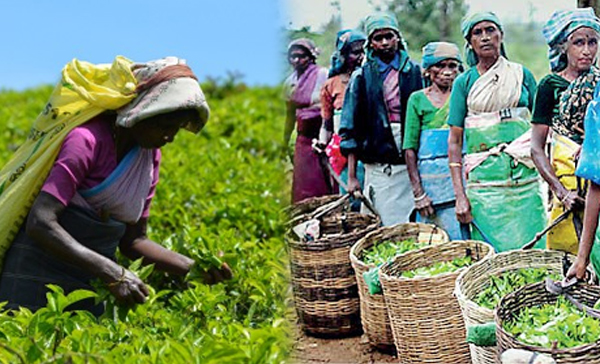
Hundreds of people from Sri Lanka’s historically oppressed Malaiyaha (hill country) community held demonstrations to emphasize their basic rights as citizens of the country.
“We demand that Malaiyaha Tamil people be accepted as free and equal Sri Lankan citizens,” said Shalini Manori, a 54-year-old tea estate worker, who participated in the June 1 demonstration in Hatton town in the Nuwara Eliya District of Central Province.
The majority of the community’s 1.5 million people work in tea and rubber estates, contributing to the country’s crucial foreign exchange earnings as Sri Lanka accounts for close to 20 percent of global tea exports.
But its tea workers are landless and the poorest, and live under a constant threat of forced displacement as they lack land and housing rights, their leaders say. Most worker-families live on the estates in 400-square-foot rooms in abject poverty.
The demonstrators carried banners and raised slogans with the beating of drums to seek “assured rights” to housing and land, a living wage, protection of the law, and equal compensation for male and female workers.
More than 50 percent of tea plantation workers in the country are women from the Malaiyaha Tamil community.
“Women are overworked and underpaid,” Manori told UCA News, adding that the low salaries in the tea estates force them to take on extra work on weekends in farms, brick-kilns and other such informal sectors.
She said that women workers are often assigned backbreaking and low-valued tasks, such as tea leaf plucking and bush pruning, while they are already overburdened at home with child rearing and domestic chores.
The Malaiyaha Tamils are descendants of Indian indentured laborers who were brought in by the British to work on coffee, tea, and rubber plantations. Their socio-economic exclusion, marked by a prolonged period of statelessness and disenfranchisement, has led to poor human development indicators for the community.
The community has the worst figures for poverty in the country, with widespread child malnourishment, high rates of anemia among women, alcoholism among men, and low educational attainment.
In 2023, the Malaiyaha community undertook a nearly 300-kilometer journey, calling for recognition as free and equal citizens in the country.
Menaka Kandasamy of the Ceylon Workers Red Flag Union said the government has approved an increase in the daily wage of workers from 1,000 rupees to 1,700 rupees (US$5.66).
“But most of the estate companies do not pay even that to their workers,” she told UCA News.
Kandy-based activist Nilushi Synthiya said the average daily wage paid is around 1,350 rupees, but a family of four spends more than that due to the high cost of living in Sri Lanka.
Synthiya criticized the tea estate companies “for citing financial losses during wage negotiations, though they continue to record enormous profits.”
She also emphasized the urgent need to grant land and housing rights to the hill people and to accord them equal linguistic status to their Tamil language.
Global rights organizations, including Amnesty International, the World Alliance for Citizen Participation, the Asian Forum for Human Rights and Development, and Front Line Defenders, have expressed concern for the Malaiyaha community.