

Families of the forcibly disappeared in Sri Lanka’s north have urged the British High Commissioner to press for international involvement in the investigation of newly uncovered mass graves, expressing their deep distress and mistrust in local mechanisms.
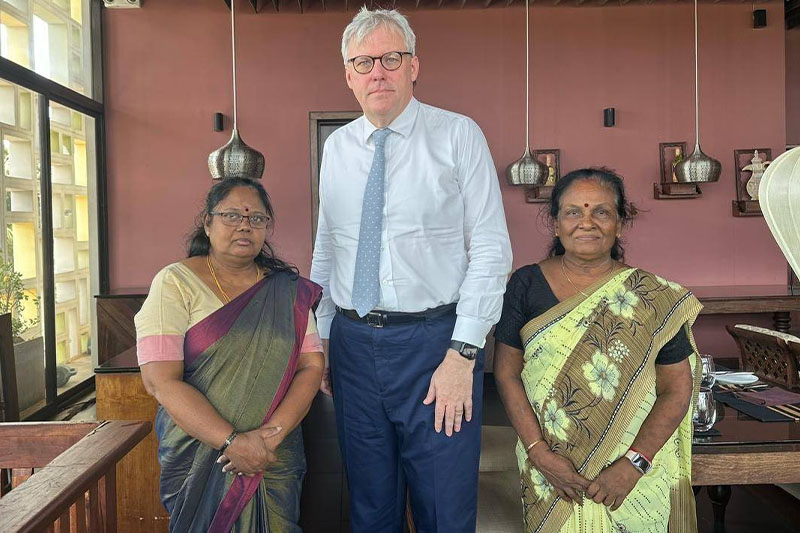
At a private meeting held on June 19 in Jaffna, Tamil mothers and relatives of victims of enforced disappearances met with British High Commissioner Andrew Patrick.
The meeting, organised by civil society representatives, focused on the discovery of the latest mass grave at the Sindubathi-Chemmani site.
“We are distressed about the frequent occurrence of mass graves in our area. These graves must be excavated in accordance with international law and under the supervision of the international community,” the relatives told the High Commissioner.
Excavations at the Sindubathi site have so far uncovered the skeletal remains of 19 individuals, including three infants under ten months of age.
The work was temporarily halted due to lack of funding.
Justice Minister Harshana Nanayakkara, responding in Parliament, acknowledged the funding shortfall and confirmed that a request for additional resources had been submitted.
The relatives, many of whom have been campaigning for truth and justice since the end of the civil war in 2009, expressed scepticism about the state’s willingness to ensure accountability.
Leeladevi Ananda Nadarajah, Secretary of the Association of Relatives of the Enforced Disappeared in Jaffna District, handed over a formal letter to High Commissioner Patrick during the meeting.
In the letter, the group criticised successive Sri Lankan presidents for publicly pledging not to prosecute military personnel accused of war crimes.
It also pointed to the lack of trust in the country’s legal institutions, including the Attorney General’s Department, which they claimed perpetuated impunity for crimes committed during the war.
They called on the international community to intervene and urged the UK and other states to support the tabling of a resolution at the upcoming September session of the United Nations Human Rights Council in Geneva.
The letter specifically advocated for Sri Lanka to be brought before the International Criminal Court.
The Chemmani mass graves were first exposed in the late 1990s, but relatives say the full extent of the atrocities remains unaccounted for.
This latest discovery in the same region has reignited demands for an impartial, internationally-monitored investigation into war-time and post-war disappearances.