Hirunika leads protest opposite Prime Minister’s residence

Several protests are being staged in various parts of Colombo today as well.

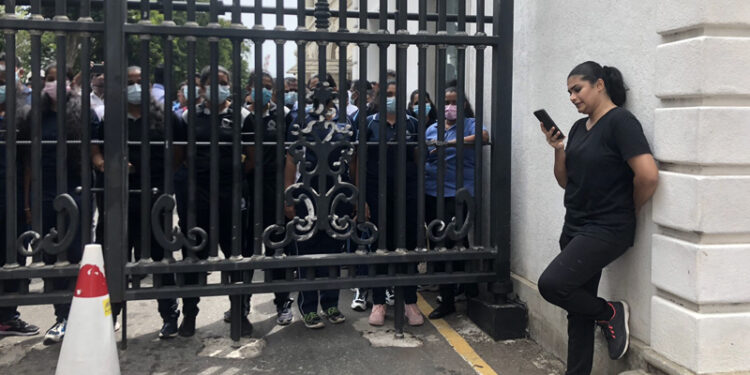
A protest led by former MP Hirunika Premachandra is being staged near the private residence of Prime Minister Ranil Wickremesinghe.

The Samagi Vanitha Balawegaya headed by Hirunika Premachandra has gathered on the road opposite Thurstan College, in Colombo 07.

The protest is being held to highlight the difficulties faced by the people due to the economic crisis.

Meanwhile, the Bank of Ceylon Mawatha in Colombo has also been closed for traffic due to another protest.

A number of protests have been held from time to time by the public over the last few weeks to show their displeasure over the hardships faced due to the economic crisis.

Sri Lanka is currently facing a shortage of several essential items, especially gas and fuel. The public has been forced to stand in queues for several hours and days to purchase gas and fuel.

Posted in Uncategorized

Few clauses in SJB’s 21A unconstitutional, requires referendum

The Supreme Court (SC) has determined that several clauses in the 21st Amendment to the Constitution Bill submitted by the main Parliamentary Opposition, the Samagi Jana Balawegayas (SJB), are inconsistent with the Constitution, and that it needs a people’s referendum to be passed, while the Government’s 22nd Amendment to the Constitution Bill will be sent to the Attorney General’s (AG) Department soon.

Cabinet Spokesperson Dr. Bandula Gunawardana, addressing the weekly press briefing held to announce Cabinet decisions yesterday (21), said that Cabinet approval was granted to the 22nd Amendment to the Constitution Bill on Monday (20), and that it will now be sent to the Legal Draftsman’s Department and the AG’s Department.

Meanwhile, Speaker of the House Mahinda Yapa Abeywardena announced in Parliament yesterday that he had received the SC’s determination on the 21st Amendment to the Constitution Bill put forward by the SJB. Thus, he said that the SC has determined that Clauses 2-15, 19, 23, 24, 26-28, 30(a), 36, 39, 43, and 51 of the SJB’s 21st Amendment to the Constitution Bill are inconsistent with a number of provisions of the Constitution, and has therefore ordered that a people’s referendum be held for them to be passed.

Speaking in Parliament yesterday, Minister of Justice and Constitutional Reforms Dr. Wijeyadasa Rajapakshe PC claimed that the SC has determined that no clause in the said SJB Bill can be passed in Parliament without a public referendum and that the Opposition has to therefore accept the practicality of the situation.

“The Opposition and even some experts have asked as to whether the proposed 21st Amendment to the Constitution is necessary. The proposed 21st Amendment to the Constitution is a necessary solution to addressing the current problems. When we talk with the International Monetary Fund (IMF) and the European Union (EU), they ask us where our democracy is, and they ask us to build it.

“During the course of last month, we spoke with all party leaders in and out of the Parliament, and with embassies, religious leaders, trade unions, and civil society organisations. We took all their ideas and everyone agreed to put in an Amendment similar to the 19th Amendment to the Constitution. We believe that the Bill that the Government has presented is practical, as we cannot chase after mirages,” Dr. Rajapakshe PC said.

With regard to the 22nd Amendment to the Constitution Bill presented by the Government, Dr. Rajapakshe PC said that they have done what they can.

Also addressing the same media briefing yesterday, Minister of Agriculture and Wildlife and Forest Resources Conservation Mahinda Amaraweera said that the Government expects the Parliament’s full support to pass the 22nd Amendment to the Constitution Bill.

“Many main things have been included in the 22nd Amendment to the Constitution Bill to widen democracy, including the establishment of an Audit Commission and other independent commissions,” he said.

The 19th Amendment to the Constitution was passed in 2015, seeking a dilution of the powers of the Executive Presidency. However, the 20th Amendment to the Constitution, passed in 2020, dilutes the powers of the Prime Minister and the Cabinet of Ministers, thus consolidating more power in the hands of the Executive President.

Sri Lanka sued by bondholder in US following historic default

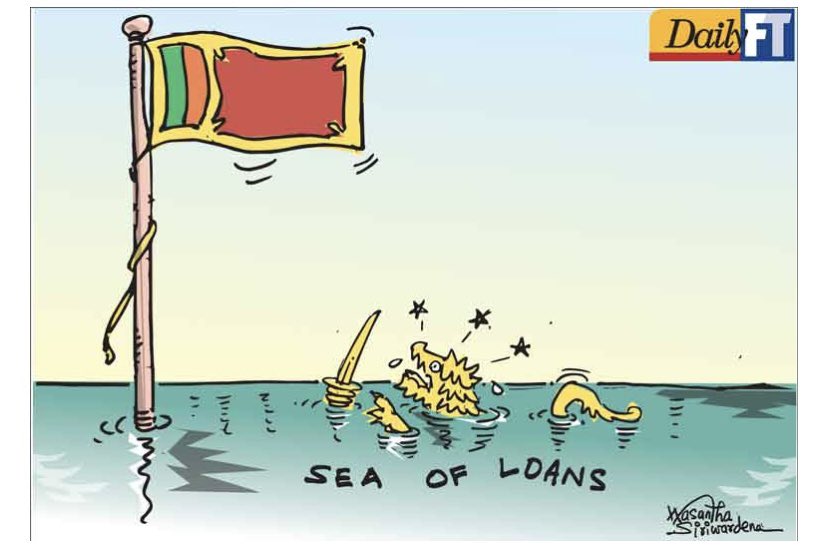
Sri Lanka was sued in the US by a bondholder after the South Asian nation defaulted on its debt for the first time in history while struggling to stop an economic meltdown.

Hamilton Reserve Bank Ltd., which holds more than $250 million of Sri Lanka’s 5.875% International Sovereign Bonds due July 25, filed the suit Tuesday in a New York federal court seeking full payment of principal and interest.

Sri Lanka, an island nation off the southern tip of India, fell into default in May after the expiry of a 30-day grace period for missed interest payments on two of its sovereign bonds. It was the first sovereign debt default by the country since it gained independence from Britain in 1948.

Hamilton Reserve, based in St. Kitts & Nevis, said in the lawsuit that the default is being “orchestrated by officials at the highest levels of government,” including the ruling Rajapaksa family, and accused Sri Lanka of excluding bonds held by domestic banks and other interested parties from an announced debt restructuring.

“As a result, these favored Sri Lankan parties stand to be paid principal and interest in full, while the Bonds — which are also broadly held by US retirement systems including Fidelity Investments, BlackRock, T. Rowe Price, Lord Abbett, JPMorgan, PIMCO, Neuberger Berman and other US investors — remain indefinitely in default and unpaid, causing American retirees tremendous suffering from potentially massive losses of up to 80% of their original investment value,” lawyers for Hamilton Reserve said in their complaint.

A group of Sri Lanka’s largest creditors, including Pacific Investment Management Co., T. Rowe Price Group Inc. and BlackRock Inc., has been set up and restructuring talks are expected to start soon, Bloomberg reported, citing people familiar with the arrangement who requested anonymity ahead of a formal announcement.

The island nation is grappling with a worsening humanitarian crisis after it ran out of dollars to purchase imported food and fuel, pushing inflation to 40% and forcing the default. Sri Lanka needs $5 billion to ensure “daily lives are not disrupted,” and a further $1 billion to strengthen the rupee, Prime Minister Ranil Wickremesinghe told parliament earlier this month.

Sri Lanka hired Lazard Ltd. and Clifford Chance LLP in May to serve as financial and legal advisors on debt restructuring as the country seeks a bailout from the International Monetary Fund.

Sri Lankan authorities on Monday began talks with the IMF, working toward an agreement that could offer creditors enough comfort to lend fresh funds to the bankrupt nation that’s seeking $6 billion in coming months.

The case is Hamilton Reserve v. Sri Lanka, 22-cv-5199, US District Court, Southern District of New York (Manhattan).

Source: Bloomberg

Sri Lanka closes schools for fourth time this year amid worsening fuel shortage – Save the Children

Sri Lankan authorities announced over the weekend that State and government-approved private schools across Colombo and surrounding regions will be closed this coming week, in a further blow to children’s education already impacted by years of disruptions due to COVID-19.

The move comes amid a worsening nation-wide fuel shortage, with parents having to wait up to two days – or over 50 hours – in queues to refuel their cars. While parents queue for fuel, many children are either accompanying them for hours, or are staying home worrying about their parents’ wellbeing. Queuing for fuel is also keeping parents away from work, creating further financial stress on families.

Without enough fuel for both private vehicles and public transport, many children across the country have no way to get to school, even in regions where schools are formally open. Only 20% of public bus services across the country are in operation and private transport services, such as trishaws [motorised rickshaws], are also operating at partial capacity, with drivers stuck in long fuel queues.

Sri Lanka is facing its worst economic crisis since independence, with food security, agriculture, livelihoods, and access to health particularly affected. Many schools in Sri Lanka were closed for one and a half years during the height of the pandemic, but since they re-opened at the start of 2022, they have closed multiple times as a result of the current crisis.

This latest closure will further disrupt children’s education across major cities and towns, as well as prevent children from accessing free school meals, a lifeline for the country’s most vulnerable children. A recent needs assessment by Save the Children showed that 50% of families were struggling to support their children’s education as a result of the crisis and some children were already dropping out of school.

While the government of Sri Lanka has requested that schools across the country re-introduce online learning systems that were in place during COVID-19, many children and families don’t have the money to afford data. Children have also told Save the Children that in many rural areas, they don’t have access to the internet or share a device with multiple children.

Hasna*, 16, a student from Colombo, told Save the Children:

“Standing in the line for kerosene oil made me very sad. We’ve never had to do something like that before, but now we have to go, and there’s nothing to do. My mother has headaches, and that makes me scared.

“Going to the queues is a huge expense for us – the bus used to be 30 Rupees (8 cents USD), but now we have to pay 200 Rupees (56 cents USD), so we all try to go together and split the cost. But now the situation with the trishaws [motorised rickshaw] is the same with buses – everyone’s on strike and there are no buses. The only reason I was able to go for my O-Levels in a trishaw is because the driver knew us, and was willing to stay in line only because it was us. Otherwise, I wouldn’t have been able to go.”

Ranjan Weththasinghe, Save the Children’s Director of Programmes in Sri Lanka, said:

“A recent needs assessment by Save the Children shows that 50% of families are really struggling to support their children’s education and some children are already dropping out of school. Parents are having to decide whether to buy data to access online classes, or use this money for food. Faced with such a decision, families make the life-saving choice. But at what cost?

“Children across Sri Lanka have had a terrible two years, with COVID-related school closures completely disrupting their ability to get a basic education. This economic crisis is making things worse. Not only are schools closing once again, but families have even less resources at their disposal to keep kids learning than they did before the pandemic.

“We are deeply concerned that this worsening economic crisis is going to hold back Sri Lanka’s children for possibly years to come. Children are the country’s future. Their needs must be the priority. Now is the time for the international community to show solidarity with the people of Sri Lanka.”

The UN and humanitarian organizations are calling on donors to urgently provide life-saving assistance to the women, men, and children most affected by the crisis to prevent the humanitarian situation deteriorating in the country.

Save the Children Sri Lanka is implementing a ‘food for education’ program across 887 schools in seven districts in the country, many of which will be impacted by the latest closures. The project complements the government’s school meal program to improve children’s nutrition and reduce the dropout rate from schools across the country.

Notes:

Save the Children conducted a rapid needs assessment from May to June 2022 from a total of 2309 households across nine districts in Sri Lanka.
Save the Children Sri Lanka aims to help one million people through humanitarian assistance implemented in vulnerable communities in nine districts across the country. Save the Children’s response will provide immediate food and nutrition needs to the most vulnerable populations and protect and diversify livelihoods. It will provide support to children, in small and resource-poor schools in rural and urban areas, to ensure they have uninterrupted access to education.
Sri Lanka was formerly an upper-middle income country, however the pandemic in 2020 resulted in the country being downgraded to lower-middle income status.
The World Bank suggests that over 500,000 people in Sri Lanka may have been pushed into poverty as a result of the COVID-19 crisis and this number is now likely to increase.
Sri Lanka was progressing steadily towards the 2030 Agenda for Sustainable Development, especially in relation to poverty reduction (SDG 1) reductions in maternal, neonatal and infant mortality (SDG 3), and in literacy, enrolment and completion rates for primary and secondary education (SDG 4). However, the current economic crisis threatens reversing many of these gains, including the peace dividends.

STC (Source)

Posted in Uncategorized

Sri Lankan Economy Heading Towards A Dangerous Phase By Ameer Ali

Sri Lanka is moving into an uncharted territory and a dangerous one with negative economic growth and critical shortages in consumer essentials. Economic crisis has now turned into humanitarian crisis and unless supply shortages are eased and consumer queues are shortened the situation may soon develop into a law-and-order crisis. The nation is confronting the effects of a double whammy. A self-inflicted catastrophe at home is coinciding with adverse market reaction arising from anti-inflationary measures adopted by industrial economies. It is going to be a nightmare to say the least for a reshuffled team of managers headed by a stopgap Prime Minister, who has to work with an unpopular but autocratic president Gotabaya Rajapaksa whose erratic policies brought catastrophe in the first place. Working relations between the two leaders are reported to have soured as the tussle over the tenure of CGSL’s Governor demonstrates.

Supply disruptions and slowdown in economic activities caused by the war in Ukraine and Covid pandemic respectively had allowed the evil of inflation to raise its ugly head in the industrialized world and the fight against inflation has taken the usual route of raising interest rates. US raised it by 0.75% for the first time since 1994, Australia did the same, UK raised it by 1.75% and EU is contemplating on a rise of 50 basis points in days to come. These increases will have a flow on effect on commodity prices, and for an import dependent economy like Sri Lanka it would mean increase in import prices and further depreciation of the rupee culminating in steeper increase in cost of living. That would make life excruciatingly painful to a population that is already struggling to survive with shortages in food, fuel, medicine and other necessities. RW’s warning of things to get worse before getting better is going to be realized with unparallel severity.

The eagerly expected IMF stabilization package with debt restructuring, the details of which are yet to be drawn out, would take at least months if not a year to come into effect. Even then, unless that package comes with generous provisions for immediate relief to low-income earners, the poor and needy, life is not going to be comfortable to the majority of people. IMF’s remedy works at best in the long run and is not helpful to solve the immediate problems facing the people. Bridging funds from the World Bank and the Asian Development Bank must be expedited before IMF reforms come into operation.

Ranil Wickremesinge and the CBSL chief have already introduced certain fiscal and monetary measures along the lines acceptable to IMF advisors. These measures, although are necessary to achieve macroeconomic stability, themselves would add to the economic pain of consumers considerably. These reforms are not going to reduce supply shortages that are crippling households at the moment. Therefore, over the next twelve months at least, the country desperately needs direct humanitarian assistance by way of food, fuel, medicine and other essentials from anywhere in the world. Time has come to think outside the box.

Without such assistance, according to Jens Laerke, a spokesperson for UN office for Coordination of Humanitarian Affairs (OCHA), Sri Lanka would be in “a full-blown humanitarian emergency”. What a turn of fortunes or misfortunes to an island that never faced such dire situation in its recorded history. The irony is that the economic managers who were immediately responsible for this calamity are still in power and calling the shots.

So far only India and to a lesser extent China have come forward to lend a hand. The reason for their readiness to help is more than altruism and falls into the realm of geopolitics. Japan too has promised to aid and Australia has decided to advance $50 million to emergency food program. However, apart from a few, assistance is not forthcoming that readily and generously from others, which makes one to think whether Sri Lanka’s foreign policy is set on the right track. With the fuel crisis disrupting the normal functioning of virtually every sector of the economy, one is driven to wonder what would have been the situation had Sri Lanka maintained its extremely friendly relations with the OAPEC (Organization of Arab Petroleum Exporting Countries) nations? Sometime back, when there was a similar crisis during JR’s presidency, he at once dispatched his Foreign Minister Hameed to Libya, and Gadhafi did not send his visitor back empty handed. Before JR, when there was a foreign exchange crisis during Sirimavo’s Leftist Coalition Government, it was her Minister of Education Mahmud who was sent to the Arab Middle East to seek assistance, which helped to ease that crisis temporarily. Even today, it is the Arab Middle East that is providing employment to Sri Lanka’s surplus labour and it is the hard-earned dollars from that labour that replenish the treasury’s coffer, at least to a limited extent. Why then the new economic managers are not thinking of a Muslim delegation to the Middle East at this time of fuel shortage? To be honest, the current Minister of Foreign Affairs is not the right person to be sent to that part of the world, not because that he is not a Muslim but because that his lack of sensitivity and compliance with injustices done to the local Muslim community under GR’s presidency didn’t go well with the Muslim world. At least OIC’s resolution against Sri Lanka on the eve of UNHRC’s meeting in Geneva in 2020 should have alerted the government that fences have to be mended with the Arab world. This is not to rekindle the past in the parochial interest of Muslims or Islam, but to draw attention during a time of emergency to the cultural nuances of that region, which, if understood rightly and handled wisely, could bring in immense benefits to the country. The fuel crisis provides a good opportunity to rethink about Sri Lanka’s relations with Arab Middle East. There is an old Tamil lyric: aadukira maattai aadi karakkanum, paadukira maattai paadi karakkanum (one should milk the dancing g cow with dance and singing cow with song).

Rajapaksa regime’s distancing from the Non-Aligned Movement and leaning more towards China at the expense of India, the West and others is proving to be costly at present. India is no doubt getting closer, because it has ulterior motives. China also will continue to help to outbid India. Yet, Sri Lanka’s foreign policy regime needs a new setting. During the last three years in particular, considerable damage had been done to Arab-Lanka relations. It needs serious reparation. That requires a team of highly qualified and professional diplomats, possibly with fluency in the language of the area to which they are posted to. How many foreign language speaking diplomats, apart from English, does the country have at present? The entire foreign policy department needs an overhaul.

This is not the time to mix politics or ideology with economics. More immediately, peoples’ and particularly children’s lives are in jeopardy. According to a UNICEF spokesperson, Sri Lanka is second highest in child malnutrition in South Asia. These children are the country’s future asset. If the new managers fail to generate enough humanitarian aid and ease the shortages, the country is destined to become chaotic and anarchical. There is a limit to peoples’ endurance. Already one hears of the army shooting in the air in Mullaitivu to disburse a Tamil crowd waiting to get some fuel? Why the army in the north while the police take charge in the south? Why is this discrimination? Is there something sinister and diabolical brewing behind the scene to misrepresent the crisis and turn it into a communal problem?

Sometime back GR promised UN Secretary General in New York that he would meet members of Tamil diaspora to discuss about Tamil issues. That never happened. Recently, a TNA parliamentarian has expressed his disappointment from Switzerland that Sri Lankan government is not willing to seek economic or financial assistance from Tamil diaspora at a time when the country needs assistance from any benefactor without strings attached. Why is this parochialism on the part of rulers?

The 14th Governor of CBSL, Dr. Indrajit Coomaraswamy, in a recent panel discussion organized by the bank had summarized the origins of the current catastrophe and expressed confidence in the success of IMF’s structural reforms. He had pinpointed a bitter truth that excess demand created by governments had cause a drain on treasury’s coffer. That demand was generated by plans to build and maintain white elephants in the name of economic development – a fact the Governor diplomatically avoided mentioning. Rajapaksa regime had been notorious for this wastage. Even now what on earth is the use of maintaining an army of 300,000 that consumes nearly 50 percent of budget expenditure salaries? People are paying the price for this unwanted profligacy by foregoing their minimum comfort. IMF structural reforms would take time to steady the sinking ship. The immediate worry is to bring relief to the daily suffering of households. This why we need to think outside the box.

*Dr. Ameer Ali, Murdoch Business School, Murdoch University, Western Australia

Posted in Uncategorized

Sri Lanka PM talks debt restructuring, One China policy with Chinese envoy

Sri Lanka Prime Minister Ranil Wickremesinghe has discussed debt restructuring with Deputy Chinese Ambassador Hu Wei and has also assured him of the island nation’s “adherence” to the ‘One China Policy’, the prime minister’s office said.

“Sri Lanka was looking forward to discussing the debt restructuring with China (sic),” the statement said Tuesday June 21 afternoon.

China has lent the largest amount of commercial loans to cash-strapped Sri Lanka as a bilateral lender. Beijing has been hesitant to restructure Chinese debt claiming it would then have to do the same for other debtor nations.

Debt restructuring is crucial for Sri Lanka, now going through its worst ever forex crisis, to reach a deal with the International Monetary Fund (IMF). The Indian Ocean country has already hired France-based Lazard as financial advisor and London-based Clifford Chance LLP as legal advisor to support the country in debt restructuring.

The One China policy, the adherence of which Wickremesinghe had assured the deputy ambassador, is United States policy which recognises the People’s Republic of China as the sole legal government of China, but only acknowledges, and does not endorse, the PRC position that Taiwan is part of China.

The One China principle, on the other hand, that there is only one sovereign state under the name China, with the PRC serving as the sole legitimate government of that China, and Taiwan is a part of China. The statement from the PM’s office used ‘One China policy’ but did not get into specifics.

The deputy ambassador has also asked Wickremesinghe about Sri Lanka’s food security initiatives and “reassured the Prime Minister that China would be donating rice to Sri Lanka to help ease the food crisis”, the statement said.

Prime Minister Wickremesinghe had previously had warned of a possible food crisis in the coming months, which will add to the woes of Sri Lankans already reeling under the prevailing forex crisis.

Lankan PM to visit India shortly

The Sri Lankan Prime Minister Ranil Wickremesinghe is to visit India shortly to meet his Indian counterpart Narendra Modi and other key Indian ministers, reliable sources said on Tuesday. The exact dates of the visit are being worked out, the sources added.

Both Wickremesinghe and Modi have been keen on meeting each other ever since Wickremesinghe assumed office in May. But the Sri Lankan leader had been busy trying to manage the unprecedented economic crisis his country has been undergoing. In addition, he had to manage a fractious parliament in which he had nil support to begin with. Adding to his challenges, was the controversy over his appointment as Prime Minister bypassing others with more support in parliament. Further, agitators on the streets were wanting both President Gotabaya Rajapaksa and Wickremesinghe to go home making way for a more legitimate all-party government.

Therefore, Wickremesinghe’s primary task, upon taking over, was to establish his legitimacy by proving majority support in parliament even if it was to be only a temporary patchwork of disparate elements. Eventually, and to his credit, fairly quickly, he did stitch together an informal, but working coalition with the help of the Rajapaksas’ political party, the Sri Lanka Podujana Peramuna (SLPP).

While the irate citizens of Sri Lanka were wondering if their rulers would ever take time off from mindless politicking and attend to their crying needs, India was steadily sending aid in the form of food, fuel, fertilizer and medicine which has now reached US$ 3.5 billion in value.

But many wonder if India will be able to continue with such inputs on such a massive scale, for long. India has to factor in the fact that no other country has come in with help in any substantial way. While China has had geostrategic issues troubling it, the Western powers are waiting for the IMF’s investigations and recommendations and the Sri Lankan government’s response to those recommendations.

Against this background, a desperate Sri Lanka has asked India for an additional US$ 500 million to buy fuel. A request to push through this deal expeditiously is expected to be high on Wickremesinghe’s agenda for his talks with Prime Minister Modi, Finance Minister Nirmala Sitharaman and Foreign Minister S.Jaishankar.

On their part, the Indians, comprising Prime Minister Modi, his ministerial colleagues and the Indian Security Establishment, will be keen on getting firm commitments from Wickremesinghe on implementing or speeding up a number of projects for which MOUs had been signed, some way back in 2017.

New Delhi will also be worried about the controversy whipped up by certain circles in Sri Lanka over the US$ 500 million renewable energy projects in North Sri Lanka given to Gautam Adani. The project had been given in an unconventional way circumventing the normal tender procedure. There is controversy over the pricing of power also. Modi and his ministers will be keen to know if Adani’s project will go through smoothly and unhindered.

The power situation in Sri Lanka is worrying not only Sri Lankans but also India. India, which imports most of its oil, cannot go on sending oil consignments to Sri Lanka. It is learnt that Adani might get a major coal-powered energy project also in Sri Lanka.

To rebuild the shattered Sri Lankan economy, IMF’s help is a must. And for its part, the Lankan government must implement the IMF’s recommendations without being influenced by lobbies with a vested interest in the old, rotten system. Western aid givers and lenders have made it clear that they will go by the results of the IMF’s mission and course Sri Lanka’s follow-up actions. An IMF team is currently in Sri Lanka on a 10-day visit.

Although queues in front of fuel and cooking gas outlets are still miles long, and shortages and high prices are hitting the lower middle class and the poor below the belt, sources close to the government see a silver lining. They point out that remittances from expatriate workers and earnings from exports have increased and are expected to further increase giving rise to the hope that with greater Western support following the IMF’s intervention, the economy will be on the road to recovery towards the end of the year.

Posted in Uncategorized

Supreme Court rejects petitions against Dhammika Perera’s appointment

The Fundamental Rights applications filed challenging the appointment of Dhammika Perera to Parliament, were rejected by the Supreme Court on Tuesday (21).

One Writ Application and Four Fundamental Rights Applications were filed with the Supreme Court challenging the appointment of Dhammika Perera to Parliament, by nominating him to the SLPP National List seat left vacat following the resignation of Basil Rajapaksa.

On Monday (20) Businessman Dhammika Perera promised to the Supreme Court that he will NOT take oaths as an MP or as a Minister UNTIL a decision is made with regard to the FR petitions challenging his appointment.

He made this promise when Five Fundamental Rights applications filed challenging his appointment were taken up at the Supreme Court on Monday (20).

The promise was made via President’s Counsel Romesh De Silva in the presence of Supreme Court Justice Priyantha Jayawardena, Yasantha Kodagoda, and Arjuna Obeysekera.

The FR applications were taken up for consideration on Tuesday (21)

Businessman Chandra Jayaratne, Journalist Roel Raymond, the Center Policy Alternatives are among the parties that filed these applications.

Beijing restless as QUAD comes to Colombo’s aid

A more “proactive” role in Sri Lanka is looming for the Quadrilateral Security Dialogue (Quad). The discussion forum between the United States, Japan, Australia and India is poised to provide aid to the country, grappling with the worst political-economic crisis in the post-independence era.

Economic and political analysts told AsiaNews that Japanese Prime Minister Fumio Kishida and Indian Prime Minister Narendra Modi have agreed to work together to assist the island nation. Japan’s initiative comes despite Sri Lankan President Gotabaya Rajapaksa canceling a .5 billion project funded by Tokyo to build a light rail in Colombo in September 2020.

Last year, the Rajapaksa administration then excluded Japan and India from a project to jointly develop a container terminal at the capital’s port, causing high diplomatic tensions. Friction with Delhi over the issue partly disappeared after India’s Adani Group won a contract to develop another terminal at the same port.

From the U.S. perspective, the Quad can help prevent Sri Lanka’s economic implosion, a scenario that in turn could trigger a humanitarian crisis with broader, destabilizing regional impacts. U.S. Senate Foreign Affairs Committee Chairman Bob Menendez revealed last month that Washington “is preparing long-term economic support” for Colombo, while Tokyo is providing food assistance to the crisis-ridden country.

According to Menendez, the Quad could do more by also providing badly needed fuel and offering technical support and advice in the areas of financial accounting, health care, food security and macroeconomic policy.

In Washington’s eyes, the Rajapaksas have brought Sri Lanka to the brink of financial ruin and humanitarian catastrophe. Mahinda Rajapaksa, first as president and then as prime minister, led the country straight into the Chinese “debt trap.” His brother Gotabaya then failed to take the necessary economic measures to avoid a default on sovereign debt. Today Sri Lankans of all backgrounds are calling for change, starting with the resignation of the current president.

About 10 percent of Sri Lanka’s billion foreign debt is owed to China, and Colombo is struggling to repay some of its loans from Chinese banks. Political analysts note that “the Rajapaksas are seen as very much bent toward China,” while the Chinese presence near Indian shores is seen by Delhi as “a strategic headache.”

Beijing is troubled by the Quad, considered by Xi Jinping to be the embryo of an “Asian NATO.” Referring to the Quad’s activism regarding Sri Lanka, Chinese Foreign Minister Wang Yi said there is never a shortage of newsworthy ideas: “They are like the foam in the Pacific Ocean or the Indian Ocean, which may attract attention, but they soon dissipate.”

AN (Source)

Weerasekera warns TNA not to test patience of Buddhists

Former Minister Sarath Weerasekera today warned the Tamil National Alliance (TNA) not to test the patience of Buddhists.

Speaking in Parliament today, Weerasekera said that the TNA was making defamatory statements towards Buddhist monks and Buddhist teachings.

He accused the TNA of being the political party of slain LTTE leader Vellupillai Prabakaran.

Weerasekera said that when Prabakaran was killing people the Buddhist community did not harm ordinary Tamils.

The former Minister of Public Security said that there is a limit to the patience of Sinhalese Buddhists.