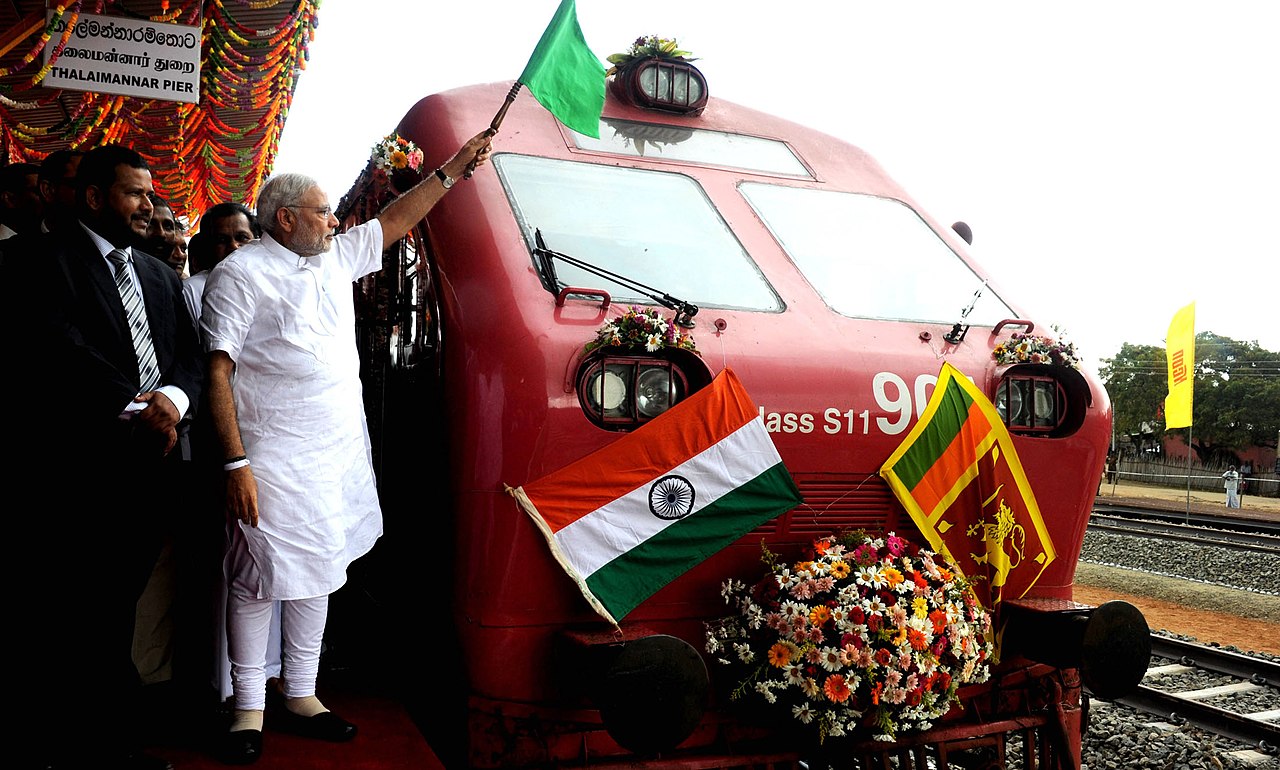
Indian Army Chief meets President Rajapaksa & Prime Minister

The Chief of Army Staff of the Indian Army, General Manoj Mukund Naravane met with President Gotabaya Rajapaksa and Prime Minister Mahinda Rajapaksa on Wednesday (13).

General Naravane met with the President, to seek his guidance on strengthening bilateral defence linkages further, tweeted the Indian High Commission in Sri Lanka.

“Sri Lanka’s leading role as a partner in security was appreciated including within the Colombo Security Conclave initiative,” said the High Commission.

The Chief of the Army Staff of India Gen. Manoj Mukund Naravane called on Prime Minister Mahinda Rajapaksa at Temple Trees this morning.

“Between the two armed forces, we have an excellent relationship,” Gen. Naravane told Prime Minister Rajapaksa, further noting that this positive interaction will also help cement the bilateral relations between the two countries at all levels, including people-to-people connections.

The Prime Minister expressed his appreciation for the assistance provided by the Indian Armed Forces to Sri Lanka throughout the years, especially in the area of training.

During the current visit to Sri Lanka, Gen. Naravane will be presenting driving and firing simulators to the School of Sri Lanka Army Service Corps in Anuradhapura. Speaking about this to the Prime Minister, the Indian Army Chief noted that technology will play a big role in the future, particularly in the area of training.

Given the high costs involved in maintaining a standing army, Gen. Naravane pointed out that simulators can serve a very useful role.

Among other aspects discussed between the two delegations included regional concerns of fundamentalism and terrorism, and the importance of caring for veterans after their service to the country.

Posted in Uncategorized

31 more COVID-19 deaths reported:Death toll surges to 13,408

A total of 31 more COVID-19 related deaths that occurred yesterday (12) were confirmed by the Director-General of Health Services today pushing the death toll to 13,408.

According to the Government Information Department, 11 females and 20 males are among the deceased.

A total of 23 people who are above 60 years of age are among the deceased while 8 of them are between 30 and 59 years of age.

Several western diplomats in the tour to the north

The envoys of Canada, Norway, and the Netherlands visited Batticaloa and Jaffna today.

Norway’s Ambassador Trine Joranli Eskedal and Dutch ambassador Tanja Gonggrijp attended meetings in Batticaloa and met with state minister S. Viyalendran and District Secretary K. Karunagaran.

“We discussed the longstanding problems and needs of the people in the Eastern Province. I also outlined the development projects carried out by the government,” said S. Viyalendran.

The envoys of Norway and the Netherlands also met with Batticaloa District Secretary K. Karunakaran.

They also met Batticaloa Mayor Thiyagarajah Saravanapavan.

“We discussed matters surrounding the 13th amendment and the projects that are being implemented to transform Batticaloa. We need to apply pressure on the international community to take Sri Lanka to the negotiation table to find a solution for the Tamils. We have also asked for a political solution,” said the Batticaloa Mayor.

Sri Lanka reports 23 Covid-19 deaths on Tuesday, toll rises to 13,377

Sri Lanka Tuesday reported 23 deaths due to COVID-19 after the figures were confirmed by the Director General of Health Services on Monday, October 11.

Among the deaths reported today, 11 are of males and 12 of females. The majority of deaths – 19- are of elderly people in the 60 years and above age group. A male below 30 years of age also succumbed to the disease.

According to the data reported by the Government Information Department, the total deaths due to Covid-19 since the pandemic began last year has now risen to 13,377.

Sri Lanka 2021 GDP growth downgraded to 3.6-pct by IMF, global growth lowered

Sri Lanka’s 2021 economic growth projection has been downgraded to 3.6 percent by the International Monetary Fund in its latest economic outlook from an earlier 4.0 percent, while global growth has also been lowered slightly.

World output has been lowered to 5.9 percent from 6.0 percent in a July projection.

“This modest headline revision, however, masks large downgrades for some countries,” Gita Gopinath, the IMF chief economist said.

“The outlook for the low-income developing country group has darkened considerably due to worsening pandemic
dynamics.

“The downgrade also reflects more difficult near-term prospects for the advanced economy group, in part due to supply disruptions.”

The forecast for emerging markets has been increased to 6.4 percent from 6.3 percent.

Advanced economies have been downgraded by 0.4 percent to 5.2 percent with the US at 6.0 percent (down 1.0 percent) but Euro areas have been upgraded by 0.4 percent to 5.0 percent.

The US Federal Reserve is also firing commodity bubble by printing large volumes of money amid a recovery in credit, driving up broad money. IMF said projections for some commodity exporters have been upgraded on the back of rising commodity prices.

Aggregate Demand Bubble

Gopinath said there were supply disruptions, where the pandemic played a part with shipping.

She said the recovery was unusual and not seen in the past.

“There are labour shortages and unemployment at the same time,” Gopinath said.

Critics say economic disruptions are one outcome of firing indiscriminate aggregate demand bubbles also known as the Keynesian stimulus.

Nobelist Friederick Hayek had explained how it happens.

“Just as there cannot be a uniform price for all kinds of labour, an equality of demand and supply for labour, in general, cannot be secured by managing aggregate demand,” he wrote.

“The volume of employment depends on the correspondence of demand and supply in each sector of the economy, therefore on the wage structure and demand between the sector.”

Eventually, higher unemployment is the result.

Social Unrest

The Fed has in the past created unrest across the world by firing commodity bubbles, particularly with food prices.

Gopinath said at the moment growth projections were high and there were no signs of stagflation but inflation risks were there.

“On the other hand, these supply shortages, alongside the release of pent-up demand and the rebound in commodity prices, have caused consumer price inflation to increase rapidly in, for example, the United States, Germany, and many emerging markets and developing economies,” she said.

“Food prices have increased the most in low-income countries where food insecurity is most acute, adding to the burdens of poorer households and raising the risk of social unrest.”

The Fed has claimed that inflation is ‘transitory’ while classical economists have said US inflation can go up as much as 9.0 percent and that Fed Chief Jerome Powell is ‘delusional’.

US money supply data (Divisia M4) calculated by the New York-based Centre for Financial Stability has raised red flags for many classical economists.

Sri Lanka is seeing the effects of the Powell bubble on energy and food prices while the country’s peg with the US dollar has also broken amplifying its effects.

“Monetary policy will need to walk a fine line between tackling inflation and financial risks and supporting the economic recovery,” Gopinath said.

“We project, amid high uncertainty, that headline inflation will likely return to pre-pandemic levels by mid-2022 for the group of advanced economies and emerging and developing economies.

“While monetary policy can generally look through transitory increases in inflation, central banks should be prepared to act quickly if the risks of rising inflation expectations become more material in this uncharted recovery.

“Central banks should chart contingent actions, announce clear triggers, and act in line with that communication.”

Posted in Uncategorized

BJP’s Subramanian Swamy in Sri Lanka for talks & Navratri festival

In a display of major diplomatic ties between Sri Lanka and India, BJP MP Subramanian Swamy arrived in the island on Tuesday (12).

Swamy, during his two-day visit, will participate in the Navratri festival hosted by Prime Minister Mahinda Rajapaksa at Temple Trees, the latter’s official residence in Colombo.

He is also slated to meet Fisheries Minister Douglas Devananda and will address a forum at the Institute of National Security Studies of the Defence Ministry.

Posted in Uncategorized

Indian Army Chief to arrive in Sri Lanka today on a five-day visit

Chief of the Army Staff of the Indian Army (COAS) General Manoj Mukund Naravane, is scheduled to arrive in the country on a five-day goodwill visit on Tuesday (Oct 12) at the invitation of his Sri Lankan counterpart General Shavendra Silva,.

Leading a five member delegation, the visiting Indian Army chief is expected to meet the President, Prime Minister, State Minister of National Security, Defense Secretary, Secretary to Ministry of Foreign Affairs and tri forces commanders during his stay in the country.

Accompanied by his spouse Mrs Veena Naravane, the visiting dignitary will also be present to witnesses the final demonstration of the bilateral ‘Mitra Shakti’ exercise at Maduru Oya Special Forces Training School.

Saving GSP+ Requires Genuine Progress on Human Rights

The Sri Lankan government has pledged to scale back its violations of the human rights in order to protect a valuable trade deal with the European Union (EU). Although ministers continue to deny wrongdoing, during a visit by EU officials they agreed to some changes including reforming anti-terror laws that have been used to target minorities and dissidents. Whether these promises will be met remains to be seen. But the situation will be monitored and, if adequate improvements are not made, GSP+ status that removes tariffs for many goods is set to be lost with serious economic consequences.

Calls for accountability

In recent months, concerns have repeatedly been raised about human rights and democracy in Sri Lanka, with calls for greater state accountability. Against the background of a grim economic, social and political situation made worse by mishandling, even harsh repression has not silenced dissatisfaction at home including from members of the majority community. International critics too have expressed dismay at the drive to give even more power to the ruling Rajapaksa family while failing to address ordinary people’s most basic needs.

This has had repercussions where maintaining basic standards has been a condition for certain advantages or benefits to be provided. The EU consists of 27 countries including Germany, France, Italy and Spain, and is one of Sri Lanka’s main trading partners. The Generalised Scheme of Preferences (GSP) reduces or removes import duties on a wide range of goods for low and middle income countries on two-thirds of tariff lines. GSP+ offers special incentives to certain countries so that these tariffs are 0 percent if they put into practice a range of international conventions on human rights, labour rights, environmental protection and good governance. At present Sri Lanka benefits from this measure. But in June the European Parliament passed a resolution on abuses in Sri Lanka, which called on the European Commission (the EU’s executive arm) to consider temporarily withdrawing this highly favourable trading status.

This may sound drastic. However continuing to offer tariff-free trade for numerous goods when key conditions were not being met could be seen as unfair to the people of countries not granted GSP+ status, making their exports more expensive and so less competitive even if their states were closer to meeting the required good practice standards. And it might also be regarded as short-changing EU residents if customs revenues were waived that could have been used to alleviate poverty in poorer European regions if the benefits did not reach those for whom they were intended in an equitable and transparent manner.

While the regime was dismissive at first of the EU warning, the economy has since experienced a sharp downturn, bringing widespread hardship and insecurity made worse by the pandemic and how it has been handled. This has made it politically harder to ignore the potential damage to the economic wellbeing of Sri Lankans if GSP+ status was withdrawn and the political consequences if ministers were blamed by the public.

An Institute of Policy Studies blog analysing the potential impact was sobering. Researchers estimated that if the UK followed the EU lead, Sri Lanka’s exports could fall by $627 million compared with 2019. According to its calculations, the biggest loss by far would be to apparel, followed by tobacco and related products, seafood and rubber articles. In the garment industry, already hit by the pandemic, there was huge concern in the run-up to a visit by an EU delegation.

The EU visit and its aftermath

EU officials who took part in the mission to Sri Lanka included Nikolaos Zaimis, Senior Adviser, Directorate General for Trade at the European Commission, Ioannis Giogkarakis-Argyropoulos, Head of Division for South Asia at the European External Action Service and Denis Chaibi, Ambassador of the European Union Delegation in Colombo. The Sri Lankan government took a relatively conciliatory approach.

According to a joint press release on the fifth Working Group on Governance, Rule of Law and Human Rights, which met in Colombo on September 29, “The two partners reaffirmed their commitment to good governance, adherence to the rule of law, and protection of human rights…agreed on the importance of engaging civil society and giving it the necessary space to function in all its diversity” and “The Working Group discussed matters related to minorities.” What is more, “Sri Lanka provided an update on the action in process to review the Prevention of Terrorism Act, and reiterated its commitment to bring it in line with international norms and standards within a time bound process. The EU and Sri Lanka agreed to take stock of progress in this regard by the next meeting of the EU-Sri Lanka Joint Commission in early 2022. The need to uphold international norms and standards of human rights while countering terrorism and violent extremism was also underlined.”

On October 1, the delegation met Foreign Minister G.L. Peiris and others in the ministry to discuss some of the contentious issues including cooperation with the United Nations Human Rights Council. Ongoing cooperation was indicated.

This message was reinforced at a meeting with President Gotabaya Rajapaksa on October 4 where Foreign Secretary Jayanath Colombage was also present. Rajapaksa rather implausibly claimed that Sri Lanka had never been under a dictatorship or an authoritarian regime in any period of its history but stated that immediate steps would be taken to amend the Prevention of Terrorism Act and that the country would abide by the agreements on human rights in the world today. On other aspects of minority rights, he painted a rosy picture that those on the receiving end of harsh repression would not readily recognise.

“In the discussion with #EU delegation, headed by Nikolaos Zaimis, I iterated the steps that have been taken to establish lasting democracy & reconciliation in Sri Lanka,” he tweeted the following day. “I ensured that #SriLanka is committed to comply with the agreements made under EU GSP+ regime.” The same day, Professor Peiris gave a speech to Parliament highlighting the value of positive international engagement including with the UN and other partners.

A press release from the EU delegation on October 6, as the Monitoring Mission concluded, outlined key aspects of the 10-day visit including meeting not only the President, Foreign Minister Justice Minister Ali Sabry and Finance Minister Basil Rajapaksa but also “the opposition, civil society including human rights defenders, trade unions and employers.” Issues focused on included “non-discrimination, the respect for the rights of all communities in Sri Lanka, the ongoing use of the PTA, impediments to the exercise of fundamental freedoms, and the development of draft legislation on Non-Governmental Organisations. The meetings also reviewed drugs policy, environment and climate change, as well as corruption.”

That progress would be monitored and GSP+ status might be withdrawn if the necessary changes failed to happen was made clear in a quote from EU Ambassador Denis Chaibi, “The effective implementation of international commitments forms the basis of Sri Lanka’s privileged access to the EU market. We have been working together with the Sri Lankan Government since 2015 to advance the issues of concern and welcome the continued engagement. The monitoring and engagement with the Government of Sri Lanka will be the subject of regular reports to the European Parliament and the Council of Ministers.”

In future, according to Senior Adviser Nikolaos Zaimis, speaking at a webinar, GSP+ requirements might be tightened, with a speedier process to withdraw the preferences if there were serious violations. He also highlighted the benefits and urged Sri Lanka to make greater use of the programme while diversifying and increasing industrialisation.

It is not certain how far the Sri Lankan government will move with regard to restoring some of the human rights and democratic provisions that have been weakened or removed. To some extent, ministers may be playing for time in the hope that their fortunes may change. Nevertheless there would appear to be some openings for easing the plight of most vulnerable and marginalised, especially if Sri Lankans seeking greater justice, humanity and reconciliation could work together to advance rights and freedoms for people of diverse backgrounds and communities. At least there appears to be a slowing down of some of the most destructive aspects of the drive to consolidate power in the hands of a few.

The courage and determination of those who have drawn international attention to the grim situation in Sri Lanka have had an impact. Although the government is far from trustworthy and the EU has its own interests to pursue, keeping GSP+ status may be an incentive to rein in some types of bad practice and offer slightly more democratic space in which solidarity can be strengthened and alternative futures explored.

Source:groundviews

Arms seizure: Indian NIA seeks info from Sri Lanka under treaty

The National Investigation Agency (NIA) has sought information about suspected Liberation Tigers of Tamil Eelam (LTTE) members from Sri Lanka under the Mutual Legal Assistance Treaty (MLAT) as part of the probe into the seizure of five AK 47 rifles from a foreign vessel off the Kerala coast in March this year.

The agency has also invoked various sections of the Unlawful Activities Prevention Act (UAPA) in the case, the New Indian Express reported.

It was on March 18 this year that a Sri Lankan fishing vessel, Ravihanshi, was intercepted by the Coast Guard from which 300kg of heroin, five AK 47 rifles and 1,000 pieces of ammunition were seized. The Narcotics Control Bureau registered a case first following the seizure of heroin and arrested six crew members — all Sri Lankan nationals.

The case related to the seizure of AK 47 rifles and ammunition was first registered at Vizhinjam police station which was later taken over by NIA. The national agency has so far arrested 15 persons of whom 10 are from Sri Lanka including three staying illegally in India.

During the probe, NIA found links of the accused with LTTE and that the smuggling of drugs and weapons was part of an attempt to revive the proscribed terrorist organisation. It was also found that many LTTE activists in Sri Lanka are behind the incident.

Posted in Uncategorized

Sri Lanka may hold PC polls in early 2022, but no pressure from India: foreign minister

Sri Lanka wishes to hold the country’s long-delayed provincial council elections before March 2022 but it will not be due to pressure from India or any other foreign government, foreign minister G L Peiris said.

Speaking to reporters on Monday (11), Peiris denied that India’s foreign secretary Harsh V Shringla who was on an official visit to Sri Lanka last week had put pressure on the government to hold early elections.

“That’s a complete myth. The Indian foreign secretary didn’t come here and put pressure on the government over elections in our country. His visit was in relation to other matters. The Indian foreign secretary doesn’t have to arrive in Sri Lanka for us to take that decision,” said Peiris.

The Indian High Commission in Sri Lanka said in a statement on October 06 that, at a meeting with President Gotabaya Rajapaksa, the foreign secretary had reiterated India’s position on complete implementation of the provisions in the 13th Amendment to the Constitution, including devolution of powers and the holding of Provincial Council elections at the earliest.

“India didn’t say they were putting pressure. The word ‘pressure’ is wholly incorrect. This was always India’s position on the 13th amendment and the provincial polls. It’s nothing new,” Minister Peiris said responding to reporters’ questions.

“There are no members in a single provincial council for two years running. This is a disservice to democracy and to the people. In no part of the country can a citizen or voter meet an elected representative to take their issues to. Our government has decided to hold elections,” he said.

Provincial polls in Sri Lanka were postponed in 2017 when the then government proposed a hybrid system of first-past-the-post and proportional representation. According to Minister Peiris, the Attorney General has made it clear that polls to the nine provinces cannot be held until the 2017 Act is amended and passed in parliament.

All nine provinces in Sri Lanka are currently being run by their respective governors following the end of their five-year terms at various points. The United Nations Human Rights Council (UNHRC) has also called for the early conduct of polls, a sentiment echoed by India. The provincial councils are a legacy of the Indo-Lanka accord signed in 1987 and was proposed as a solution to the ethnic conflict.

“We wish to go for elections once our programme is reformed as needed, based on the people’s expectations,” said Peiris.

“The Attorney General has advised that provincial polls cannot be held without passing a new bill in parliament. What we need is to hold the elections before March 2022. It’s not due to anyone’s influence; it is not under pressure from a foreign government. That’s a total untruth,” he said.

In March this year, President Gotabaya Rajapaksa said that the PC polls must be held soon either under the previous Provincial Councils Elections Act or under the proposed new (Amendment) Act with its “complications” removed.

The president’s office quoted him as saying the Amended Provincial Councils Act which included a new delimitation of the constituencies, a quota for women candidates and other changes “had been defeated by the former government which proposed it.”

Sri Lanka’s Supreme Court has also determined that the provincial polls can be held under either the old or new system but upon the amending legislation being passed.