Seven political parties not represented in Parliament summoned before the PSC on Election Law Reforms

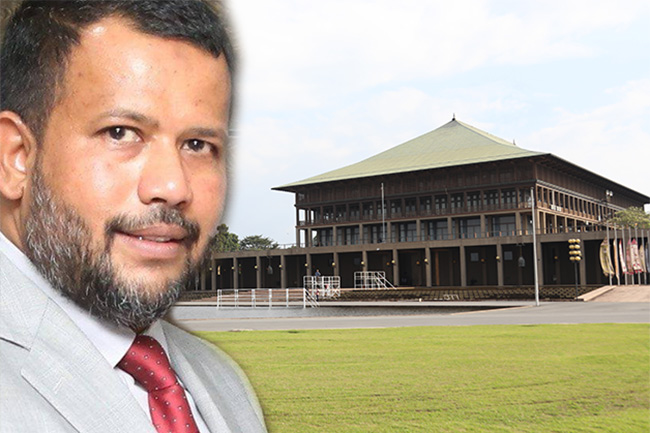
Seven political parties that are not represented in Parliament have been summoned before the Parliament Select Committee (PSC) to identify appropriate reforms of the election laws and the electoral system and to recommend necessary amendment, said its Secretary and Deputy Secretary General and Chief of Staff Kushani Rohanadeera.

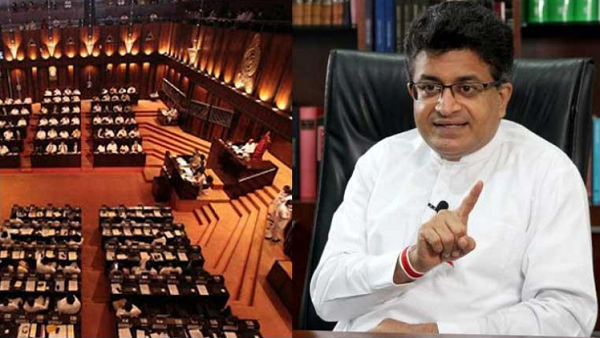
The committee will meet in Parliament today at 2.00 pm under the chairmanship of Leader of the House, Foreign Minister Dinesh Gunawardena.

Among the parties invited so far, Liberal Party, Akil Ilankai Tamilar Maha Sabai, Social Democratic Party of Tamils, Sinhaladeepa Jathika Peramuna and Samathuvakkadchi Party have confirmed their participation, the Deputy Secretary General said.

The parties that have not yet confirmed their participation are the Mawbima Janatha Party and the United Peace Alliance.

PAFFREL, an election monitoring organization, presented their proposals at the PSC meeting on the 14th.

The Parliamentary Select Committee was appointed by Speaker Mahinda Yapa Abeywardena last April to make recommendations to amend the electoral law and the electoral structure.

The committee met for the first time on May 17.

The other members of the committee are Ministers Nimal Siripala de Silva, Prof. GL Peiris, Pavithradevi Wanniarachchi, PC Ali Sabry, State Minister Jeevan Thondaman, MPs Kabir Hashim, Ranjith Madduma Bandara, Mano Ganesan, M.A. Sumanthiran and Sagara Kariyawasam.

Posted in Uncategorized

Massacred Tamil political prisoners remembered in defiance of police ban

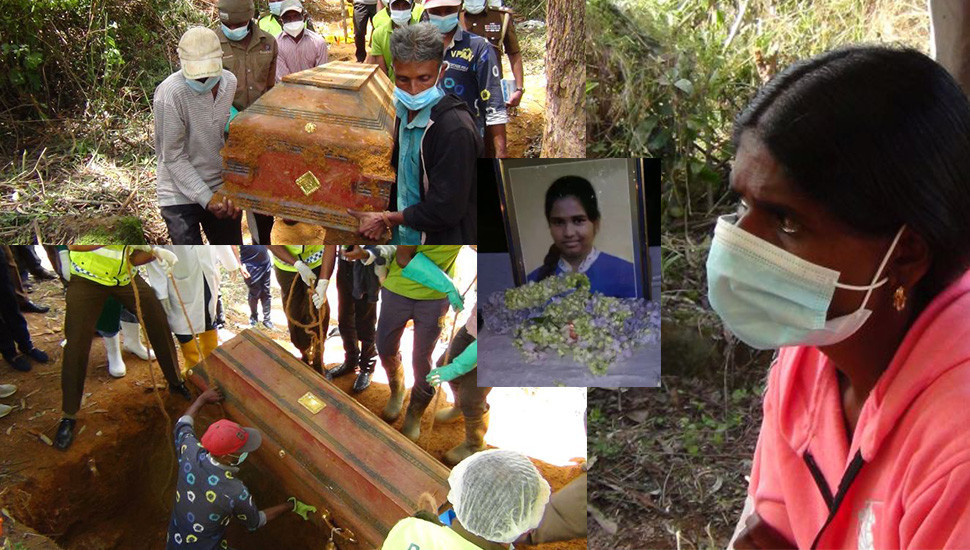
The 53 Tamil political prisoners massacred in Welikada prison 38 years ago were remembered in Trincomalee on Sunday (25-07-2021) despite a police ban.

Attendees, including TELO Secretary General and MP for Batticaloa Govindan Karunakaran, defiantly laid flowers for the victims of the massacre, as a Sri Lankan police officer attempted to obstruct the service.

The remembrance event organised by the Tamil Eelam Liberation Organization(TELO), was held at the Welikada Martyrs’ Memorial on Trincomalee beach.

On the 25th July 1983 Sellarasa “Kuttimani” Yogachandiran, leader of the Tamil Eelam Liberation Organisation (TELO) and Ganeshanathan Jeganathan, a political writer, had their eyes gouged out in mockery before being killed by Sinhalese inmates at the high security Welikada prison in Colombo. A total of 37 Tamil prisoners were murdered the same day, and 18 more were killed two days later.

5th August 1983 – The Guardian

“It is the massacres in the Welikade gaol which are attracting the most attention. There is a particular interest in circumstances in which two alleged guerrilla leaders were killed.

The two men, Sellarasa “Kuttimani” Yogachandiran, leader of the Tamil Eelam Liberation Organization (TELO) and a political writer, and Ganeshanathan Jeganathan had been sentenced to death last year for the murder of a policeman.

In speeches from the dock, the two men had announced that they would donate their eyes in the hope that they would be grafted on to Tamils who would see the birth of Eelam, the independent state they were fighting for.

Second hand reports from Batticaloa gaol, where the survivors of the Welikada massacre are now being kept, say that the two men were forced to kneel and their eyes gouged out with iron bars before they were killed.

Along with TELO Secretary General Kuttimani and TELO Founder Thangathurai, the Tamil prisoners who were massacred in Welikada on 25th July 1983 were:

Nadesathasan, Jegan, Alias Sivarasa, Sivan Anpalagan, A. Balasubramaniam, Surash Kumar, Arunthavarajah, Thanapalasingham, Arafat, Anpalagan Sunduran, P. Mahendran, Ramalingam Balachandran, K. Thillainathan, K. Thavarajasingham, S. Subramaniam, Mylvaganam Sinnaiah, G. Mylvaganam, Ch. Sivanantharajah, T. Kandiah, S. Sathiyaseelan, Kathiravelpillai, Easvaranathan, K. Nagarajah, Gunapalan Ganeshalingam, S. Kularajasekaram, K. Krishnakumar, K. Uthaya Kumar, R. Yoganathan, S. Sivakumar, A. Uthayakumar, A. Rajan, G. Amirthalingam, S. Balachandran, V. Chandrakumar, Yogachandran Killi, Sittampalam Chandrakulam and Master Navaratnam Sivapatham.

SL in deep crisis: More focused, stronger action needed BY Prof. Tissa Vitarana

In the context of the deepening global economic crisis, the country’s foreign exchange (forex) crisis is not improving. The slight increase in exports has been undermined by increased imports, especially aggravated by the need to import vaccines to meet the Covid-19 crisis. Also, the decision to restrict the import of luxuries and non-essentials is not being enforced effectively. The result is that with more foreign borrowing, our foreign debt is increasing. The annual repayment of debt has reached $ 4.5 billion, with interest repayment alone amounting to $ 1 billion. Neither the Government nor the people appear to realise the gravity of the forex situation and do not act accordingly. Our import policies need to be tightened. The Government has failed to explain to the people the magnitude of the crisis and the need to tighten the belt at all levels, setting a proper example from the top, so as to conserve our forex. The result is the forex crisis.

But internally too the economic crisis is deepening, accompanied by social, political, and health crises. The hunger crisis is severe with many people having only one meal. The loss of income due to the closure of factories and offices and the loss of self-employment is a major factor. In addition, many have had pay cuts. Another major cause is the rise in the cost of goods, especially essentials like food. This has led to the inability to buy essentials, and increasing poverty and hunger. In fact, studies indicate that 60% of the people have incomes below the poverty line. The level of malnutrition has gone up to 18%. Thus, the correction of the hunger problem should be given the first priority by the Government. I appeal to the new Finance Minister Basil Rajapaksa to ascertain the families faced with poverty and hunger and to supply dry rations to them as the first priority.

The Covid-19 pandemic is liable to expand with the spread of the more virulent B.1.617.2 Delta Indian variant in the country. There has to be a country-wide, people-based campaign to curb this. Covid-19 committees should be established in every village and slum. These should detect Covid-19 cases early and institute cluster control measures, and ensure that every person strictly observes the four health guidelines (preventing crowding, ensuring social distancing, ensuring that masks are worn when out of the home, and the effective washing of hands). Covid-19 committees have to be set up in schools as necessary. It must be ensured that all the vulnerable people in the society who are liable to get severe disease or die (elderly over 60 years and those with serious chronic diseases) are vaccinated.

Imported chemical fertiliser should be continued for this period (seasons) of cultivation so that farmers do not suffer. Organic fertiliser should, meanwhile, be produced adequately and be introduced country-wide thereafter.

Another major problem is the high cost of food and other essentials. The revival and strengthening of co-operatives, producers, and consumers is the only way out. This would prevent profiteering by middlemen. The introduction of the new solidarity concept, which ensures that the ownership of enterprises is given to the employees alone, would result in successful outcomes, e.g. the paddy fields in Kerala, India. The strengthening of the state sector in marketing e.g. the marketing department, the Co-operative Wholesale Establishment, etc., would also help.

Measures like these will help to overcome poverty and hunger, and eliminate malnutrition. I urge the Government to think and act on these lines to improve the conditions of the people and to make the country more productive and the people happier.

(The writer is a virologist, government parliamentarian, the Committee on Public Accounts Chairman, and the Lanka Sama Samaja Party Leader)

Sri Lanka settles 1 bn USD bond repayment – Keheliya

The government has settled a debt repayment amounting to 1 Billion US Dollars. This was revealed at the cabinet media briefing held this morning.

“In a pandemic stricken world, where the entire economies have collapsed and communities are suffering, this is a testament to our tactful cashflow management,” co-cabinet spokesperson minister Keheliya Rambukwella said.

He added that the bond was settled without causing an impact on Sri Lanka’s foreign reserves, by managing the country’s cashflows intelligently.

“At one point, foreign reserves had depleted to 1.2 Billion USD. But, we were able to handle a war, manage our cashflows and retain our foreign reserves,” Rambukwella noted.

Meanwhile, State Minister of Money and Capital Market Ajith Nivard Cabraal has told EconomyNext that Sri Lanka’s forex reserve fall after a July sovereign bond payment will be temporary and will be boosted later with other inflows, including investments into under-utilized government properties.

According to State Minister Cabraal, properties such as the General Post Office, the Grand Orient Hotel and Narahenpita Tractor Corporation land had caught the attention of investors.

He added, the projects had the potential to bring around 700 million to 1,000 million dollars.

Also speaking to EconomyNext President’s Secretary Dr. P.B.Jayasundara has said, Sri Lanka is in a balancing act with international powers to attract more investment.

The ghastly tale of the killing of Tamil prisoners at Welikada in 1983 – FT.LK

All stories have their heroes and villains. During the Welikada Prison massacre of July 1983 in which 53 Tamil prisoners lost their lives, there were few prison officials who put their lives on the line to protect the Tamil inmates while there were the others, who by their complicity, encouraged the attackers and failed in their duties by not taking timely measures to protect them.

The killings inside the prison took place on two days with 35 inmates killed on 25 July and 18 others on 27 July. That week, 38 years ago, mayhem was unfolding outside the prison walls too with senseless killings, looting and arson attacks taking place against Tamils, in a month that has since come to be known as ‘Black July.’

The Presidential Truth Commission on Ethnic Violence (1981-1984) appointed by President Chandrika Kumaratunga in 2001 said the murder of the Tamil prisoners within the well-secured precincts of the Welikada Prison and the traumatic experience of those who escaped death would ‘constitute the most agonising moments of challenge to the collective conscience of our Nation.’ In this case, like with many similar extra judicial killings that have taken place in the country since, no one was held accountable, none prosecuted, and the case closed with the State settling the civil lawsuits filed by relatives of some of the victims by paying compensation without admitting liability.

The Commission recorded evidence from survivors of the massacre, prison officials, human rights and civil rights activists and other witnesses to piece together the terrifying atmosphere within the prison during the dark days in July 1983 and how apathy by the Government and some prison officials led to the massacres which would have been averted had they acted on time.

The first massacre on 25 July took place within wing ‘B3’ of the Chapel section of the Welikada Prison where, most prominent among the inmates, was Selvarajah Yogachandran alias Kuttimani who was serving a death sentence for the killing of a Police Constable while concurrently serving another sentence for a bank robbery.

Sarvanaperumal Yogarajah who was held in wing ‘C3’ on the ground floor of the prison and escaped the massacre by feigning death were among those who testified before the Commission which was headed by retired Chief Justice S. Sharvananda with S.S. Sahabandu P.C. and M.M. Zuhair P.C. as its members.

The prisoners were aware of the unrest that had begun at Borella on the evening of 24 July where large crowds had gathered for the cremation of 13 soldiers who were killed in a landmine explosion in the north the day earlier and there was a sense of foreboding among the Tamil prisoners that they could come under attack.

On the afternoon of 25 July, the prisoners in wing ‘C3’ could hear loud sounds of people walking around and shouting but could not see what was happening within wing ‘B3’ where the first massacre was underway. Sometime later Yogarajah had heard the loud cry, “Kuttimani killed” in Sinhala. He could also hear the commentary of some of the inmates whose cells were near the lobby area and could see through the iron bars the bodies of the prisoners who had been battered by fellow inmates being dragged out to the open yard in the prison.

While the attacks were underway in wing ‘B3’, some other prisoners were trying to break open the gate that led to wing ‘C3’ where the witness was being held but a single prison officer had stood between the Tamil prisoners and the attackers, having hidden the keys of the cell in the toilet and standing guard until those trying to break in left the area.

However later two of the attackers who were on the upper floor, presumably, because they had failed to get past the guard, had broken through the wooden floor above the corridor and come down into wing ‘C3’. Having come they appeared to have changed their minds or been prevailed upon by the guards in the corridor to get away, that they shouted at their accomplices upstairs not to come down through the hole and told some of the men in the cells, “We have killed enough today, we will come back another time.”

Things were quiet the next day as all the inmates were kept locked up, but this was to change a day later. In the middle of the night of 26 July, prison officers had come to wing ‘C3’ and asked the 28 Tamil inmates there including the witness to collect their belongings and come along without making a noise. They were relieved thinking they were being transferred out of the prison but instead were moved to the Youth Offenders (YO) Block which is a separate area within the prison compound. They were then locked up on the ground floor of the building.

Nine other Tamil detainees who were held in the YO block had been moved to a dormitory upstairs to make room for the 28 who were transferred from wing ‘C3’. Yogarajah said that though they were moved to a new block, they were anticipating another attack and decided to improvise weapons for self-defence using whatever was at their disposal including plates, buckets and even saving the curries served to them.

Among the nine prisoners who were moved upstairs, there were three Christian priests and hence they were provided with a table and some chairs to use for mass. They had broken the table and chairs and fortified themselves as best as they could anticipating the worst.

On the afternoon of 27 July, those in the YO block had heard the sound of a mob on the rampage approaching the building. Each one of the Tamil detainees had fought back, some were killed but Yogarajah had feigned death and managed to escape. A few days later, he and the other survivors were transferred to the Batticaloa Prison.

The Commission observed that while there were individual officers who attempted to restrain and bring the situation under control, there is material to conclude that certain prison officials were complicit in the attacks carried out on the Tamil prisoners on the two days and there were no organised measures taken to deal with the situation.

The Commission also said that army personnel who were on guard outside the Welikada Prison had refused to help prison authorities who sought their intervention saying they had ‘no orders from headquarters’ while witnesses told the Commission that soldiers were heard shouting ‘Jayawewa’ when news broke of the killings of the Tamil prisoners.

Civil Rights Movement (CRM) General Secretary Suriya Wickremasinghe was among a few who worked tirelessly to locate and interview witnesses to the incidents and ensure high standards were maintained during the interview process so as to elicit the truth by testing the veracity of each version with the other. She and a few others also travelled to Madras (Chennai) in South India to interview some of the survivors.

In her testimony before the Commission, Wickremasinghe said she heard from one of the witnesses how an Assistant Superintendent of Prisons who was on duty at wing ‘C3’ on 25 July put his foot on the padlock of the door that led to the cell and stood up to the attackers thus preventing the killing of Tamil prisoners in that cell on the first day while another witness spoke of two jailors who threatened the Tamil prisoners (he could not identify them) telling them, “Let’s see (balamu), today is your last day.”

She also said the conduct of the army personnel on duty outside the prison on 25 July was ‘very strange’ and they seemed to have obstructed every attempt to control the situation and to let the injured be taken for treatment.

The CRM assisted in filing 30 civil cases in the District Court for damages on grounds the State failed to take care of the prisoners. The State settled all the cases by paying compensation without admitting liability.

The findings of the Commission were a damning indictment of the Government of the day. All evidence relating to the attacks on 25 and 27 July were not placed at the inquest proceedings into the killings, no attempts were made to identify the miscreants and efforts to trace police records turned futile, with the Commission told that the records were untraceable. Attempts to initiate an internal inquiry by the head of the Welikada Prison at the time Leo de Silva too were sabotaged and he was prevented from giving evidence at the inquest by the Magistrate even though he was a key witness.

Of the 72 Tamil prisoners who were at Welikada Prison that week in July, only 19 escaped the massacre. They were transferred to the Batticaloa Prison on 29 July. Some escaped to India in September by breaking out of prison while a few were released sometime later without charges.

In some stories, the villains go unpunished, the heroes go unrecognised and the victims forgotten. The story of the Welikada Prison massacre of 1983 is one such, but also one of many such unfortunate events the country has seen. Nearly four decades later, there are few lessons learnt from such tragedies.

SL far from meeting UN Standard Minimum Rules for the Treatment of Prisoners

The Daily FT asked Ambika Satkunanathan, human rights lawyer and former Commissioner of the Human Rights Commission of Sri Lanka (HRCSL) who led the first national study of prisons at HRCSL if prisons are any safer for inmates today, if there are better protocols in place to keep prisoners safe and the role of the public/civil society in looking at prisoners with the empathy they deserve. Following are excerpts of the interview:

Q: How safe are the country’s prisons for inmates?

To determine whether Sri Lanka’s prisons are safe we have to look at two elements – the conditions in which persons are held and their treatment by prison officials. As the HRCSL’s prison study illustrated, the conditions in which they are held do not meet basic standards and in many instances are inhumane and constitute degrading treatment. For example, at Welikada Prison the entire H Ward building was noted to be sinking on one side, as the building is very old.

The whole building was condemned and abandoned a few years ago but due to overcrowding the ground floor and a half of the first floor were still being used in 2020. Nine or even 10 persons sleep in a cell which is locked at night and hence they have to use a bucket or plastic bag to relieve themselves at night. There is little ventilation or light, and people have to deal with bed bugs, rats, and pigeons, which create an environment that is hazardous to health. Those on death row are held 23 hours in cells that have little light due to which many have problems with their eyesight.

Where the treatment of persons in prisons is concerned, the use of violence to subjugate, degrade, humiliate, and control a person is common. There are instances when I have searched and found persons who were hidden from us because they had been badly tortured the day prior to our visit.

There was an instance where a person was being tied up and assaulted when HRCSL visited, and the officer released the person as soon as he heard HRCSL had arrived. The person came running towards the officers, fell at their feet and pleaded with them to save him. Although the use of violence is common, persons in prison have very few ways of complaining of the ill-treatment and could face reprisals if they do. This is all to say that our prisons are not safe at all.

Q: Are there adequate protocols in place to be followed in case of unrest/attacks on inmates within prison?

To my knowledge there are no formal protocols on how to deal with unrest in prison, and particularly guards, who are at the front line, have little or no knowledge of how to quell unrest or resolve conflict in non-violent ways.

Q: Since 1983, we have had several other incidents where inmates were killed inside prisons but there has been almost zero accountability/prosecution. What role should the state play in such instances?

We have to make a distinction between the state and government. Although there are some legal mechanisms to deal with violation of rights, such as the Convention Against Torture Act, the state itself is tolerant of violence and violence is embedded in many of its structures and processes. As long as we don’t acknowledge or address structural violence, it will be impossible to make prisons or even society less violent.

At the same time, successive governments have had scant respect for the rule of law and impunity is entrenched in Sri Lanka. Many governments did not even symbolically adopt a zero-tolerance approach to torture or extra-judicial killings. Even those that claimed to have a zero-tolerance policy didn’t always practice what they preached and hence state officials knew they would not be held accountable. The state (and of course the government) nearly always protects its own.

Q: Is Sri Lanka any closer to achieving the objectives of the United Nations Standard Minimum Rules for the Treatment of Prisoners (Mandela rules)?

Successive governments ignored the penal sector because prisons are viewed as places where you lock up persons considered undesirables, throw away the key and forget about them. This is easily done because the prison population consists mostly of the poor and marginalised. Because those in prison are viewed as ‘criminals’ they are not considered persons who have rights but as second-class citizens.

Our aim should not be to build more and better prisons. Our aim should be to reduce the number of persons being sent to prisons and close prisons. For this we need criminal justice reform as well as socio-economic policy to address the drivers of crime. We need responsible policymaking on allocation of public resources. For instance, we spent over $ 100 million to build the Lotus Tower but don’t think an equal amount should be invested in social protection mechanisms, such as employment and preventing homelessness to prevent the society to prison pipeline.

Q: What roles can the civil society/public play to build empathy for prisoners?

The public and civil society have a critical role to play in reducing the society to a prison pipeline and helping people break out of the cycle of poverty, violence, and imprisonment. Most often politicians point to public demand for tougher punishments for crime to justify increasingly punitive measures. The public supports such Government measures because they don’t see the state’s failure to prevent crime, nor do they link that to the state’s failure to address the socio-economic drivers of crime.

Instead of demanding tougher punishments the public should demand the Government invest in social protection and support mechanisms. Also, people don’t seem to be aware that the deprivation of liberty is supposed to be ‘the’ punishment. Once deprived of liberty you are not supposed to be deprived of everything else. In Sri Lanka most think a person has to be punished in prison and isn’t deserving even of decent food or a bed. What we need is a humane approach that recognises persons in prison too have dignity and rights.

A simple way to start humanising persons in prison is to be mindful of the language we use. Often people don’t realise that certain terms which we commonly use are dehumanising. An example is the term ‘inmate’. Instead of saying inmate or prisoner we can use incarcerated people or people in prisons. The change in how we use language is something that even I had to do consciously because we have normalised the use of these words to the point that we don’t realise how they enable the dehumanisation of persons in prisons.

Posted in Uncategorized

China firm proposes US$200mn cargo services centre in Colombo Port

Colombo International Container Terminal, a unit of China’s CM Ports group has proposed a 200 million US dollar cargo services centre inside Colombo Port, cabinet spokesman Minister Keheliya Rambukwelle said.

“We believe that we can make our country a shipping hub with its geographical location,” Minister Rambukwelle said.

“So in order to gain a considerable amount of market share in Asia, there are a few shortcomings. There is a need to invest to clear the shortcomings. We expect an investment of around 200 million dollars for this.”

The cabinet of ministers had cleared a request by the Minister of Shipping to set up a Cabinet Appointed Negotiations Committee to evaluate the proposal.

CICT has proposed setting up the centre in a 5.3-hectare plot in the Battenberg area of the Colombo South Harbour as a public-private partnership, a statement from the state information office said.

With the building of Colombo East Terminal and Colombo West Terminal, Colombo Port’s throughput is expected to go up to 10 million twenty-foot equivalent units by 2023, raising the demand for cargo services.

The Bloemendal area and also the Unity Container Terminal areas have been identified for value-added services.

Posted in Uncategorized

Chinese Prime Minister Li Keqiang to visit Sri Lanka

Chinese Prime Minister Li Keqiang is likely to visit Sri Lanka in September.

The Virakesari newspaper reported that Prime Minister Li Keqiang will be in Sri Lanka on 10th September.

He is expected to undertake a two day visit during which he will have talks with President Gotabaya Rajapaksa, Prime Minister Mahinda Rajapaksa and Finance Minister Basil Rajapaksa.

According to the Virakesari newspaper the Chinese Prime Minister will also visit the Colombo Port City.

He is expected to review the progress on the work at the Colombo Port City.

SL to discuss with 21 countries to lift travel ban on tourists

Minister Prasanna Ranatunga today said the Tourism Ministry together with the Ministry of External Affairs was working on removing the travel restrictions imposed on the entry of tourists to Sri Lanka.

The minister said that 21 countries have currently banned travel to Sri Lanka due to the Covid-19 situation.

He said he hoped to hold discussions with Norway, Bahrain, Nepal, Japan, France, Australia, New Zealand, Qatar and Vietnam through the Ministry of External Affairs.

In addition, the Minister said that he had instructed the Tourism Promotion Bureau to implement worldwide promotional programs to attract tourists to Sri Lanka.

Accordingly, it was decided to launch new promotional programs in Russia and the Eastern European market from next month.

This was revealed during a special discussion held at the ministry to implement an action plan to attract more tourists to Sri Lanka.

The Minister said that this special promotion program would be implemented from August 1.

Minister Ranatunga said that the government hopes to end the Covid-19 vaccination drive in Sri Lanka by the end of September this year.

He said the government hopes to vaccinate 60% of the total population by then.

Teacher-principal trade unions to go ahead with strike as talks with PM fail

The discussion held between Prime Minister Mahinda Rajapaksa and the representatives of teacher-principal trade unions on disparities in salaries has ended without reaching an agreement.

Speaking to media on the matter, General Secretary of the Ceylon Teachers’ Union (CTU) joseph Stalin stated that they would carry on their trade union action until the demands are met.

The discussion went on for nearly two hours at the Temple Trees earlier today (July 27).

Teachers across the island withdrew from conducting online lessons on July 12, demanding solutions for anomalies in salaries, ‘forced quarantining’ protesters, and several other issues.

A total of 17 trade unions representing school principals and teachers including the Ceylon Independent Teachers’ Services Union (ITSU) had joined the said strike action which entered the 16th consecutive day today.

In the meantime, PM Rajapaksa, issuing a press release following the discussion with the trade unions, stated that the final decision on the salary issue and transformation of the teacher-principal service into a ‘closed service’ will be given after the meeting of the Cabinet of Ministers scheduled for next Monday (August 01).

He has, accordingly, informed the teachers and principals to prepare to resume work from next Monday.

The prime minister, stating that he has a clear understanding of the wage disparities in the teacher-principal service, pointed out that the government is not in a position to increase the salaries immediately due to the current pandemic situation in the country and the world.

“We’re ready to resolve this issue,” he said adding that a decision, however, should be taken after discussing with the National Salaries and Cadre Commission.

The prime minister told the trade union representatives that Minister of Education has submitted a Cabinet paper pertaining to the ongoing issue.

Commenting on the matter, Prof. G.L. Peiris stated that this Cabinet paper was prepared taking into account the related supreme court’s verdicts, Cabinet decisions and the contents of the ‘Subodhini Committee’ report.

The aim of making the teacher-principal service a ‘closed service’ is to minimize their salary anomalies without creating disparities in other sectors in the public service, State Minister of Education Reforms Susil Premajayantha, who attended the said meeting, has told the trade unions.

Posted in Uncategorized

‘No individual nor the Sri Lankan state held accountable’- PEARL stmt on Black July’83

No individual nor the Sri Lankan state has been held accountable for the atrocities that were committed,or the many other acts of violence that preceded and followed the events of Black July, said in a statement issued by the People for Equality and Relief for in Lanka (PEARL) on Black July 1983.

“Between July 23 and July 30, 1983, in a series of brutal pogroms and riots sponsored by the Sri Lankan state, Sinhala mobs inflicted devastating violence upon the Tamil population of the island. Black July represented a grievous escalation of ethnic tensions and anti-Tamil violence that had been occurring for decades, as Sinhala mobs, armed with voter registration lists to specifically target the Tamil community, took over 3,000 Tamil lives, destroyed 5,000 shops and 8,000 homes, and displaced over 150,000 Tamils. At least 500 Tamil women were victims of sexual violence and many Tamil families were burned alive.

The violence was a systematic and intentional genocide, as mobs were transported around Colombo in vehicles owned by government establishments. The almost entirely Sinhalese police, military, and security forces stood idle and watched, or sometimes even encouraged and took part in the violence Black July is not only considered the spark for the 26-year long armed liberation struggle against the Government of Sri Lanka, but prompted the till then largest exodus of Tamils from their homeland, as over 500,000 Tamils fled the island, giving seed to the global diaspora we now know. We as a people continue to experience the collective trauma of Black July, and the far-reaching consequences it had on our lives, to this day.

Nearly four decades later, there has been no justice for Black July. No individual nor the Sri Lankan state has been held accountable for the atrocities that were committed,or the many other acts of violence that preceded and followed the events of Black July. The international failure to secure criminal or state accountability for historical and recent mass atrocities has reinforced the impunity of the Sri Lankan state for atrocity crimes against Tamils. The armed conflict was marred by severe human rights violations, culminating in the Mullivaikkal Massacre of 2009, during which anywhere from 40,000 to 169,796 Tamil people were killed. As we remember Black July, the right of Tamils to memorialize remains criminalized on the island, in a continuation of historic repression through successive Sinhala-Buddhist nationalist governments.

The consistent failure of domestic institutions to hold the Sri Lankan state accountable and the unrepentant and increasingly authoritarian nature of the Rajapaksa Government makes international action imperative to addressing the grave human rights situation in Sri Lanka. International engagement with Sri Lanka must not come at the cost of undermining the demands for justice of victim-survivor communities.

As PEARL continues to advocate for accountability for mass atrocities and genocide recognition, we remember Black July and mourn the collective loss of the Tamil people. We move forward in solidarity with the Tamil people’s demands for justice and self-determination,” said in the statement.