Will the Government of Sri Lanka default on its obligations to service its mountain of debt over the next couple of years, including two bond repayments of a total of $ 1.5 billion due in 2022? According to Ceylon Chamber of Commerce Chairman and Sunshine Holdings Group Managing Director Vish Govindasamy, this is the billion dollar question that is consuming the business community.
“Today you go to any business gathering, one thing that is discussed is how the Government is going to repay its debt. Two years ago, prior to the Covid-19 pandemic, we did not worry about debt repayment, default scenarios, or whether or not we should go to the IMF (International Monetary Fund). We had our own scenarios. Now the business community is consumed with advising the Government on how to repay its debt, which is not our job. We should be running our businesses to the best of our ability,” he said, addressing a CEOs’ forum on Sri Lanka’s debt situation.
The forum, organised by the Institute of Chartered Accountants of Sri Lanka (CA Sri Lanka), was titled “Debt situation of Sri Lanka: What is ahead of us?” and was held at Shangri-La Colombo on 2 August, in the presence of high-level corporate personalities. CA Sri Lanka President Manil Jayesinghe, delivering the welcome speech, said that the aim of the forum was not to delve on the past but to ensure the business community receives the required clarity from the Government in terms of policy.
This issue of clarity was a recurring theme throughout the discussion, with Govindasamy and Verité Research Ltd. Executive Director Dr. Nishan de Mel, in particular, highlighting the need for the Government to clearly publicise and communicate its plans and targets with specificity.
Govindasamy said that the Government could provide confidence to the business community through such clear communication.
“The Government needs to tell people how it is planning to service its debt. It also needs to tell the business community: ‘This is what we can do so you go ahead and do this’. This needs to be communicated strongly to the business community to give us confidence so we can do what we do best.”
He also advocated for Sri Lanka pitching to become part of global supply chains and capitalising on the opportunities created by the declining status of China as the “world’s factory” due to the Covid-19 pandemic and the US-China trade war. According to QIMA, a provider of supply chain compliance solutions, 96% of US-based companies and 100% of Europe-based companies had listed China as one of their top three sourcing countries in 2019, but those proportions dropped to 77% and 80%, respectively, in the first quarter of 2021.
“A lot of countries have been hit by being dependent on large supply chain bases like China and India and most are looking to diversify. We need to jump in and try to bring those supply chains here so we can be a supplier for the world’s largest companies. I think we have the talent and infrastructure but we need to give that ‘C word’; confidence. Only then can we get those big companies to agree to come here. That can only be done by the Government because businesses can’t inspire confidence. This can be achieved by improving Sri Lanka’s ranking in indexes such as the World Bank Doing Business Index. For this we need to ensure policy consistency and demonstrate stability. Businesses are not risk averse, but the risks that businesses can’t take are knee-jerk reactions from the Government on policy,” he said.
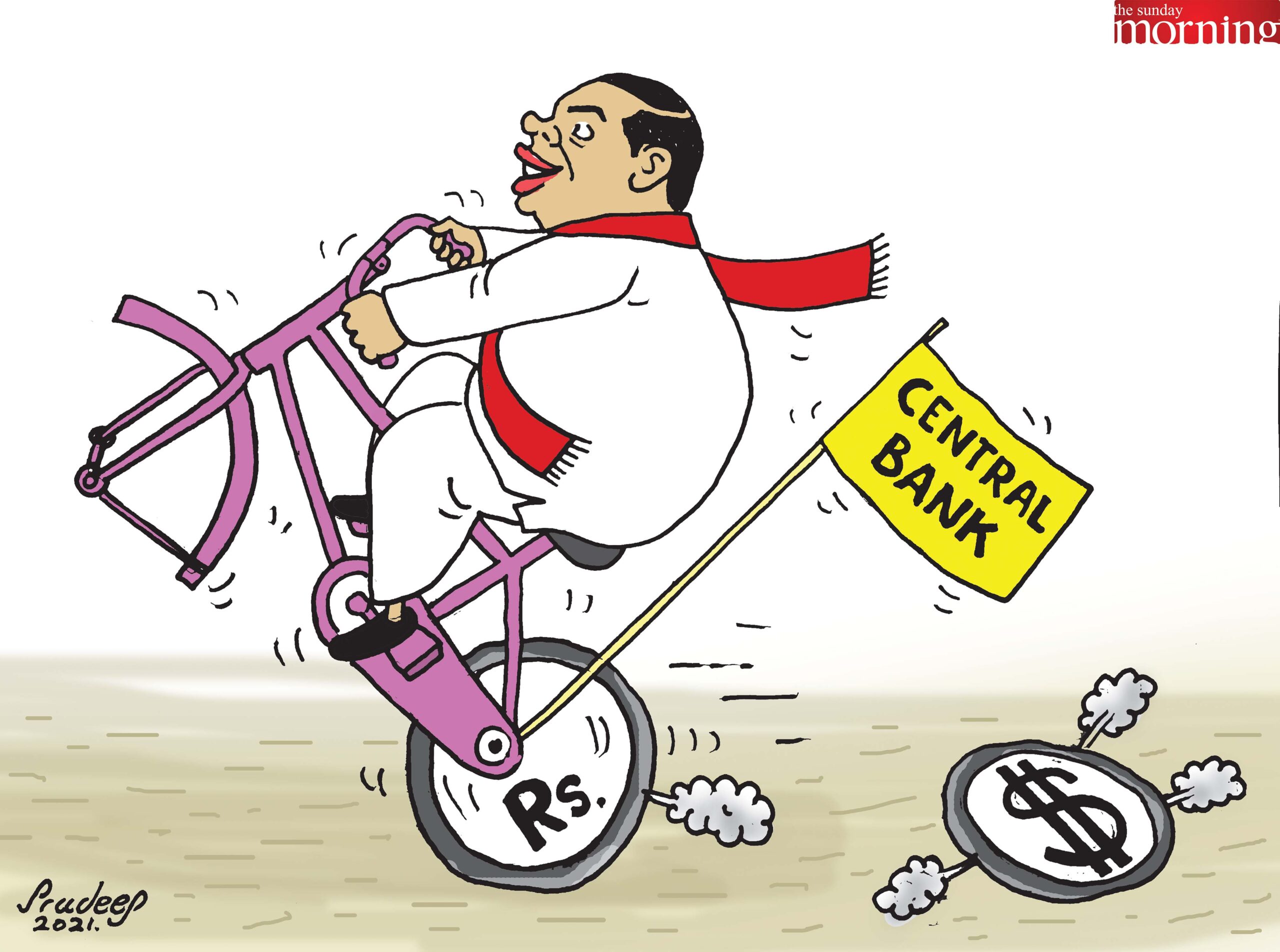
Speaking of the correlation between policy consistency and economic confidence, Dr. de Mel criticised the Central Bank having changed foreign exchange-related policy 18 times in 2020 and six times in 2021 so far, compared to only four times in 2019 and five times in 2018.
In terms of the confidence-building process, especially in terms of the international investor community, he also explained the difference between what he calls a workable plan and a gamble.
“The difference between a plan and a gamble is a written analysis of where the expected inflows would come from and how the outflows would be moving out. You can proceed without a plan and you may have gambler’s luck and succeed, but if you have a plan you are much more likely to succeed. This kind of a workable plan can build confidence and in turn make the plan even more workable. It is when people don’t believe that the Government has a workable plan that they keep their money out of the country,” he said.
He claimed that Sri Lanka’s present foreign reserves problem too began with a crisis of confidence, as confidence is at least 50%, if not 75%, of economic success.
“In December 2019, when rating agencies downgrade Sri Lanka one notch, that effectively closes out international financial markets to Sri Lanka because you can’t borrow at single digits anymore. Therefore, the decision not to borrow from international financial markets is not a choice that the Government is making. That is the crisis of confidence,” he said.
The late 2019 rating downgrade referred to by him was Fitch Ratings revising the outlook on Sri Lanka’s long-term foreign-currency Issuer Default Rating (IDR) to Negative from Stable while affirming the IDR at “B”, and Moody’s Rating Services terming the sweeping tax cuts President Gotabaya Rajapaksa announced soon after taking office a “credit negative”.
Speaking specifically about these tax cuts, Dr. de Mel claimed that they were implemented without a proper analysis.
“There is no calculation that shows us this reduction will help growth or revenue. I’m not saying it won’t, but there is no published analysis. For one of the most comprehensive and far-reaching tax reforms in the history of Sri Lanka to be undertaken without analysis is enough to see why rating agencies and others evaluating Sri Lanka are concerned. Sri Lanka must answer as to why it is making economic policy without analysis, which then makes it a gambler’s luck approach to economic policy. It may work, it may not work. What’s more, there is no way for us to determine if it is working or not when the targets or milestones for monitoring and evaluating the success are not laid down.”
Fitch Ratings subsequently downgraded Sri Lanka to “CCC” in November 2020 and affirmed the rating in June 2021. With the focus turning to rating agencies at the forum, Fitch Ratings Managing Director Maninda Wickramasinghe clarified that a rating downgrade is not a sudden or impulsive decision by an agency but one that results from long-term analysis.
“In December 2005 is when Sri Lanka first received a rating from Fitch, it was a ‘BB-’ with a Stable outlook. Fitch revisited this in December 2015 and the rating was ‘BB-’ with a Stable outlook. In June 2021, we affirmed the rating at ‘CCC’. It is not like a rating agency gets up one morning and decides to downgrade a sovereign. The signals and writings are constantly on the wall.”
In order to improve its ratings, he requested the Central Bank of Sri Lanka to maintain a dialogue with rating agencies as such communication had proven fruitful for Sri Lanka in the past, especially with the post-war rating upgrade from “B+” to “BB-” in July 2011.
“In 2008 and 2011 Sri Lanka had rating upgrades from Fitch. One thing I could attribute that to is CBSL (Central Bank of Sri Lanka) taking the initiative, through former Central Bank Deputy Governor the late C.P.J. Siriwardana, to form a committee which maintained a dialogue with the rating agencies. CBSL also engaged rating advisors. I think it’s time to get that system going again and also include the Ministry of Finance from the fiscal side. It is probably the perfect time to have this dialogue and come up with a strategic plan.”
Responding to these calls for clearly communicated plans with metrics and milestones, CBSL Governor Prof. W.D. Lakshman, speaking at the forum, revealed that the Government has a plan, which has approximately six months left, to produce results.
“There is a policy plan that the Government is pursuing which the CBSL is supporting. This policy plan has to show that it is working in the next six months or so. In this plan there is a heavy focus on exports, domestic production and the domestic entrepreneurs, and small and medium-scale enterprises (SMEs). These are some of the activities that were rather neglected in the past due to the policy focus on trade dependent activities, which made the country consume more than it earns.”
While conceding that there is a shortage of confidence in the economy at present, he said that measures have been taken to address this problem following the appointment of Basil Rajapaksa as Finance Minister.
“Several meetings have been held with the private sector and government institutions and state-owned enterprises (SOEs) by the new Finance Minister. We are in the process of adding this missing confidence element. We have a plan with robust analysis aimed at increasing foreign exchange earning activities, such as exports, remittances, and tourism.”
However, he said that until these foreign exchange sources normalise, the Government is pursuing several short-term measures to replenish foreign reserves to match or surpass the levels they were at the beginning of this year, by the end of this year. According to him, these will be from the short-term swap facilities, the expected IMF special drawing rights (SDRs) allocation in September this year of $ 780 million, and the inflow of China Development Bank (CDB) syndicated loan proceeds of $ 300 million. Through these mechanisms the CBSL expects to replenish reserves by more than $ 1 billion.
Official reserve assets stood at over $ 5.6 billion in early January 2021, but dipped to approximately $ 3 billion following the repayment of a $ 1 billion bond at the end of July. Samagi Jana Balawegaya (SJB) MP and economist Dr. Harsha de Silva, addressing the media on 8 July, claimed that as of 31 July, Sri Lanka’s official foreign reserves level has fallen to around $ 2.8 billion.
“The Government has not publicised it locally but the Central Bank has disclosed this figure internationally. If you subtract our $ 380 million gold reserves from that, the foreign reserves we have in hand amount to just $ 2.35 billion. This is the lowest that our foreign reserves have fallen to in recent years. We measure foreign reserves based on import cover, and as of now, our foreign reserves cover imports only for the next 1.6 months.”
Meanwhile, delivering the guest speech at the CA Sri Lanka forum and speaking at the parliamentary debate on the 2020 Annual Report of the Central Bank on 3 August, State Minister of Money and Capital Market and State Enterprise Reforms Ajith Nivard Cabraal placed great emphasis on the resumption of tourism for the strengthening of foreign reserves.
“We are working on the tourism trade and on measures we need to take to open the country safely. There is an urgency in procuring and administering vaccines to the public because we want to open up the country. By end-2021 we plan to reopen tourism thanks to this vaccination drive and this will bring in foreign exchange and revenue.”
Prof. Lakshman earlier said that Sri Lanka has opted for commercial loans over concessional loans over the years, pointing out that in 2000, the concessional percentage of Sri Lanka’s total debt was as high as 99% but that it has gone down to 48%. The State Minister too said that plans are afoot to reduce the international sovereign bonds (ISB) share of Sri Lanka’s debt to 15% in 2021, 13% in 2022, and 11% in 2023 and focus on government-to-government (G2G) inflows.
“Sri Lanka can’t afford to have ISBs dominating its debt structure. We need to reduce our debt-to-GDP ratio by not just reducing the debt but also increasing gross domestic product (GDP). We must keep interest rates low which will help us manage the debt easier as there will be greater serviceability. We are focusing on government-to-government type of long-term non-debt inflows and G2G debt inflows that are on concessionary terms. Stabilising the rupee is also vital. Last year, we didn’t achieve as much as we wanted to but going forward, we would like to see that also being at the top of our priorities.”
The State Minister projected a GDP growth of approximately 5% in 2021 and even higher growth next year after seeing GDP contract 3.6% in 2020, saying that nobody should be worried about a debt or economic crisis in this country.
Cabraal also made a request from the private sector to work in partnership with the Government to ensure that both sectors can thrive. He said that the Government, for its part, must maintain policy consistency, which is why it has not increased taxes and interest rates despite so many voices requesting such increases, and stated that there is an attempt to keep the rupee stable.
In turn, he urged exporters to convert their export revenue without holding on to them and to avail themselves of the attached benefits of conversion. He requested importers to import only what is necessary without importing next year’s inventory fearing that the rupee would depreciate in the months ahead. CEOs were requested by the State Minister to develop new ideas and make their investments including in equities and he called on investors to invest in Sri Lanka with a long-term view, as Covid-19 will be a thing of the past at some stage.
Prof. Lakshman too echoed these sentiments, calling on the private sector to work together with the Government, saying the state sector can do little but the private sector can do a lot in terms of building foreign reserves.
Govindasamy, in response, said that the private sector understands its responsibilities and asked for policy consistency to support the private sector and to attract foreign investment.
“Like the Government, the private sector also plans three to five years ahead. Shocks like the pandemic or natural disasters we have to handle, but shocks coming from policy changes are challenging. Policy changes are important, but there has to be a cooling off period granted so that we can change course. I was happy to hear the State Minister talk about policy consistency. That message needs to be clearly communicated to the world. Tell them to ‘come and invest in Sri Lanka so Sri Lanka can increase its foreign exchange sources, and in return this is what Sri Lanka could do for you’.”
Noting that foreign reserves had been around the $ 2 billion mark when Sri Lanka had sought IMF assistance in 2009 and 2016, Dr. Harsha de Silva on 8 August urged the Government not to impoverish the population by maintaining its unwavering stance of not relying on the IMF.
However, Cabraal has regularly reiterated the Government’s stance that it does not need to turn to the IMF, including in Parliament on 3 August.
“People offer advice all the time but most of the time the only advice they have is ‘go to the IMF’. That is not the only alternative. There are other alternatives and we are implementing these alternatives daily now and this will boost economic growth.”
However, addressing the CA Sri Lanka Forum, Dr. de Mel said that the right question is not about whether Sri Lanka should seek IMF assistance or not.
“To IMF or not to IMF is not the question, even though people have been fixated on this lately. The right question is does Sri Lanka have a workable plan to steer the repayment of debt in a way where the inflows match the outflows? The path to avoiding default has to begin with a plan that has robust, sensible, and durable analysis behind it, upon which you rebuild confidence to regain access to international financial markets. That can be done with IMF assistance or even without the IMF if you can do the analysis and build confidence on your own.”
He added that if there is a decision to turn to the IMF, it is important that the IMF is approached by Sri Lanka with a plan that the country has analysed and has confidence in as otherwise, the IMF could make a plan for Sri Lanka which may not be suitable to the country’s situation.
Dr. de Mel also reiterated his belief that any plan that the Government has to repay its debt and manage the economy must be publicised.
“It was encouraging to see the Governor telling us that there is a plan and there is analysis. I would say one way to build confidence is to publish that plan and analysis and to show that things are going according to plan, because scrutiny and transparency are important.”