Post-Geneva governance model: No devolution of power By DR.Dayan Jayatilleka

‘Lanka wants to learn from Chinese CP’s governance experience – President tells Jinping,’ The Island, 31 March

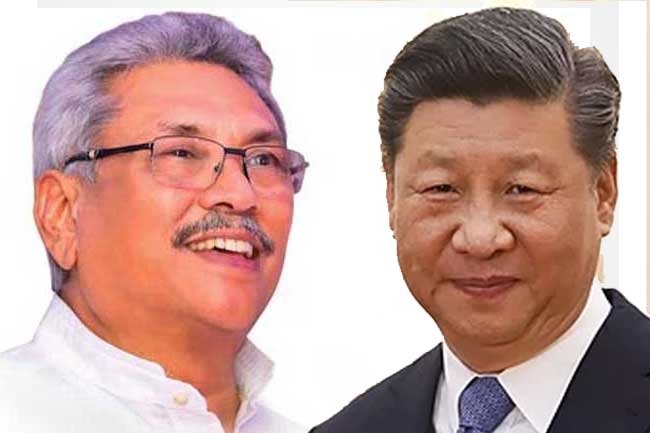
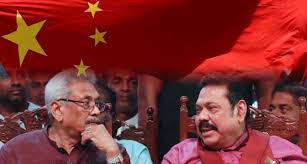
While it is heartening that President Xi telephoned President GR the other day, post-Geneva defeat, and discussed the BRI, President GR expressed a disturbing aspiration. The statement of the Chinese Embassy in Colombo tells us that:

“Gotabaya Rajapaksa said that Sri Lanka warmly congratulates the Communist Party of China (CPC) on the 100th anniversary of its founding and highly appreciates the historic achievements made by the CPC…Sri Lanka thanks China for its valuable support, and is willing to collaborate closely with China to firmly support each other’s positions on issues concerning respective core interests and safeguard our common interests. Sri Lanka hopes to learn from the CPC’s governance experience…” (Lanka wants to learn from Chinese CP’s governance experience – President tells Jinping – The Island, https://island.lk/lanka-wants-to-learn-from-chinese-cps-governance-experience-president-tells-jinping/)

The 100th anniversary of the CPC is an event of great and mostly positive importance in history, but President GR obviously fails to separate state-to state or government-to-government relations from party-to-party relations. It is not President Xi but President GR who mentioned the 100th anniversary of the CPC. It is not the place of the Head of State and Government of Sri Lanka to comment on the anniversary or achievement of a ruling party; only of a state, i.e., a country.

I am unsurprised that it was President GR and not President Xi who mentioned Sri Lanka learning from the CPC’s “governance experience”. I always suspected it was more (domestic) demand-driven than (external) supply-driven.

If this statement came from an elected communist leader of Nepal, I’d think it very proper. But when an ultranationalist Sinhala Buddhist and ex-military officer without a communist cell—big C or small C—in his body (to riff on President Biden), says his country “hopes to learn” from the Communist Party of China’s, and not, mind, the People’s Republic of China’s, “governance experience”, I have Myanmar on my mind.

Small island, big picture

The history of Sri Lanka has always been determined by its dynamics with the world outside. From the Ravana legend, the Vijaya story and the Mihindu event through to Dutugemunu, the interaction with India has been one determinant or axis of determination. The other has been the impact of the West since 1505, itself a function of successive waves of competitive expansion and displacement of world leadership.

As Robert D. Kaplan, author of Monsoon, wrote in an earlier work, Warrior Politics: “Whether in antiquity or in the post-Cold War world, the central question of foreign affairs remains: Who can do what to whom?”

The Gotabaya regime should study the evolution of the broader picture of which Sri Lanka is a small but significantly situated part. It must understand how the US under the Biden administration reads the global contestation, and the grand-strategic prism through which Sri Lanka will be perceived.

There is no better way of understanding US thinking than to study what President Biden said in his first media conference. The key takeaways are:

(i.) “China has an overall goal…to become the leading country in the world, the wealthiest country in the world, and the most powerful country in the world. That’s not going to happen on my watch, because United States is going to continue to grow and expand.”

(ii.) “I spent hours upon hours with him [President Xi] alone with an interpreter…He is very, very straightforward. Doesn’t have a democratic — with a small ‘D’ — bone in his body, but he’s a smart, smart guy. He’s one of the guys…who thinks that autocracy is the wave of the future and democracy can’t function in an ever-complex world”.

(iii.) “Americans value the notion of freedom. America values human rights. We don’t always live up to our expectations, but it’s a values system. We are founded on that principle. And as long as you and your country continue to so blatantly violate human rights, we’re going to continue, in an unrelenting way, to call [it] to the attention of the world and make it clear what’s happening.”

(iv.) “…We have to have democracies working together. Before too long, I’m going to invite an alliance of democracies to come here to discuss the future.”

(v.) “…It is clear, absolutely clear … this is a battle between the utility of democracies in the 21st century and autocracies…It’s about an autocracy. Demand decisions made by a leader of a country—that’s what’s at stake here. We’ve got to prove democracy works…I predict to you; your children or grandchildren are going to be doing their doctoral thesis on the issue of who succeeded: autocracy or democracy? Because that is what is at stake, not just with China.”

The counterview of Eastern autocracies and their fellow-travellers, that democracies have flunked the Covid-19 test while autocracies have succeeded, is starkly demolished by the conspicuous success of liberal, social democratic, New Zealand led by Jacinda Ardern.

Dubbing it ‘An Alliance of Autocracies,’ the New York Times reports that China is constructing an anti-US alliance to counter Biden’s ‘Alliance of Democracies’. Sri Lanka is Afro-Asia’s oldest democracy, and that is both a distinctive soft-power asset as well as an organic part of the national ethos. Sri Lanka’s national interest would be best served by enhancing that profile; entrenching itself in that role. By contrast, in the global grand-strategic contest, President GR seems intent upon moving to move into the personal ideological comfort zone of an ‘Alliance of Autocracies’.

Geneva 20102-2014 and 2021 show that this does not even have the utility of enabling Sri Lanka to secure the support of the majority of the global South and balance off the West.

Foreign policy folly

The USA and China fought it out over the UNHRC resolution on Sri Lanka. The USA won. Sri Lanka bet on China. Gotabaya Rajapaksa’s policy platform speech at the Shangri-La Hotel, 2018, prefigured this tilt. To avoid the train-wreck in Geneva this March, the Sri Lankan leadership should have understood three imperative factors:

Firstly, the Biden administration meant a whole new ballgame had begun and Sri Lanka should adjust accordingly, moving in a democratic-reformist direction to the middle-ground in domestic affairs, and balancing much more even-handedly in great power relations.

Secondly, Sri Lanka could not rely wholly and entirely on China as a balancer, but, as in Sri Lanka’s sole UNHRC voting success in May 2009, on both China and India.

Thirdly, there was no way to get the Indian diplomatic umbrella to unfurl over Sri Lanka alongside the Chinese umbrella, other than by a credible, time-bound commitment at the Presidential level, to the implementation of the 13th Amendment.

Instead of figuring out these almost axiomatic facts of the changed external environment, the Gotabaya administration continued to keep all its eggs in the China basket (with the smaller, older, Netanyahu basket kept covered within it).

Post-Geneva, the Gotabaya administration should have figured out the limits of China’s global influence.

The Ethnic/External Interface

Closer home, President Gotabaya has finally articulated a stand on devolution of power that places him on a collision course with his giant neighbour. He may think he’s imitating India on Article 370, but India has a secular Constitution and federal system of linguistic states. Given the glaring asymmetries of size, space and strength, President GR’s stand may turn out much more like the fatal abolition by the parliament of former Yugoslavia, of the autonomous status of the province of Kosovo.

The morning after Geneva, no more Mr. Nice Guy. The devolution of power, framed for ‘separatism’, is on a death-list for disappearance and elimination. Here’s the (triangulated) evidence.

“He stressed the sovereignty of Sri Lanka will not be betrayed by allowing these countries to achieve their geopolitical needs by introducing separatism under the guise of power devolution. The President made these observations addressing the ‘Gama Samaga Pilisandara’ programme held at Pitabeddara earlier today (27 March).” (Will not betray sovereignty of the country, President assures (adaderana.lk), http://www.adaderana.lk/news/72623/will-not-betray-sovereignty-of-the-country-president-assures

“…He noted that the sovereignty of Sri Lanka would not be betrayed by allowing other countries to achieve their geopolitical needs by introducing separatism under the guise of power devolution.” (Sovereignty of Sri Lanka would not be betrayed – President | Daily News, http://www.dailynews.lk/2021/03/29/local/245230/sovereignty-sri-lanka-would-not-be-betrayed-president)

The President’s Media Division’s release reads: “…We are not ready to bring back separatism in the name of devolution of power and betray our sovereignty to fulfil their political needs. The people of this country gave power to us to bring these basic things back on track.” (dbsjeyaraj.com)

The Sri Lankan polity and the international community must be most grateful to the President. These being his first public remarks on the Geneva vote, he ended any confusion as to whether he would respond realistically, by moderating his discourse and centring his course—or by doubling down. He doubled down, interpreting his mandate as including the rollback of devolution (“The people of this country gave power to us to bring these basic things back on track”). He’s going to the bitter end with his hardcore base, just like Trump.

The President’s remarks left little doubt as to whose ‘geopolitical needs’ he thought were to be served under the guise of devolution. He accused them of seeking to ‘bring back separatism’.

He overlooked the salient fact that separatism was not ‘brought’ in under the name or through the ‘guise’ of the devolution of power, but displaced federalism as a slogan in the 1970s, when devolution/autonomy had been thwarted for decades, since the coerced tearing-up of the Bandaranaike-Chelvanayakam Pact of 1957.

He left no doubt at all that he was hostile to the idea of devolution, which has bulked large in the UNHRC resolution as well as the official statements of India, made in Delhi, Colombo and Geneva.

President Gotabaya Rajapaksa obviously doesn’t share the broadly held view the world over, that the devolution of power to ethnic minority areas, making for a measure of autonomy, is the best vaccine against separatism. Instead, he holds the opposite view that devolution of power is on a continuum with, and actually makes for, separatism. A reform which for Realists is the alternative to secessionism and thus the solution (or part of one), is for President GR, the stepping stone to secessionism and thus the problem (or part of it).

President GR perceives devolution and sovereignty as antinomian choices in a zero-sum game. He certainly didn’t inherit this opinion from his elder brother Mahinda, or his father, the right-hand man of S.W.R.D. Bandaranaike. The first attempt at the devolution of power was the Bandaranaike-Chelvanayakam Pact of 1957, and D.A. Rajapaksa was very much with Prime Minister S.W.R.D. Bandaranaike when the defeated UNP as well as the Buddhist clergy linked to ‘Sinhala Only’, took to the streets against it.

Paradoxically, President Gotabaya and his fellow ex-military brass seem to have got their views on devolution and the 13th Amendment from Lalith Athulathmudali, the Oxford-educated, hawkish, pro-Israeli, Minister of National Security of the UNP Government of President J.R. Jayewardene, at the time they served in the military.

The implications of the President’s hardened stand on devolution are three-fold:

1. So long as President Gotabaya Rajapaksa is in office there will be no implementation of the 13th Amendment and the devolution of power envisaged in the Indo-Sri Lanka Accord. The Provincial Councils will be reduced to a mere facade: Viyath Maga’s Ven. Dr. Medagoda Abeytissa urged their abolition while Sinhala ultranationalist SLPP MP Gevindu Cumaratunga exhorted in Parliament that the system of PCs remain only as a developmental agency devoid of legislative power.

2. So long as the Tamils of northern and eastern Sri Lanka are denied devolved power, the Tamils of Southern India will be disaffected, potentially generating domestic geopolitical dissonance in India; extremism and restiveness in its Southern cone when it is facing a buildup by an axis of its rivals on its Northern tier.

3. So long as devolution is unimplemented while Sri Lanka permits projects on its northernmost islands bordering India, which can be perceived as violation of the annexures of the Indo-Sri Lanka Accord, and creates potentially dual-use (electronic intelligence) artificial islands thrusting into the Indian Ocean/Indo-Pacific, Delhi’s strategic ‘buffering’ gains of the Indo-Lanka Accord will be disintegrated.

Secrets of small state sovereignty

At the root of the GR administration’s blunders in foreign policy lie the intertwined notions that everything that happens within a country’s borders is an exclusively domestic matter and that insularity and impunity constitute the Alpha and Omega of national sovereignty.

In the real world, is such a notion of sovereignty and exclusively domestic affairs realisable and sustainable for Sri Lanka?

President Gotabaya Rajapaksa’s administration initially identified itself as “neutral”, not “nonaligned”. This was introduced during his candidacy at the second Viyath Maga convention (Shangri-La Hotel 2018) by Prof. Rohan Gunaratna, whose expertise is counter-terrorism. The President’s foreign policy advisor and later the Secretary to the Foreign Ministry Admiral Colombage took pains to draw the distinction which he disclosed that the President intended, between ‘Nonaligned’ and ‘neutral’. The Nonaligned Movement’s members certainly took the point and many abstained while several voted for the UNHRC resolution.

One lesson of the Geneva debacle is that Sri Lanka must practice a foreign policy which is “tous azimuths” as De Gaulle put it—covering all points of the compass—or “multi-vector” as Russia’s iconic Foreign Minister and Prime Minister Evgeni Primakov had it, while being solidly anchored in its ‘base community’ with its various ‘trade unions’—SAARC, the NAM/G-77 and the SCO.

Another tropical island protects and asserts its sovereignty admirably.

Cuba maintains its global identity as a nation of the South and a member of the Nonaligned Movement.

The Cuban armed forces have behaved impeccably in warfare whether on its native soil or in places as far away as Angola, where 300,000 Cuban troops served over a period of 12 years. No US Secretary of State has referred to its “lack of accountability for past atrocities” as Antony Blinken did on Sri Lanka at the UNHRC this year.

The Cubans kept their armed forces transparently clean. When a famous frontline commander of its overseas missions, Gen. Arnaldo Ochoa was credibly suspected of breaking the law in certain peacetime smuggling operations which he permitted (and may have thought were helping Cuba gain foreign exchange by breaking the US embargo) a nationally televised trial was held in which the Cuban Defence Minister Raul Castro called for the death penalty because General Ochoa had besmirched the spotless ethical and moral reputation of the Cuban armed forces.

This is why Cuba has no resolutions brought against it by the West at the UNHRC, no allegations remotely like those made about Sri Lanka by successive UN Human Rights High Commissioners, and wins by record super-majorities, the resolution it has moved against the US at the UNGA every year for the last quarter-century.

A critical imperative in effectively and durably protecting small state sovereignty, is the permanent occupation of the moral high-ground through verifiably ethical military conduct.
Former Bishop of Mannar Rayappu Joseph passes away

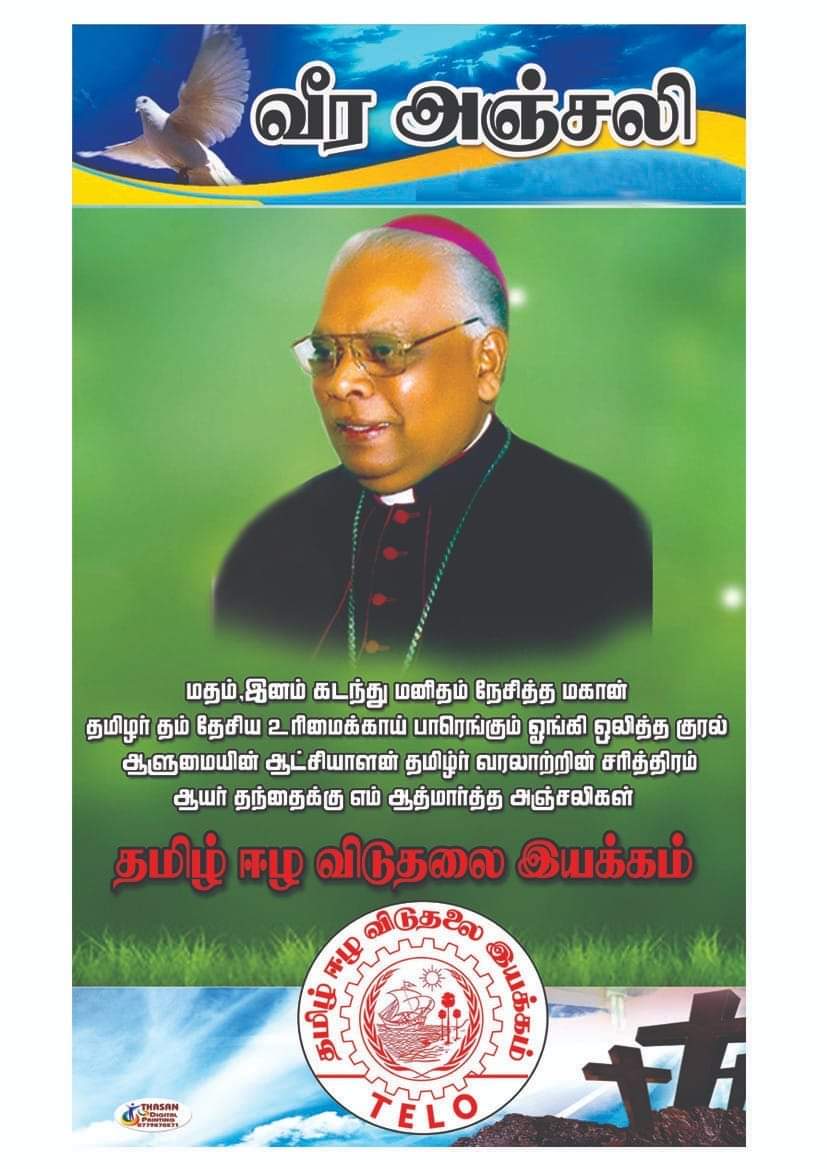
The former Catholic Bishop of Mannar and lifelong Tamil rights activist, Right Reverend Dr Rayappu Joseph has passed away, aged 80. Notably, Rt. Rev. Joseph used information from local government offices in the Kilinochchi and Mullaitivu districts to pinpoint that 146,679 people were unaccounted for following the final stages of the armed conflict in May 2009.

Born in Neduntheevu (Delft) on April 16, 1940, to a practitioner of indigenous medicine, Rayappu Joseph studied at Jaffna St Patrick’s College, after an early childhood spent in Cheddikulam and in Mannar.

He began his priesthood in 1967 and became Bishop of Mannar in 1992, retiring in 2015 following a stroke.

Rt. Rev. Joseph was a prominent and vocal defender of human rights and a campaigner of justice for Tamils. He authored numerous reports detailing the forcible disappearances of Tamil youths during the armed conflict and served as a witness for Sri Lankan military attacks, such as the 1999 Sri Lankan army shelling of Madhu Church which saw 37 Tamil civilians killed 64 wounded.

The former Bishop was a vocal critic of militarisation and regularly protested against state violations during the armed conflict, as well as advocating for the release of Tamil political prisoners.

Rt. Rev. Joseph was often seen at rallies in support of Tamil self-determination, including during the wave of Pongu Thamil rallies in the early 2000s. In 2005 he said:

“There is nothing wrong in the Tamil nation raising its national flag. The Tamil national flag is not the Tigers’ flag but it is the Tamil people’s flag. Hoisting it is not against peace. Many who shout against it are silent over the recent killings.”

Rt. Rev. Joseph frequently called on the Liberation Tigers of Tamil Eelam (LTTE) to work towards an end to violence, and led several demonstrations calling for peace. He was occasionally involved in mediating disputes between Tamil civilians and the LTTE.

Following the end of the armed conflict, Rt. Rev. Joseph continued campaigning for justice for the genocide committed against the Tamil people, defying the Rajapaksa regime’s post-war crackdowns on civil society and calling for an international investigation. His work with local government statistics, leading to the figure of 146,679 unaccounted for, was crucial in countering the Sri Lankan state’s claims of ‘zero civilian casualties’ from its onslaughts in the final stages of the war.

He was staunch in his rejection of domestic mechanisms for justice, writing in a letter to the Sri Lankan president’s 2014 Commission on Missing Persons:

“I have over the years grown to be weary of domestic mechanisms in resolving serious injustices that Tamil people have faced over the period of the war, prior to it and after its conclusion. Over the years many commissions such as yours have been set up and there is absolutely no shred of evidence that they have tackled impunity. Most, if not all of these commissions have provided only to be eye washers for the then Governments in power.”

In 2014, Rt. Rev. Joseph formally convened the Tamil Civil Society Forum, which remains a vital and critical voice of the Tamil people in the North-East today. He continued his advocacy and campaigning in defiance of threats from the Sri Lankan government and military, and even backlash from the Sri Lankan Catholic Church.

Rt. Rev. Joseph largely stepped back from campaigning and public life after suffering a stroke on May 2, 2015. He had been travelling to Colombo to meet then US Secretary of State John Kerry. His last major public engagement was the launch of the Talaimannar Public Rail Service during the visit of Indian Prime Minister Narendra Modi.

Rt. Rev. Dr Rayappu Joseph passing on April 1, 2021 has unleashed an outpouring of tributes to his decades of tireless campaigning and advocacy.

Posted in Uncategorized

Former Foreign Minister Mangala Samaraweera explains the UNHRC Resolution on Sri Lanka

Sri Lanka’s former Minister of Foreign Affairs Mangala Samaraweera speaking of the UNHRC Resolution on Sri Lanka said Sri Lanka got the friendship and the support of the whole world including all power blocs when it co-sponsored the UNHRC resolution in 2015 and achieved so many rewards as a result.

He said the previous government managed to build such an acceptance within such a short time but unfortunately, it is now lost.

He urged the people of this country not to be fooled by the same old lie being repeated over and over again, to use their intelligence and listen to what others are saying and then decide who the real traitors are and who the true patriots are.

Following is the remarks by former Foreign Minister Mangala Samaraweera at the Press Conference held at the Solis Hotel on 31.03.2021:

During the last few weeks, much has been talked about the Geneva resolution which was presented on March 23. I felt it as my duty to speak about this as the Minister of Foreign Affairs at that time when Sri Lanka along with the United States, United Kingdom and 40 other countries co-sponsored the 30/1 resolution on Sri Lanka.

If we are to go back to the beginning, it was on May 23, 2009, just a week after the conclusion of the deadly war with the LTTE, the Secretary-General of the United Nations, Mr. Ban Ki-moon, came to Sri Lanka on the invitation of President Mahinda Rajapaksa.

In the joint communique which was issued at the conclusion of this meeting, the two sides agreed to conduct an inquiry into the alleged war crimes and the alleged human rights violations in the country. Within four days of Mr. Ban Ki-moon’s arrival, the United Nations Human Rights Council (UNHRC) in Geneva called a special Session on Sri Lanka to discuss the situation here.

For this Session, Sri Lanka very hurriedly presented a resolution to the UNHRC, the 25/1 resolution of March 2014 on promoting reconciliation, accountability and human rights in Sri Lanka and to undertake a comprehensive investigation into the alleged serious violations and abuses of human rights and related crimes by both parties.

In fact, this resolution, if it would have been implemented, would have been quite good and that is why the majority of the international community hoped Sri Lanka would be bound by their promises and therefore, 29 countries voted in favour with 12 voting against.

In 2009, 29 countries supported Sri Lanka where they even promised an accountability mechanism to look into human rights violations, talked about improving the human rights situation here and even talked about the 13th Amendment for the first time in an international forum like the UNHRC. They got 29 countries to support them but unfortunately from that point onwards, like all other promises of the Rajapaksa era, they didn’t bother to implement many of them.

And that is why the trust within the international community kept decreasing and in 2012, 29 fell to15 in terms of the countries that supported the Sri Lankan government. In 2013, only 13 countries supported us. In 2014, the UN Human Rights Council passed the Sri Lanka resolution by a vote of 23 to 12, with 12 abstentions.

And this time, we saw again that our support base has fallen to 21 countries and most of them are autocracies who are more interested in hiding or protecting their atrocities than supporting Sri Lanka.

So it is in this context that I went to Geneva as the Minister of Foreign Affairs just a couple of weeks after the election. My first visit was to meet my good friend and who I call my sister minister, Sushma Swaraj Ji. On the very day I was sworn in, I was in India meeting her and then I went to Geneva to meet the United Nations High Commissioner for Human Rights Prince Zeid Ra’ad Al Hussein. I made a very special request from him not to go ahead with the 2014 resolution because according to the resolution as the first report of that resolution was to be tabled in Geneva in March, 2015.

Fortunately for the country, the government changed on January 8. I was there in February I believe and we got them to agree not to table that report in March and instead we requested time till September to submit our own resolution which will cover the question of reconciliation and accountability. In fact, I told Prince Zeid quoting from our manifesto of the presidential election, item 93, “Since Sri Lanka is not a signatory to the Rome Statute regarding international jurisdiction with regard to war crimes, ensuring justice with regard to such matters will be the business of a national independent judicial mechanism.”

So we said, give us a little more time until September we will present our resolution for a national independent judicial mechanism and the Prime Minister along with a group of top level experts drafted this resolution and then we invited the US Ambassador and UK High Commissioner to co-sponsor this resolution.

This whole idea that we sponsored a foreign resolution is an utterly misleading lie. We managed to get the powerful countries to back us and each and every word in that resolution was approved by President Sirisena. This is, President Sirisena’s speech from February 4, 2016 and I quote, “I clearly state that we are facing these resolutions to protect the pride and dignity of our country, our people and our security forces and also to make our tri forces to be internationally renowned armed forces. We should face these resolutions with patience, discipline and decorum so that our country should be respectfully recognized by all international organizations including the UNO and all states in the world.”

These are the very words of our president and as a result, Sri Lanka got the friendship and the support of the whole world. In fact, when our joint resolution was presented in Geneva in September, not one country opposed it. Now this time we saw when an investigation was initiated in Geneva, Pakistan and China got up and opposed that. However, all power blocs supported us in 2015. We had the support of the USA, the European Union, the UK, Japan, India and most of all China and Russia. Forgive me for saying so but I believe this was one of the golden moments in the history of foreign policy in this country. Whatever anyone says, I will challenge them anywhere to argue that this was actually a golden moment where we stuck to our words carrying out a balanced foreign policy which all countries appreciated.

That is why we achieved so many rewards but the three which come to my mind at the moment are that we were able to secure the GSP + concession again for Sri Lanka which we had lost a couple of years before. With the direct intervention of Prime Minister Ranil Wickremesinghe and myself in Geneva, we managed to get the Green Card for the fishing community of Sri Lanka to sell their tuna fish in the European Union which was banned under the earlier regime. Also, after having discussions with Samantha Power, who was the US Ambassador to the UN, we requested that our Army again be submitted for peacekeeping matters. We were admitted and I believe even today, there are members of the armed forces gaining quite high salaries working in the peacekeeping forces.

Sri Lanka was celebrated by all the countries. I know for a fact that during our time, President Obama used to call Sri Lanka the ‘good news country’. I still remember in 2016 when we attended the G7 summit in Japan. After the main meeting, President Sirisena was invited and we went in and sat down in advance before the other world leaders arrived. I was seated behind President Sirisena and it still brings me tears when I recall how every leader who walked into the room and once they saw President Sirisena, they walked up to him and shook his hands and then went to their seats. Obama, Cameron, Merkel, Trudeau, Abe and all the leaders of the G7 first came right up to the Sri Lankan head of state and shook his hands and then started talking about the issues.

That was the kind of acceptance we managed to build within such a short time but unfortunately, we have lost it and now those who made Sri Lanka feel loved by the world are being called traitors and those who actually did the treacherous work are pretending to be patriots.

So finally, all I have to say is that the people of this country are not to be fooled by grandstanding, not to be fooled by the same old lie being repeated over and over again, to use your intelligence and to please listen to what others are saying and then decide who the real traitors are and who the true patriots are.

Watch the remarks by former Foreign Minister Mangala Samaraweera at the Press Conference held at the Solis Hotel on 31.03.2021

US State Dept to issue SL human rights report

The US Department of State is due to release the 2020 Country Reports on Human Rights Practices in Sri Lanka.

In a summarised version of the report the State Department said despite dozens of arrests for alleged material support to the deceased suicide bombers behind the 2019 Easter Sunday attacks and continuing investigations, no suspects had been prosecuted for involvement in the attacks.

The report said said the government has also gazetted an order deploying the armed forces to ensure public security each month since the expiration of the state of emergency, keeping the military continuously deployed since the attacks.

The report also signifies the passing of the 20th Amendment to the Constitution noting that opposition political leaders and civil society groups widely criticized the amendment for its broad expansion of executive authority that activists said would undermine the independence of the judiciary and independent state institutions, such as the Human Rights Commission and the Elections Commission, by granting the president sole authority to make appointments to these bodies with parliament afforded only a consultative role.

The report also highlights significant alleged human rights issues.

Posted in Uncategorized

Myanmar junta attends BIMSTEC meeting chaired by Sri Lanka

The Myanmar junta today attended a Bay of Bengal Initiative for Multi Sectoral Technical and Economic Cooperation (BIMSTEC) meeting chaired by Sri Lanka.

The 17th BIMSTEC Ministerial Meeting was held today with the participation of Bangladesh, Bhutan, India, Myanmar, Nepal, Sri Lanka and Thailand. This event was held virtually in Colombo, Sri Lanka.

Union Minister, Ministry of International Cooperation Myanmar, U Ko Ko Hlaing attended the virtual meeting.

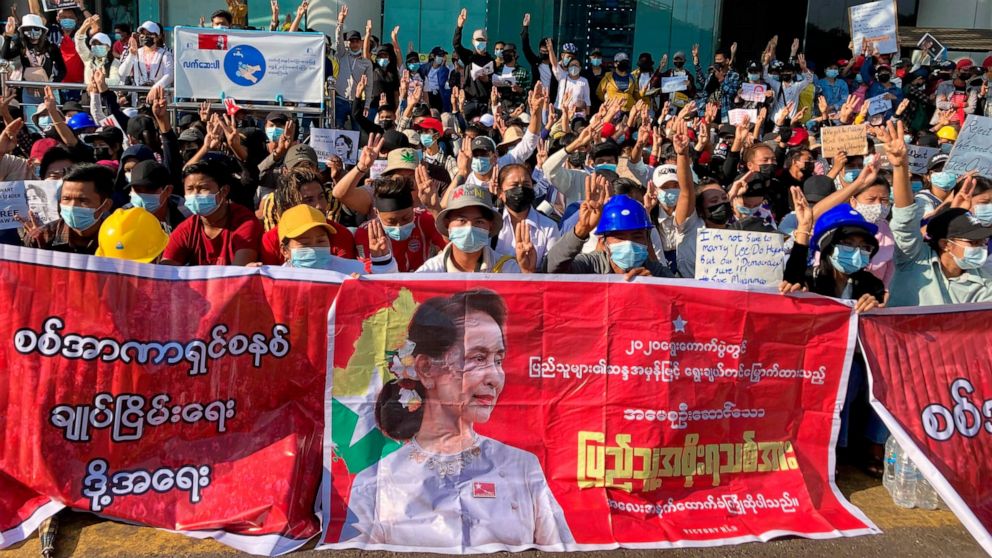
Myanmar has been rocked by protests since the army overthrew Suu Kyi’s elected government on February 1 citing unsubstantiated claims of fraud in a November election that her party won.

On Thursday, protesters again took to the streets of cities across Myanmar, defying a security force clampdown that has killed at least 535 people.

At the BIMSTEC meeting, Foreign Minister Dinesh Gunawardena called for the early conclusion of the Charter of the Association of BIMSTEC Speakers and Parliamentarians.

The Foreign Minister informed that the platform would provide Speakers and Parliamentarians space for greater understanding, trust and friendship and to exchange ideas and information on parliamentary practices and commitment on democratic principles.

The Foreign Minister was elected as Chair of the meeting and State Minister for Regional Cooperation Tharaka Balasuriya led the Sri Lanka delegation at the meeting.

On 31st March 2021, Foreign Secretary Admiral Professor Jayanath Colombage led the Sri Lanka delegation at the Special Senior Officials meeting which preceded the Ministerial Meeting.

The Foreign Minister also emphasized the need to focus on expediting the adoption of the BIMSTEC Transport Connectivity Master Plan which was finalized by the Third Working Group and the Asian Development Bank.

The Minister stated transport connectivity which include coastal shipping, waterways, ports and harbours used over centuries and today road connections and air cargo capable of withstanding future disruptions, is vital for the supply chains, people to people contact and development of the region.

The Foreign Minister welcomed the newly appointed Secretary General Tenzin Lekphell from Bhutan, and wished him success in leading the BIMSTEC Secretariat and pledged Sri Lanka’s support to all his endeavors.

The BIMISTEC Ministers reviewed the progress made since the fourth BIMSTEC Summit held in Kathmandu in 2018, where Sri Lanka was elected as Chair.

State Minister Balasuriya said that Sri Lanka fully focused its energies and worked closely with Member States to finalize the BIMSTEC Charter, building on the 1997 Bangkok Declaration.

This Charter defines the long term vision and priorities for cooperation, delineates roles and responsibilities of different layers of institutional structure and decision making processes.

In addition he stated that the Member States also prioritized and rationalized sectors and subsectors of the organization where Sri Lanka agreed to lead the sector on Science, Technology and Innovation with sub sectors Technology, Health and Human Resource Development. He stated that the relevant line agencies in Sri Lanka are developing a programme of action for the sector taking into consideration also the gaps exposed in the relevant areas by the pandemic.

He informed that the current pandemic has amply demonstrated the importance of technology. In this connection Sri Lanka is also getting ready to host the Technology Transfer Facility in Sri Lanka upon conclusion of the Memorandum of Association at the 5th BIMSTEC Summit.

The Ministers noted with appreciation the extensive measures taken by member States of BIMSTEC in responding and supporting Member States to face challenges posed by the COVID 19 pandemic and urged member states to mobilize all relevant sectors and sub sectors to take collective measures to combat the challenges of poverty, natural disasters, climate change, pandemics and other public health emergencies, terrorism and transnational crimes, and food and energy security through partnerships and joint actions.

While noting with appreciation the extensive measures taken by Member States of BIMSTEC, State Minister further noted that the COVID-19 has devastated economies of member states in various degrees and the BIMSTEC region no longer enjoys US$3 trillion economy, which accounts for 4 per cent of the global GDP and 3.7 per cent of the global trade.

Therefore, he urged Member States to continue to share experiences, including success, challenges and lessons learnt in building back better from the COVID-19 pandemic through inclusive, resilient sustainable recovery strategies and investments.

The Sri Lanka Delegation informed the meeting that the date to host the 5th BIMSTEC Summit will be informed after consultations with Member States through the BIMSTEC Secretariat in the coming months.

The Member States delegations were led by Dr. A. K. Abdul Momen, Foreign Minister of Bangladesh, Dr. Tandi Dorji, Foreign Minister of Bhutan, Dr. S.Jaishankar, Minister of External Affairs of India, U Ko Ko Hlaing, Union Minister, Ministry of International Cooperation Myanmar, Pradeep Kumar Gyawali, Minister for Foreign Affairs Nepal, Tharaka Balasuriya, State Minister of Regional Cooperation of Sri Lanka and Don Paramudwinai, Deputy Prime Minister and Minister of Foreign Affairs of the Kingdom of Thailand.

Posted in Uncategorized

PSC to identify appropriate reforms of election laws and electoral system

A Parliament Select Committee (PSC) is to be appointed to identify appropriate reforms of the election laws and the electoral system and to recommend necessary amendments.

Secretary General of Parliament Dhammika Dasanayake said that the motion to appoint the PSC will be moved in Parliament by Leader of the House, Minister Dinesh Gunawardena on behalf of Prime Minister Mahinda Rajapaksa at the time of the adjournment on April 5.

The Select Committee which consists of 15 members is expected to submit its report within six months.

The responsibility of the Committee is to identify shortcomings of the existing electoral system and its structure and to make recommendations with regards to the amendments pertaining to the subject matter.

Posted in Uncategorized

Lanka wants to learn from Chinese CP’s governance experience – President tells Jinping

President Gotabaya Rajapaksa has told Chinese Leader Xi Jinping that Sri Lanka hoped to learn from the Chinese Communist Party’s governance experience, and especially looked forward to strengthening exchanges and cooperation on poverty alleviation and rural vitalization strategies, during a phone conversation between the two leaders on Monday evening.

The following is the full text of a statement issued by the Chinese Embassy yesterday regarding their conversation: “President Xi Jinping pointed out that since the onset of the COVID-19 pandemic, China and Sri Lanka have pulled together and helped each other, writing a new chapter of China-Sri Lanka friendship. China attaches great importance to the development of bilateral ties, and stands ready to work with Sri Lanka to determine the strategic direction and achieve steady growth of the relationship. China will continue to provide as much assistance as its capacity allows for Sri Lanka’s fight against COVID-19, and seek to gradually carry out cooperation in fields like aviation and education while keeping pandemic control measures in place, and continuously explore new channels and areas of collaboration. China stands ready to steadily push forward major projects like the Colombo Port City and the Hambantota Port and promote high-quality Belt and Road cooperation, providing robust impetus for Sri Lanka’s post-pandemic economic recovery and sustainable development.

Xi Jinping emphasized that China and Sri Lanka are strategic cooperative partners that enjoy sincere mutual assistance and ever-lasting friendship. China will never forget Sri Lanka’s valuable support for the restoration of Beijing’s lawful seat in the United Nations, and is willing to make continuous joint efforts with Sri Lanka to firmly support each other on issues concerning respective core interests, defend our legitimate rights, promote international equity and justice, and safeguard the common interests of developing countries.

Gotabaya Rajapaksa said that Sri Lanka warmly congratulates the Communist Party of China (CPC) on the 100th anniversary of its founding and highly appreciates the historic achievements made by the CPC. Particularly, under President Xi Jinping’s strong leadership, China has made great achievements in economic development and the fight against COVID-19. Sri Lanka thanks China for its valuable support, and is willing to collaborate closely with China to firmly support each other’s positions on issues concerning respective core interests and safeguard our common interests. Sri Lanka hopes to learn from the CPC’s governance experience, and especially looks forward to strengthening exchanges and cooperation on poverty alleviation and rural vitalization strategies. The Sri Lankan side is willing to work with China to expand cooperation in fields like infrastructure and tourism, and smoothly advance major projects such as the Colombo Port City. He is confident that these efforts will boost his country’s economic and social development and bring the Sri Lankan people more benefits.

Posted in Uncategorized

ISI-Sponsored Narco-Terrorism Flourishing in Sri Lanka, Say Officials as Boat With 300Kg Heroin Seized

NCB said investigations so far have revealed that an unknown vessel carried the heroin and arms consignment from Chabahar Port, Iran, and handed it to the Sri Lankan boat.

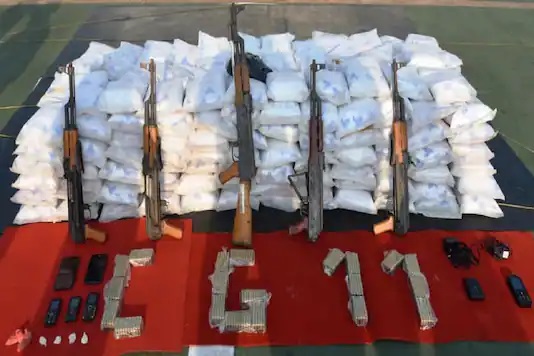
The interception of a Sri Lankan boat carrying 300 kilograms of heroin, five AK-47 guns and ammunition off the coast of Vizhinjam in Kerala points to ISI-sponsored narco-terrorism flourishing in Lanka, Indian security officials told CNN-News18.

The Indian Coast Guard and the Narcotics Control Bureau had seized the boat carrying the drugs and arms consignment on March 25, the second such major seizure in March.

Officials, on the condition of anonymity, said Pakistan’s intelligence agency ISI has created sleeper cells in Sri Lanka and other neighbouring countries, and exports drugs to foment trouble. The drug income is then used to fund illegal activities, including extremist activities, they said.

In the March 25 seizure, Coast Guard and the NCB had found heroin worth Rs 3,000 crore stashed in the boat along with AK-47 rifles and 1,000 rounds of 9mm ammunition. “A number of incriminating documents were also seized from the occupants of the vessel,” said the NCB, adding that six Sri Lankan nationals were arrested.

The agency said that investigations so far have revealed that an unknown vessel carried the heroin and arms consignment from Chabahar Port, Iran, and handed it over to the Sri Lankan fishing boat, Ravihansi, in the high seas near Lakshadweep. Ravihansi then attempted to traffic the consignment to Sri Lanka when the Indian authorities intercepted it.

Intelligence inputs and the investigations so far have indicated that a Pakistan-based drug trafficking network is involved in the current seizure.

Officials said that earlier, Sri Lankan authorities, too, had seized drugs worth Rs 2.5 billion that had been smuggled from the Gwadar port, which is controlled by China.

Pointing to a nexus between China and Pakistan, they said smuggling of such huge quantities of drugs was not possible without the support of China.

Sources said that one Dubai-based smuggler is working for this ISI-sponsored and China-controlled drug smuggling racket, and the money from this has been used to create unrest, and fund extremism. They said the money was used for the 2019 Sri Lanka Easter bombings, fuelling the farmer protest in India, and for sending weapons to Punjab and Jammu border from Pakistan.

According to Rakesh Asthana, the Director-General of the NCB, this network has Pakistani nationals based in Sri Lanka, Maldives, Dubai, and East Africa to assist the kingpins in Pakistan.

Source:News18

Sri Lanka: Discrimination against Muslims and Tamils is getting worse – Middle East Eye

Sri Lanka recently passed regulations allowing detention without trial for two years for those suspected to have caused “religious, racial or communal disharmony”. This is a significant expansion of the already notorious Prevention of Terrorism Act (PTA), which has historically been used to target Tamils and Muslims.

Alongside a proposed ban on Islamic face coverings and the closure of more than 1,000 Islamic schools, this move is a further indication that Sri Lanka seems determined to repeat its past. Sri Lanka has consistently used laws to marginalise vulnerable communities, and these latest actions continue policies designed to oppress Tamils and Muslims, while strengthening the majoritarian ethnocracy that has dominated the country since shortly after its independence in 1948.


The Sinhalese, the majority of whom are Buddhist, make up more than 70 percent of the country’s population. Sri Lanka’s post-independence nation-building project emphasised Buddhism to the detriment of other communities. Leaders envisaged the island as a Buddhist stronghold, and their particular brand of Theravada Buddhism was ethno-nationalist in nature.

According to Sinhalese scriptures, Sri Lanka was the land of the Sinhalese from ancient times, and a place where Buddhism must be protected. Other communities were invaders, who either didn’t belong or were there at the benevolence of the majority. This was formalised in the country’s constitution, which says it is the state’s role to “protect and foster” Buddhism.

The systematic privileging of Sinhalese Buddhism was done initially through legislation, by enacting discriminatory laws against Tamils, but took on increasingly violent forms, including the targeting of Tamils in pogroms that killed thousands and destroyed thriving Tamil commerce, particularly in the capital.

The initially peaceful Tamil resistance of the 1960s and ‘70s, demanding equal rights and autonomy, was met with violence, which in turn fuelled popular demands for a separate Tamil state. The state, in response to militant Tamil youth, enacted the PTA in 1979, which gave security forces and the judiciary wide-ranging powers.

Declaring a state of emergency, Sri Lankan security forces arrested Tamil youths en masse, torturing them and in many cases forcibly disappearing them. The violence of the state pushed more and more Tamils to support the armed resistance, giving rise to a fully-fledged militancy that fought an all-out war with the Sri Lankan military, until its end in 2009.

The state’s brutal crackdown, supported and presaged by oppressive legislation, was successful in its own eyes.

Historic homeland

It is important to understand why the Sri Lankan state targeted Tamils in the way it did. Eelam Tamils, as Tamils native to Sri Lanka are also known, had a distinct identity and the concept of a historic homeland in the island’s northeast, which was at odds with what the majority envisaged. Rejecting the minority label, Tamils purposefully declared themselves as a separate nation within Sri Lanka, and increasingly mobilised around this identity.

This was a major obstacle to Sri Lanka’s nation-building project, and thus could not be tolerated. The common Tamil view of this situation as a genocide stems from the belief that the Sri Lankan state’s intent is to dismantle the Tamil identity and subsume it within a primarily Sinhalese-Buddhist Sri Lankan national identity, in which other communities play a subordinate role.

While Sri Lanka’s war ended 12 years ago with the defeat of the Liberation Tigers of Tamil Eelam, the conflict didn’t end. The state continued to oppress Tamils through the suffocating militarisation of the northeast. But it also set its eyes on a new target: the Muslim minority, most of whom also speak Tamil and had largely aligned with the state in its fight against Tamil militants. When the war ended, they had outlived their usefulness in the eyes of the state.

After the perceived vanquishing of the Tamils, Sri Lanka was in need of a new enemy. Islamophobia became commonplace, escalating into violence targeting Muslims and their businesses. The state took no action against perpetrators, and anti-Muslim campaigns, often led by Buddhist monks, proliferated.

After the Easter bombings by Islamic State-linked militants in 2019, Islamophobia exploded. Instead of acting to protect Muslim Sri Lankans, however, the state continued to marginalise them.

Wanton cruelty

The state also forced the cremation of Muslim Covid-19 victims, denying a dignified laying to rest in a burial, as per Islamic beliefs. This wanton cruelty, which began in March 2020 and continued despite global outrage, ended only recently, with the UN Human Rights Council session giving increased attention to Sri Lanka’s failure to pursue accountability for mass atrocities committed during the war.

But while international pressure did cause the government to somewhat relent this time, more is to come. The current government under President Gotabaya Rajapaksa, himself accused of overseeing gross human rights violations, has been particularly committed to seizing any opportunity to hurt non-Sinhalese communities. As soon as the forced cremations were halted, the government announced it would look at banning Islamic face coverings and closing Islamic schools.

Tamil memorialisation activities, linked to the war and the armed resistance, also remain restricted. Last year’s Tamil Remembrance Day commemorations faced severe restrictions by the government, and this past January, a memorial was demolished – the latest among dozens of Tamil memorials and war cemeteries destroyed by the state.

Human rights groups have been calling for the repeal of the PTA since the 1980s. Yet, the draconian legislation, first said to be a temporary measure, remains in place.

The greatest opportunity for repeal was during the 2015-2018 “good governance” regime, but instead of holding Sri Lanka to its commitment to do so, the US and the EU prematurely rewarded Sri Lanka with increased political, trade and military links, reinforcing the ethnocratic structures that are so easily leveraged against minority communities.

And notably, despite the recent uptick in violence against Tamils and Muslims, the EU has just agreed to fund capacity-building for Sri Lanka’s counterterrorism efforts and its war crimes-accused security forces, together with the UN and Interpol, in a project worth $5m.

International pressure

Last Tuesday saw the UN Human Rights Council pass an important resolution that would place Sri Lanka under further scrutiny and establish an international mechanism to collect evidence of rights abuses. Sri Lanka’s immediate rejection of the resolution confirms that there is no political will to deal domestically with the crimes that occurred.

It’s also further evidence that the international community cannot rely on this forum alone. While efforts at the council are limited by institutional constraints, they are still useful leverage. Sri Lanka certainly seems to focus on the council as the biggest “threat” it’s facing – but the international community cannot rely on this very limited forum alone.

Individual countries have to use their own bilateral relationships in ways that give Sri Lanka limited options, other than to address longstanding grievances. In parallel, international efforts have to get underway to address international crimes. If Sri Lanka is allowed to continue to go down the path it’s going, its future will look remarkably like its past.

The views expressed in this article belong to the author and do not necessarily reflect the editorial policy of Middle East Eye.

Committee to probe if political parties named on racial, religious basis

The Elections Commission has decided to appoint a five-member committee headed by an Additional Elections Commissioner to look into and report whether registered political parties had been named on religious or racial basis.

The decision was taken at the meeting of the Elections Commission held yesterday.

The Committee will also look into whether the constitutions of the registered recognized political parties include clauses related to religious or racial matters.

The Chairman and the Secretary of the Elections Commission and another member of the Commission are expected to supervise the task of the committee.

Posted in Uncategorized