Sri Lanka inflation rises to 69.8-pct in September

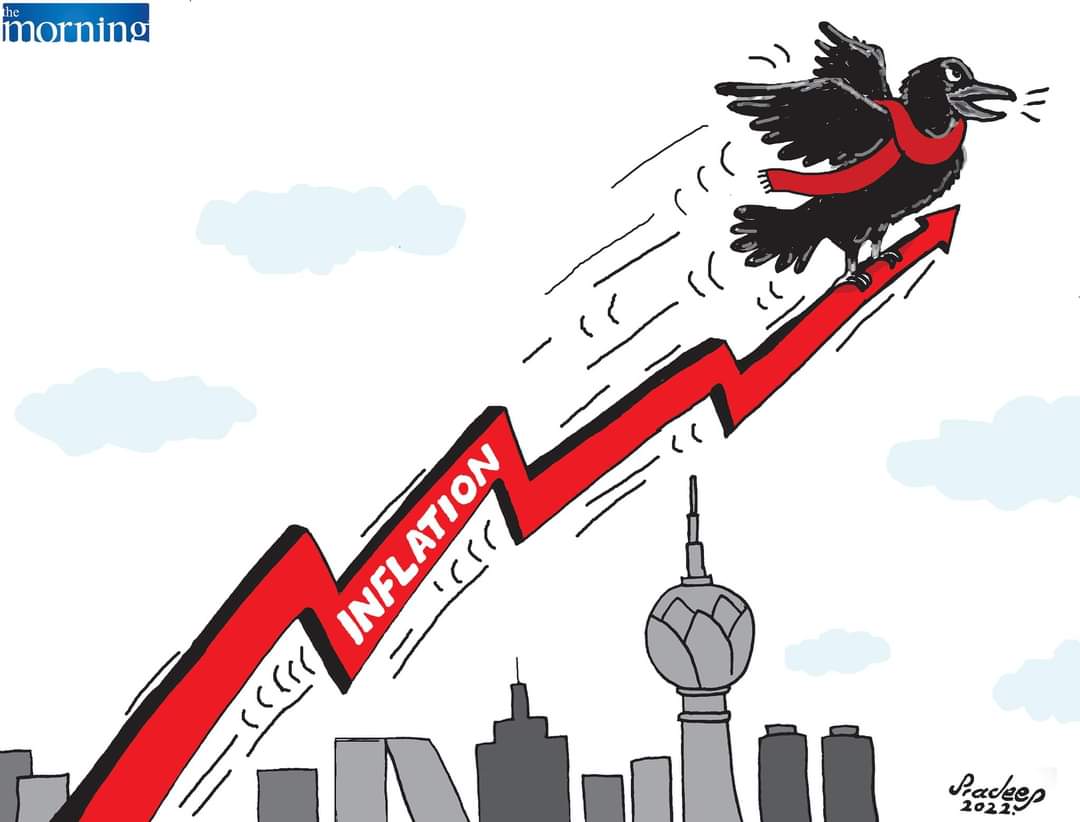
Sri Lanka’s inflation in the capital Colombo accelerated to 69.8 percent in September 2022 from 64.3 percent a month earlier, data from the state statistics office showed amid the worst currency crisis in the history of the island’s intermediate regime central bank.

The widely watched Colombo Consumer Price Index rose 3.8 percent to 244.7 points in the month.

The food sub-index rose 0.9 percent to 323.3 points.

Food prices were up 94.9 percent in the last 12 months. Food prices are up 120 percent from January 2020 when Sri Lanka began to print money aggressively after cutting taxes in December 2019.

Sri Lanka’s central bank has allowed interest rates to go up and private credit is now negative. Attempts are also made to minimize the budget deficit with high taxes and state enterprise credit is also contained with utility price hikes.

Sri Lanka operates Latin America style soft-peg with inherent anchor conflicts and triggering currency crises when attempts are made to suppress market interest rates.

Currency crises intensified from around 2014 when aggressive open market operations were unleashed to suppress rates in an ill-fated infaltion targeting exercise despite having a reserve collecting peg.

Sri Lanka cut taxes and printed large volumes of money to suppress rates in a ‘stimulus’ from 2020 ultimately driving the country to default.

Food prices are up 120 percent from January 2020 when Sri Lanka began to print money aggressively after cutting taxes in December 2019. Adding to the inflation is money printing by the Federal Reserve which had fired the highest price rises in 40 years.

Bad US and European policy in a resurgence of mercantilism also led to bad policy across countries.

Posted in Uncategorized

China has been our closest buddy in recent decades: PM

China has the honour of being Sri Lanka’s closest buddy in the past decades Prime Minister Dinesh Gunawardana said yesterday while heaping his praise on the 73rd national day of the People’s Republic of China.

He stated that China has been a genuine friend that stood in times of trials, challenges and success for the sake of the people of this country.

Even in the current situation, China has further assured to help us with investment and extend its cooperation to uplift tourism and in other fields.

“The new trade agreements that we committed at the discussion table would yield good results and fetch success in the coming months. The Chinese have laid the foundation to become the global giant by gaining top recognition and by striking a perfect balance in the global arena.” the prime minister said.

China is honoured for its rapid and balanced progress in political, social, and economic power; cultural, scientific, and technological environmental research; and space exploration, he said.

China is a true and a powerful global leader. Especially through its leadership and extending its hand to the Asian, African and Latin American countries and the contribution it makes towards the prosperity of all nations across the globe.

RW, Modi discuss Sri Lanka’s economic crisis in Tokyo

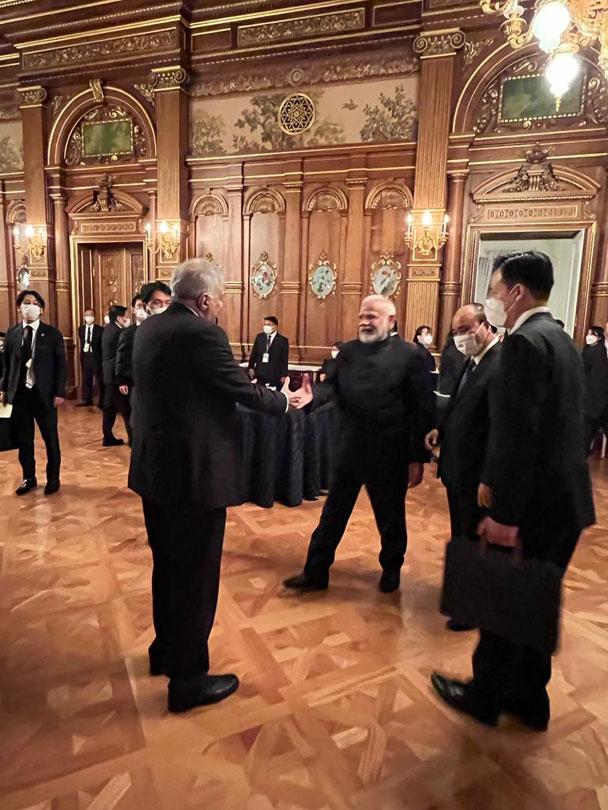
President Ranil Wickremesinghe and Indian Prime Minister Narendra Modi discussed Sri Lanka’s debt restructuring when the two held informal discussions in Tokyo last evening, on the sidelines of the funeral of former Japanese Prime Minister Shinzo Abe.

Sources present at the discussion said that during the meeting which lasted for around 10 minutes, the Indian Prime Minister congratulated Wickremesinghe on his presidency and also discussed Sri Lanka’s present economic crisis.

Modi and Wickremesinghe discussed Sri Lanka’s debt restructuring and Modi also inquired on Sri Lanka’s talks with the International Monetary Fund and the current status of the talks.

After being briefed by Wickremesinghe, the Sri Lankan President requested for more Indian investments to which the Indian Premier had responded positively saying India would increase its investments in Sri Lanka to assist the country out of the economic crisis.

The meeting between the two South Asian leaders was expected especially at a time when India has played a crucial role in assisiting Sri Lanka during the economic instability.

Sri Lanka will ask for vote on upcoming “unfair” UN resolution: foreign minister

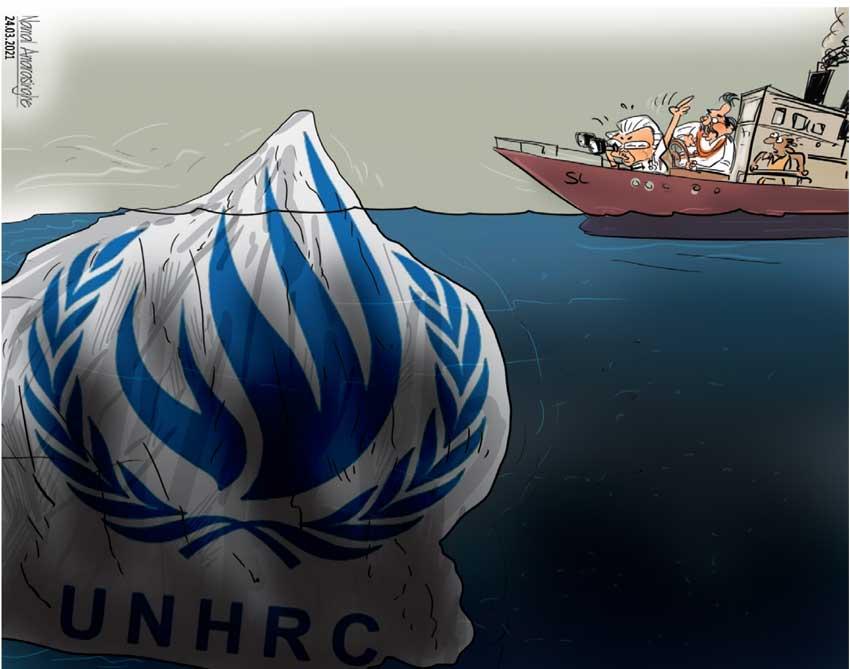
Sri Lanka will seek a vote on an upcoming resolution at the United Nations Human Rights Council (UNHRC) with the help of its friends as the resolution is “unfair” and aimed at tarnishing the country’s image at a time of economic crisis, Foreign Minister Ali Sabry said.

The new resolution is likely to tighten Sri Lanka’s space to deal with international trade further as several key conventions in trade concessions like Europe’s GSP Plus are tied directly to human rights. Already the European Union has threatened to withdraw its trade concession as the country has failed to fulfill its commitments on implementing some key international conventions.

The draft resolution, titled “Promoting reconciliation, accountability and human rights in Sri Lanka” and sponsored by the United Kingdom, the United States, Germany, Canada, Malawi, Montenegro and North Macedonia, was formally handed over to the Human Rights Council Secretariat last week.

The draft text requests the Office of the High Commissioner for Human Rights to enhance its monitoring and reporting on the situation of human rights in Sri Lanka, including on progress in reconciliation and accountability, and on the human rights impact of the economic crisis and corruption.

“It is unfair,” Foreign Minister Ali Sabry told EconomyNext on Thursday September 29.

“It is against our constitution and we have to respond to that. We are not going to agree on that. Whether we will win or lose, there are things on which we cannot compromise. We will ask for a vote through our friends,” he said.

Sri Lanka has been strongly against an external evidence gathering mechanism by the Office of High Commissioner for Human Rights though the UN body has already started the mechanism despite facing a lack of finance initially.

Sri Lanka’s human rights record has been criticised widely since the final stage of a 26-year civil war that ended in 2009 due to the alleged killing of thousands of ethnic minority Tamils by government forces. The government of Sri Lanka has repeatedly denied the allegation.

Some Western nations have already imposed a travel ban on some military leaders who led the government’s war effort on the grounds of alleged crimes. Canada and Germany had refused to accommodate Sri Lankan military officials in the island nation’s diplomatic missions in those countries.

Minister Sabry said the resolution is a concern because it seeks long term prosecution of military officials.

“Particularly what we are concerned about is an outside evidence gathering mechanism and the long-term prosecution of Sri Lankan armed forces outside Sri Lanka. That we cannot agree with,” he said.

The new resolution has called upon the government to address Sri Lanka’s ongoing currency crisis including by investigating corruption and prosecuting those responsible including public and former public officials. It has asked the UNHCR to stand ready to assist and support independent, impartial, and transparent efforts on this.

“They have brought in some economic crimes which has not been defined. Many countries have gone through (economic crises). But what is the UNHRC doing about an economic crisis?” said Sabry.

“If there is a crime, we have to prosecute in Sri Lanka. Economic recovery must take place in Sri Lanka and the international community should support us. So, tarnishing our image at this point in time will have a negative impact. People will not want to work with us and no new people want to come and invest,” he said.

President hopes all creditors will support Sri Lanka

President Ranil Wickremesinghe said amidst major economic stress, Sri Lanka is undertaking an unprecedented fiscal effort as part of the government’s commitment to restoring the country’s debt sustainability.

Therefore, he expressed hope and expectation that Sri Lanka’s creditors, and all stakeholders, will support Sri Lanka in these efforts to restore the country’s debt sustainability and help put the country back on the path of inclusive and sustainable economic growth.

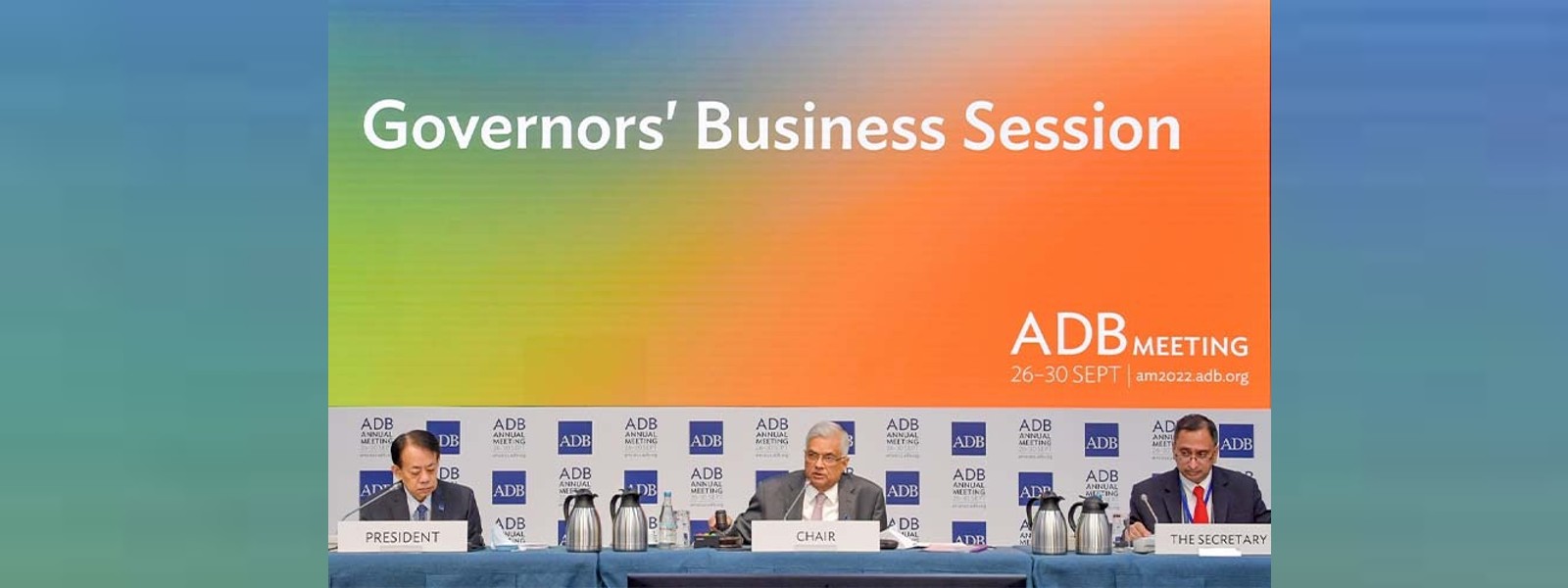
President Wickremesinghe presided over the annual meeting of the ADB Board of Governors on Thursday (29) which was held at the ADB headquarters in Manila, Philippines and attended by Governors and official government delegations.

President Wickremesinghe noted that the government has already undertaken major macroeconomic policy reform measures and this program is aligned with the commitment of the government to implement an ambitious and comprehensive package of reforms that will help restore the sustainability of the country’s public finances, addressing external imbalances, and restarting the growth engine through structural reforms and improvements in governance.

“Amidst major economic stress, Sri Lanka is undertaking an unprecedented fiscal effort as part of our commitment to restoring the country’s debt sustainability. It is our hope and expectation that Sri Lanka’s creditors, and all stakeholders, will support us in these efforts to restore our debt sustainability and help put the country back on the path of inclusive and sustainable economic growth,” he said.

The President said that whilst Sri Lanka undertakes these deep and often painful reforms, the country is experiencing rising unemployment and a reduction in purchasing power of the consumers. He added that the government is cognisant of the adverse impacts on the most vulnerable members of society, adding that every effort has been taken to allocate greater financing and resources towards targeted support for social protection.

He assured that the government has stabilized Sri Lanka’s economy and many countries and stakeholders are keenly monitoring how they resolve this crisis. Wickremesinghe said that his government is well aware that the evolution of Sri Lanka’s economic crisis includes both domestic policy elements as well as external shocks, adding that the resolution of the crisis also requires both domestic efforts and the support of external partners. “It is incumbent upon Sri Lanka and our creditors and partners to set an example of how collaborative and good faith action can result in sustainable and equitable solutions to sovereign debt issues.”

However, he emphasized that the economic levers alone are insufficient to stimulate global economic recovery. Adding that the factors underlining the main crisis is not only of economic origin, the President said they are also the consequences of evolving geopolitics.

He noted that as this global rivalry intensifies into a new cold war, which will determine a new global power balance by 2050, the inability of the major countries to give leadership to the mitigation of the global climate change crisis is becoming more apparent.

“As they say in many of our countries when the elephants fight, it is the grass that is crushed. This is the predicament of many of our member countries. Therefore, we must overcome the geopolitical rivalries to address the major threats to our existence, otherwise we will all fail leading to instability in our region reminiscent of Europe after World War I. On the other hand, our ability to successfully meet these challenges will lead to remarkable progress in raising the living standards of our people through the rise of the economies of our member countries.”

Hence, President Wickremesinghe said that the ADB’s Strategy 2030 seeks to respond to global challenges, including climate change and natural disasters, food and energy insecurity, whilst also embracing opportunities in the digital economy, sustainable energy, and leveraging technology for inclusive education and healthcare. Thus, he said that the ADB has a crucial role in helping to shape and finance policies that improve people’s lives and livelihoods across Asia and the Pacific.

Posted in Uncategorized

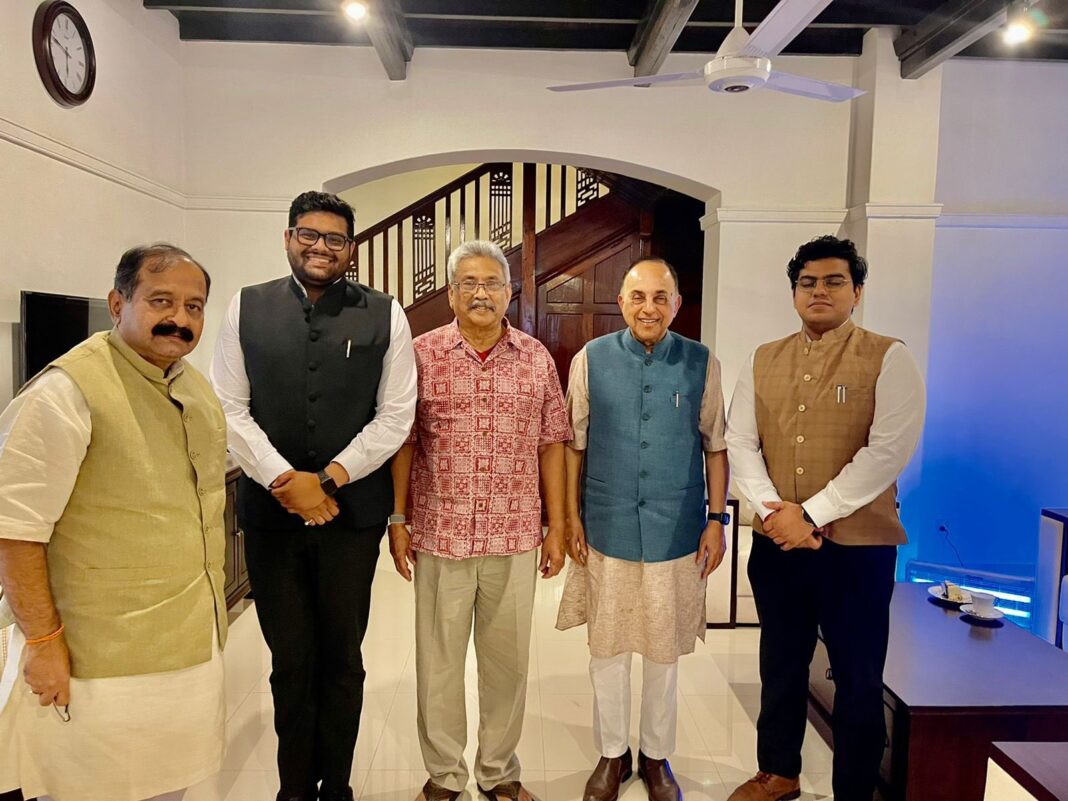
Deposed President Gotabaya Rajapaksa meets Subramanian Swamy

Deposed President Gotabaya Rajapaksa had talks with Indian politician Subramanian Swamy.

Swamy, who is in Sri Lanka, had met Rajapaksa together with members of his delegation.

Subramanian Swamy also met former Prime Minister Mahinda Rajapaksa and attended an event hosted by the former Prime Minister.

The Indian politician, a member of the ruling BJP party, is known to be a close friend of the Rajapaksa family.

While in Colombo, Subramanian Swamy also met Prime Minister Dinesh Gunawardena and members of the Ceylon Workers Congress.

Swamy also delivered the keynote speech at an event held at the General Sir John Kotelawala Defence University.

Posted in Uncategorized

IMF says time frame for Sri Lanka bailout remains uncertain

Sri Lanka’s Government appears increasingly upbeat about its chances of receiving International Monetary Fund board approval for a $2.9 billion bailout by December, but the multilateral lender has cautioned that the time frame remains uncertain, and much depends on discussions with the heavily indebted country’s creditors.

Peter Breuer, senior mission chief for Sri Lanka, and Masahiro Nozaki, mission chief for Sri Lanka, in written comments to Nikkei Asia, said, “It is difficult to predict the timeline, as the process of debt relief discussions takes time. All parties who are involved in the process should move expeditiously, so that Sri Lanka can emerge from the crisis as quickly as possible.”

On Sept. 1, Sri Lanka reached a staff-level agreement with the IMF to obtain the $2.9 billion, a crucial lifeline for a country wrestling with the worst economic crisis in its history. The country’s year-on-year inflation topped 70% in August, and the public continues to face severe shortages of essentials.

Earlier this year, Sri Lanka defaulted on a foreign bond for the first time, after its foreign reserves dwindled to next to nothing. “We announced that we are not in a position to pay,” central bank Gov. Nandalal Weerasinghe said in May, confirming the “preemptive default.”

“Our position is very clear. Until [the lenders] come and restructure, we can’t pay,” Weerasinghe said.

Last Friday, Sri Lanka’s Finance Ministry held an online presentation for external creditors to explain the situation and discuss the next steps toward restructuring. A handout cited “some past policy mistakes” along with the COVID-19 pandemic and the resulting crisis as key factors that crippled the economy, depleted reserves and forced the country to stop debt repayments.

The day before, President Ranil Wickremesinghe chaired a meeting with ambassadors from 23 Paris Club and non-Paris Club countries, including Japan, France and India, to discuss related matters.

Wickremesinghe appealed to all creditor countries to offer the “financing assurances” on debt sustainability the IMF has said are essential for the board to give the final green light.

The Indian High Commission in Sri Lanka, for its part, expressed support even before the creditor briefings. On Sept. 20 it said that it had started discussions on restructuring Sri Lanka’s official debt to India. A spokesman told Nikkei Asia that the “cordial atmosphere” of the talks reflected New Delhi’s support for an “early conclusion and approval of a suitable IMF program.”

Noting the need for other creditors to work on ensuring Sri Lanka’s debt is manageable, he added that India would remain “closely engaged” with relevant stakeholders.

During last Friday’s presentation, Weerasinghe and Mahinda Siriwardana, secretary to the Treasury and Ministry of Finance, noted that as of the end of June, Sri Lanka’s public debt stood at 122% of gross domestic product. A figure equivalent to 70% of GDP was denominated in foreign currency.

According to the presentation by the Ministry of Finance and the central bank, China, Japan and India were the country’s top three bilateral creditors, with China accounting for 52% in total, followed by Japan at 19.5% and India at 12%.

The Sri Lankan officials also pushed for the formation of an ad-hoc coordination group to expedite the process of obtaining financing assurances from multiple creditors. They explained that such a group would allow official bilateral creditors to give such assurances to the IMF collectively, after discussing the matter among themselves.

The Japanese Embassy in Colombo agreed that it is essential for all creditors to come to the table for debt restructuring discussions to ensure that the process is transparent and fair. “If all the creditor countries will participate in a coordination platform proposed by President Wickremesinghe, the government of Japan is ready to contribute to the discussion in a constructive way,” the embassy told Nikkei Asia.

But all eyes are on top creditor China, known for its preference for refinancing loans or deferring repayments rather than restructuring and settling for loss-making “haircuts.”

On the sidelines of the United Nations General Assembly last week, Sri Lankan Foreign Minister Ali Sabry met his Chinese counterpart, Wang Yi, who pledged China’s support for a Sri Lankan economic recovery.

A Chinese Foreign Ministry readout of the meeting said that Wang promised China “is ready to work with Sri Lanka to carry forward the traditional friendship, consolidate strategic mutual trust and deepen and expand pragmatic cooperation.” He also said that China would “continue to offer assistance within our capacity to help Sri Lanka overcome temporary difficulties.”

Still, a highly placed Sri Lankan diplomatic source said that although debt discussions have started with some countries, it is “impossible” to say how long they will take and when a final decision will be made.

Source:Nikkei Asia

Posted in Uncategorized

Parliamentary debate on draft of 22A scheduled for October

The Committee on Parliamentary Business has decided to hold the debate on the draft of the 22nd Amendment to the Constitution on October 06 and 07, the Communications Department of Sri Lanka Parliament says.

The meeting was chaired by Speaker of Parliament Mahinda Yapa Abeywardena this morning (Sep. 29).

The committee also decided that the parliament would convene from October 03 (Monday) to October 07 (Friday).

Accordingly, October 03 is set aside for the purpose of taking up 50 Questions for Oral Answers which were postponed due to various reasons. From October 04 to 06, except for Friday (Oct. 07), Questions for Oral Answers are reserved for the time period between 9.30 am and 10.30 a.m.

Furthermore, it has been decided to extend the time allotted for the debate pertaining to government business by half an hour from the October 04 (Tuesday) to allocate that time for the independent Members of the Parliament to express their opinions. Accordingly, the time for debating the government business, scheduled to end at 4.30 p.m., will be extended until 5.00 p.m.

It was agreed upon to allocate the remaining 30 minutes until 5.30 p.m., for the Motion at the Adjournment Time on one day and Questions at the Adjournment Time on every other following day.

On October 04, from 10.30 a.m. to 5.00 p.m., Order under the Strategic Development Project Act, No. 14 of 2008 published under the Gazette Extraordinary No. 2291/25, Order under Excise (Special Provisions) Act No. 13 of 1989 published under the Gazette Extraordinary No. 2290/19, two regulations under the Import and Export Control Act No. 1 of 1969 published under the Gazette Extraordinary No. 2294/29 are scheduled to be taken up for debate.

Furthermore, Select Committee of Parliament to study the practical problems and difficulties that have arisen in relation to enhancing the rank in the Ease of doing business index in Sri Lanka and make its proposals and recommendations is to be moved.

The Motion at the Adjournment Time brought in by the Government will be held from 5.00 p.m. to 5.30 p.m.

On October 05, from 10.30 a.m. to 12.30 p.m., Order under the Extradition Law, No. 8 of 1977 published under the Gazette Extraordinary No. 2282/19 will be taken up, the Secretary General stated. Thereafter, from 1.00 p.m. to 5.00 p.m., the debate on the Amendments to the Standing Orders of the Parliament will be held for the second consecutive day. From 5.00 p.m. to 5.30 p.m., time has been set aside for Questions at the Adjournment Time.

The debate on the 22nd Constitution Amendment Bill is scheduled to be held on October 06 and 07. Accordingly, the debate on October 06 will be held from 10.30 a.m. to 5.00 p.m. From 5.00 p.m. to 5.30 p.m., time has been set for the Motion at the Adjournment Time by the Opposition.

The Secretary General also said that the debate on the 22nd Constitution Amendment Bill is scheduled to be held on October 07 from 9.30 a.m. to 5.00 p.m.

The constitutional amendment, which had been referred to as the 21st Amendment so far, will in fact be the 22nd Amendment, as another draft 21st Amendment has already been gazetted.

The 21st Amendment to the Constitution is the constitutional amendment presented to the parliament by the main opposition Samagi Jana Balawegaya (SJB) in April as a private Bill. It was later published in the government gazette and challenged in the Supreme Court.

Dr. Wijeyadasa Rajapakshe, who was appointed the Minister of Justice, Prison Affairs & Constitutional Reforms, later presented a government Bill to the Cabinet of Ministers in his ministerial capacity, which is referred to as the 22nd amendment.

The Supreme Court, delivering its determination, ruled that the 21st amendment put forward by the SJB cannot proceed further without a public referendum.

In such a backdrop, the Cabinet of Ministers gave the approval to publish the 22nd amendment presented by the Justice Minister in the government gazette.

Policy approval of the Cabinet of Ministers was given on June 20, 2022 for the preliminary draft for the 22nd amendment. The 22nd constitutional amendment bill was prepared by the legal Draftsman accordingly. The Attorney General had later informed that the bill is in accordance with the Constitution.

Consequently, the Cabinet of Ministers approved the proposal presented by the Minister of Justice, Prison Affairs and Constitutional Reforms, to publish the 22nd constitutional amendment Bill in the Government Gazette and thereafter present the same in Parliament for approval.

The constitutional amendment is expected to empower Parliament over the executive president and annul the 20A to the Constitution, which had given unfettered powers to President after abolishing the 19th Amendment.

Under the 22A, the President, the Cabinet of Ministers and the National Council will be held accountable to the parliament. Fifteen Committees and Oversight Committees are also accountable to parliament.

The 22nd constitutional amendment comprises features of both the 19th amendment introduced by the Yahapalana Government and the 20th amendment brought forth under the presidency of Gotabaya Rajapaksa.

As per the draft Bill, a Constitutional Council will come into effect and it will consist of members including the Prime Minister, the Speaker of Parliament, the Opposition Leader, a Member of Parliament appointed by the President, two members nominated by both the Prime Minister and the Opposition Leader. The council will be chaired by the Speaker.

The Public Service Commission, the National Police Commission, the Audit Service Commission, Human Rights Commission, Commission to Investigate Allegations of Bribery or Corruption, Finance Commission, Delimitation Commission and the National Procurement Commission shall be responsible and answerable to the parliament. However, Election Commission is not.

As per this amendment, no person shall be appointed by the President unless such appointment has been approved by the council upon a recommendation made to the council by the Head of State in instances of appointing the Chief Justice and the judges of the Supreme Court, the president and the judges of the Court of Appeal, the members of the Judicial Service Commission other than its chairman.

The same is applicable when appointing the Attorney General, the Auditor General, the Inspector-General of Police, the Central Bank Governor, the Parliamentary Commissioner for Administration and the Secretary-General of Parliament.

The 22nd constitutional amendment abolishes the ability of a dual citizen to be appointed as a Member of Parliament.

It also includes provisions of the 20th amendment that the number of Cabinet Ministers shall not exceed 30 and the number of ministers who are not members of the Cabinet and Deputy Ministers shall not exceed 40.

However, if a recognized political party or an independent group which obtains the highest number of seats in parliament forms a national government, the number of ministers in the Cabinet, the ministers who are not in the Cabinet and Deputy Ministers shall be determined by the parliament.

Meanwhile, the Supreme Court has determined that some provisions of the draft of the 22nd Amendment to the Constitution are inconsistent with the Constitution. Accordingly, the Supreme Court has arrived at the conclusion that the draft constitutional amendment needs to be passed by a special majority and a referendum or the clauses in question should be amended. The draft of the 22nd Amendment to the Constitution was challenged in the Supreme Court in terms of Article 120(1) (1) of the Constitution.


Police to quiz some politicos over secret plot to overthrow govt

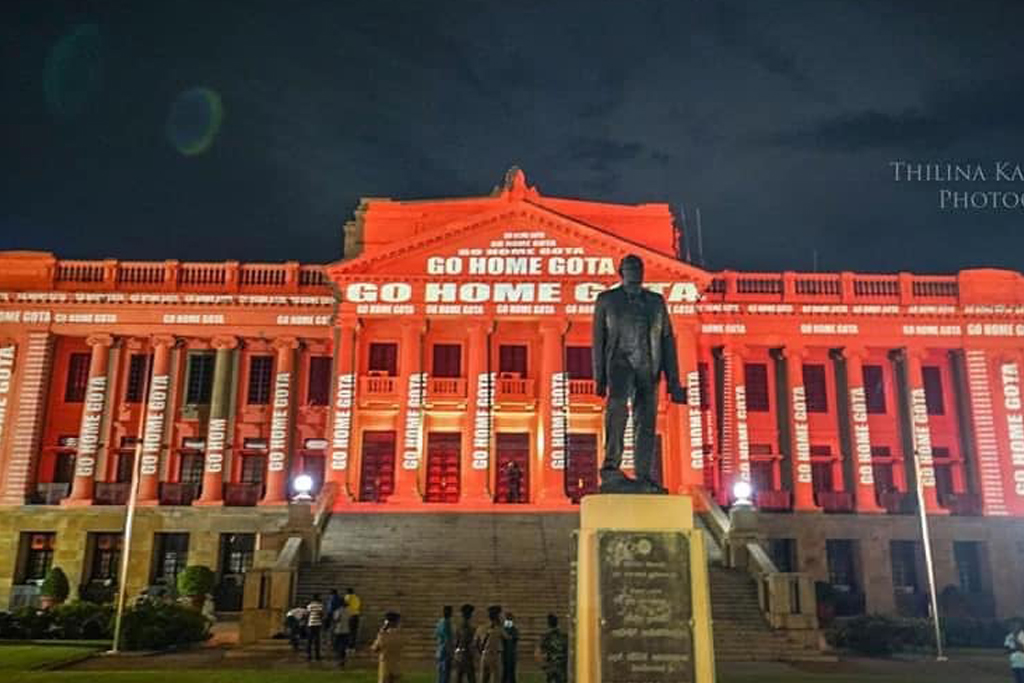
The police have launched extensive investigations over the involvement of some politicians who had encouraged some ‘protester’ groups to overthrow the government by forcefully occupying Parliament and preventing a vote to elect a new President following the resignation of former President Gotabaya Rajapaksa in July.

Highly placed sources told Daily Mirror that these politicians had even brokered talks with the parties involved and investigations are being carried out into their actions.

The Daily Mirror learns that despite reports that last week’s gazette declaring high-security zones in Colombo will be reversed,the government will brief the Supreme Court in the coming days over the purpose of why the HSZ’S are required and why the sites listed need to be protected.

Sources said that according to information received by the investigators which will be communicated to the Supreme Court is the second phase of the ‘operation’ following the July 9 public protest.

This was by a group posing themselves as protesters, and that was to surround and take over Parliament to prevent the MPS from electing a new President following the forceful exit of Gotabaya Rajapaksa.

Investigators were informed that the group had also planned to surround the Supreme Court.

It was based on this information that the security authorities had recommended the setting up of HSZS in several key areas including the Supreme Court.

However as the Supreme Court had not been consulted in the process, the relevant authorities will now consult the Supreme Court and seek its advice over the establishment of these HSZS to ensure an unhindered administration, sources said.

Some of the areas declared as HSZS by President Ranil Wickremesinghe include the Parliament Complex, Supreme Court Complex, High Court Complex – Colombo, Magistrate Court Complex – Colombo and Attorney General’s Department, Temple Trees, Presidential Secretariat, the Prime Minister’s Office, and the Army Headquarters.

Posted in Uncategorized

Sri Lanka to send delegates to IMF & WB Annual meeting

Sri Lanka has decided to send a delegation for the annual summit of the International Monetary Fund and the World Bank.

The 2022 Annual Meetings of the International Monetary Fund (IMF) and the World Bank Group (WBG) will take place in person from Monday, October 10, through Sunday, October 16 in the IMF and World Bank Group headquarters, in Washington DC.

Sri Lanka’s delegation will be led by Acting Finance Minister Shehan Semasinghe.

He said the Governor of the Central Bank of Sri Lanka, the Finance Secretary and several others will accompany him.

The Acting Finance Minister said that the 2022 Annual Meetings of the International Monetary Fund (IMF) and the World Bank Group (WBG) will be of paramount importance for Sri Lanka to restrucutre its debt, and also obtain financial assistance from the IMF.

Source: News 1st