SLFP undecided on supporting PM Ranil

The Sri Lanka Freedom Party (SLFP) is yet to decide on whether or not to extend its support to newly appointed Prime Minister and United National Party Leader MP Ranil Wickremesinghe so that he could command a majority in Parliament.

Speaking to The Morning, SLFP General Secretary MP Dayasiri Jayasekara said that the final decision on the matter is yet to be taken.

According to sources, the SLFP and the group of “independent” government Party (Sri Lanka Podujana Peramuna [SLPP]) MPs in Parliament had proposed the names of MPs Nimal Siripala de Silva, President’s Counsel Dr. Wijeyadasa Rajapakshe, and Dullas Alahapperuma for the post of the Prime Minister.

Meanwhile, the SLPP and former Prime Minister and incumbent MP Mahinda Rajapaksa has reportedly extended his support to Wickremesinghe.

Yesterday (12) evening, Wickremesinghe replaced Rajapaksa who resigned from the post on Monday (9) as unrest broke out in Sri Lanka.

Posted in Uncategorized

Cardinal, Omalpe Sobitha Thera against Ranil as PM

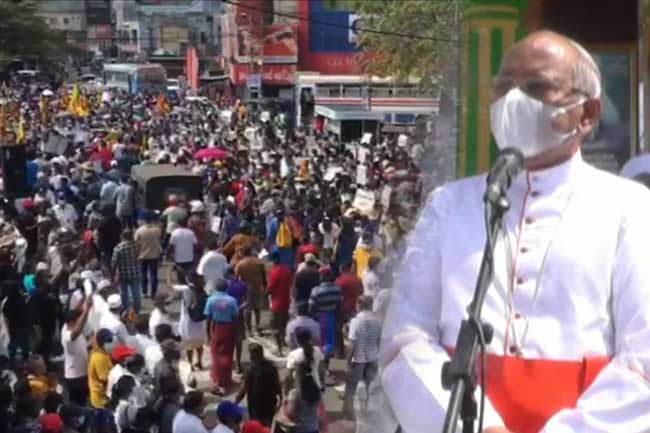
Religious leaders today opposed the decision made by President Gotabaya Rajapaksa to appoint UNP Leader Ranil Wickremesinghe as the new Prime Minister.

Archbishop of Colombo Cardinal Malcolm Ranjith said Mr. Wickremesinghe does not command a majority in Parliament. “ Mr. Wickremesinghe is the only MP who represents his party. Therefore the appointment is not legal,” he said.

“President should listen to the request made by the Mahanayaka Theras who wanted a nonpartisan person to be appointed as the Premier,” he added.

Venerable Omalpe Sobitha Thera said the President has no right to go against the will of the people. “ People never expected this kind of Prime Minister. The Former Prime Minister also deceived the people and left creating a mess. President also seems to be following the same path,” he said.

Venerable Thera said the request that has been made by Leader of Opposition Sajith Premadasa to be appointed as the Premier should be heeded by the President. A non partisan person should come forward through the leader of the opposition. The President should have a dialogue with everyone concerned,” he added.

From rejected MP to chosen PM

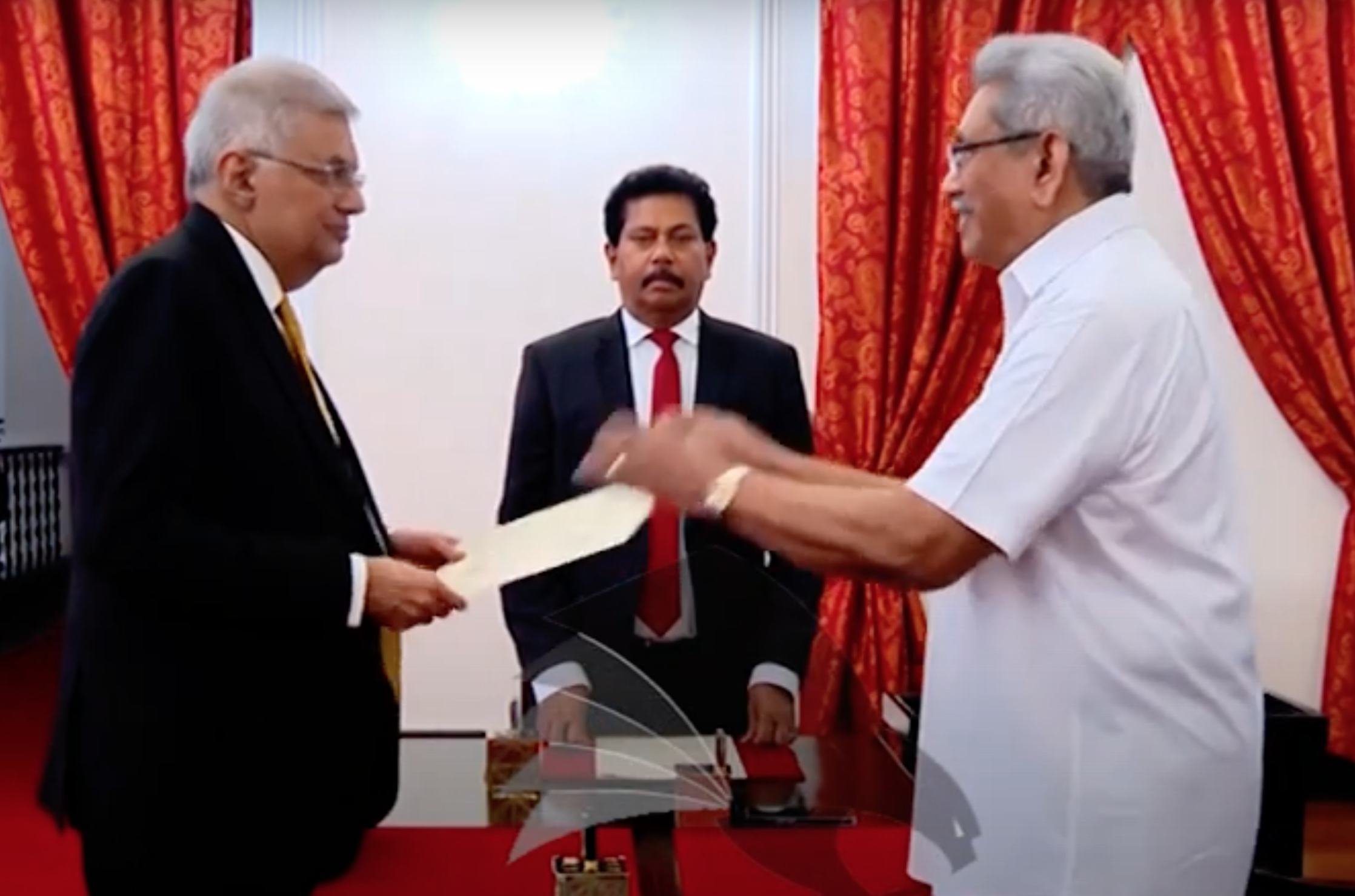
Completing a stunning comeback, United National Party (UNP) Leader and National List MP Ranil Wickremesinghe, who failed to secure his seat in Parliament in the August 2020 General Election, was sworn in as the new Prime Minister last evening (12).

Wickremesinghe took oaths before President Gotabaya Rajapaksa at the President’s House, with Secretary to the President Gamini Senarath and Prof. Maithree Wickremesinghe also present on the occasion.

Wickremesinghe has served as Prime Minister of Sri Lanka on five previous occasions. Following a humiliating defeat for himself and the UNP at the General Election in August 2020, he entered Parliament last year through the sole National List seat won by the party.

When inquired by a foreign journalist whether he has the moral mandate to become the PM, being the sole MP from his party, Wickremesinghe made reference to former British Prime Minister Sir Winston Churchill, who served as Prime Minister of the UK from 1940 to 1945, during the Second World War, and again from 1951 to 1955.

“Churchill had only four Members of Parliament backing him in 1939. How did he become Prime Minister? Because of the crisis (a reference to the Second World War). I have done the same,” he said.

President Rajapaksa and Wickremesinghe held a round of discussion on Wednesday evening (11), during which the new appointment for the vacated premiership and the present crisis situation in the country was discussed at length.

Wickremesinghe’s appointment comes after Mahinda Rajapaksa resigned as Prime Minister following an attack on peaceful protestors camped outside the Temple Trees and the “GotaGoGama” protest site at Galle Face Green by a mob of ruling party supporters on Monday (9), which led to retaliatory attacks around the country and public furore.

The resignation of Mahinda Rajapaksa was later notified in a Gazette Extraordinary published on Monday, under the directives of the President.

Soon after the swearing-in of Wickremesinghe, former Prime Minister Mahinda Rajapaksa, who was reportedly relocated to the Sri Lanka Navy Dockyard in Trincomalee due to security reasons, congratulated his successor.

“Congratulations to the newly appointed Prime Minister of #lka, @RW_UNP. I wish you all the best as you navigate these troubled times,” Rajapaksa Tweeted.

The citizens of the island nation have been showing their discontentment with the incumbent Government as they continue to stand in long queues to meet their basic necessities, including food and medicines.

It was reported last week that the President had requested Mahinda Rajapaksa to vacate the premiership, in order to allow the formation of a government of national unity, an interim arrangement until the present economic crisis could be dealt with.

Rajapaksa’s resignation as the Prime Minister came after several rounds of discussions among the ruling Sri Lanka Podujana Peramuna Party (SLPP) and its constituent parties. The PM’s departure also resulted in the dissolution of the Cabinet.

Sri Lanka: debt crisis, neocolonialism and geopolitical rivalry

By ASOKA BANDARAGE – AsiaTimes

Sri Lanka is in the throes of an unprecedented economic crisis. Faced with a shortage of foreign exchange and defaulting on its repayments of foreign debt, the country is unable to pay for its food, fuel, medicine, and other basic necessities. Notwithstanding the austerities that would be entailed, a bailout by the International Monetary Fund (IMF) has been accepted as the only way out of the dire economic situation.

Opposition political parties and citizens across the country blame the Rajapaksa government’s widespread corruption and mismanagement for the crisis, and demand that the president and the Parliament resign.

Prime minister Mahinda Rajapaksa did so on May 9. However, the protesters at Galle Face Green, an urban park in central Colombo, and elsewhere have not been able to put forward an alternative leadership or a viable roadmap for the future. The country remains mired in confusion, chaos and a highly volatile political impasse.

To understand the complexity of the current crisis, and to prevent us falling back into the same paralyzing debt cycle, it is necessary to move beyond domestic politics and the relentless news cycles of corporate media and explore some of the commonly overlooked yet basic global economic and geopolitical dimensions.

Debt crises and global inequality
The transfer of financial and resource wealth from poor countries in the Global South to the rich countries in the North is not a new phenomenon. It has been an enduring feature throughout centuries of both classical and neo-colonialism. At the start of 1989, developing nations owed foreign creditors US$1.3 trillion, that is, “just over half their combined gross national products and two-thirds more than their export earnings.”

Recently, the effects of the war in Ukraine and the Covid-19 crisis have worsened the high debt burdens of developing countries. These countries were already struggling to pay accumulated debts stemming from the expansion of capital flows from the high-income countries to lower-income countries after the 2008 global financial crisis.

Financial liberalization was fostered by powerful global interests, including the IMF, when interest rates dropped in the richer countries. This facilitated borrowing by developing countries from private international capital markets through international sovereign bonds (ISBs), which come with high interest rates and short maturation periods.

Financial liberalization facilitated by the IMF and the developed countries working with the domestic elites of poor countries has created a hierarchical and asymmetrical international financial architecture.

As a December 2021 report published by the Bretton Woods Project points out, this unequal framework creates “macroeconomic imbalances, financial fragilities, and exchange-rate instability that can trigger debt and/or currency crises and curb the economic policy autonomy of affected countries to pursue domestic goals.”

The international non-governmental organization Debt Jubilee Campaign (soon to be called Debt Justice) has pointed out that 54 countries are now experiencing a debt crisis.

According to the World Bank, Sri Lanka owes $15 billion in bonds, mostly dollar-denominated, out of a total of $45 billion to $50 billion in long-term debt. The country needs $7 billion to $8.6 billion to service its debt load in 2022, whereas it had just $1.6 billion in reserves at the end of March 2022.

The downgrading of Sri Lanka by rating agencies such as Moody’s added to the difficulty of further borrowing to pay off the debt. The devaluation of the Sri Lankan rupee by 32% since the beginning of the year has made it the world’s worst performing currency, according to economists, exacerbating the plight of the Sri Lankan people.

The multilateral Asian Development Bank and the World Bank own 13% and 9% of Sri Lanka’s foreign debt respectively. Currently, China is Sri Lanka’s largest bilateral lender, owning about 10% of its total foreign debt, followed by Japan, which also owns 10%.

About half of Sri Lanka’s total foreign debt (55% according to some estimates) is market borrowings through US- and EU-based ISBs. Asset managers BlackRock and Ashmore Group along with Fidelity, T Rowe Price and TIAA, are among Sri Lanka’s main ISB creditors. However, the information on the ownership of ISBs – including one worth $1 billion that will mature on July 25 – is not publicly revealed.

Sri Lanka is in negotiations with the IMF on restructuring and repaying its massive debt. IMF structural adjustment will include the familiar privatization, cutbacks of social safety nets and alignment of local economic policy with US and other Western interests, to the further detriment of local working people’s standard of living and inevitably leading to more wealth disparity and repeat debt crises.

Debt crisis and geopolitical rivalry
Economic crises create opportunities for external powers to expand economic exploitation and geopolitical control. In Sri Lanka’s context, this means India, the US and China.

Sri Lanka’s big neighbor India has extended a $1 billion credit line to provide essential food and medicine. The Sri Lankan government has stated that there are no conditions attached to the Indian loans. However, Sri Lankan analysts believe that agreements have been made giving Indian companies exclusive access to investments on the island.

Sri Lanka is strategically located in the sea lanes of the Indian Ocean. More than 80% of the global seaborne oil trade is estimated to pass through the chokepoints of the Indian Ocean. Although bizarrely overlooked by the global media, a cold war is already in place between China and the Quadrilateral Alliance (United States, Japan, Australia and India) over the control of Sri Lanka and the Indian Ocean.

Sri Lanka is part of China’s $1 trillion Belt and Road Initiative, which includes the island’s Hambantota Port and Port City. The United States, on the other hand, signed an open-ended Acquisition and Cross Services Agreement (ACSA) with Sri Lanka on August 4, 2017, facilitating military logistic support.

The US is also seeking to sign a Status of Forces Agreement (SOFA), which would in effect turn Sri Lanka into a US military base. While the proposed US Millennium Challenge Corporation Compact has not been signed because of local protests, the pact’s objective – US control over the land, transportation and communication infrastructure in Sri Lanka – continues unabated.

In this context of Sri Lanka as a tense theater of geopolitical rivalry, the debt crisis cannot be understood simply as an economic crisis. Could it, in fact, be a “staged default” designed to push Sri Lanka into an IMF bailout that would complete the island’s subservience to the US-dominated economic and political agenda?

Alternative sustainable approaches
The young “Gotta Go Home!” protesters who demand President Gotabaya Rajapaksa’s resignation seem to be unaware of the global dynamics of the Sri Lankan crisis. Perhaps local and foreign interests guiding the protests may want to keep it that way.

They are certainly not encouraging the protesters to join global calls for much-needed debt cancellation, debt swaps and regulation of capital market borrowing to prevent debt crises occurring in the first place.

However, at least a few Sri Lankan professionals concerned about the implications of an IMF bailout have put forward alternative short and long-term solutions. They recognize that while exploitative colonial and neocolonial policies have turned Sri Lanka into a poor and desperate country, the island is rich with abundant natural resources and human capital.

If the land and ocean and the graphite, ilmenite and other mineral resources are sustainably utilized, Sri Lanka can be economically self-sufficient and prosperous. There is also much to be learned from Sri Lanka’s pre-colonial history in this regard, not least its hydraulic civilization.

The Committee on Public Accounts has revealed that there are enough oil and natural-gas deposits in the Mannar Basin to meet the entire country’s needs for 60 years. If the abundant sustainable solar and wind power are also utilized, Sri Lanka can become not only energy self-sufficient, but an exporter of energy as well.

Bioregionalism, economic democracy, and food and energy sovereignty are the only route to a sustainable future for Sri Lanka and other debt-trapped countries, and indeed the world at large.

To overcome the dominant forces seeking to monopolize control over the natural environment and humanity, people – especially the young – need to awaken and work in partnership with one another to fight the destructive greed that ensnares and threatens to destroy us.


Posted in Uncategorized

Debt restructuring talks unaffected by unrest, assure IMF and CBSL

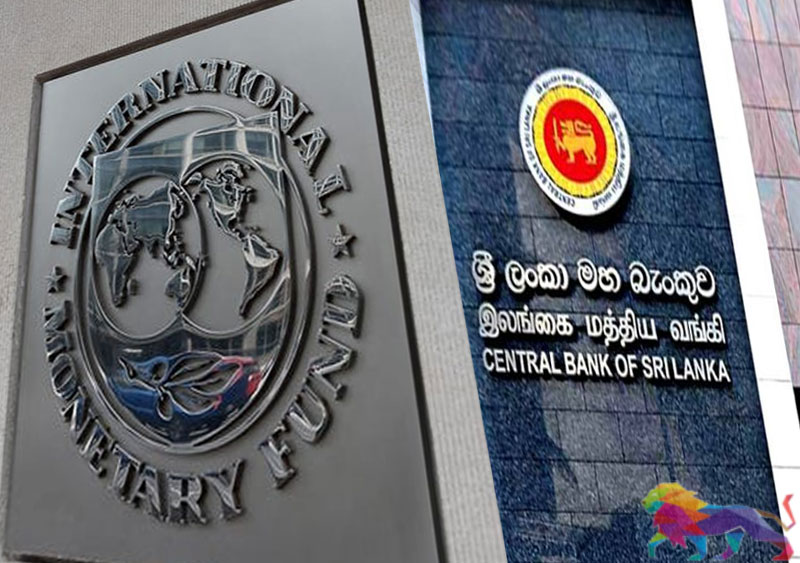
Both the International Monetary Fund (IMF) and the Central Bank of Sri Lanka (CBSL) yesterday (11) assured that despite the recent unrest, political instability, and resultant islandwide curfew, technical-level discussions on Sri Lanka’s debt restructuring would be carried out as usual.

Issuing a statement in response to media queries, the IMF yesterday (11) stated that despite the unrest that has been created in the country with the resignation of Prime Minister Mahinda Rajapaksa, the virtual mission which was to commence from 9 May until 23 May is to continue, so as to prepare for policy discussions that will take place under a new government.

“On our virtual mission during 9-23 May, discussions at the technical level have just started and will continue as planned, so as to be fully prepared for policy discussions once a new government has been formed.”

Meanwhile, CBSL Governor Dr. Nandalal Weerasinghe stated that since technical discussions are a standard process, they will be carried out as usual; however, policy implementations will require decisions to be made by state authorities.

“Active state institutions should be there to approve and implement fiscal policy decisions,” Weerasinghe said.

This statement was issued following local economists as well as Citigroup Global Markets expressing their concern over the repercussions that the country may face due to the declared state of emergency as a result of the political instability in the island.

The economists assumed that the negotiations with the IMF might be delayed, and thus entering into the IMF programme would take over six months. At the same time, on Tuesday (10), Bloomberg cited Citigroup as saying that the investment banking company foresees a possibility of delays in bailout talks.

The IMF statement further read that they are following the developments in Sri Lanka and “are concerned about rising social tensions and violence”.

However, the IMF said that they are to remain committed to assist the country in line with the IMF’s policies.

On Tuesday (10), speaking to The Morning Business, former Ceylon Chamber of Commerce Chairman Chandra Jayaratne expressed that the discussions with the IMF relating to debt sustainability could be carried out by relevant officials such as CBSL Governor Dr. Weerasinghe and Treasury Secretary Mahinda Siriwardena, without endorsement from Sri Lanka, as there is no official government in place after the resignation of the Prime Minister.

However, Jayaratne added that when it comes to presenting the plans for debt repayment in the future based on forecasts, the endorsement of the Government is required in implementing certain policies, such as reduction of expenditure, increase of government revenue, transfers for the poor to ease their suffering and other reforms.

Posted in Uncategorized

Ranil to be sworn in as PM on Friday

United National Party leader – Ranil Wickremesinghe is to be sworn in as the new Prime Minister on Friday (13), reports say.

It is said that he has agreed to temporarily hold the position on the invitation of the President.

Mr. Wickremesinghe and the President held a discussion earlier today (11) which lasted for nearly an hour.

It is said that another discussion is to be held tomorrow.

During today’s discussion, Mr. Wickremesinghe had requested the President not to obstruct the peaceful protest near the Presidential Secretariat and the President has agreed to this, sources say.

Meanwhile, speaking to the media, UNP Chairman Vajira Abeywardena has said that Ranil Wickremesinghe will be able secure the backing of the Parliament majority after being sworn in as the new Prime Minister.

Political sources say a host of MPs from the SLPP, SJB and from several other parties have already expressed their assent.

Why should the SJB appoint an outsider as PM?

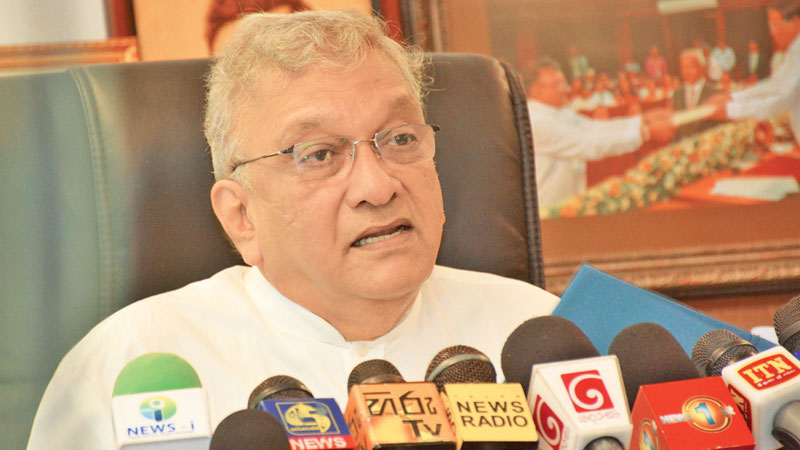
Parliamentarian Lakshman Kiriella says the Samagi Jana Balawegaya did not engage in any form of discussion pertaining to appointing former Speaker of House Karu Jayasuriya to the post of Prime Minister.

Speaking during a media briefing today, MP Kiriella said the SJB Parliamentary Group nor the Working Committee discussed such a matter.

He added they will not bring in an outsider to the post of Prime Minister claiming that the SJB worked towards forming a government.

Kiriella also stated that the former good governance government handed over an economically sound government to the currently administration.

MP Kiriella also stated that the notion that all 225 Members of Parliament should resign, is being shared by supporters of the Sri Lanka Podujana Peramuna, adding that the SJB has no such opposition.

He challenged such groups to hold an election in order to witness the people’s mandate.

Posted in Uncategorized

New prime minister and cabinet will be appointed this week – President

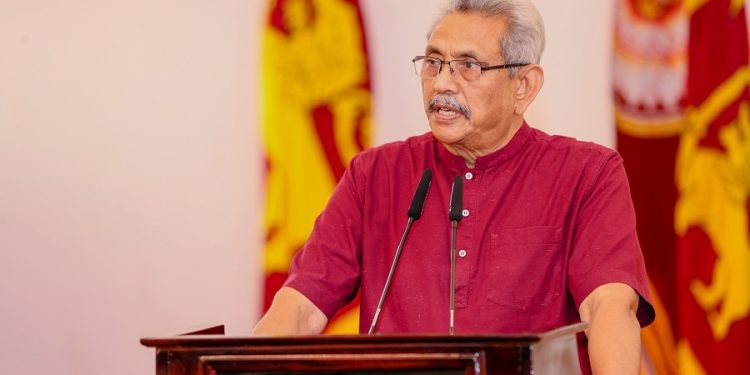
President Gotabaya Rajapaksa, condemning the initial actions that led to the unruly incidents on the 9th of May, says he has directed the Inspector-General of Police to conduct an impartial inquiry in this regard.

Delivering a special statement to the nation today (May 11), he said the armed forces and the police have been ordered to take stern legal action against people engaging in unruly behaviour.

President Rajapaksa noted that he would take steps to appoint a new Cabinet of Ministers and a Prime Minister this week, who can command a majority in the Parliament and earn the trust of the people.

He also expects to introduce constitutional amendments to strengthen the positive features of the 19th Amendment to the Constitution and provide more powers to the Parliament.

Read the President’s full statement below:

Most Venerable Maha Sangha,
Other Religious Dignitaries,
Mothers and Fathers,
Brothers and Sisters,
Beloved Children, Friends,

At present, our country is facing the worst crisis in its history. The economic crisis that preceded this event created social and political instability due to the difficulties faced by the people.

As a solution to these problems, a common proposal was put forward by various parties to form a new government with a majority of parties represented in the Parliament. In the past, I have had many discussions with leaders of various parties and groups in this regard. I too accepted that idea and took some difficult and tough decisions to set the platform for this solution.

When the last Cabinet was replaced, a new Cabinet was appointed consisting of young MPs where a large number of former Senior Ministers as well as Rajapaksas were not appointed. Also, the Prime Minister resigned and an agreement was reached to dissolve the entire Cabinet and make room for a new Prime Minister and Cabinet.

But on Monday morning, May 9, as you all know, a very unfortunate situation arose. Based on this incident, riots broke out all over the country in a very short period of time. Even before the curfew was imposed and the tri-forces were deployed, this process took place in an organized manner throughout the country. Within hours, about nine people, including a Member of Parliament, were brutally beaten to death. Approximately 300 were hospitalized. Also, a large number of houses were set on fire. Looting began all over the country.

I strongly condemn without prejudice the original incident which led to these events. The IGP has been instructed to initiate investigations into the incident.

However, the series of murders, assaults, intimidation and destruction of property that followed cannot be justified. From the moment this incident took place, I have been taking steps to control the situation in the country with the involvement of the Secretary of Defence, the Chiefs of the Armed Forces, the Inspector General of Police, the Chiefs of Intelligence and the Security Council.

At this juncture, the primary responsibility of the government is to ensure the safety of all citizens. Therefore, the three Armed Forces and the Police have been ordered to strictly enforce the law against the rioters. Steps will be taken to strictly enforce the law against all those who planned, supported and promoted this incident.

Therefore, I urge everyone to refrain from such acts of sabotage. I urge the responsible citizens of this country to look at the loss of life and property that has taken place so far and to condemn the groups that continue to spread hatred. While working to ensure the security of the country, I will work with all party leaders to bring about political stability in the country.

I am taking steps to form a new government to control the current situation, to prevent the country from falling into anarchy as well as to maintain the affairs of the government that have been halted. This week, I will appoint a Prime Minister who commands the majority in Parliament and can secure the confidence of the people and a Cabinet of Ministers.

Thereafter, I will take steps to amend the Constitution to re-enact the contents of the 19th Amendment to empower that Parliament.

The new Prime Minister of the new government will be given the opportunity to present a new programme and to take the country forward. There have also been calls from various factions for the abolition of the presidential system. After the new government stabilizes the country, the opportunity will be given to discuss with everyone and to work in this regard. I request the assistance in maintaining the state machinery uninterrupted to protect the lives of the people as well as their property and to provide the essentials to the people without allowing the country to collapse at this critical juncture.

Therefore, I urge all Sri Lankans to act with restraint and prudently at this juncture.

May the Noble Triple Gem bless you all.

Sri Lanka crisis: Ex-PM flees to naval base as arson attacks spread

Security forces are out in force across Sri Lanka with orders to shoot looters on sight amid continuing protests at the government’s handling of a devastating economic crisis.

Despite a nationwide curfew, there was a second night of arson attacks.

Shops near Colombo were torched, as well as a resort owned by former Prime Minister Mahinda Rajapaksa’s son.

The ex-PM is holed up in a naval base after resigning on Monday when fury erupted over fuel and food shortages.

At least nine people have been killed and about 200 injured in unrest since Monday.

It began when government supporters attacked protesters who are demanding that President Gotabaya Rajapaksa, the former PM’s younger brother, should leave office.

Opposition politicians have warned the violence could have been staged to give the army a pretext to take power. Rumours of a possible coup have been fuelled by the presence of large numbers of troops with armoured vehicles on the streets.

“When there is a dangerous situation in the country, powers are given to the military to deal with it,” Defence Secretary Kamal Gunaratne told a news conference.

“Don’t ever think that we are trying to capture power. The military has no such intentions.”

Sri Lanka had already seen weeks of protests over its dire financial situation, which has caused the Sri Lankan rupee to plunge, provoking severe shortages of basic items such as food, fuel and medical supplies.

The worst trouble overnight was in the north of the capital, Colombo, where rival groups set fire to shops in the town of Negombo.

On Monday night, mobs burned more than 50 houses belonging to politicians, while a controversial museum dedicated to the Rajapaksa family was also razed to the ground in their traditional heartland, Hambantota, in the country’s south.

Shops, businesses and offices are shut for a third day on Wednesday under a nationwide curfew in place until Thursday morning.

A meeting between Sri Lanka’s political party leaders has been moved online over security concerns.

The streets of the capital, Colombo, bear the evidence of this week’s rioting – a heavy police presence, troops on the streets, and overturned and burnt buses after Monday’s violence.

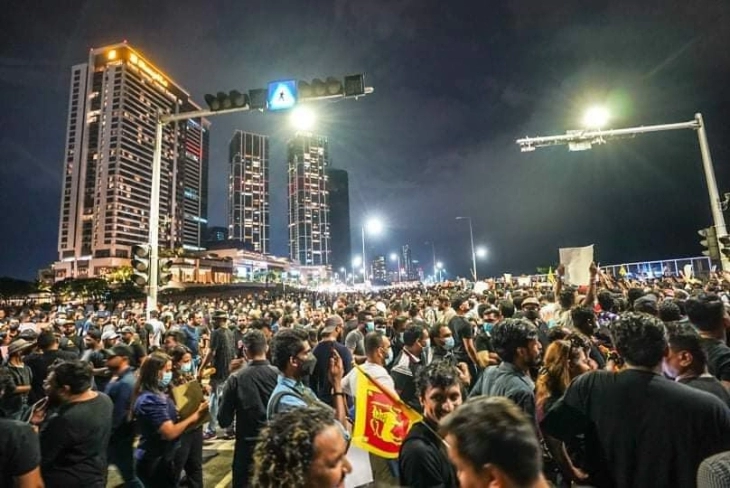
Nonetheless, protesters continue to gather despite the curfew at Galle Face Green, the main protest site in Colombo. They insist President Rajapaksa has grossly mismanaged the economy and must stand aside.

He is the last Rajapaksa family member in office and the resignation of his brother as prime minister did nothing to placate demonstrators or bring calm.

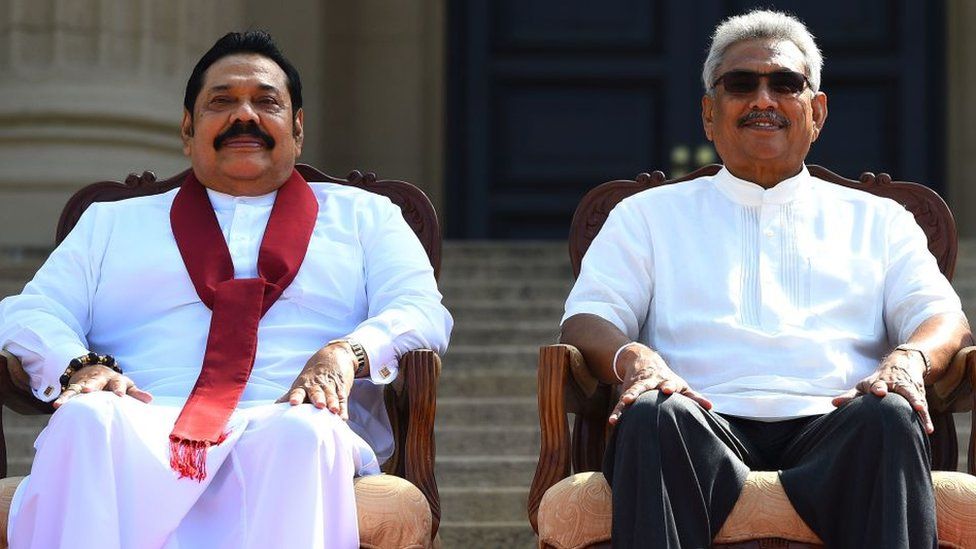
Sri Lanka’s new President Gotabaya Rajapaksa (R) and his Prime Minister brother Mahinda Rajapaksa, pose for a group photograph after the ministerial swearing-in ceremony in Colombo on November 22, 2019.

Protesters blame Gotabaya (right) and Mahinda Rajapaksa for the current crisis
President Rajapaska says he is holding talks with other political parties aimed at forming a unity government. But the main opposition says it will not be part of the interim administration unless the president stands down.

At present, there is no clarity on which political parties might come together to form such a government.

The political stalemate comes as Sri Lanka attempts to iron out a bailout package with the International Monetary Fund (IMF) – the island’s $81bn economy is near bankruptcy.

It has suspended its foreign debt payments, largely because it cannot service loans from China that paid for massive infrastructure projects.

While the pandemic hit the vital tourism sector and shrank Sri Lanka’s earnings and foreign exchange reserves, experts say problems have been exacerbated by populist tax cuts in 2019 and a disastrous ban on chemical fertilisers in 2021 that devastated crop yields.

Protesters gathered in front of Trincomalee Naval Base in the north-east after reports that Mahinda Rajapaksa had fled there with his family after escaping from his Colombo residence when it was besieged by crowds on Monday night.

The military confirmed on Wednesday that he was inside the base.

“We took Mahinda to the naval base for safety reasons,” the defence secretary said.

Earlier, there had been rumours that Mr Rajapaksa and others in the family had fled to India, which the Indian High Commission in Colombo denied.

Sri Lankans are still reeling from the violence that has erupted. Many politicians are sheltering in safe houses or avoiding appearing in public.

“It is not at all safe, particularly for politicians on the government side,” Nalaka Godahewa, until recently media minister, told the BBC. His house was among those torched.

Mahinda Rajapaksa, once celebrated by the majority Sinhalese as a war hero for defeating the Tamil Tiger rebels, has suddenly become a villain. Many blame his supporters for targeting anti-government protesters, which then set off a chain of violent events.

The Rajapaksas have always stood together, but this time, their differences are out in the open. The problem appears to have started after Gotabaya asked the family patriarch Mahinda to “take one for the team” and resign.

How the family, who have dominated Sri Lankan politics for years, overcome this crisis is now an open question.

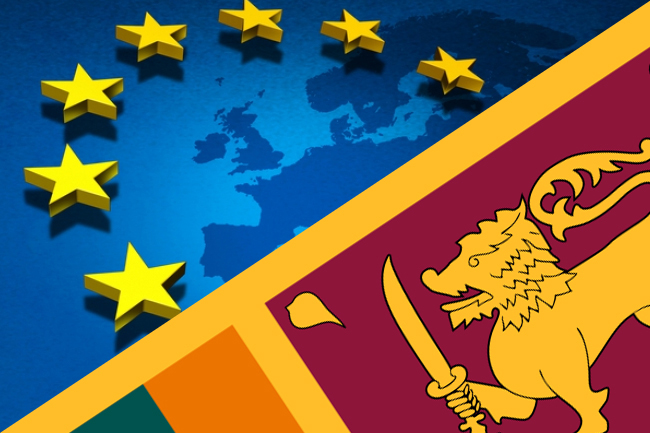
EU condemns ‘vicious’ attack on peaceful protestors

The European Union (EU) condemns the recent vicious attack against peaceful protestors in Colombo, which triggered further violence after a month of peaceful demonstrations had shown, despite some isolated incidents, that Sri Lankans are able to exercise peacefully their right to freedom of expression.

While claiming that the EU and its 27 Member States are monitoring closely developments in Sri Lanka, the EU stated that it deplores the loss of life, including of a Member of Parliament, and the high number of injured people.

“The EU calls on the authorities to initiate an investigation into the events and to hold accountable those instigating or perpetrating violence. The EU urges all parties to refrain from violence and to show restraint.”

“The EU recalls the importance to safeguard the democratic rights of all citizens, and to focus on solutions that will address the significant challenges currently faced by the Sri Lankan’s.”

“Over the last few months the EU has provided humanitarian assistance, including for handling the COVID crisis and the ensuing challenges, and is actively looking at ways to further mitigate the impact of the economic crisis on the most vulnerable people,” the statement added.