

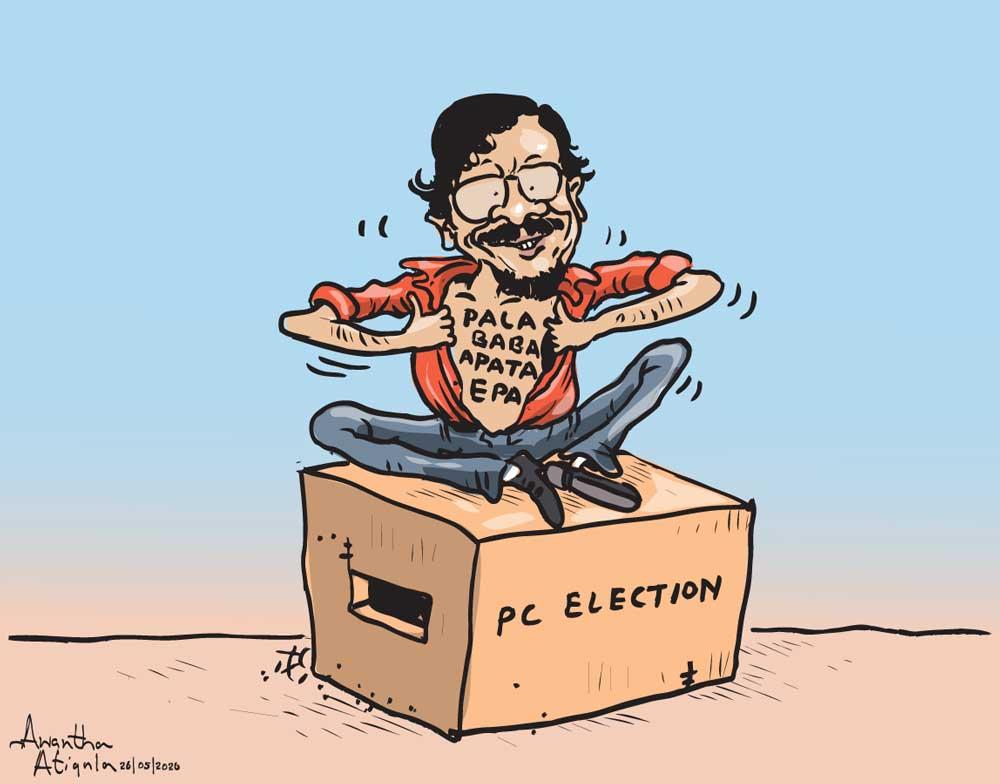
For nearly seven years, the Provincial Council system has existed in a political limbo. The councils remain dissolved, elections remain postponed, and yet the machinery continues to consume hundreds of billions of rupees annually. Last week’s remarks in Jaffna by the General Secretary of the Janatha Vimukthi Peramuna, stating that Provincial Council elections would not be held this year due to funds being redirected towards disaster relief, once again exposed the uncertainty and confusion surrounding the future of the Provincial Council system.
What makes the statement more troubling is not merely the postponement itself, but the casualness with which elections are discussed in this country. Timely elections are not optional in a democracy. To delay Provincial Council elections for more than a decade is a democratic failure. The last Provincial Council election was held in 2014. An entire generation of young voters has now reached adulthood without ever casting a ballot for a Provincial Council representative.
Yet, while elections must be held, the country must also confront an uncomfortable truth. We can no longer continue avoiding the larger debate about whether the Provincial Council system, in its current form, has actually served the purpose it was created for.
The Provincial Council system was born out of the Indo-Lanka Accord of 1987 and entrenched through the 13th Amendment to the Constitution. It was presented as the answer to ethnic tensions and as a mechanism to devolve power away from Colombo. Nearly four decades later, the results continue to remain questionable.
The central promise of devolution was that minority communities, particularly in the North and East, would gain meaningful control over local governance. That promise was never truly fulfilled. Successive Governments refused to fully devolve land and police powers. The Concurrent List became a convenient mechanism for the Centre to override provincial authority whenever it wished. Even those who once defended the system now admit that the Provincial Councils never evolved into genuinely autonomous institutions.
The Northern Provincial Council itself became symbolic of this failure. The North waited until 2013 for its first election under the post-war framework, 26 years after the 13th Amendment was introduced. The council completed one term and then disappeared into the political void. Reconciliation did not deepen. Trust between communities did not significantly improve. Ethnic grievances did not disappear.
Meanwhile, in the rest of the country, Provincial Councils increasingly became viewed as another expensive political layer added onto an already bloated State structure. Before the system collapsed into dormancy, the country was maintaining hundreds of councillors, ministers, official vehicles, staff, offices, and privileges. Many functions duplicated work already performed by Parliamentarians, ministries, municipal councils, and Pradeshiya Sabhas.
And now, despite the absence of elected politicians, the Provincial Council structure itself continues to operate. Schools still function under provincial administrations. Provincial hospitals still require funding. Public servants still receive salaries. Roads still need maintenance. The annual cost of sustaining the provincial administrative apparatus now exceeds Rs. 500 billion.
This is where the public frustration becomes understandable. The country is essentially funding a Provincial Council system without Provincial Councils. Governors appointed by the President now exercise powers that should belong to elected representatives. What was designed as a democratic mechanism for decentralisation has slowly transformed into a centrally controlled administrative utility.
The Government therefore faces a historic responsibility. With its commanding parliamentary majority, it has the political space to finally decide whether Sri Lanka intends to revive this system properly or replace it altogether. Continuing indefinitely in the current state is neither democratic nor financially defensible.
If elections are to be held, they must be held soon, and with clarity regarding the electoral framework. The endless excuses about delimitation processes and legal deadlocks have long exhausted public patience. Democracy cannot remain suspended because politicians lack the will to resolve procedural disputes.
However, if the Government genuinely believes the Provincial Council system has failed, then it must present an alternative vision honestly and courageously. It cannot simply allow the system to decay while politically benefiting from the ambiguity.
There is growing merit in the argument that genuine decentralisation should occur at grassroots level rather than through expensive provincial political structures. Strengthening Municipal Councils, Urban Councils, and Pradeshiya Sabhas may ultimately provide more direct and practical governance to ordinary citizens. Local authorities deal with daily realities. Waste collection, rural roads, drainage, markets, public health, and community services directly affect people’s lives far more than provincial political theatre.
But any attempt to move beyond the 13th Amendment must be approached carefully and consensually. Minority communities cannot be asked to simply abandon existing constitutional safeguards without credible guarantees of equality, representation, and regional participation in governance.