Teachers-principals strike continues

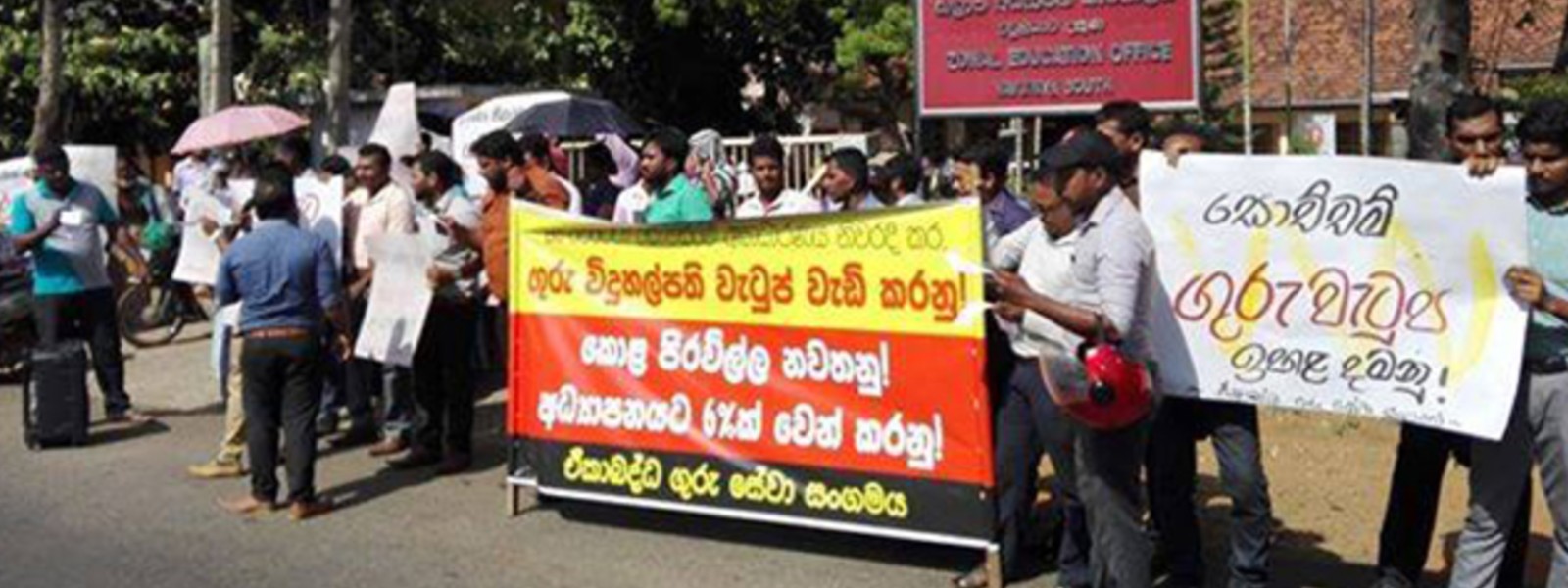
Stating that discussions with the respective authorities have failed to provide substantial solutions to their issues including the teacher-principal salary anomalies, trade unions have decided to continue their ongoing strike, The Sunday Morning learnt.

With teachers withdrawing from online teaching on 12 July, the strike enters its 21st day today (1). Since then, the education sector processes appear to be at a standstill, as schools remain closed for months due to the Covid-19 pandemic, and students, despite having only limited facilities to access online learning, and therefore being reliant on online education, being unable to study online, given the present crisis.

Speaking with The Sunday Morning, Ceylon Teachers’ Union (CTU) General Secretary Joseph Stalin said: “The discussions we had with the authorities proved futile, and on 27 July, the Prime Minister, along with the Cabinet of Ministers, decided that they would appoint a subcommittee to look into the issue in order to come up with lasting solutions. However, we are against it, as a subcommittee would only prolong the issue. The subcommittee too has failed to give us a substantial solution, and therefore, regardless of what happens, our struggle will continue.”

He further added: “The authorities have informed us that they would be coming up with a new cabinet paper tomorrow (2) in order to address the issues the teachers and principals are facing, but we are yet to receive a satisfactory answer in this regard.”

The trade unions demand a permanent solution to the perennial salary anomaly issue, along with the demand to withdraw the controversial Kotelawala National Defence University (KNDU) Bill. Moreover, the trade unions also demand that at least 6% of the gross domestic product (GDP) be allocated to education, amongst several other demands.

Several attempts made by The Sunday Morning to contact Education Minister Prof. G.L. Peiris and Education Ministry Secretary Prof. Kapila Perera for more insight in this regard, proved futile.

However, on 27 July, Cabinet Co-Spokesman Ramesh Pathirana noted that the Government does not have the financial stability to bring about immediate solutions to the matter, but that it would be considered in the next budget.

Meanwhile, a meeting to be held last week between President Gotabaya Rajapaksa and the teachers’ and principals’ trade unions has been rescheduled for this week

Posted in Uncategorized

US reiterates call for Sri Lanka to replace or amend PTA

The United States (US) has reiterated calls for Sri Lanka to replace or amend the Prevention of Terrorism Act (PTA).

The US Ambassador to Sri Lanka, Alaina B. Teplitz said that doing that sooner rather than later would be a real sign of genuine commitment to human rights values.

“Particularly since this Government has used the PTA to detain people and that some of those people, Hejaaz Hizbullah and Jazeem the poet, haven’t had a trial. They’ve been in detention for a long time. And Hejaaz Hizbullah is now an Amnesty prisoner of conscience. So that isn’t a credit really to the government’s statements about a commitment. We need to see that there’s actually some genuine follow-through,” Teplitz said during a media roundtable discussion held virtually.

Teplitz said the United States is ready to stand by and support the Government and do what they can to help it meet those commitments.

“I think other things that could be done that would build credibility would be, of course, ensuring independence of institutions like the Office of Missing Persons or of Reparations and ensuring that the leadership of those offices is constituted by people of integrity who are widely respected by all communities and who can ensure that those institutions fulfill their missions. Their work is still needed,” she added.

The Ambassador noted that the United States has long supported the human rights and political rights of all people in Sri Lanka, no matter what community they might come from or represent or what part of the island they might come from or represent.

She said the US supports a Sri Lanka that remains wholly democratic and is united and strong and sovereign.

The EPDP’s Sorna Accahs Precipitate A Suicide

A recent event shows how close to anarchy Jaffna is, fueled by rowdy militants claiming to have turned to the path of democracy. Details are sketchy because the Police in Jaffna want to keep a lid on things.

The matter in Jaffna’s Kannaapuram revolved around two dove rearing households about two weeks ago. What is known is that some doves from one household, said to be to, went and settled in the neighbour’s house.

The dispute was as to ownership and whether the doves went on their own or were stolen. It resulted in some six persons from one group going to the other, assaulting three persons there and running away. The problem was that the three people who were assaulted were close to the EPDP. One woman from the side that was assaulted, Lalitha, is the EPDP Women’s Wing Joint Secretary.

Persons from this household close to the EPDP and dominated by women, called their next-door boy, Puvanenthirarajh Suhanthan, born on 25 July 2001. They dissembled as if wanting to talk things over, saying he would be let off if he apologized. So says his father. When Suhanthan went there, he was tortured. Many women joined in beating him up badly and poured chilli-powder dissolved in water on his face. The attached video suggests that he was also shaved on his head.

The assault by women was so terrible that the men watching did not interfere.

As if sure of impunity, the women even proudly caught themselves on camera.

Those who are fans of Vikram, the famous he-man Tamil actor, would have heard of Sorna Accah, an illiterate political thug and murderess who manipulated elections. Jaffna surely now has its share of them as seen in the video. Since the incident, these women have been nicknamed Sorna Accahs by many members of the Jaffna public.

So sure of their safety, the assailant women even uploaded their films on social media. Sunhanthan was mentally devastated by this on his birthday. He committed suicide on 27 July just after his birthday.

As with all deaths, Suhanthan was tested for COVID-19. Sadly he was found to have COVID-19. Suspecting the EPDP hand in this diagnosis, the body was sent to Jaffna Hospital where the first diagnosis was confirmed. Suhanthan was promptly cremated!

This cremation alone upset many of his friends lamenting their inability to give him a decent funeral, although no one was to blame. Many youths were angered as the police suppressed information by naming anyone who handled or passed around the videos as witnesses. Being a witness is a terrible inconvenience in our legal system where cases never finish, and witnesses need to hang around court wasting many days. So even reporters refuse to share the many copies of the different videos they have of this pernicious assault by women. As such the circulation of the videos has been suppressed, preventing the full identification from the public of those persons seen in the video.

Under pressure from young friends who knew Suhanthan, six women including Lalitha and one man from some videos were arrested but were soon released. Questioned, the police cited fear of COVID from those arrested. Few seem to understand the reasoning by the police and note the connection of those arrested to EPDP big-wigs. One well-informed reporter said that Minister Douglas Devananda’s hand has not been seen yet, but that does not mean that he is not working behind the scenes.

The courts have now been approached and an inquiry will occur on 2 Aug. 2021.

Source:https://www.colombotelegraph.com/index.php/the-epdps-sorna-accahs-precipitate-a-suicide/ Watch the video clip. Real Sorna Akkas in action.

Interprovincial public transport services to resume from tomorrow

Interprovincial bus and train services will resume from tomorrow (August 01) in compliance with health guidelines, says State Minister for Transport Dilum Amunugama.

However, the public transport services will be up and running only in the morning and evening, the state minister noted.

“We decided not to operate public transport services in the middle of the day as the health authorities have warned that there is still a very serious pandemic situation.”

Speaking further in this regard, he stated that buses and trains are resuming operations to provide services to the public servants who are called back to work from Monday (August 02).

On Friday (July 30), the government announced that all state sector employees will be re-called to duty as per usual from the next month in order to restore normalcy in the public service.

The Sri Lanka Transport Board (SLTB) has been instructed to carry passengers only up to the seating capacity, the state minister said, stressing that they were further directed to adhere to health guidelines.

Private passenger transport buses will also be allowed to function from tomorrow, he added.

Posted in Uncategorized

Blueprint for making Indo-Lankan relations “special” By P.K.Balachandran

The Sri Lankan High Commissioner-designate to India, Milinda Moragoda, has submitted to President Gotabaya Rajapaksa, a detailed blueprint for making Sri Lanka-India relations a “special” one marked by “inter-dependence, mutual respect and affection.”

The document, entitled “Integrated Country Strategy for Sri Lanka Diplomatic Missions in India” covers the entire gamut of bilateral relations, and aims at addressing the “trust deficit” that has marked Sri Lanka-India relations. The idea is to transform the relationship from a narrow “transactional” one to one which will be broad-based and long lasting.

The document suggests adoption of multifarious bilateral interactions ranging from the top-most political level to the grass-roots people to-people level.

Worked out by a broad-based team led by Niluka Kadurugamuwa, the Deputy High Commissioner of India in New Delhi, under the guidance of High Commissioner-designate Milinda Moragoda, the proposals are founded on the belief that India-Lanka relations rest on a sound foundation based on Buddhism “India’s most precious gift to Sri Lanka.”

Buddhism was brought to Sri Lanka by the son and daughter of the Buddhist King Dharmashoka. “Against this backdrop, any setbacks to our relationship, however intractable they may appear to be at any given point of time, can only be temporary,” Moragoda says in his covering letter to the President.

The need for a fresh look at the relationship arose from the fact that despite the existence of a lot of good in it, it has increasingly become transactional “as a consequence of the changes in the geo-political equilibrium in the region, that has resulted in a growing trust deficit.”

However, the documents says that the transactional relationship “could be channeled towards building confidence and utilized to a means to bridge the trust deficit.”

The document stresses the importance of high level political visits –visits by the Head of State/Head of Government from either side, each year. There should be frequent visits by the Foreign Ministers. Line ministers should also make visits. These interactions could be virtual. There should be coordination with India in multilateral forums to strengthen bilateral ties. The India-Lanka Parliamentary Friendship Group should be re-activated with visits organized.

Sri Lanka should not only interact with the Central government in New Delhi but also with State governments some of which are particularly important for Sri Lanka, such as Tamil Nadu, Odisha, and West Bengal. The proposed opening of a Consul General’s office in Kolkata is welcomed. Sri Lankan Provincial Councils and local bodies members should be encouraged to interact with their equivalents in India under the relevant protocols. Chief Ministers of Indian States should be invited to visit Sri Lanka to promote economic and other ties. Sri Lanka could also explore appointing competent Honorary Consuls in key States for making local contacts.

For the implementation of policies and also for the generation of new ideas, the Indo-Sri Lanka Joint Commission and other Joint Committees should meet regularly. The Indo-Sri Lanka Foundation and the Kalinga Foundation could help generate new ideas.

Investments

To attract Indian investment to Sri Lanka, the High Commissioner designate has envisaged an Inter-Agency Committee on Trade, Investment and Tourism. Representatives of the Export Development Board, Board of Investment, Sri Lanka Tourism, Sri Lanka Tea Board and Sri Lanka Airlines will be participants in the committee. The BOI has set out targets for an Indian investment of US$ 300 million in 2021 and the Lankan Mission in India has set a goal of US$ 256 million. Indian investments could be in auto parts, electric and electronic goods, the hospitality industry, IT services, infrastructure, manufacturing, pharmaceutical, textiles and renewable energy. The documents has urged follow-up action in existing projects such as the West Container Terminal in Colombo Port, the Trincomalee Oil Tank Farm and projects in the power sector.

The Lankan missions in India should draw up a list of high net-worth investors, hold meetings with them and organize seminars and field trips to Sri Lanka. Sri Lanka’s access to Indian markets is hampered by protectionism and also challenging and changing regulatory mechanisms. And on its part Sri Lanka should improve its export basket whose content is now limited. However, the ED has set an export target of US$ 621.9 million for 2021 and the Lankan missions in India have proposed a figure of US$ 674.17 million for 2022.

The products Sri Lanka could sell in India are: pepper, cloves, cinnamon, nutmeg , vegan and vegetarian food, processed meat and fish, confectionary and beverages, paper desiccated coconut and related products, tiles and kitchenware, electrical conductors, switch boards and panels, various kinds of tea, men’s trousers, shirt and skirts.

Sri Lanka should take the initiative in getting help from India in the field of technology innovation, capacity building and product development to expand the export market. Indian technical help could be sought for the automation of the gem and jewelry industry, and the pharmaceutical industry.

Sri Lankan trade associations and trade associations should participate in trade fairs in India. The missions should help organize B to B meetings and seminars. Lankan missions should interact with Indian governments to secure easier access to Lankan products. Indian businessmen should be invited to visit Si Lanka to interact with their Lankan counterparts.

Tourism and Connectivity

There is immense potential in the Indian tourism sector. The Lankan Tourism Board has set a target of 63, 733 Indian arrivals in 2021 and 169, 955 in 2022. The areas which show potential for travel expansion are: MICE, weddings, film shooting, and the Ramayana Trail, Murugan and Siva Sakthi Trails. Sri Lanka needs to be present in tourism fairs in India. Fully vaccinated Indian tourists should be encouraged to visit Sri Lanka.

Since it is People-to-People contacts which will be the bedrock of a bilateral relationship, connectivity must be improved ,the document says, and suggests resumption or establishment of passenger ferry services beween Thalaimannar and Rameswaram, Colombo and Tuticorin, an Kankesanthurai and Karaikal. The document also propagates the facilitation of grid connectivity between the two countries for Sri Lanka to get power from India in times of drought and for Sri Lanka to sell power to India in case it has a surplus.

Defense Cooperation

In the field of defense cooperation, the document points out that Sri Lanka has not used the Indian Special Line of Credit of US$ 50 million for countering terrorism. Ways of using it should be explored, especially since more Lines of Credit in the defense sector are in the pipeline. The document points out the importance of having “political level strategic cooperation in the field of defense and security.” It can build on the model of the war-time Indo-Lankan Troika which was very useful.

Mechanisms for political level strategic cooperation existing in India and other countries should be studied. This would be apart from organizing regular high level visits of defense personnel and exchange of visits. There should be Sri Lankan high level defense personnel visits to India at least once a year. There should be India-Lanka and multilateral military exercises every year. There should be facilities in Sri Lanka for training Indian military personnel. There should be closer and regular interaction between the police forces of the two countries with places in Indian paramilitary and police institutions for Sri Lankan personnel. The office of the Defense Advisor in the Sri Lanka High Commission ought to be strengthened.

Fishing Issue

On the contentious issue of Indians fishing in the Palk Strait, the document says that the Sri Lankan missions in New Delhi and Chennai should interact with officials of the Central and State governments and also fishermen’s associations in Tamil Nadu to highlight the issue of IUU especially bottom trawling by Indian fishermen.

However, the document advocates a “humane approach” to the “genuine problems faced by fishermen on both sides of the maritime boundary.” The Sri Lankan government, it said, is working out a proposal on this issue.

Detailing the other areas of cooperation the document calls for joint research in fisheries and marine resources. It also talks of cooperation to set up a mechanism for disaster management

Lankan Refugees in India

The document makes suggestions for the resolution of the problem of Sri Lankan displaced persons in India. Its resolution will keep vested interests and fringe elements from exploiting the community’s plight for their narrow political ends. The Sri Lankan government should announce a comprehensive package which may include customs duty waivers, settling-in expenses, housing, and economic rehabilitation. The documents seeks the involvement of the UNHCR and also the political leadership of Tamil Nadu where the refugees live.

Culture and Education

India and Sri Lanka share a common cultural, linguistic, intellectual and religious legacy going back centuries into history. There has been a cultural cooperation agreement since 1977, but a lot more can be done. Sri Lanka should emulate the Indian Cultural Center in Colombo and spread Sri Lankan culture, dance, music and art in India by setting up a Sri Lankan Cultural Center and also participating in cultural events in India to showcase Lankan culture.

Buddhism has been a lynchpin of the age-old relations between Sri Lanka and India. While the mission in India is in touch with the Mahabodhi Society, it has to expand to other parts of India where there are Buddhist communities, the document said. Facilities should be provided for Indian scholars to study Buddhism in Sri Lanka and Sri Lankans should be able to study Pali and Buddhism in India. Sri Lanka should be able to provide Ordination for Indian Buddhist monks and allocate places for them in its Pirivenas. The government of India has already set apart US$ 15 million for the promotion of Buddhist links between India and Sri Lanka.

Religious Trails

With the help of Ambassador Dr.V.K.Valsan, the document has identified areas of cooperation in the field of Hinduism. The promotion of the Ramayana Trail, the Murugan Trail and the Siva Sakthi Trail will increase religious tourism between the Hindus of Sri Lanka and India. e The Hindu epic Ramayana intimately links the two countries. Cooperation between Sri Lanka and India in this area already exists as Sri Lanka has sent a sacred stone from the Sita temple here to the Ram Mandir in Ayodhya.

The document further urges the government to provide opportunities for Indian Hindu religious leaders and scholars to interact with their counterparts in Sri Lanka and to enable Sri Lankan diplomatic missions to actively participate in major Hindu religious ceremonies. The Lankan government should also facilitate Catholic devotees and scholars to visit the Velankanni church in Tamil Nadu which is very popular among both Tamil and Sinhalese Catholics.

Opinion Makers

The document urges the Lankan missions in India to be in touch with Indian journalists, foreign journalists based in India, intellectuals, opinion makers, film makers, archeologists, artistes, and think tanks to enhance Sri Lanka’s profile and also have positive stories presented in the Indian media. The South Asian University in New Delhi should be helped to become a center of excellence.

Tours of Sri Lanka should be organized for opinion makers to enable them to understand the realities in Sri Lanka and interact with their counterparts in the island. Heads of Lankan missions in India should give six interviews per year to the Indian print and electronic media and also be active on social media to clarify matters about Sri Lanka and promote the country.

The Lankan government and the missions in India should draw up plans to celebrate the centenary of Rabindranath Tagore’s visit to Sri Lanka in 2022 and the 75 th. Anniversary of the establishment of diplomatic relations between Sri Lanka and India in 2023.

Posted in Uncategorized

Inter-provincial travel ban to be lifted

The inter-province travel ban is to be lifted on Monday, Government sources said. Sources told Daily Mirror the matter had been discussed during a meeting chaired by President Gotabaya Rajapaksa yesterday.

Accordingly, sources said the interprovince travel ban is expected to be lifted from Monday and a formal announcement will be made today or tomorrow.

However, access will remain restricted to areas placed under isolation.

The Director General of Health is expected to issue amended guidelines lifting the inter-province travel ban.

Public transport services between the provinces will also resume from next week.

The government had already announced that the work from home option has been cancelled for public servants from Monday. All public servants have been instructed to return to work from Monday, 2nd August. They have been instructed to return to work by following the health guidelines. Secretary to the President P.B. Jayasundera informed the Secretary of Public Services, Provincial Councils and Local Government J.J. Ratnasiri to take measures in this regard.

A travel ban enforced around the island was lifted earlier this month while the inter-province travel ban remained.

India consistently called upon Sri Lanka to protect interests of Tamils: Indian Govt

India on Thursday said it has consistently called upon Sri Lanka to fulfill its commitments to protect the interests of the Tamil community and supported efforts to preserve the island nation’s character as a multi-ethnic and multi-religious society, PTI news agency reported.

It is understood that some Tamil political parties based in Sri Lanka have sought an international probe into allegations of human rights abuses during the country’s civil war, Minister of State for External Affairs V Muraleedharan said in a written reply to a question in the Rajya Sabha.

He said India had urged the government of Sri Lanka to carry forward the process of reconciliation and address the aspirations of the Tamil community.

“India has always supported efforts to preserve Sri Lanka’s character as a multi-ethnic, multi-lingual and multi-religious society in which all citizens, including the Sri Lankan Tamil community, can live in equality, safety and harmony,” the minister said.

He was replying to a number of questions, including on human rights abuses during the civil war in Sri Lanka.

“The government of India has consistently called upon Sri Lanka, during bilateral discussions at all levels, to fulfil its commitments on addressing the issues related to protecting the interests of Tamils in Sri Lanka,” Muraleedharan said.

The Tamil community in the island nation has been demanding the implementation of the 13th amendment to the Constitution that provides for devolution of power to it. The 13th amendment was brought in after the Indo-Sri Lankan agreement of 1987.

At the 46th Session of the UN Human Rights Council (UNHRC), India stressed on its abiding commitment to the aspirations of the Tamils of Sri Lanka for equality, justice, peace and dignity, Muraleedharan said.

He said it was reiterated that respecting the rights of the Tamil community, including through meaningful devolution, would contribute to the unity and integrity of Sri Lanka.

The minister did not give a direct reply to a question on whether India will initiate measures for an international probe as there is no scope for the domestic process to fix accountability against human rights abuses in that country.

Muraleedharan said India believes that delivering on the legitimate aspirations of the Tamil community is in the best interests of Sri Lanka.

“In addition, India also urged the government of Sri Lanka to carry forward the process of reconciliation, address the aspirations of the Tamil community and continue to engage constructively with the international community to ensure that the fundamental freedoms and human rights of all its citizens are fully protected,” he said.

Posted in Uncategorized

CBSL prints record Rs 213.48 in a single day

The central bank has printed 213.48 billion rupees on Tuesday, central bank data show, the highest amount to be printed by the country so far this year.

The money had been printed a day after Sri Lanka settled a USD 1 billion bond payment.

But Ajith Nivard Cabraal, the state minister of Money & Capital Market and State Enterprise Reforms, had told the AlJazeera news outlet that the country’s economy is stable.

“Our rupee has been stable for the past three months, our interest rates have been the same for the past three months,” he said adding that the turnover at the stock exchange is also increasing almost daily.

“What more do you need to have as indicators of economic stability?” he queried.

Sri Lanka fails to sell 31-pct of Treasury bond auction, tap offer

Sri Lanka has failed to sell 31 percent of a bond 120 billion rupees Treasury bond auction, and a tap issue has been opened for part of the balance, data from the state debt office showed.

30 billion rupees of 01 December 2024 bonds were sold at 6.87 percent after calling bids for 30 billion.

21.23 billion rupees of 01 February 2026 bonds were sold at 7.47 percent, after calling bids for 35 billion.

11.4 billion rupees of 01 May 2028 bonds were sold at 8.17 percent after calling bids for 35 billion.

20 billion rupees of 15 March 2031 bonds were sold at 8.86 percent, after calling bids for 20 billion

The debt office said bonds would be available on tap till 1600hour on July 30, for 2024 and 2021 maturities at the weighted average yields, up to 20-pct of the offered amount.

Sri Lanka has estimated maturing bonds and coupons in excess of 150 billion on August 01.

Sri Lanka has printed large volumes of money over the past year inflating the monetary base and losing forex reserves as the newly minted money generate import or the Treasury use them to repay foreign debt.

To the extent that the Treasury is able to roll over paper and sell to real buyers instead of inflating reserve money, foreign reserves would be ‘saved’ by crowding out domestic credit.

China’s loan books carry crucial lessons Sri Lanka By Jeevan Kelum

In our last column published on 24 June titled “Are Sri Lankan banks failing the production economy?”, we wrote about how Sri Lanka’s banks have been failing the production economy due to their risk aversion and lack of lending towards productive sectors of the economy.

To briefly recap, we argued that the banking system plays a significant role in bridging gaps in financial resources and allocating resources in an economy. Lending plays an important role in balancing the structure of the economy and providing credit for capital formation in strategic economic sectors for sustainable and inclusive growth.

This week, we offer the contrasting example of China – an Asian economy which started out as one of the poorest in the world but has since grown to become the largest economy in the world in purchasing power parity terms, lifting 850 million people out of extreme poverty in the process.

Post-Covid stimulus

This analysis looks at data from six of China’s biggest banks which account for over 50% of the sector’s market capitalisation. The banks include Agricultural Bank of China, Bank of China, China Construction Bank Corporation, China Merchants Bank, Industrial and Commercial Bank of China, and Ping An Insurance.

Figure 1 depicts the total volume of loans and advances and their spread between personal and corporate. In 2020, the total stock of personal loans was $ 4.4 trillion, while the total stock of corporate loans was $ 5.7 trillion. This means that 44% of total loans and advances were for personal loans and the remaining 56% was corporate lending.

It is clear from the data that both corporate and personal lending have been increasing since 2017. However, corporate lending in particular has grown by 13% in 2020, perhaps as a response to the Covid-19 outbreak. As mainstream economic theory argues that such lending can be inflationary, it is important to understand how (if at all) this liquidity is being used to support production.

Personal loans and advances

Figures 2 and 3 depict the sector-wise composition of personal and corporate loans in 2020.

In the last four years, residential mortgages have comprised around 74% of the total loan stock. This is parallel to the 11% of corporate loans given to real estate, and 37% of corporate loans given to infrastructural sectors such as “Water, environment, and public utility management”, “Production and supply of electric power, heat, gas, and water, “ and “Transportation, storage, and postal services”. These trends reflect China’s rapid urbanisation and an over 90% home ownership rate which is higher than most advanced economies in the west. This synergy between personal and corporate lending has helped spur the development of the housing industry.

When compared to Sri Lanka, it is noteworthy that loans and advances for personal consumption (including credit card loans) account for 21% of total personal loans and less than 10% of the combined loan book of the six Chinese banks. When considering the loan books of the top eight banks of Sri Lanka, loans for personal consumption account for 25%. This indicates that a significant portion of Sri Lanka’s credit has been directed to consumption (most likely on imports), instead of growth enhancing capital formation.

Facilitating consumption while neglecting production can push a country like Sri Lanka further towards imports dependency, placing pressure on the exchange rate, and therefore the inflation rate too. Sri Lanka is dealing with the legacy and consequences of such policies today.

Corporate loans and advances

Five main sectors account for about 75% of corporate loans and advances in the six Chinese banks under study. These sectors are “Transportation, storage, and postal services”, “Manufacturing”, “Leasing and commercial services”, “Real estate”, and “Production and supply of electric power, heat, gas, and water”. China’s developmental goals of maintaining the production base and strengthening supportive and connective infrastructure are clearly reflected in this spread.

The vast amount of credit provided to infrastructure, combined with China’s low external debt and well developed infrastructure, indicates that the country has been largely self-reliant in terms of financing infrastructure. By contrast, Sri Lanka’s infrastructure development has historically been dependent on financing from foreign multilateral agencies like the World Bank and Asia Development Bank, or bilateral partners like Japan and China. Local private commercial banks’ lending for transport and energy infrastructure is virtually negligible compared to China. Meanwhile, Sri Lanka’s external debt to gross national income (GNI) is 69% compared to China’s 15%.

Long-term lending, long-sighted development

A stand-out feature of the loan books of Chinese banks is the relatively long maturity periods of the majority of loans and advances. Figure 4 shows the maturity period of respective loan stocks as at the end of the year 2020 of six major financial institutions in China. About 50% of the Chinese corporate loans are due after five years, and another 22% due in the one-to-five-year period. In other words, about 70% of loans and advances granted by Chinese banks are medium to long term. Businesses in China therefore enjoy patient financial support to expand the production and sustain growth.

By comparison, most loans and advances by Sri Lankan banks are concentrated in the five-year category. This tends to drive Sri Lankan businesses towards the pursuit of short-term profits, which in turn contributes to macroeconomic instability and poor economic planning. Short-term lending is fundamentally incompatible with policy goals of developing infrastructure and technology – both of which require patient, long-term financial support.

Running with a balance sheet mismatch

When banks start to fund long-term projects and offer grace periods and extended credit terms, a balance sheet mismatch is one of the major concerns of many treasury managers (Figure 5). Depending on the economic condition in the country, many risk-averse bankers resort to minimise this risk by encouraging short-term trade-oriented investments. However, bankers have a fiduciary duty to secure the depositor’s money and pay the return. So, how do China’s banks manage this mismatch while contributing to growth?

In total, we can see a significant net liability position in the on-demand category, and after the three-month category, it turns to a net asset position. Theoretically, these banks have funded long-term projects using short-term financing and therefore have critical liquidity risks. However, these banks manage their liquidity and continue to maintain loan books to fund strategic sectors. A comprehensive study on this area will help Sri Lankan banks learn strategies and best practices for risk mitigation and liquidity management.

Maintaining policy consistency

China’s domestic credit to the private sector by banks (Figure 6) has been increasing rapidly over the years and crossed 180% of gross domestic product (GDP) by 2020. By contrast, Sri Lanka’s risk-averse banking sector has a much lower leverage, with bank credit to the private sector amounting to about 50%.

One of the main contributors to the success of the Chinese economy, and the high volume of credit to the private sector, is policy consistency. Since 1978, China’s policy rates have been maintained in single-digit figures except on a few occasions (Figure 7). As the regulatory body of the banking system and the facilitator of economic development, People’s Bank of China (central bank of China) maintains low policy interest rates to reduce the cost of financing corporations and to direct resources to strategic sectors. Post-2000, the country’s exponential economic growth has been fuelled by low interest rates. The policy rate was reduced even after the Covid-19 outbreak, with an intention of heating up the economy. Strong economic policy consistency led by political stability in the country is the key to push the economy where it is now today.

Conclusion

Over the past decades, Sri Lanka’s policymakers have lacked a strategic plan to shift the economy from a services and consumption base to a manufacturing and production base. The few Asian countries that managed this transition did so through bold policy moves, including harnessing the banking system to re-engineer the structure of the economy. Countries like China, Singapore, South Korea, and to an extent even Bangladesh, have done what Sri Lanka has failed to do, thereby ensuring social stability and a higher standard of living for their people.
Sri Lankan policymakers and bureaucrats have to take a holistic approach to align all elements of the economy towards well-defined national economic objectives. When the Central Bank reduces the policy rates to increase liquidity, with the objective increasing investment and production, measures such as targeted lending must be put in place to ensure that commercial banks pump this liquidity towards strategic sectors.
Moreover, it is important that such policies are consistent and maintained for a period of time sufficient to allow investments to mature and generate profits.

(The writer holds a BSc. in Accountancy (Sp), FCA, ACMA, and MBA-PIM (SJP) and is Vice President (Finance, Research, and Strategic Development) at Econsult Asia, which is an economic research and management consultancy firm with an alternative development outlook)