Sri Lanka in February: A month of forgettable performance by Col R Hariharan

Sri Lanka is worried about the new draft resolution put forward by the Core Group led by UK, which would be voted on March 22.

Overview

If the happenings during the month in Sri Lanka are any indication, the government of President Gotabaya Rajapaksa, voted to power by 6.9 million Sinhalas to restore Sinhala pride and Buddha Sasana as he claims, did not cover itself with glory. This was evident in the government conduct on three issues which peaked during the month – troubled ethnic relations, the handling of the United Nations Human Rights Council (UNHRC) meeting on Sri Lanka’s human rights accountability, and challenges of governance. Perhaps, the bonhomie showed by visiting Pakistan Prime Minister Imran Khan, despite accusations of Islamophobia voiced by Muslim minority, was the only moment of cheer for the government.

Significance of P2P march

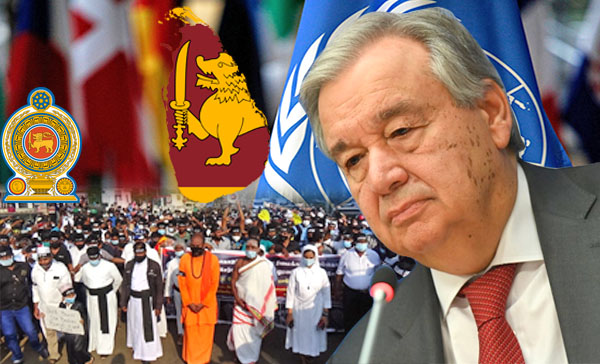
Perhaps for the first time since the 70s, Tamils of all hues – Jaffna and Easterners, Muslims and Tamils of Indian origin (Up country Tamils) – came together, across political affiliations, to march peacefully for five days to voice their demands. They covered a distance of 750 km from the eastern town of Pottuvil to Polikandy in Jaffna in the North, to draw attention to demands, ignored by successive governments, as well as concerns on current issues.

The march held from February 3 to 9, now embedded in Tamil lore as P2P, did not draw much attention in mainstream media, though Tamil media estimated the participation of a thousand people. Apparently, it was timed to draw international attention on the eve of the UNHRC meeting slated to discuss Sri Lanka’s human rights accountability issue. The proceedings of the UNHRC session, so far, indicates they had achieved their aim.

The P2P march is a watershed moment for a number of reasons. For the first time, besides Tamils from north and east, plantation Tamils and Muslims had joined hands to project their demands peacefully. It was led by civil society organisations, with Tamil and Muslim political parties taking a back seat.

Slogans raised at the march voiced, much more than longstanding demands of Tamils of North and East, like forcibly disappeared, vacation of land under occupation of security forces and release of LTTE suspects still in custody without due legal process. They also protested against denial of burial rites to Muslim victims of Covid pandemic, continued recourse to Prevention of Terrorism Act (PTA), denial of minimum wage of Rs 1000 per day to plantation Tamils and aberrations of Sinhala majoritarian rule against minorities. This would indicate, the patience of minority population is wearing thin over the government’s continued indifference to their grievances. This increases the likelihood of minority politicians coming together for making common cause to build upon the Tamil idiom to further their political aspirations.

Two mainstream political parties the SJB (clone of its parent UNP) and the JVP – came out in support of the Tamil marchers. Prime Minister Mahinda Rajapaksa who is politically savvy, would remember that the P2P was reminiscent of the early 70s, when Tamils started projecting their demands for autonomy peacefully. It later snowballed into satyagraha movement under Dr SJV Chelvanayakam’s leadership and opened the gates for Tamil separatist struggle.

Wasted opportunity at UNHRC

The four-week long 48th session of the UNHRC conducted virtually, has so far gone according to script. HR Commissioner Michelle Bechelet’s report (analysed last month in Sri Lanka Security Trends) was taken up for discussion, with 40 countries presenting their views in the interactive dialogue that followed.

Foreign Minister Dinesh Gunawardane’s address was largely defensive, trying to counter Ms Bechelet’s report with recycled arguments, rather than breaking new ground to tone down the damage caused by the report. He said her report has “unjustifiably broadened its mandate and scope” to incorporate many issues of governance and matters that are essentially domestic, and dismissed the previous resolutions brought at the UNHRC as politically motivated. Few would be convinced by his argument that the former Sri Lanka government decision to co-sponsor UNHRC Resolution 30/1 resulted in compromising national security, which eventually led to the Easter attacks of 2019.

Representatives of the UK, Germany, Canada, Norway and the US shared the concerns raised by the OCHR and called upon Sri Lanka to share a time table for the implementation of the recommendations mentioned in the report.

India did not allow the recent hiccups in its relations with Sri Lanka to highlight the core aspects of Sri Lanka’s human rights issue. India’s Permanent Representative, Indra Mani Pandey, noted that India was an active participant in the discussions on the seven resolutions on the question of human rights in Sri Lanka since 2009 and Sri Lanka remained a close friend and immediate neighbour.

“We believe that respecting the rights of the Tamil community through meaningful devolution contributes directly to the unity and integrity of Sri Lanka.” Therefore, she added India advocated “delivering on the legitimate aspirations of the Tamil community is in the best interest of Sri Lanka.” India called upon Sri Lanka to take steps to address such aspirations through reconciliation and full implementation of the 13th Amendment to the Constitution.

Sri Lanka is worried about the new draft resolution put forward by the Core Group led by UK, which would be voted on March 22. Sri Lanka would consider certain comments and clauses of the draft resolution as provocative. For instance, it takes note of the passage and operationalisation of the 20th Amendment to the Constitution, counsels the government to respect local governance including holding of elections to provincial councils and ensure they are able to operate effectively, in accordance with the 13th Amendment.

It asks Sri Lanka to provide sufficient resources and technical means for effective functioning of the Office on Missing Persons and the Office for Reparations and stresses the importance of maintaining support to these institutions, “safeguarding their independent functioning.”

It expresses serious concern over emerging trends over the past year, which “represent clearly early warning signs of a deteriorating human rights situation in Sri Lanka, including the accelerating militarization of civilian functions, erosion of the independence of the judiciary and key institutions responsible for the promotion and protection of human rights, ongoing impunity and political obstruction of accountability for crimes and human rights violations in emblematic cases.”

Presumably, the draft resolution would be toned down in its final form; but the writing on the wall is clear – Sri Lanka cannot do business as usual, if it wants to maintain its win-win relations with its traditional Western allies. India in 2010 had provided valuable support to Sri Lanka in the UNHRC in shaping the final resolution. With China assuring Sri Lanka its support in international forums, how would India handle Sri Lanka’s request for help in the UNHRC, remains to be seen when the final resolution takes shape.

Future

Alan Keenan of the International Crisis Group summed up the situation in Sri Lanka in his paper, “The Rajapaksa family’s return to government has put an end to tentative efforts to address the legacy of civil war and brought in more centralised, militarised government, anchored in Sinhala majoritarianism. As Sri Lanka’s longstanding ethno-religious tensions continue to linger, the presence of hard-line Sinhala nationalists in power rules out any accommodation of Tamil political claims. Once-fringe ideas of militant Buddhist groups regarding violence and hate speech against Muslims are increasingly being adopted as government policy.”

The Rajapaksa government has so far shown neither the willingness, nor the ability, to tackle these issues dispassionately. The Rajapaksas weakest link is the ineptitude in handling foreign relations, which has caused maximum damage to the country. This was seen in all critical situations: continued insensitivity in handling India’s concerns, embarrassing the new US administration by undiplomatic comments, and clumsiness in handling Prime Minister Imran Khan’s visit to Colombo and the inability to strategize the approach to the UNHRC session. The after effects of this weakness is likely to impact the country in the coming months.

[Col R Hariharan, a retire MI specialist on South Asia and terrorism, served as the head of intelligence of the Indian Peace Keeping Force in Sri Lanka 1987-90. E-mail: colhar@gmail.com Website: https://col.hariharan.info]
Posted in Uncategorized

‘Collective decision will be taken over PC Election’

State Minister of Provincial Councils & Local Government Roshan Ranasinghe says a collective decision will be reached pertaining to the conduct of the Provincial Council Election.

Speaking to media in Kandy the State Minister said Provincial Councils exist at present without public representatives, adding that activities and productivity is minimal.

State Minister Ranasinghe added concerns will arise if officials engaging in management duties resort to fulfilling duties that a politician is expected to execute.

He therefore highlighted the importance of public representatives to Provincial Councils.

The State Minister charged that elections were delayed by the good governance government and vowed to ensure the conduct of elections as a government on the directives of the President and Prime Minister.

On a separate note State Minister Roshan Ranasinghe said the former government came into power labelling the then government as thieves, and charged the good governance government of causing the controversial Treasury bond transactions and other financial malpractices.

He also claimed that national security was compromised under the former government.

The State Minister said the economy that was at a 7.2% growth rate when being handed over by the Mahinda Rajapaksa led government, was handed back in 2019 having dropped to 2.7%.

He charged the good governance government of being one of the worst governments to date.

State Minister Ranasinghe also claimed the Leader of the Opposition should have inquired into public grievances during his term as a Minister adding that the public is fully aware of his pretences.

Catholics in Sri Lanka mark ‘Black Sunday’ as mark of protest

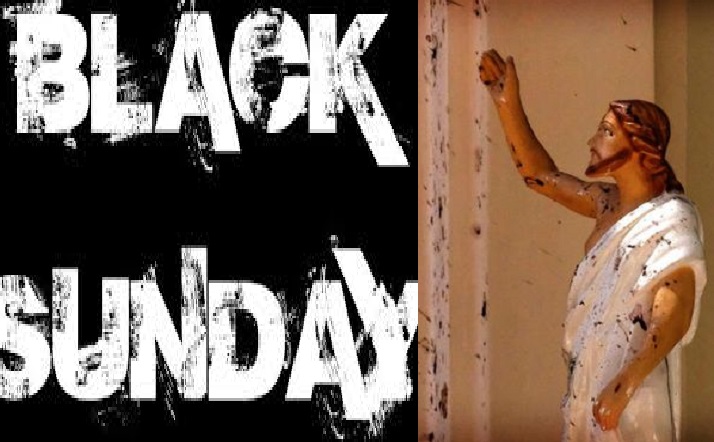
Catholics in Sri Lanka today marked ‘Black Sunday’ as a mark of protest over the failure to find those linked to the Easter Sunday attacks.

Worshippers wore black face masks when attending mass today while some were dressed in black.

Religious leaders from the Buddhist and Muslim faiths also supported the protest by attending some of the services.

Cardinal Malcolm Ranjith demanded that the Government find the main perpetrators of the deadly attacks.

“Our effort is to establish who was actually behind the attacks,” Cardinal Malcolm Ranjith said in a statement.

Ranjith told a press conference last week that he was unhappy with the lack of progress in the inquiry, and laid out an ultimatum.

“If the authorities fail to come up with answers as to who was behind the attacks by the second anniversary of the bombings, we will call for a nationwide black-flag campaign,” he said.

The campaign would involve Sri Lankans flying a black flag above their homes as a sign of protest, the cardinal added.

The US Justice Department in January charged three Sri Lankans with supporting terrorism for their alleged participation in the attacks, which were claimed by the Islamic State group.

All three are in custody in Sri Lanka but have not been charged locally. The Justice Department said it would support their prosecution in the country.

At least 45 foreigners, including five Americans, were among those killed.

SL Core Group at UNHRC: Amended Draft Resolution tomorrow

The United Nations (UN) Core Group of Countries on Sri Lanka will present the amended draft of the resolution on Sri Lanka to the UN Human Rights Council (UNHRC) tomorrow (8) for an informal dialogue, after which the draft will be studied before expressing objections, Foreign Secretary Prof. Jayanath Colombage said.

The Core Group comprises the UK, Canada, Germany, Montenegro, and North Macedonia.

He told The Sunday Morning that they have not yet been informed of the date the vote will be taken up.

“On 8 March, the Core Group will present its resolution once again for an informal dialogue. We think the vote will most probably be on 20 or 21 March. We are making preparations accordingly, and once this resolution is presented on 8 March to be read again, we will read it and express our objection,” he said.

When queried as to whether a consensual resolution could be reached based on the new draft, he said: “Though they earlier mentioned a consensual resolution, they have put some facts strongly to which we expressed our objection. We will be getting the new draft that has been prepared after we made our objections, only on 8 March. We will study it and most likely will not go for a consensual resolution because they won’t let go of the things that they are holding on to. We won’t accept what they are saying either.”

Commenting on the support of UNHRC Member States during a vote, the Foreign Secretary said that while Sri Lanka received support in connection with the speech of the UN High Commissioner for Human Rights, the vote, however, was different.

He said that powerful countries make threats and make voting members fear them, adding that they promise funds and loans in order to get them not to support Sri Lanka.

“They also assure that they won’t look into the human rights records of the voting countries. They make threats like that. Therefore, the UNHRC is completely a pro-western entity which was clearly evident during the first day, as 21 countries spoke in support of us but not a single western country was there. All 15 countries except for the Solomon Islands that spoke against us are western countries. The Solomon Islands is also an old colony of the US,” he claimed.

Meanwhile, highly placed sources claimed that Sri Lanka has decided to go for a vote despite a request made by the Core Group led by the UK for a last-minute consensual resolution.

They said the Government knows that Sri Lanka will be defeated, yet is still going for a vote.

“Sri Lanka has 10 votes in the Council, but it is likely to increase to 15 with the resolution of the Covid-19 burial issue. India, Japan, and Australia are likely to abstain from voting and around 29 countries are likely to vote in support of the resolution,” they further claimed.

The amended draft resolution that was made public by some media has inserted a new point between the second and third points to comment on the joint statement issued on 26 May 2009 by then President Mahinda Rajapaksa and UN Secretary General Ban Ki-moon to seek a political settlement and to bring about lasting peace and development in Sri Lanka.

Another amended point has highlighted the responsibility of states to comply with their relevant obligations to prosecute those responsible for gross violations of human rights law and serious violations of IHL.

The draft resolution has stressed the importance of a comprehensive accountability process for all violations and abuses of human rights committed in Sri Lanka by all parties, including those by the Liberation Tigers of Tamil Eelam (LTTE). The term “by all parties” has been added anew here.

Increased marginalisation of Tamil and Muslim minorities, restrictions on media freedom, and restrictions on the public memorialisation of victims of war, including the destruction of a memorial, have been added in the new draft as areas of serious concern.

Meanwhile, it has taken off “Government of Sri Lanka” from the line “the decision made by the Government of Sri Lanka to mandate cremations for all those deceased from Covid-19”.

It has requested Sri Lanka to review the Prevention of Terrorism Act (PTA) and to ensure that any legislation on combating terrorism complies fully with the State’s international human rights and humanitarian law obligations. The word “fully” has been added anew.

Posted in Uncategorized

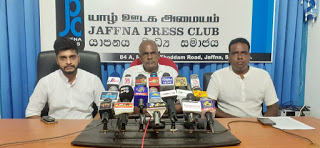
Lankan Tamil businessman floats “Sri Lanka BJP” aimed at socio-economic development of all

A Colombo-based Tamil hotelier of Indian Origin, Velusamy Muthuswamy, has announced the formation of a political party called Ilankai Bharatiya Janatha Katchi (IBJK) to further the socio-economic development of all Sri Lankans, especially the Tamils in the plantation areas and the war-torn Northern and Eastern provinces.

It will promote education, multiple language skills, sports and entrepreneurship, Muthuswamy said.

He made the announcement in Jaffna in Northern Sri Lanka on Saturday. Muthuswamy told the Jaffna media that that radio journalist M.Indrajith will be the party General Secretary and V.Dilan, a businessman, will be the Treasurer. The party would be known in English as Sri Lanka Bharathiya Janatha Party (SLBJP) and in Sinhala as Sri Lanka Bharathiya Janatha Paksaya (SLBJP).

Secular and Multi-ethnic

Releasing the party’s manifesto Muthuswamy said that the IBJP will be a trans-ethnic and trans-religious party and would be open to all ethnic and religious groups. It will work for the welfare of the downtrodden in all communities.

Cooperation Not Confrontation

Muthuswamy told this correspondent that the IBJK will not take a confrontational path to achieve its aims but will seek the help of the Sri Lankan government and foreign governments to fulfil it aims.

“Confrontation with the government has not yielded results in Sri Lanka. Cooperation is the only way forward. This was acknowledged even by R.Chanakayan, an MP belonging to the ITAK(Federal Party), in a recent interview,” he pointed out.

The IBJP’s aim will be to uplift educational standards among Indian Origin Tamils and the Tamils in the war-affected Northern and Eastern Provinces, he said.

“Educational standards are poor among the Indian Origin Tamils in the plantation areas and have fallen steeply in Jaffna. The Ilankai Bharatiya Janata Party hopes to seek and provide facilities to teach English and also Sinhala as these two languages are essential to get employment. I will also get businessmen to teach entrepreneurship.”

He pointed out that the Tamils are nowhere in Sri Lankan sports. “This is because there are no facilities for sports development in the areas they live in or the schools they go to. I consider sports a necessary appendage of education,” he said.

Family Background

It is his family background which has made him focus on education. “ I am 73. Three generations ago my family was in the plantations as workers. But I broke away from servitude by setting up a hotel (eatery) and a bar and followed these up with a travel agency. I utilized my earnings to educate my nine children, four of whom are now doctors. At the request of my educated children I closed the bar and kept the hotel. I opened a ticketing agency which has world-wide connections. I want other Tamils to follow my example,” the entrepreneur said.

Why Political Party?

Asked why form a political party to achieve non-political aims like education and sports, Muthuswamy said that governments and foreign missions will open their doors to his organization more readily if it is a political party with political potential.

He denied that the Ilankai Bharatiya Janatha Katchi has anything to do with the Indian BJP. “There is no link with India’s BJP so far. But I admire Mr.Modi. His schemes are progressive and he is achieving results.”

SLPP’s Bid and Deb’s Declaration

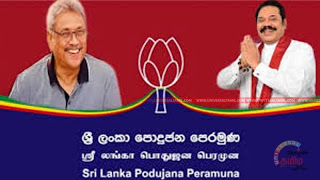
Some months back, the Chief Organizer of the ruling Sri Lanka Podujana Peramuna (SLPP), Basil Rajapaksa, had told the media that he would like to organize the SLPP on the lines of the BJP in India and the Communist Party of China apparently to instil discipline and ideological consistency in the cadres of the SLPP to ensure political success. However, the SLPP has not established any link with either the BJP or the CPC.

Later, the Tripura Chief Minister Biplab Kumar Deb raised the hackles in Sri Lanka (and Nepal too) by saying that India’s Home Minister and BJP honcho Amit Shah had told him that the BJP would one day rule Sri Lanka and Nepal.

While Nepal formally protested, the Sri Lankan government did not react officially but it let it be known unofficially that there is no provision in Sri Lankan election law to register foreign political parties.

Subsequently, Tripura Chief Minister Deb put the lid on the controversy by saying that Amit Shah had made the remark only jokingly.

Posted in Uncategorized

‘Tweaked’ UN resolution on Sri Lanka still falls short on accountability

An updated draft United Nations Human Rights Council (UNHRC) resolution on Sri Lanka was released this morning, showing some changes to the language of the text but still falling short on Tamil demands for an international accountability mechanism.

The updated draft resolution now calls on the Office of the High Commissioner for Human Rights to “collect” as well as “consolidate, analyse and preserve” evidence that could be used in future war crimes trials. However, it has failed to implement UN High Commissioner, Michelle Bachelet’s recommendations which call on member states to consider asset freezes and travel bans on Sri Lankan officials credibly accused of human rights abuses and to consider “steps towards the referral of the situation in Sri Lanka to the International Criminal Court (ICC).”

The changes, made public this morning, include:

“Recognizes the importance of preserving and analysing evidence relating to violations and abuses of human rights and related crimes in Sri Lanka with a view to advancing accountability, and decides to strengthen the capacity of the Office of the High Commissioner to [collect], consolidate, analyse and preserve information and evidence and to develop possible strategies for future accountability processes for gross violations of human rights or serious violations of international humanitarian law, to advocate for victims and survivors, and to support relevant judicial proceedings in Member States with competent jurisdiction”

Concerns over the “increased marginalisation of Tamil and Muslim minorities, surveillance and intimidation of civil society, restrictions on media freedom, and shrinking democratic space; restrictions on public memorialisation of victims of war including the destruction of a memorial”

“Also calls upon the Government of Sri Lanka to ensure the effective and independent functioning of the Human Rights Commission of Sri Lanka, the Office on Missing Persons and the Office for Reparations to deliver their respective mandates as established”

“Further calls upon the Government of Sri Lanka, having due regard for the rule of law and human rights to protect civil society actors including human rights defenders to investigate any attacks and to ensure a safe and enabling environment in which civil society can operate free from hindrance, surveillance and insecurity and threat of reprisals.”

The updated resolution marks the first time that Sri Lanka’s marginalisation of Tamils and Muslims and restrictions on memorialisation are being recognised in the operative paragraphs of a UN resolution. Earlier this year authorities destroyed the Mullivaikkal monument that was constructed in Jaffna University to commemorate those killed by a Sri Lankan military offensive in 2009. As global outrage ensued, authorities reportedly allowed it to be rebuilt, but restrictions on memorial events have been repeatedly put in place by Sri Lankan authorities.

The surveillance of human rights defenders is also highlighted and comes as Tamil families of the disappeared come under increasing harassment from Sri Lankan security forces.

Responding to the updated draft, former Senior Lecturer in Law at University of Jaffna, Dr Kumaravadivel Guruparan said that it has simply been “tweaked”.

“It still doesn’t do enough to alleviate our most fundamental concerns,” he continued. “The inclusion of ‘collect’ in OP6 makes it better but the usefulness of the mechanism will depend on a) what judicial processes it will be feeding into and b) how much funds OHCHR is allocated.”

“In the absence of any information regarding a wider judicial process, the whole thing is as good as it is on paper,” he added.

As the UNHRC meets this month, Tamils in the North-East and in the diaspora have undertaken hunger strikes and protests calling on the international community, particularly members of the Core Group on Sri Lanka, to refer Sri Lanka to the ICC.

Tamil activists and politicians have expressed their disappointment over the draft resolution for failing to hold Sri Lanka accountable for serious human rights abuses. Earlier this week, both the Tamil National People’s Front (TNPF) and the Tamil Civil Society Forum (TCSF) submitted letters to the UNHRC to highlight that the resolution fails to “even meet the basic expectations of the Tamil victims” in pursuing international accountability for war crimes committed by Sri Lanka.

In their letters, they highlighted that Core Group’s request to the Office of the High Commissioner of Human Rights (OHCHR) to enhance its monitoring and reporting on the human rights situation in Sri Lanka, “stagnates accountability at the UNHRC in Geneva.”

The resolution which sets a deadline for March 2022 for “a written update to the Human Rights Council” and a “comprehensive report including further options for advancing accountability” later that year has been criticised for stalling accountability and justice for victim-survivors.

Addressing the UNHRC this week, Leeladevi Anandanadarajah, the Secretary of the North-East Relatives of the Missing Persons Association, criticised the undue praise of Sri Lanka’s domestic accountability mechanisms, particularly the Office for Missing Persons (OMP), which they have continuously rejected as it has repeatedly failed to address Tamil grievances.

Last week, the Core Group, the EU, Australia, and Switzerland alongside a number of other countries expressed concern over the worsening human rights situation in Sri Lanka as they responded to the UN High Commissioner’s report. Sri Lanka told the UNHRC that it “categorically rejects the conclusions and recommendations” of the UN High Commissioner’s report and called on member states to reject any resolution on Sri Lanka.

Sri Lanka BJP has no links to India : Muththusami

The newly-formed Sri Lanka Bharatiya Janata Party (BJP) does not have any links to India’s BJP, its leader V. Muththusami said Saturday.

“If India is assisting us, we will inform the media about it,” Muththusami told reporters.

He said that the objective of the party would be to work with the government in developing the standards of education and sports of the Tamils.

“We will engage in activities in the central region, the Northern and Eastern provinces and Colombo,” the SLBJP leader explained.

He said that plans to establish the party had been made six years ago.

Posted in Uncategorized

No room for Tamil, Islamist extremism : President

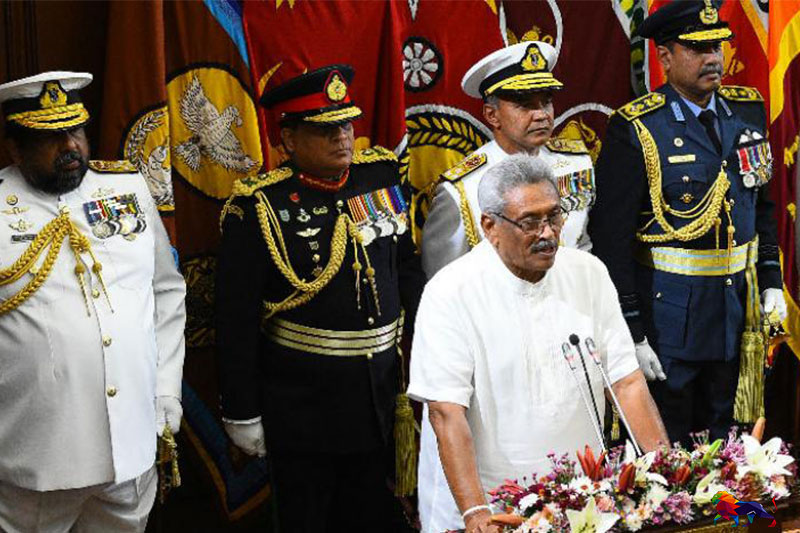
President Gotabaya Rajapaksa has said that he would not allow Tamil or Islamist extremism to raise its head under his rule.

Speaking in Weragala, the President insisted that the perpetrators of the 2019 April 21st attacks will be punished under the current government.

“It is our duty to punish them. We will do that,” Rajapaksa noted.

Citing the presidential commission’s report on the April 21st attacks, the President blamed the previous government for being incapable of preventing the bombings.

“Page 306 the report states, based on this evidence it is difficult for the commission to ascertain why the government including PM Ranil Wickremesinghe failed to take steps to quell Islamist extremism,” he observed.

The President also responded to accusations that he has failed in his presidency.

“I have not failed. For 20 years I went to war for this country and then served as the defence secretary to President Mahinda Rajapaksa. It was then that we managed to end the 30-year long war,” Rajapaksa remarked.

SLPP rejects to give proposals to draft a new Constitution

Sr Lanka Podujana Peramuna has refused to submit it’s proposals to the Expert Committee appointed to draft a new Constitution.

SLPP’s stalwarts Prof. G.L. Peiris, Basil Rajapaksa and Sagara Kariyawasam have informed their party’s decision during a meeting with the members of experts committee chaired by legal luminary Romesh de Silva PC.

Both Basil Rajapaksa and G.L. Peiris have pointed out that it is not justifiable to draft a Constitution based on the proposals of the political parties, without taking into consideration the views of the public.

The committee is of the view that it not practical to obtain the views of the 22 million people of the country and therefore, the committee would obtain proposals of the political parties based on the theory of representative democracy.

However, SLPP has not agreed with the committee’s position and as a result, a confusion has taken place at the meeting.

Source: Srilanka Mirror

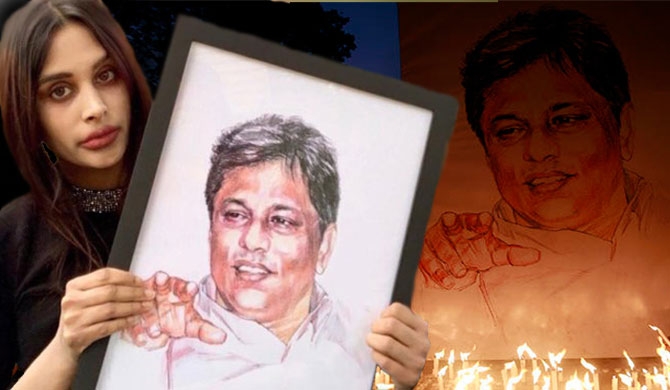
“I hold Rajapaksa responsible — as I made plain when I moved to sue Rajapaksa in Los Angeles for his role in my father’s murder.it is high time for the world to draw a red line at the killing of journalists and ensure that murderous autocrats pay a price” by Ahimsa Wickrematunge

(Ahimsa Wickrematunge, a writer and activist, is the daughter of murdered Sri Lankan journalist Lasantha Wickrematunge)

In 2007, my father, Lasantha Wickrematunge, one of Sri Lanka’s most fiercely independent journalists, exposed an arms deal involving then-Secretary of Defense Gotabaya Rajapaksa embezzling over $10 million in government funds.

Rajapaksa took him to court, alleging defamation. Shortly thereafter, my father’s printing press at the Sunday Leader, where he was editor in chief, was stormed by a masked gang in the middle of the night. Two of his staff were assaulted, and the press itself was set on fire.

On Jan. 8, 2009, weeks before my father could testify about the corrupt arms deal, military intelligence officers ambushed him as he drove to work. They murdered him, tearing my family apart, ripping a hole in my soul and petrifying journalists across Sri Lanka.

I hold Rajapaksa responsible — as I made plain when I moved to sue Rajapaksa in Los Angeles for his role in my father’s murder. His shocking November 2019 election as president of Sri Lanka has brought immeasurable pain to me and my family and damage to the fabric of Sri Lankan civil society. (When a BBC reporter questioned Rajapaksa about my father’s murder, he dodged the question, laughing dismissively.)

Last week, U.N. human rights chief Michelle Bachelet presented a report that offered a devastating verdict on human rights abuses in Sri Lanka. She recommended that the international community move to hold Sri Lanka accountable for its consistent failure to bring justice for the victims. In the next weeks, the U.N. Human Rights Council will be deliberating over a possible response.

When Mahinda Rajapaksa was elected Sri Lankan president in November 2005, he put his brother Gotabaya in charge of Sri Lanka’s Ministry of Defense. Together, they oversaw some of the worst atrocity crimes in Sri Lanka and systematically targeted any journalist brave enough to speak out against them. Despite briefly losing office following his brother’s electoral defeat in 2015, this accused war criminal — Gotabaya Rajapaksa — is now back in power.

The coverup that followed my father’s death in 2009 was meticulous, as documented in my recent communication to the United Nations and by Human Rights Watch. The autopsy report contradicted the hospital’s findings on cause of death. Investigators were threatened. Evidence was falsified and planted. Two innocent civilians who were framed for the attack were later shot, their bodies incinerated. Another was arrested and died in custody.

Six years after my father’s killing, on Jan. 8, 2015, Sri Lankans voted out the Rajapaksa regime and elected a new government, led by President Maithripala Sirisena, that pledged justice to the many victims of atrocities under the previous regime. Police investigators soon zeroed in on a military death squad, the Tripoli platoon, that had allegedly been controlled by then-Defense Secretary Rajapaksa.

But when detectives exposed Rajapaksa’s role, their investigations were stymied. As far as the Sri Lankan judiciary was concerned, he was invincible. Judges broke with centuries of precedent to issue orders preventing his arrest. When a court sought to question him over the killing of two human rights activists, a judge shut them down. When he was indicted for embezzlement, more judges stepped in to stop his trial going forward.

That was when I decided to turn to the U.S. courts. But Rajapaksa had already launched a new campaign for the presidency. His platform: rebuilding the intelligence service and exonerating intelligence officers accused of atrocities. I watched in horror 15 months ago as Sri Lankans elected the man accused of killing my father. His new status as president gave him immunity.

As president, Rajapaksa wasted no time ensuring that impunity would be the law of the land. He promoted judges who had kept him above the law. He pardoned a soldier convicted of war crimes for killing children. Detectives who investigated such atrocities fled or faced arrest. Shani Abeysekara, the FBI-trained police executive who ran Sri Lanka’s Criminal Investigation Department and led breakthroughs in several emblematic investigations, was locked up on bogus charges. In May, Rajapaksa handpicked the new head of the CID — a policeman who has been accused of covering up evidence of my father’s murder. All this as the international community continues to expect Sri Lanka to provide justice for victims.

Victims groups and the international community are well aware that Rajapaksa’s election has closed every door to human rights and accountability in Sri Lanka. The high commissioner for human rights and U.N. special rapporteurs warn that without strong international action by foreign governments and the Human Rights Council — including sanctions, travel bans and an independent international accountability mechanism — Sri Lankans face the alarming risk of seeing past human rights abuses repeated.

Foreseeing his own murder, my father wrote himself an obituary in which he lamented that murder had “become the primary tool” for controlling “the organs of liberty.” Twelve years later, with those very same organs on life support, it is high time for the world to draw a red line at the killing of journalists and ensure that murderous autocrats pay a price.

But today, as I watch the killers of heroes like Anna Politkovskaya, Jamal Khashoggi and my father rub shoulders on the world stage, it seems that killing a journalist is just another rite of passage for emerging autocrats.

Source:The Washington Post